Maths · Transformations and Similarity
Viewing as
Teaching this? The teacher view opens every answer and mark scheme.
Combined Transformations
Carrying out one transformation after another, finding the single equivalent transformation, and spotting invariant points.
Learning Objectives
- 1Carry out a sequence of reflections, rotations and translations on a shape.
- 2Describe the single transformation that has the same effect as a combination of two transformations.
- 3Use the rules for two reflections in parallel lines and in lines that cross.
- 4Identify invariant points and invariant lines.
One transformation after another
When one transformation is followed by another, the final image is often the same as the image from a single transformation, and the exam asks you to find it. This is Higher tier content on every board. The skill is to do the steps carefully, one at a time, on the grid, and then compare the first shape with the last. Several combinations come up again and again, such as two reflections giving a rotation or a translation, so the patterns are worth learning, though the grid always gives you a way to check.
Doing the steps in order
Work out the image after the first transformation, then transform that image.
-
Label each shape
Call the object \(A\), the first image \(B\) and the second image \(C\), so it is clear which shape is which.
-
One step at a time
Transform the whole shape each time, not just one point, so that you can see the final position.
-
Compare \(A\) and \(C\)
Look at how \(A\) turned into \(C\), and ask which single transformation does that.
-
Congruent shapes
Reflections, rotations and translations all keep the size, so \(C\) is congruent to \(A\).
Two reflections make a rotation
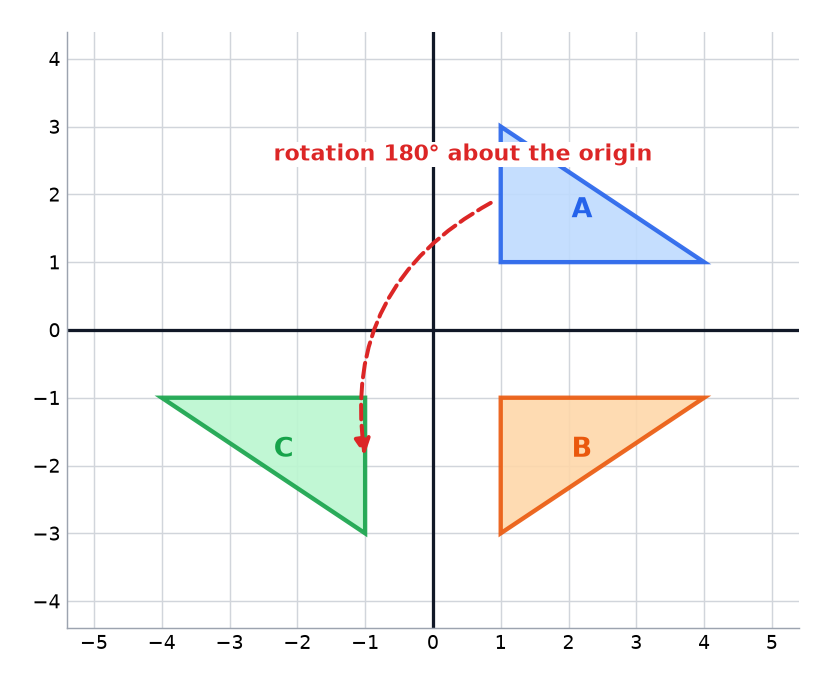
Triangle \(A\) is reflected in the \(x\)-axis to give \(B\), and \(B\) is reflected in the \(y\)-axis to give \(C\). Comparing \(A\) with \(C\), the corner \((4, 1)\) has gone to \((-4, -1)\), which is a rotation of \(180^\circ\) about the origin.
Reading the result
- Both coordinates change sign \((x, y)\) goes to \((-x, -y)\), so the single transformation is a rotation of \(180^\circ\) about the origin.
- The order did not matter here Reflecting in the \(y\)-axis first and the \(x\)-axis second gives the same result.
- Check a corner \((1, 3)\) goes to \((-1, -3)\).
- Mirror image twice The orientation is back to the original, so the combination is a rotation, not a reflection.
Two reflections in parallel lines
The point \((1, 1)\) is reflected in the line \(x = 2\), and the image is then reflected in the line \(x = 5\). Describe the single transformation that takes \((1, 1)\) to the final image.
Show the solutionHide the solution
- 1 First reflection \((1, 1)\) is 1 left of \(x = 2\), so its image is 1 right, at \((3, 1)\).
- 2 Second reflection \((3, 1)\) is 2 left of \(x = 5\), so its image is 2 right, at \((7, 1)\).
- 3 Compare \((1, 1)\) has gone to \((7, 1)\), which is 6 to the right.
- 4 Rule Two reflections in parallel lines give a translation, at right angles to the lines, of twice the distance between them: \(2 \times (5 - 2) = 6\).
AnswerA translation by \(\begin{pmatrix} 6 \\ 0 \end{pmatrix}\)
Patterns to know
These patterns save time, but always check one point on the grid.
-
Two reflections in parallel lines
A translation of twice the distance between the lines, at right angles to them.
-
Two reflections in lines that cross
A rotation about the point where the lines cross, through twice the angle between them.
-
Reflections in the two axes
A rotation of \(180^\circ\) about the origin.
-
Reflection in \(y = x\) then the \(x\)-axis
A rotation of \(90^\circ\) clockwise about the origin, since \((x, y)\) goes to \((y, x)\) and then to \((y, -x)\).
Invariant points and lines
A point or a line is invariant if it does not move under a transformation.
-
Reflection
Every point on the mirror line is invariant.
-
Rotation
The centre is the only invariant point.
-
Enlargement
The centre is the only invariant point, for any scale factor other than 1.
-
Translation
There are no invariant points, because everything moves.
Describing a combination
The point \((2, 1)\) is reflected in the line \(y = x\), and the image is then reflected in the \(x\)-axis. Describe the single transformation that takes \((2, 1)\) to the final image.
Show the solutionHide the solution
- 1 First reflection Swap the coordinates, giving \((1, 2)\).
- 2 Second reflection Change the sign of \(y\), giving \((1, -2)\).
- 3 Compare \((2, 1)\) goes to \((1, -2)\), and the rule for \(90^\circ\) clockwise is \((x, y)\) to \((y, -x)\).
- 4 State it fully Rotation, \(90^\circ\) clockwise, centre the origin.
AnswerA rotation of \(90^\circ\) clockwise about the origin
Test yourself
-
1
What single transformation is a reflection in the \(x\)-axis then the \(y\)-axis?
Show answerHide answer
A rotation of \(180^\circ\) about the origin.
-
2
What do two reflections in parallel lines give?
Show answerHide answer
A translation.
-
3
How far is the translation for parallel lines 3 apart?
Show answerHide answer
6, which is twice the distance.
-
4
Which points are invariant in a reflection?
Show answerHide answer
The points on the mirror line.
-
5
What is invariant in a rotation?
Show answerHide answer
The centre.
Exam technique: combined transformations
Be systematic, and describe the final result in one step.
-
Label every shape
\(A\), \(B\) and \(C\) keep the working clear.
-
Compare the first and last
Describe the single transformation from \(A\) to \(C\), not each step.
-
Test with a point
Check one corner against your rule.
-
Full details
A rotation needs a centre, an angle and a direction, and a translation needs a vector.
Summary and exam focus
- To combine transformations, apply them in order to the whole shape and compare the first shape with the last.
- Two reflections in parallel lines give a translation, and two reflections in crossing lines give a rotation.
- A point is invariant if it does not move.
- Describe the single transformation fully, with a centre, angle or vector as needed.
Exam focus
Triangle \(A\) is reflected in the \(y\)-axis to give \(B\), and \(B\) is reflected in the \(x\)-axis to give \(C\). Describe fully the single transformation that takes \(A\) to \(C\). (3 marks) (3 marks)
Two reflections in the two axes give a rotation of \(180^\circ\) about the origin. Check with a point: \((2, 1)\) goes to \((-2, 1)\) and then to \((-2, -1)\). Write "rotation", "\(180^\circ\)" and "centre the origin" to get all three marks.
Key terms
The words this lesson expects you to use. Each one is linked from the first place it appears above.
- Combined transformation
- One transformation followed by another.
- Invariant
- Not changed by a transformation.
- Invariant point
- A point that stays in the same place under a transformation.
- Single transformation
- One transformation that has the same effect as a combination.
- Reflection
- A transformation that flips a shape over a mirror line.
- Rotation
- A transformation that turns a shape about a centre.
- Translation
- A transformation that slides a shape.
- Parallel lines
- Lines that stay the same distance apart and never meet.
- Congruent
- Having exactly the same size and shape.
You've finished the notes
Check your understanding
Test yourself while it is fresh. Start with the flashcards, then try the exam questions.
Something here looks wrong?
Tell us what and we will go and look. It goes to whoever writes these pages, nobody else, and we do not ask who you are — so there is nothing to sign and nothing comes back to you.