Maths · Geometry and Measures
Knowledge organiser
The whole chapter on one page. Print it on A4 — it is already landscape — or cover a box and see how much of it you can say from memory.
Maths · AQA Paper 2
Geometry and Measures
Angles in Parallel Lines and Polygons
Angle facts, angles in parallel lines, and the interior and exterior angles of polygons.
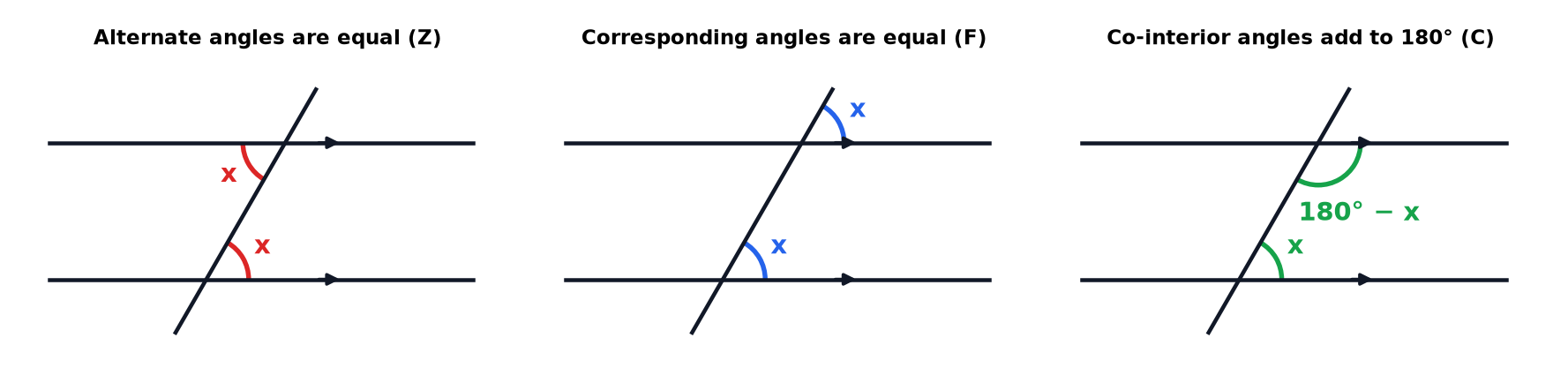
- Transversal A line that crosses two or more other lines.
- Parallel lines Lines that stay the same distance apart and never meet, marked with arrows.
- Alternate angles Equal angles on opposite sides of a transversal between two parallel lines, forming a Z shape.
Area, Perimeter and Circles
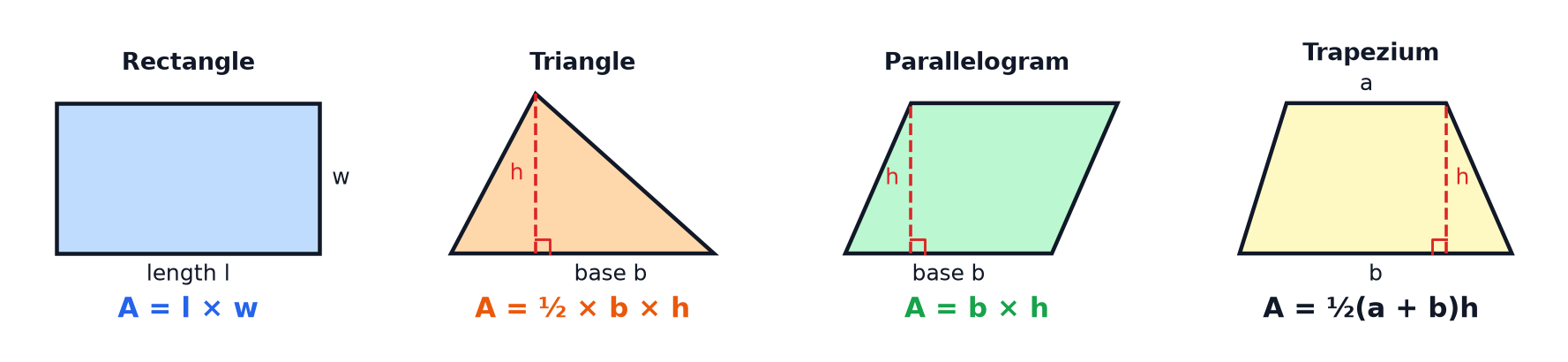
Areas of standard shapes and compound shapes, and the circumference and area of circles, semicircles and sectors.
- Perimeter The total distance around the outside of a shape.
- Area The amount of surface inside a shape, measured in square units.
- Compound shape A shape made up of simpler shapes joined together.
Volume and Surface Area
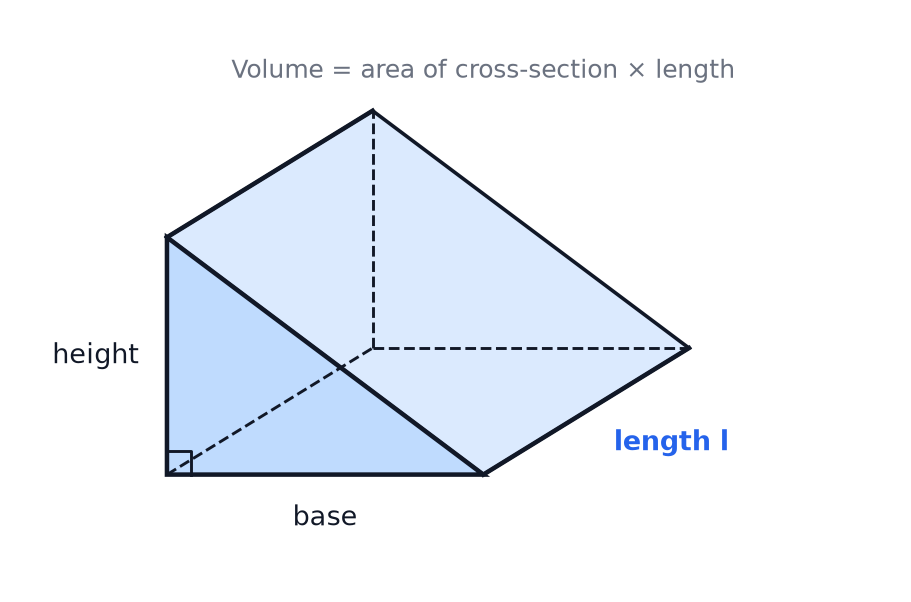
Volumes and surface areas of cuboids, prisms, cylinders, cones and spheres.
- Volume The amount of space inside a 3D shape, measured in cubic units.
- Surface area The total area of all the faces of a 3D shape.
- Cuboid A 3D shape with six rectangular faces.
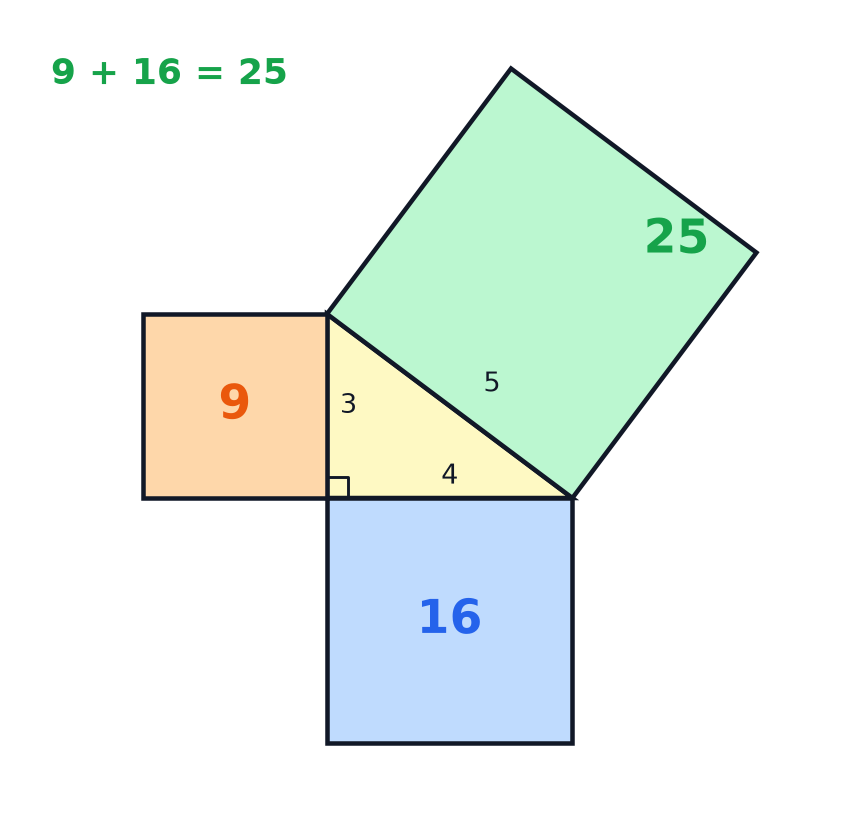
Pythagoras' Theorem
Using Pythagoras' theorem to find sides, test for right angles and solve problems.
- Right-angled triangle A triangle with one angle of 90 degrees.
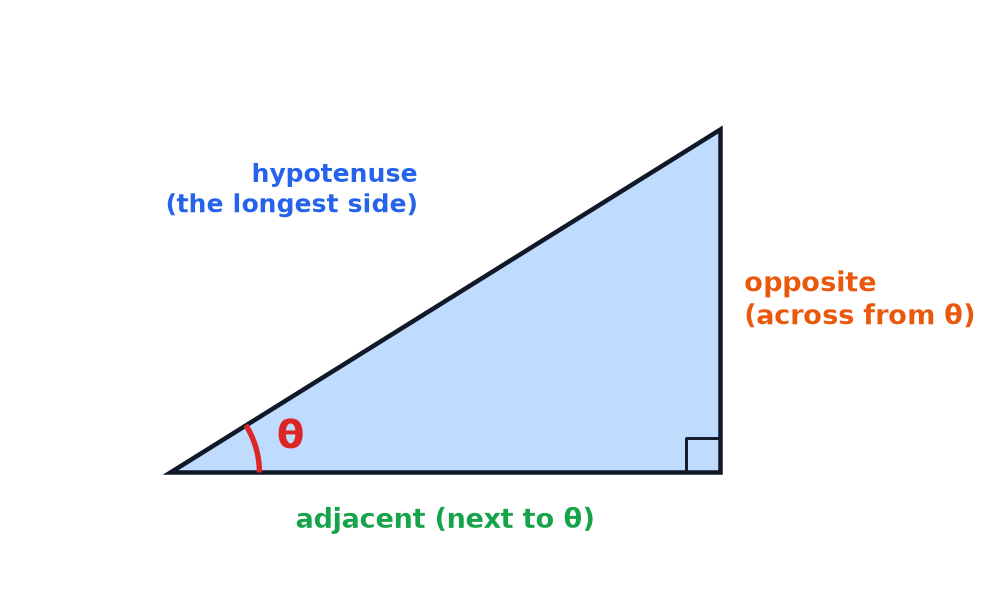
- Hypotenuse The longest side of a right-angled triangle, opposite the right angle.
- Pythagoras' theorem In a right-angled triangle, the square of the hypotenuse equals the sum of the squares of the other two sides.
Trigonometry in Right-Angled Triangles
Using sine, cosine and tangent, and the exact trigonometric values, to find sides and angles.
- Trigonometry The study of the links between the sides and angles of triangles.
- Sine The ratio of the opposite side to the hypotenuse in a right-angled triangle.
- Cosine The ratio of the adjacent side to the hypotenuse in a right-angled triangle.