Maths · Algebra
Knowledge organiser
The whole chapter on two pages. Print it on A4 — they are already landscape — or cover a box and see how much of it you can say from memory.
Maths · Edexcel Paper 1
Algebra
Simplifying and Expanding Expressions
Algebraic notation, collecting like terms, and expanding single brackets, double brackets and squared brackets.
- Consecutive Following one after another in order, such as the consecutive integers 7, 8 and 9.
- Term A single part of an expression, with the sign in front of it, such as -3x.
- Expression A collection of terms with no equals sign, such as 3x + 5.
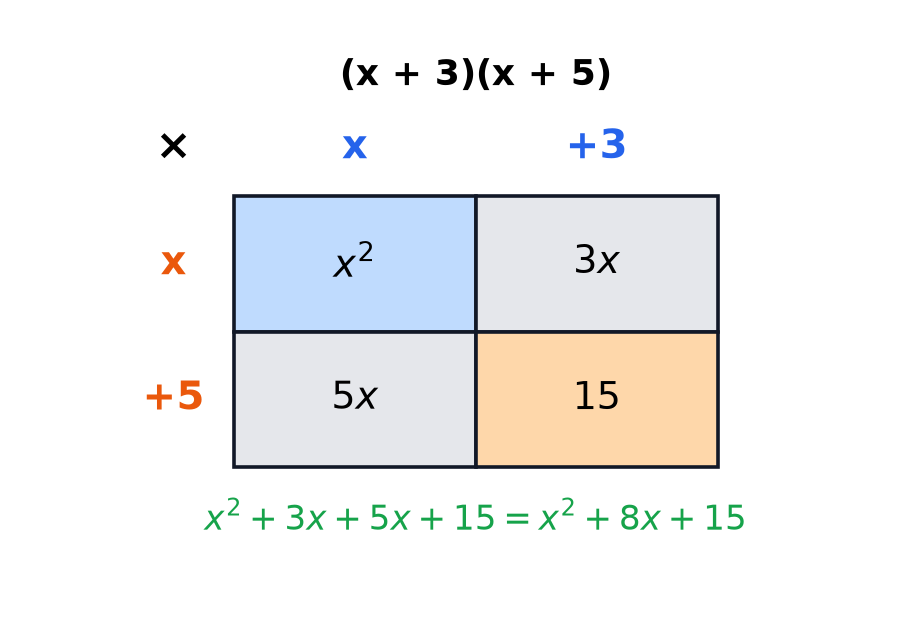
Common mistakes when expanding
- What students write (x + 3)^2 = x^2 + 9; 2(x - 4) = -2x - 8; 3x × 4x = 12x
- What is correct (x + 3)^2 = x^2 + 6x + 9; 2(x - 4) = -2x + 8; 3x × 4x = 12x^2
Factorising Expressions
Factorising is just expanding in reverse, so you can always check it by expanding.
- Algebraic fraction A fraction whose numerator or denominator contains algebraic terms.
- Factorise Write an expression as a product of brackets, the reverse of expanding.
- Common factor A number or letter that divides exactly into every term of an expression.
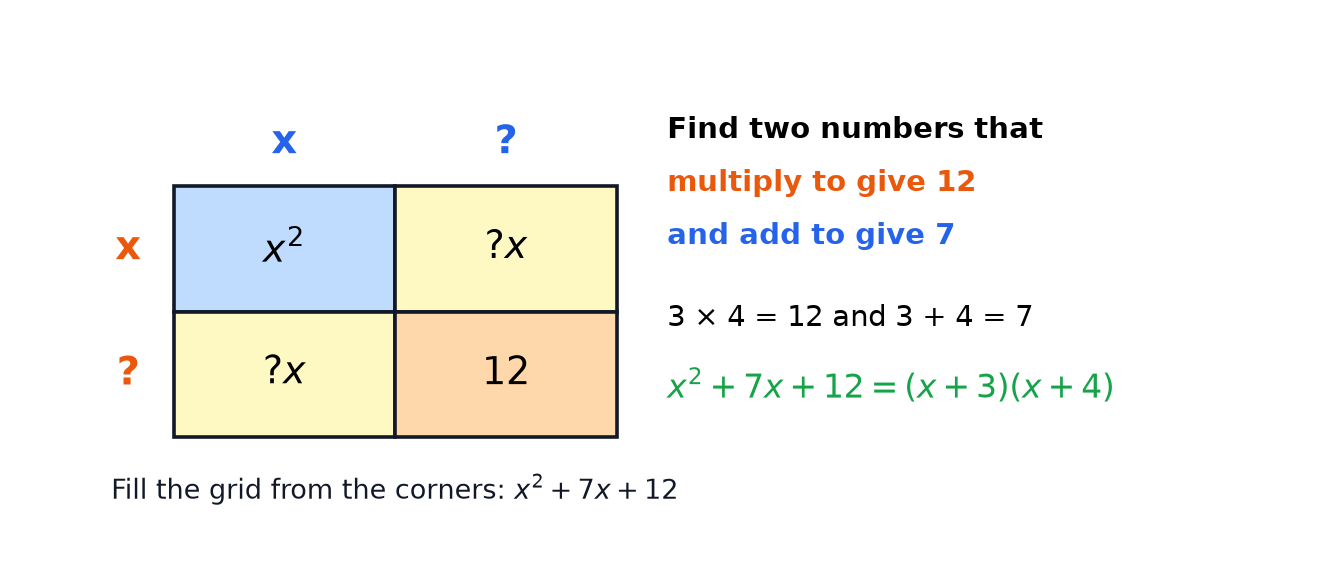
Choosing a factorising method
- Common factor first Check whether every term shares a number or letter.
- Count the terms Two terms joined by a minus sign may be a difference of two…
- Factorise the quadratic Find two numbers that multiply to give c and add to give b, or…
- Check by expanding Expand your brackets to confirm they give back the original expression.
Solving Linear Equations and Inequalities
Solving equations with brackets, fractions and unknowns on both sides, forming equations, and solving inequalities.
- Boundary value The value at which an inequality changes from true to false, such as 4 in x < 4.
- Equation A statement that two expressions are equal, which is true only for certain values of the unknown.
- Solve Find the value or values of the unknown that make an equation or inequality true.
Maths · Edexcel Paper 1
Algebra continued
Equations and inequalities
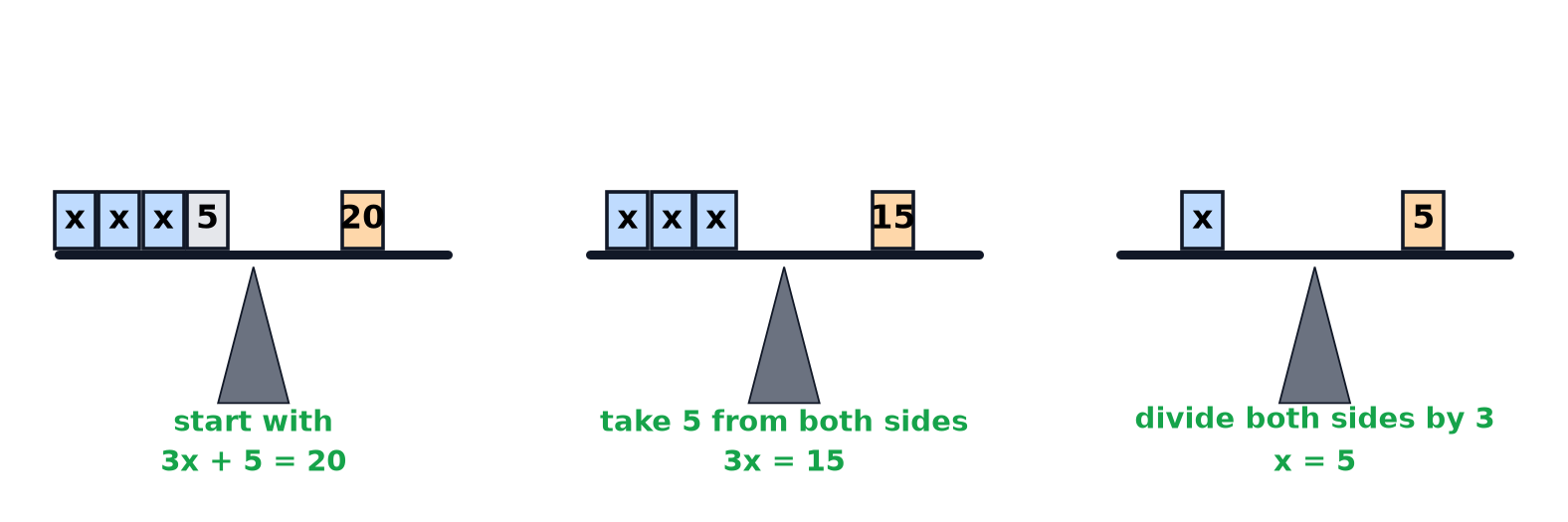
- Solving an equation The solution is a particular value or values; The equals sign stays throughout; Check by substituting the answer back in
- Solving an inequality The solution is a range of values; Show the answer on a number line, using open and filled circles
A method for any linear equation
- Expand any brackets Multiply out so there are no brackets left.
- Collect the unknowns Add or subtract so that every term in x is on one side and every…
- Simplify each side Collect like terms on each side.
- Divide Divide both sides by the coefficient of x.
Substitution and Rearranging Formulae
Substituting into formulae, writing your own, and changing the subject of a formula.
- Output The result of putting an input through a formula or a function machine.
- Substitute Replace a letter in an expression or formula with a number.
- Formula A rule that links quantities using letters.
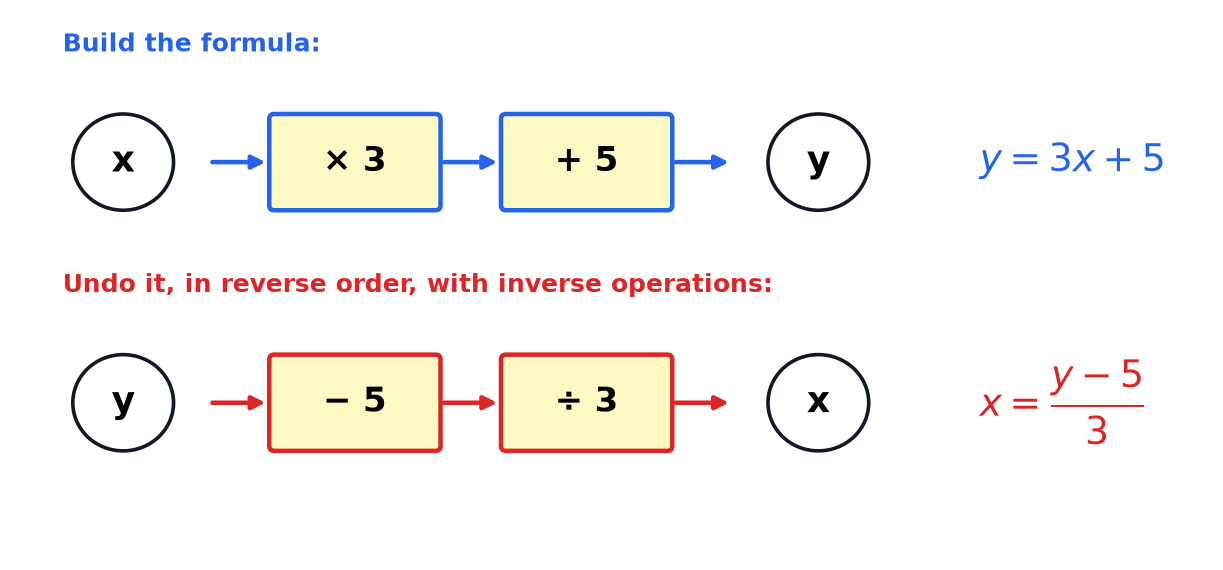
Substituting and rearranging
- Substituting Numbers replace the letters; The answer is a single number; Follow BIDMAS and use brackets for negative values
- Rearranging The letters stay in place; The answer is a new formula; Undo operations in reverse order, using inverse operations
Sequences and the nth Term
Continuing sequences, finding the nth term of linear and quadratic sequences, and testing whether a number is in a sequence.
- Common ratio The number that each term of a geometric sequence is multiplied by to get the next term.
- Sequence A list of numbers that follow a rule.
- Term One of the numbers in a sequence.
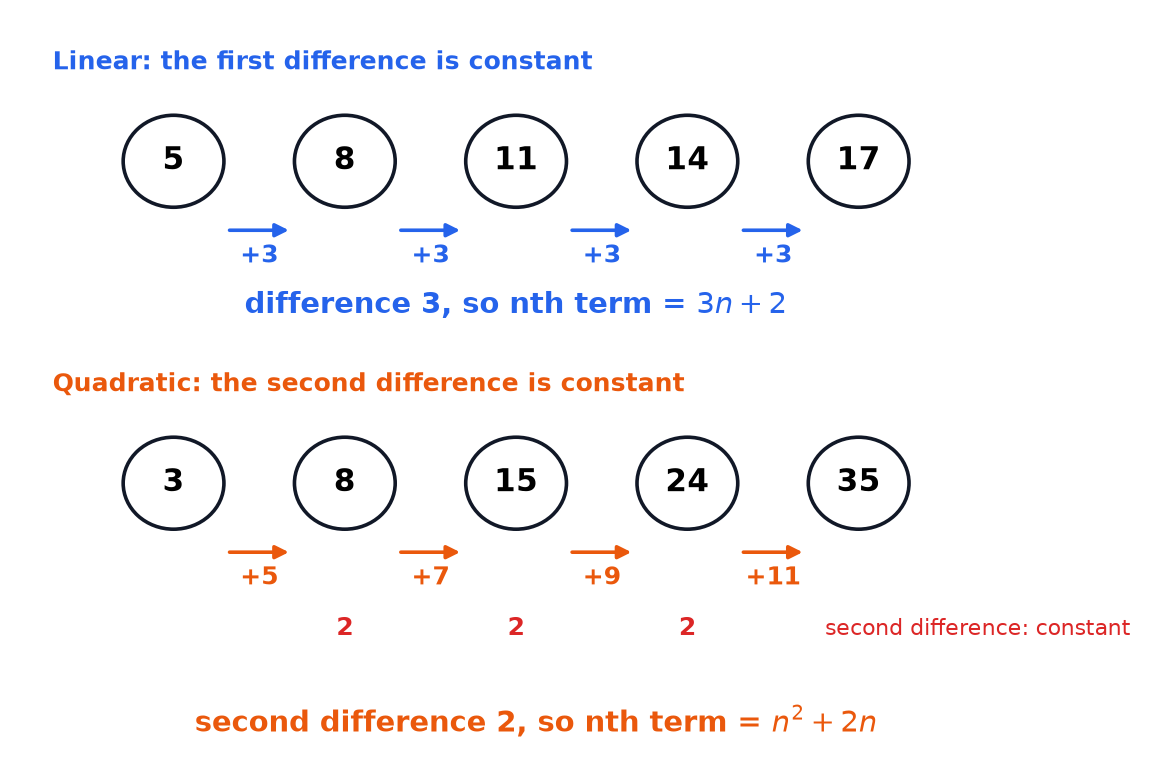
Two ways to describe a sequence
- Term-to-term rule Tells you how to get from one term to the next; Needs the previous term, so it is slow for the 100th term; Example: add 3 each time
- Position-to-term rule (nth term) Gives any term directly from its position; Lets you find the 100th term in one step; Example: 3n + 2