Maths · Standard Form and Accuracy
Knowledge organiser
The whole chapter on one page. Print it on A4 — it is already landscape — or cover a box and see how much of it you can say from memory.
Maths · Edexcel Paper 1
Standard Form and Accuracy
Standard Form
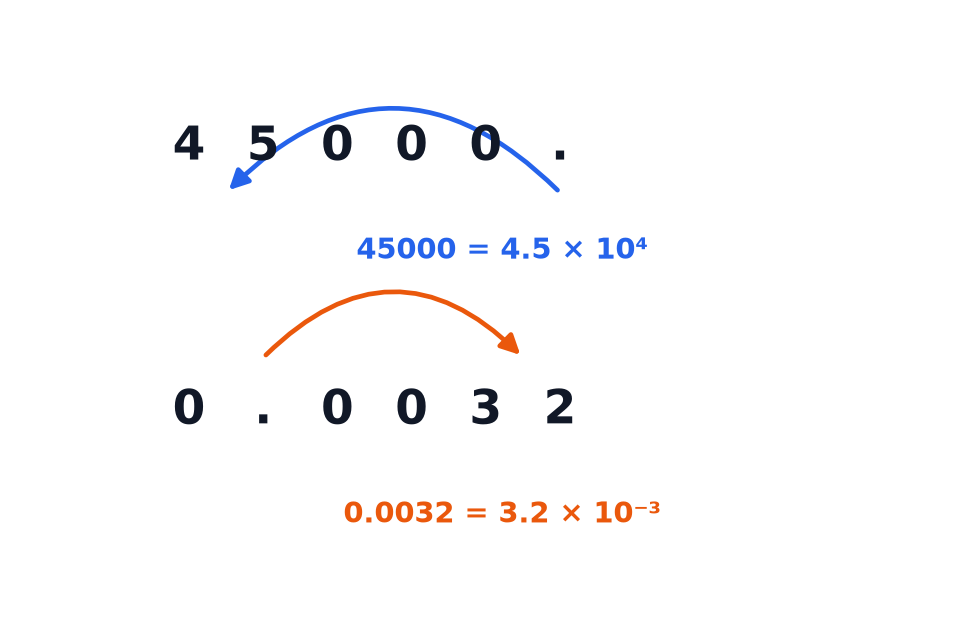
Writing very large and very small numbers in standard form, converting back, and comparing and ordering them.
- Standard form A number written as A × 10^n, with A at least 1 and less than 10.
- Power of 10 10 raised to a whole-number power, such as 10^4.
- Index The small raised number that shows the power.
Calculating with Standard Form
Multiplying, dividing, adding and subtracting numbers in standard form, and solving problems in context.
- Standard form A number written as A × 10^n, with A at least 1 and less than 10.
- Law of indices A rule for combining powers, such as adding the powers when multiplying.
- Power The small number showing how many times a number is multiplied by itself.
- First part The number between 1 and 10 in standard form.
Rounding and Estimating
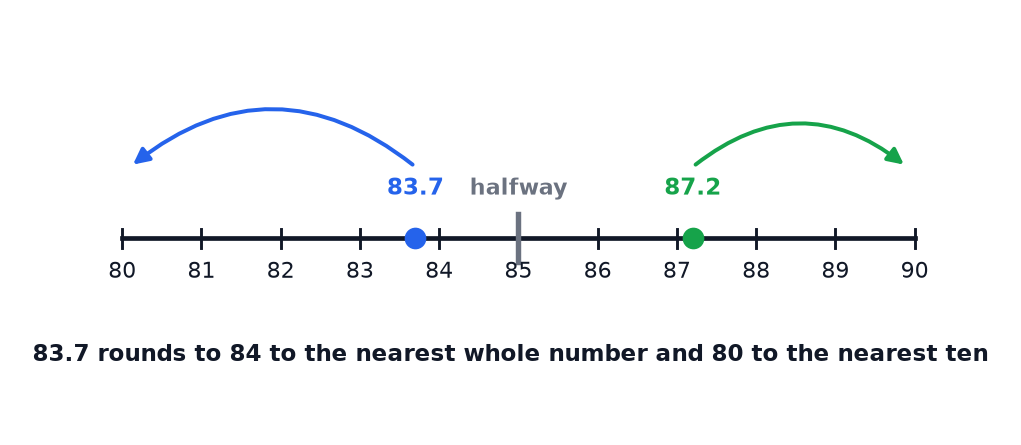
Rounding to decimal places and significant figures, estimating calculations, and spotting over- and underestimates.
- Rounding Replacing a number with a simpler one that is close to it.
- Decimal place A position after the decimal point.
- Significant figure A digit that counts, starting from the first non-zero digit.
Error Intervals and Bounds
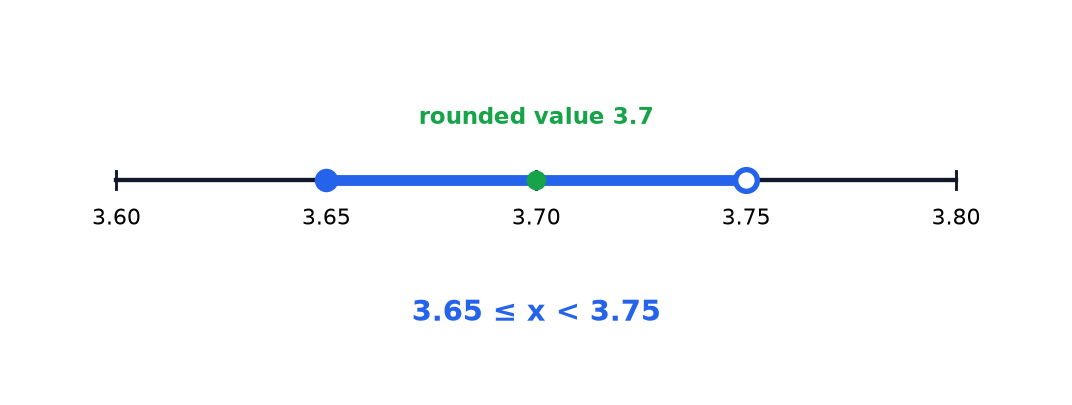
Writing error intervals for rounded and truncated numbers, and finding upper and lower bounds of calculations.
- Error interval The range of values that round to a given number.
- Lower bound The smallest value in an error interval.
- Upper bound The value that the interval goes up to but does not include.
Recurring Decimals and Rational Numbers
Converting fractions to recurring decimals, writing recurring decimals as fractions, and telling rational from irrational numbers.
- Terminating decimal A decimal that stops after a certain number of digits.
- Recurring decimal A decimal in which one or more digits repeat for ever.
- Dot notation Dots over repeating digits to show a recurring decimal.
- Rational number A number that can be written as a fraction of two integers.