Maths · Ratio and Proportion
Knowledge organiser
The whole chapter on one page. Print it on A4 — it is already landscape — or cover a box and see how much of it you can say from memory.
Maths · Edexcel Paper 2
Ratio and Proportion
Ratio: Simplifying and Sharing
Writing and simplifying ratios, sharing amounts in a given ratio, and linking ratios to fractions.
- Ratio A comparison of the sizes of two or more quantities, written with a colon such as 3 : 5.
- Part One share of a ratio. The parts added together make the whole.
- Simplest form A ratio whose parts have no common factor except 1.
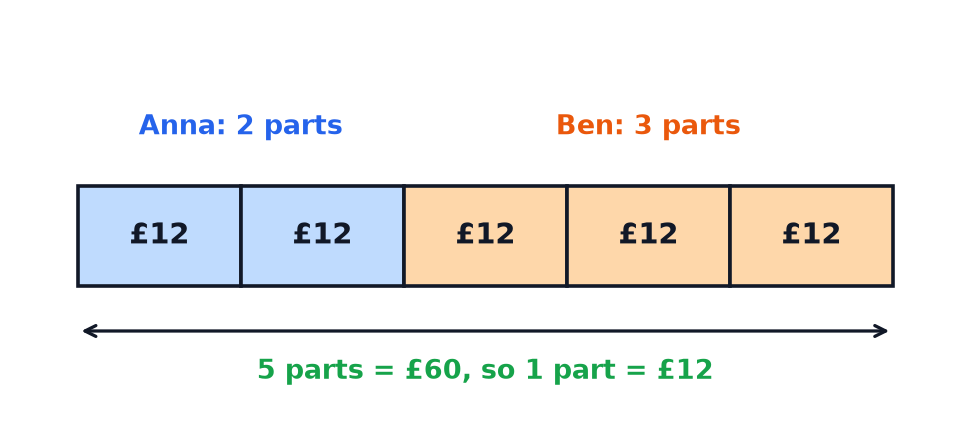
Ratio or fraction?
- A ratio such as 2 : 3 Compares one part with another part; Needs the parts added to get the whole; Has no units
- A fraction such as 2/5 Compares one part with the whole; Is already a share of the whole, so the fractions add to 1; Is found by dividing a part by the total
Direct and Inverse Proportion
Solving proportion problems with the unitary method, best buys and exchange rates, and recognising direct and inverse proportion.
- Direct proportion A relationship in which two quantities increase or decrease at the same rate, so their ratio stays the same.
- Inverse proportion A relationship in which one quantity increases as the other decreases, so their product stays the same.
- Unitary method Finding the value of one unit first, then scaling up to the amount needed.
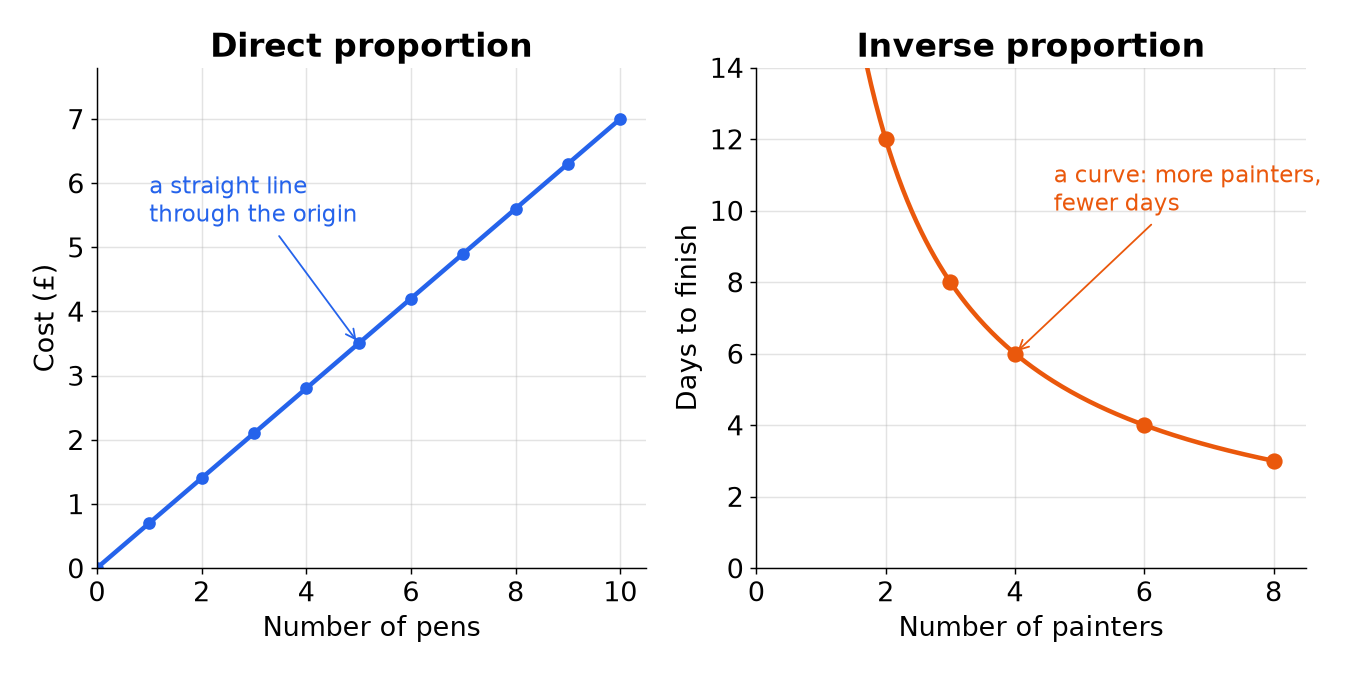
Direct and inverse proportion
- Direct proportion Both quantities rise or fall together; y ÷ x is always the same; The graph is a straight line through the origin
- Inverse proportion One quantity rises as the other falls; x × y is always the same; The graph is a curve that falls and flattens
Speed, Distance, Time and Density
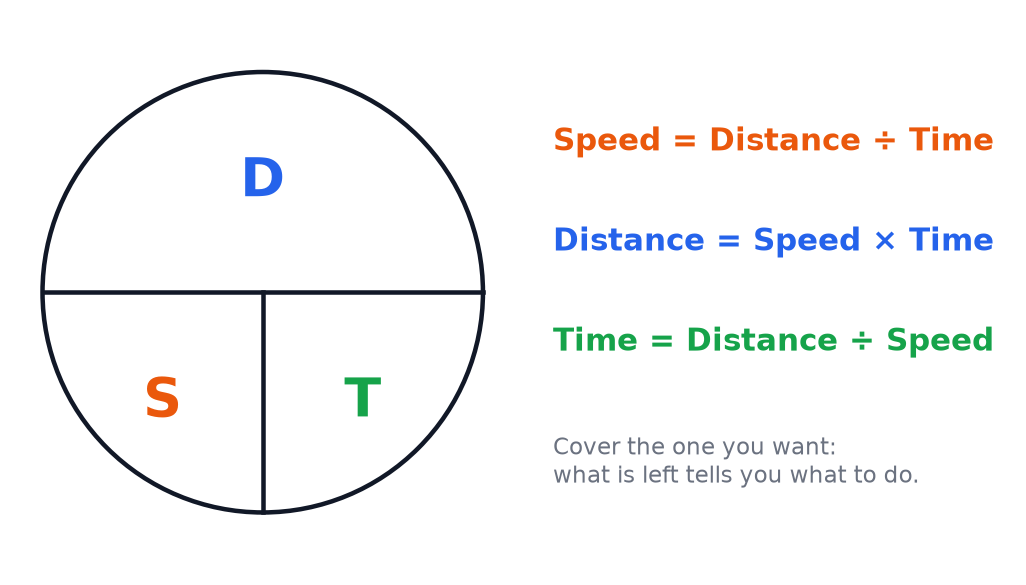
Using speed, distance and time, reading distance-time graphs, and calculating density and pressure.
- Compound measure A measure made by comparing two different quantities, such as speed (distance per time).
- Speed How far something travels in a unit of time, found by dividing distance by time.
- Average speed Total distance travelled divided by total time taken.
Units, Conversions and Scale
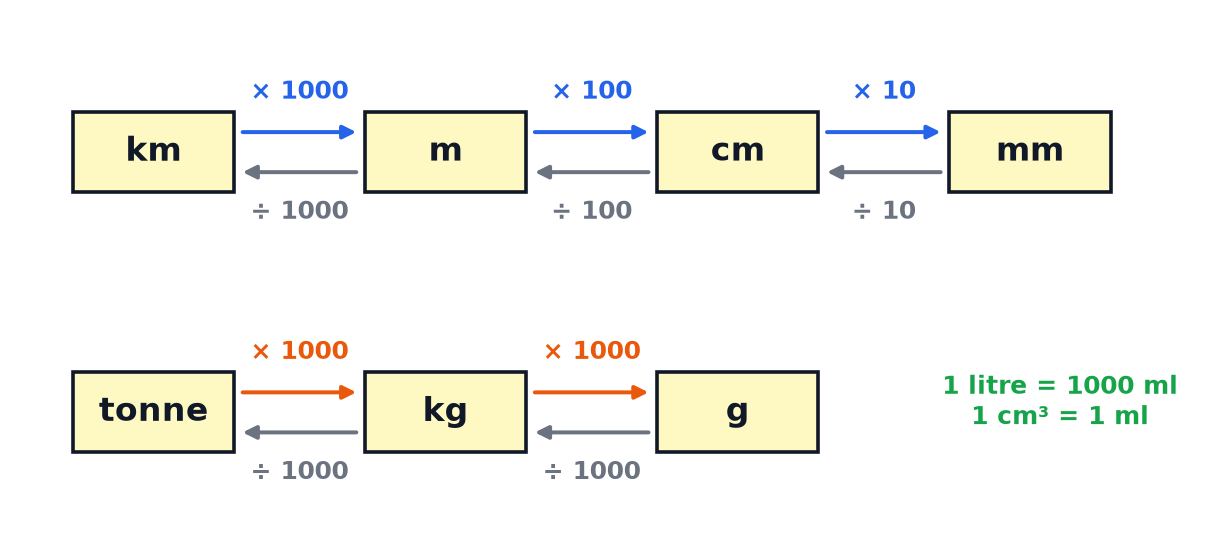
Converting between metric units, using scales on maps and drawings, and changing units of area and volume.
- Metric units Units based on powers of ten, such as millimetres, centimetres, metres and kilometres.
- Conversion factor The number you multiply or divide by to change from one unit to another.
- Capacity The amount a container can hold, measured in litres or millilitres.
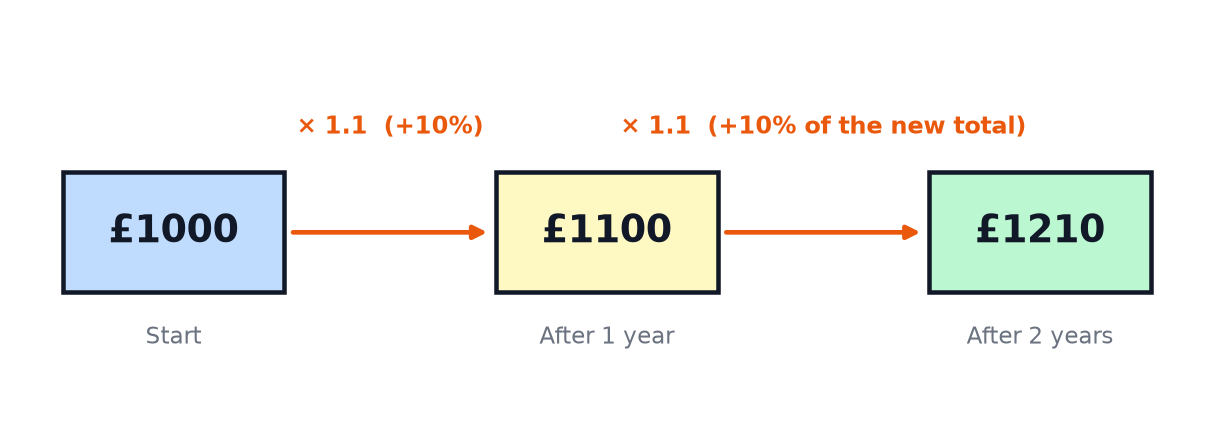
Repeated Percentage Change and Compound Interest
Using multipliers for percentage change, compound interest and depreciation, and working back to the original amount.
- Multiplier The number you multiply by to apply a percentage change in one step.
- Compound interest Interest calculated on the original amount plus any interest already added.
- Simple interest Interest calculated only on the original amount, giving the same amount each year.