Maths · Number Without a Calculator
Viewing as
Teaching this? The teacher view opens every answer and mark scheme.
Place Value, Negatives and the Four Operations
How to read, order and calculate with whole numbers, decimals and negative numbers by hand, and how BIDMAS decides what to do first.
Learning Objectives
- 1Use place value to read, write, compare and order whole numbers and decimals.
- 2Add, subtract, multiply and divide with whole numbers and decimals using written methods.
- 3Calculate accurately with negative numbers.
- 4Use the order of operations (BIDMAS) to evaluate expressions.
Why written methods matter
OCR GCSE Mathematics (J560) sets a non-calculator paper in each tier, Paper 1 at Foundation and Paper 4 at Higher, each lasting 1 hour 30 minutes and worth 100 marks. Every one of those marks has to be earned with pencil-and-paper arithmetic, and most questions award method marks even when the final answer is wrong, so showing each step is as important as getting the number right. This lesson rebuilds the skills that everything else in the chapter depends on.
Place value
The value of a digit depends on the column it sits in.
-
Columns
In \(3482.65\) the 4 is worth 400 and the 6 is worth 6 tenths (0.6). Moving one column to the left makes a digit ten times bigger; one column to the right makes it ten times smaller.
-
Zero as a placeholder
A zero holds a column open so the other digits keep their value, so \(305\) is not the same as \(35\). Trailing zeros after a decimal point do not change the value: \(0.70 = 0.7\).
-
Ordering decimals
Write every number to the same number of decimal places, then compare digit by digit from the left. \(0.45, 0.405, 0.54\) become \(0.450, 0.405, 0.540\), so the order is \(0.405, 0.45, 0.54\).
-
Multiplying and dividing by 10, 100, 1000
The digits move columns; the decimal point stays put. \(3.2 \times 100 = 320\) and \(45 \div 1000 = 0.045\).
Written methods for addition and subtraction
Line the digits up by place value, and line the decimal points up when there are decimals.
-
Addition
Add column by column from the right and carry when a column reaches 10 or more. Write \(14.5 + 3.62\) as \(14.50 + 3.62\) so the columns line up, giving \(18.12\).
-
Subtraction
Subtract column by column and exchange (borrow) from the next column when the top digit is too small. Check by adding your answer to the number you took away.
-
Money and units
Keep the units consistent. Convert pence to pounds (or the reverse) before you start, and write money answers to two decimal places such as \(\pounds 4.50\).
Long multiplication with the grid method
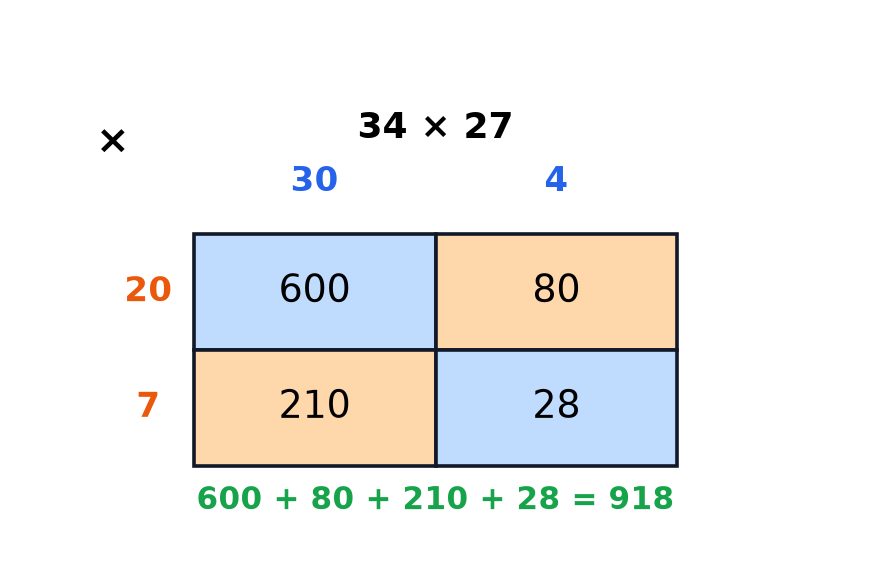
Split each number into tens and units, multiply every pair, then add the four boxes. The method is easy to check and works for any size of number.
How to use it
- Split Write \(34 = 30 + 4\) and \(27 = 20 + 7\) along the top and side of the grid.
- Multiply Fill each box with the product of its row and column: \(30\times20=600\), \(4\times20=80\), \(30\times7=210\), \(4\times7=28\).
- Add Add all four boxes: \(600+80+210+28=918\).
Long division
Work out \(4872 \div 12\) without a calculator.
Show the solutionHide the solution
- 1 Build useful multiples \(12\times 400 = 4800\), which is the largest multiple of 100 that fits into 4872.
- 2 Subtract \(4872 - 4800 = 72\), so 72 is still to be divided.
- 3 Divide what is left \(72 \div 12 = 6\), because \(12 \times 6 = 72\).
- 4 Add the parts \(400 + 6 = 406\). Check: \(406 \times 12 = 4872\).
Answer406
Multiplying decimals
Work out \(2.4 \times 0.35\) without a calculator.
Show the solutionHide the solution
- 1 Ignore the decimal points Work out \(24 \times 35\) as whole numbers: \(24 \times 35 = 720 + 120 = 840\).
- 2 Count decimal places \(2.4\) has 1 decimal place and \(0.35\) has 2, so the answer needs 3 decimal places altogether.
- 3 Put the point back \(840\) with 3 decimal places is \(0.840\), which is \(0.84\).
Answer0.84
Dividing by a decimal
It is easier to divide by a whole number, so change the question first.
-
Scale both numbers
Multiply the divisor and the number being divided by the same power of 10 until the divisor is a whole number. \(8.4 \div 0.07\) becomes \(840 \div 7\).
-
Then divide
\(840 \div 7 = 120\). The answer is unchanged because both numbers were scaled by the same amount.
-
Check with an estimate
\(8.4 \div 0.07\) should be about \(8 \div 0.1 = 80\) to \(100\), so \(120\) is the right size.
Negative numbers on a number line
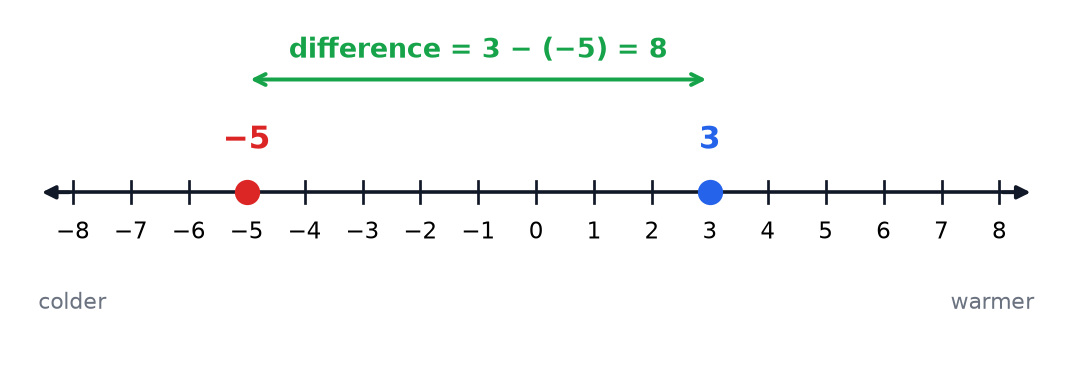
A number line is the safest way to picture negative numbers: moving right adds and moving left subtracts.
Rules for negatives
- Adding and subtracting Subtracting a negative is the same as adding: \(3 - (-5) = 3 + 5 = 8\).
- Two signs together \(+-\) and \(-+\) become \(-\), while \(--\) and \(++\) become \(+\).
- Multiplying and dividing Same signs give a positive answer and different signs give a negative one: \((-4)\times(-6)=24\) and \((-20)\div5=-4\).
The order of operations (BIDMAS)
Calculations are not always done left to right. This order decides what comes first.
-
Brackets
Work out anything inside brackets first. A fraction line and the inside of a square root also act as brackets.
-
Indices
Then powers and roots: \(4^2 = 16\) and \(\sqrt{49}=7\).
-
Division and Multiplication
These have equal priority, so work from left to right: \(24 \div 4 \times 3 = 18\), not 2.
-
Addition and Subtraction
Last of all, again equal priority and from left to right: \(10 - 4 + 3 = 9\).
Using BIDMAS
Work out \(5 + 3 \times (8 - 2)^2 \div 4\).
Show the solutionHide the solution
- 1 Brackets \(8 - 2 = 6\), so the sum is \(5 + 3 \times 6^2 \div 4\).
- 2 Indices \(6^2 = 36\), so the sum is \(5 + 3 \times 36 \div 4\).
- 3 Multiply and divide left to right \(3 \times 36 = 108\), then \(108 \div 4 = 27\).
- 4 Add \(5 + 27 = 32\).
Answer32
Common slips with negatives
What students write
- \(5 - (-3) = 2\)
- \((-4)^2 = -16\)
- \(-3 \times -5 = -15\)
What is correct
- \(5 - (-3) = 5 + 3 = 8\)
- \((-4)^2 = (-4)\times(-4) = 16\)
- \((-3)\times(-5) = 15\) because the signs are the same
Estimating to check your answer
An estimate tells you whether your written answer is the right size, and examiners often ask for one.
-
Round to 1 significant figure
Round each number so that only the first digit is non-zero, then calculate: \(38 \times 21 \approx 40 \times 20 = 800\). The exact answer, 798, is close to the estimate, so it is plausible.
-
Estimating with decimals
\(6.8 \times 3.1\) is about \(7 \times 3 = 21\). If your working gave 2.108 or 210.8, the estimate shows that you misplaced the decimal point.
-
Estimating a division
\(4872 \div 12\) is about \(5000 \div 10 = 500\), so an answer of 406 is sensible and 40.6 would not be.
-
Rounding rules
Look at the digit after the one you are rounding to. If it is 5 or more, round up, and if it is 4 or less, leave the digit alone. Rounding 3.46 to one decimal place gives 3.5.
Adding and subtracting decimals
Work out \(12.4 + 3.75 - 8.9\) without a calculator.
Show the solutionHide the solution
- 1 Line up the decimal points Write \(12.40\), \(3.75\) and \(8.90\) with the same number of decimal places.
- 2 Add first \(12.40 + 3.75 = 16.15\).
- 3 Then subtract \(16.15 - 8.90 = 7.25\).
- 4 Check with an estimate \(12 + 4 - 9 = 7\), which is close to 7.25.
Answer7.25
Choosing the right operation in word problems
Many marks are lost by picking the wrong operation, not by arithmetic slips.
-
Key words
"Total", "altogether" and "sum" mean add. "Difference" and "how many more" mean subtract. "Product", "each" and "lots of" mean multiply. "Share" and "per" mean divide.
-
Interpreting a remainder
A remainder has to be interpreted in context. If 250 people travel on coaches with 48 seats, \(250 \div 48 = 5\) remainder 10, so 6 coaches are needed because the last 10 people still need a seat.
-
Units and money
Convert to the same units before you calculate and write money to two decimal places. \(3\text{ m } 20\text{ cm} + 85\text{ cm} = 320\text{ cm} + 85\text{ cm} = 405\text{ cm} = 4.05\text{ m}\).
-
Answer the question asked
Reread the question to check whether you need the cost, the change, or the number of items.
A problem with a remainder in money
Tickets cost \(\pounds 8.50\) each. Priya has \(\pounds 60\). How many tickets can she buy, and how much money does she have left?
Show the solutionHide the solution
- 1 Find a multiple that fits \(8.50 \times 7 = 59.50\), which is less than 60.
- 2 Check the next one \(8.50 \times 8 = 68\), which is more than 60, so 8 tickets are too many.
- 3 Work out the change \(60 - 59.50 = \pounds 0.50\).
- 4 Answer in context Priya can buy 7 tickets and has \(\pounds 0.50\) left.
Answer7 tickets, with \(\pounds 0.50\) left
Negative numbers in context
Negative numbers appear in temperatures, bank balances and heights below sea level.
-
Temperature
A fall of 8 degrees from \(3^\circ\text{C}\) gives \(3 - 8 = -5^\circ\text{C}\).
-
Comparing
The further left on the number line, the smaller the number: \(-9 < -2 < 0 < 4\). A bigger digit after a minus sign means a smaller number.
-
Difference
The difference between \(-12\) and 3 is \(3 - (-12) = 15\).
-
Money
An overdraft of \(\pounds 40\) can be written as \(-40\), so paying in \(\pounds 65\) gives \(-40 + 65 = \pounds 25\).
Test yourself
-
1
Write \(0.07\), \(0.6\) and \(0.065\) in order, smallest first.
Show answerHide answer
\(0.065, 0.07, 0.6\). Writing them to three decimal places gives 0.065, 0.070 and 0.600.
-
2
What is \(3.45 \times 100\)?
Show answerHide answer
345, because every digit moves two columns to the left.
-
3
Work out \(-7 + 12\).
Show answerHide answer
5.
-
4
Work out \((-4) \times (-5)\).
Show answerHide answer
20, because the signs are the same.
-
5
Work out \(20 - 4 \times 3\).
Show answerHide answer
8, because multiplication is done before subtraction.
Exam technique: scoring method marks
On a non-calculator paper the working is worth as much as the answer.
-
Show every step
A correct answer with no working may earn only one mark on a multi-mark question, while a wrong answer with a correct method still earns method marks.
-
Set work out neatly
Line up the columns for written methods and draw the grid or division layout in full.
-
Use your estimate
If your answer is wildly different from your estimate, recheck before moving on.
-
Do not round too early
Keep exact values throughout and round only the final answer, if the question asks.
Summary and exam focus
- Place value fixes the worth of every digit, and writing decimals to the same length makes them easy to order.
- Use grid or column methods for multiplication and bus-stop or chunking for division, and always check with an estimate.
- When multiplying decimals, multiply as whole numbers and then give the answer the total number of decimal places.
- Same signs multiply to a positive; different signs multiply to a negative; subtracting a negative adds.
- BIDMAS: brackets, indices, then division and multiplication, then addition and subtraction.
Exam focus
Work out \(3.6 \times 0.45\). You must show all your working. (3 marks) (3 marks)
Do not reach for a decimal point until the end. Multiply \(36 \times 45\) as whole numbers, show that working, then count the three decimal places. Writing the whole-number product earns the method mark even if you slip later.
Key terms
The words this lesson expects you to use. Each one is linked from the first place it appears above.
- Estimate
- An approximate answer found by rounding the numbers in a calculation first.
- Place value
- The value a digit has because of the column it is in.
- Integer
- A whole number, which may be positive, negative or zero.
- Decimal place
- The position of a digit after the decimal point.
- Sum
- The result of adding numbers together.
- Difference
- The result of subtracting one number from another.
- Product
- The result of multiplying numbers together.
- Quotient
- The result of dividing one number by another.
- Negative number
- A number less than zero.
- BIDMAS
- The order in which to do operations: Brackets, Indices, Division and Multiplication, Addition and Subtraction.
You've finished the notes
Check your understanding
Test yourself while it is fresh. Start with the flashcards, then try the exam questions.
Something here looks wrong?
Tell us what and we will go and look. It goes to whoever writes these pages, nobody else, and we do not ask who you are — so there is nothing to sign and nothing comes back to you.