Maths · Geometry and Measures
Viewing as
Teaching this? The teacher view opens every answer and mark scheme.
Volume and Surface Area
Volumes and surface areas of cuboids, prisms, cylinders, cones and spheres.
Learning Objectives
- 1Calculate the volume and surface area of cuboids and prisms, using the area of the cross-section.
- 2Calculate the volume and surface area of cylinders, with answers in terms of \(\pi\) where asked.
- 3Calculate the volume and surface area of cones, spheres and pyramids (Higher tier).
- 4Use volume to solve problems about capacity and density.
Space inside and skin outside
Volume is the amount of space inside a 3D shape, measured in cubic units such as cm\(^3\). Surface area is the total area of all the faces, which is measured in square units, because it is the area of the "skin" of the shape. Examiners ask for both, and the units tell you which is which. Most volume questions use a simple idea: find the area of one end of the shape, then multiply by how far it goes.
Cuboids
A cuboid is a box shape with three different dimensions, length \(l\), width \(w\) and height \(h\).
-
Volume
\(V = l \times w \times h\).
-
Surface area
A cuboid has six faces in three matching pairs: \(2lw + 2lh + 2wh\).
-
A cube
A cube has all its edges equal, so \(V = a^3\) and the surface area is \(6a^2\).
-
Always write the units
Volume is in cm\(^3\), and surface area is in cm\(^2\).
Cuboid volume and surface area
A cuboid measures 8 cm by 5 cm by 3 cm. Work out its volume and its total surface area.
Show the solutionHide the solution
- 1 Volume \(8 \times 5 \times 3 = 120\) cm\(^3\).
- 2 Find the three pairs of faces \(8 \times 5 = 40\), \(8 \times 3 = 24\) and \(5 \times 3 = 15\).
- 3 Add and double \(40 + 24 + 15 = 79\), so \(2 \times 79 = 158\).
- 4 Units 158 cm\(^2\).
AnswerVolume 120 cm\(^3\), surface area 158 cm\(^2\)
Prisms
A prism has the same cross-section all the way through. It could be a triangle, a trapezium, an L-shape or any other flat shape.
-
Volume
Volume \(=\) area of cross-section \(\times\) length. This one rule covers every prism.
-
Find the cross-section first
Work out its area using the formulae from the last lesson, then multiply.
-
Surface area
Find the area of every face, including both ends, and add them. A net helps you not to miss one.
-
The length is the distance along the prism
It is not always the longest dimension in the picture.
Volume of a prism
The triangle at the front is the cross-section. Its area is found first, and then it is multiplied by the length of the prism.
Method for any prism
- Step 1 Find the area of the cross-section.
- Step 2 Multiply by the length of the prism.
- Step 3 Write the answer in cubic units.
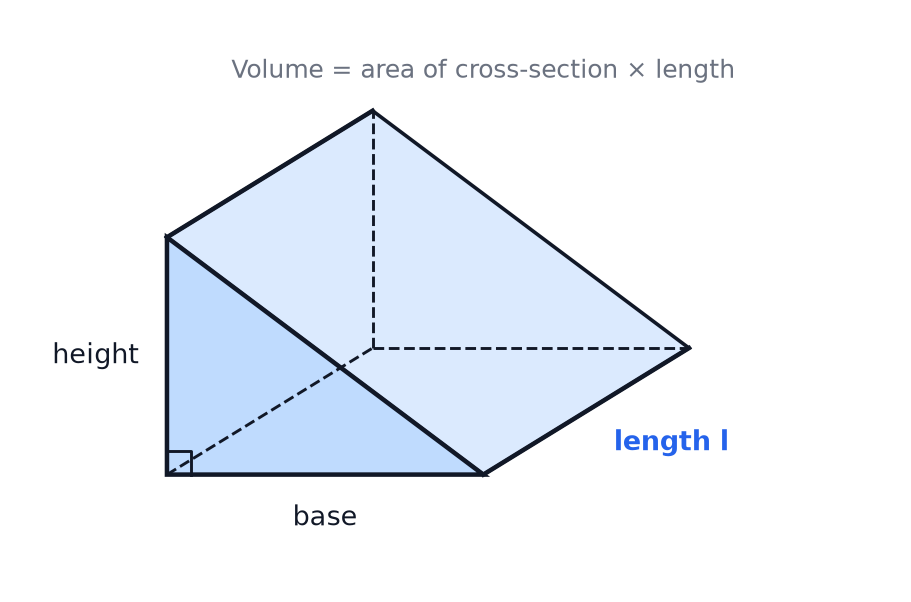
Volume of a triangular prism
The cross-section of a prism is a right-angled triangle with base 6 cm and height 4 cm. The prism is 15 cm long. Work out its volume.
Show the solutionHide the solution
- 1 Area of the triangle \(\dfrac{1}{2} \times 6 \times 4 = 12\) cm\(^2\).
- 2 Multiply by the length \(12 \times 15 = 180\).
- 3 Units 180 cm\(^3\).
Answer180 cm\(^3\)
Cylinders
A cylinder is a prism with a circle as its cross-section.
-
Volume
\(V = \pi r^2 h\), the area of the circle times the height.
-
Curved surface area
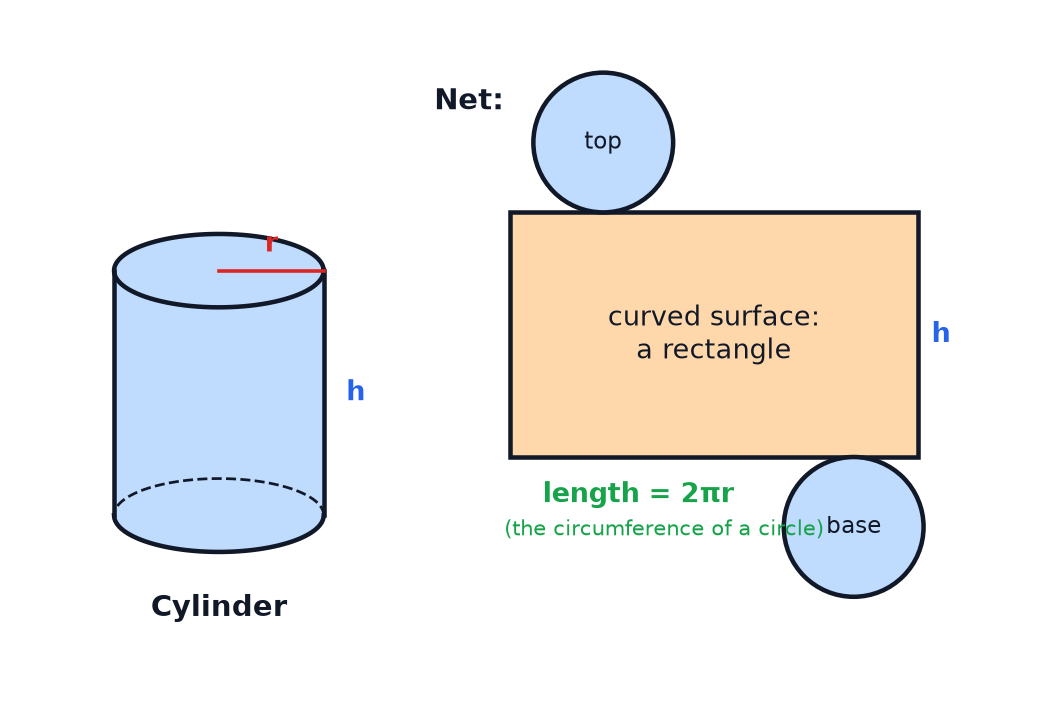
\(2\pi r h\). The curved surface opens out into a rectangle of height \(h\) and length equal to the circumference.
-
Total surface area
The curved surface plus the two circles: \(2\pi r h + 2\pi r^2\).
-
Take care with the radius
If a diameter is given, halve it first.
The net of a cylinder
The rectangle wraps around the cylinder, so its length equals the circumference of the circle, \(2\pi r\), and its height is the height of the cylinder. This is where the curved surface area formula \(2\pi r h\) comes from.
Putting the net to use
- Curved surface Rectangle area \(= 2\pi r \times h = 2\pi r h\).
- Two circles Each has area \(\pi r^2\), so they add \(2\pi r^2\).
- Open cylinder If the cylinder has no lid, include only one circle.
Volume and surface area of a cylinder
A cylinder has radius 3 cm and height 10 cm. Work out its volume and its total surface area. Give your answers in terms of \(\pi\).
Show the solutionHide the solution
- 1 Volume \(\pi r^2 h = \pi \times 3^2 \times 10 = 90\pi\) cm\(^3\).
- 2 Curved surface \(2\pi r h = 2 \times \pi \times 3 \times 10 = 60\pi\) cm\(^2\).
- 3 The two circles \(2\pi r^2 = 2 \times \pi \times 9 = 18\pi\) cm\(^2\).
- 4 Total \(60\pi + 18\pi = 78\pi\) cm\(^2\).
AnswerVolume \(90\pi\) cm\(^3\), surface area \(78\pi\) cm\(^2\)
Cones, spheres and pyramids (Higher tier)
These formulae appear on the Higher paper, and you should know how to use them even when they are given on the formula page.
-
Cone volume
\(V = \dfrac{1}{3}\pi r^2 h\), using the vertical height \(h\).
-
Cone curved surface
\(\pi r l\), where \(l\) is the slant height, not the vertical height.
-
Sphere
Volume \(\dfrac{4}{3}\pi r^3\) and surface area \(4\pi r^2\).
-
Pyramid
Volume \(\dfrac{1}{3} \times\) area of base \(\times\) vertical height.
-
Hemisphere
Half a sphere. Its volume is \(\dfrac{2}{3}\pi r^3\), and its curved surface is \(2\pi r^2\), plus \(\pi r^2\) if the flat circle is included.
Volume of a sphere
(Higher tier) A sphere has radius 3 cm. Work out its volume, leaving your answer in terms of \(\pi\).
Show the solutionHide the solution
- 1 Use the formula \(V = \dfrac{4}{3}\pi r^3\).
- 2 Cube the radius \(3^3 = 27\).
- 3 Substitute \(\dfrac{4}{3} \times \pi \times 27\).
- 4 Calculate \(\dfrac{4 \times 27}{3} = 36\), so the volume is \(36\pi\) cm\(^3\).
Answer\(36\pi\) cm\(^3\)
Volume of a cone
(Higher tier) A cone has radius 3 cm and vertical height 4 cm. Work out its volume in terms of \(\pi\).
Show the solutionHide the solution
- 1 Use the formula \(V = \dfrac{1}{3}\pi r^2 h\).
- 2 Substitute \(\dfrac{1}{3} \times \pi \times 9 \times 4\).
- 3 Calculate \(\dfrac{36}{3} = 12\), so the volume is \(12\pi\) cm\(^3\).
- 4 Note The slant height of this cone is 5 cm, because \(3^2 + 4^2 = 5^2\), but it is not needed for the volume.
Answer\(12\pi\) cm\(^3\)
Problems using volume
Volume links to other topics, and these are the classic ways it is tested.
-
Capacity
1 cm\(^3\) holds 1 ml, so a volume in cm\(^3\) can be changed to millilitres, and 1000 cm\(^3\) is 1 litre.
-
Density
Mass \(=\) density \(\times\) volume, from the previous chapter.
-
Filling and pouring
A tank has volume \(l \times w \times h\), and the time to fill it is volume divided by the rate.
-
Cutting a shape
Subtract the volume that is removed.
What the OCR exam gives you
OCR prints a formulae sheet with the paper, so some formulae are given to you.
-
Given on the formulae sheet
The volume of a prism: area of cross-section \(\times\) length.
-
Not on the sheet
The sheet does not include the cylinder, cone, sphere or pyramid formulae. OCR's specification says that any formula it needs you to know is listed, and others are given in the question, so read the question carefully, but learn the cylinder formulae.
-
Not given
The volume of a cuboid and the cylinder formulae \(\pi r^2 h\) and \(2\pi r h\), so learn them.
Test yourself
-
1
What is the volume of a prism?
Show answerHide answer
Area of cross-section \(\times\) length.
-
2
What is the volume of a cylinder?
Show answerHide answer
\(\pi r^2 h\).
-
3
What is the curved surface area of a cylinder?
Show answerHide answer
\(2\pi r h\).
-
4
How many millilitres are in 1 cm\(^3\)?
Show answerHide answer
1 ml.
-
5
What is the volume of a sphere (Higher tier)?
Show answerHide answer
\(\dfrac{4}{3}\pi r^3\).
Exam technique: volume and surface area
Marks are given for each correct area or volume, so show them separately.
-
Write the cross-section area as its own line
It is worth a method mark even if the volume is wrong.
-
Check the units
cm\(^3\) for volume, cm\(^2\) for surface area.
-
Count the faces
A prism has two ends and the rectangles along its sides.
-
Leave \(\pi\) in the answer
Only change \(\pi\) to a number if the question asks for a decimal.
Summary and exam focus
- Volume of a cuboid is \(l \times w \times h\), and of any prism it is the cross-section area times the length.
- A cylinder has volume \(\pi r^2 h\) and curved surface area \(2\pi r h\).
- Total surface area is the area of every face added together.
- Cones, spheres and pyramids appear at Higher tier, with \(\dfrac{1}{3}\) used for cones and pyramids.
- 1 cm\(^3\) is 1 ml, and 1000 cm\(^3\) is 1 litre.
Exam focus
A cylinder has radius 4 cm and height 10 cm. Work out the volume of the cylinder. Give your answer in terms of \(\pi\). (2 marks) (2 marks)
Write \(\pi \times 4^2 \times 10\) first, then square the 4 to get 16 and multiply by 10. The answer is \(160\pi\) cm\(^3\). Do not square the 4 as \(4 \times 2 = 8\), which is the most common slip.
Key terms
The words this lesson expects you to use. Each one is linked from the first place it appears above.
- Volume
- The amount of space inside a 3D shape, measured in cubic units.
- Surface area
- The total area of all the faces of a 3D shape.
- Cuboid
- A 3D shape with six rectangular faces.
- Prism
- A 3D shape with the same cross-section along its whole length.
- Cross-section
- The shape you see when you cut through a solid at a right angle to its length.
- Cylinder
- A prism with a circular cross-section.
- Cone
- A 3D shape with a circular base that rises to a point.
- Sphere
- A perfectly round 3D shape, like a ball.
- Net
- A flat pattern that folds to make a 3D shape.
You've finished the notes
Check your understanding
Test yourself while it is fresh. Start with the flashcards, then try the exam questions.
Something here looks wrong?
Tell us what and we will go and look. It goes to whoever writes these pages, nobody else, and we do not ask who you are — so there is nothing to sign and nothing comes back to you.