Viewing as
Teaching this? The teacher view adds 2 files, the mark schemes and the model answers.
Maths · Equations and graphs
Quadratic equations
Solve quadratic equations by factorising, by using the quadratic formula and by completing the square, and choose a suitable method.
Warm-up
Answer each one, then check.
-
1
Factorise \(x^2 + 5x + 6\).
Show answerHide answer
\((x + 2)(x + 3)\)
-
2
Expand \((x + 3)(x - 1)\).
Show answerHide answer
\(x^2 + 2x - 3\)
-
3
What is \(\sqrt{49}\)?
Show answerHide answer
\(7\)
-
4
If \(ab = 0\), what do you know?
Show answerHide answer
\(a = 0\) or \(b = 0\)
-
5
What is the value of \(3^2\)?
Show answerHide answer
\(9\)
Learning Objectives
- 1Solve a quadratic by factorising.
- 2Solve a quadratic with the quadratic formula.
- 3Complete the square and use it to solve.
- 4Choose the most efficient method.
QUADRATIC EQUATIONS
A quadratic equation can be written \(ax^2 + bx + c = 0\) and usually has two solutions.
Rearrange so that one side is 0 before you use any method.
Two Solutions
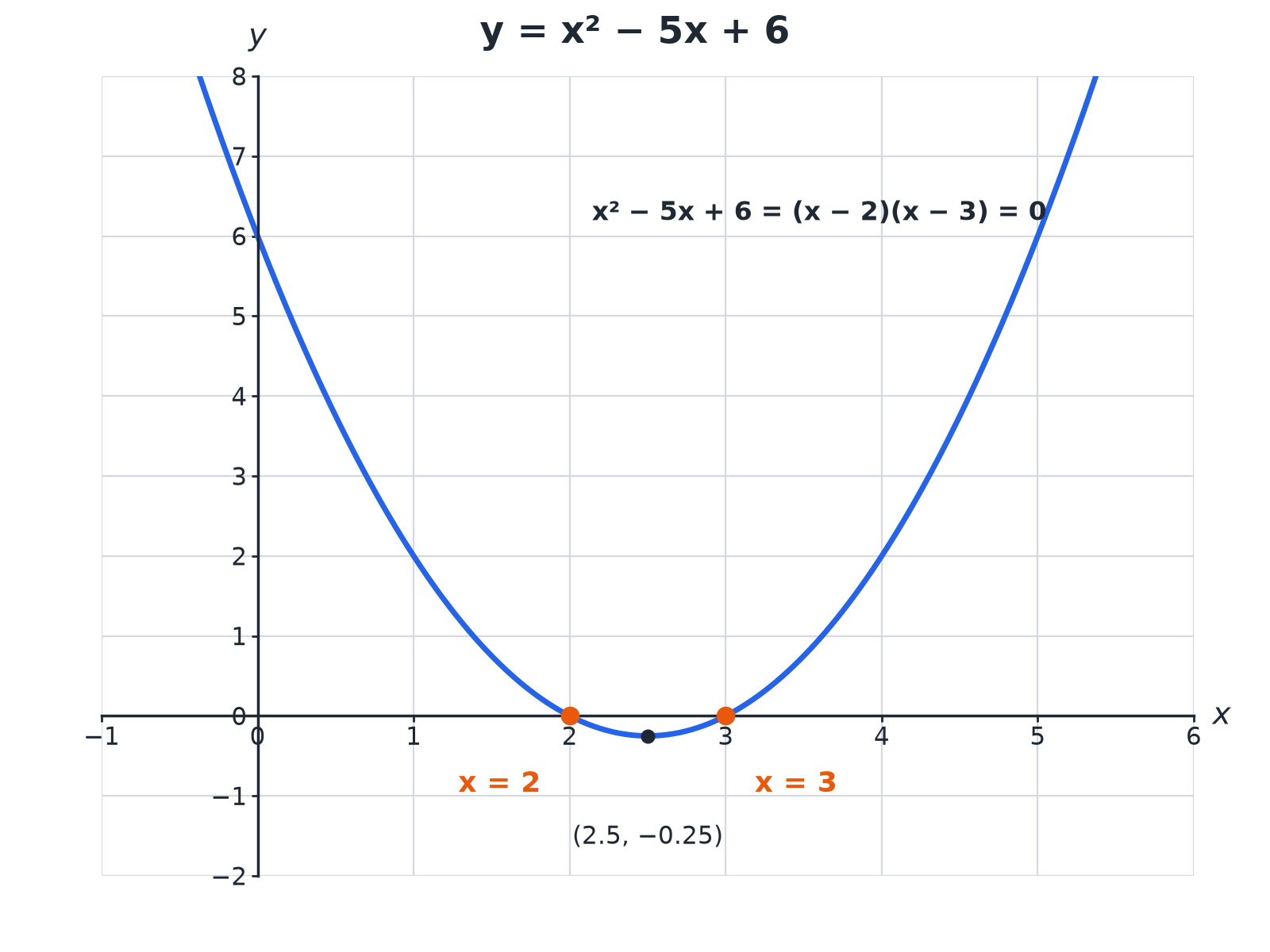
The solutions are where the graph crosses the x-axis.
Choosing a Method
Use the quickest one that works.
-
Factorising
Use it when: The quadratic factorises easily. Example: \(x^2 - 5x + 6 = 0\)
-
Formula
Use it when: It does not factorise, or the answer is needed as a decimal. Example: \(x^2 + 4x - 7 = 0\)
-
Completing the square
Use it when: You need exact surds or the turning point. Example: \(x^2 + 6x - 2 = 0\)
Factorising
Solve \(2x^2 + 5x - 3 = 0\).
Show the solutionHide the solution
- 1 Factorise \((2x - 1)(x + 3) = 0\)
- 2 Each bracket is 0 \(2x - 1 = 0\) or \(x + 3 = 0\)
- 3 Solve \(x = \tfrac{1}{2}\) or \(x = -3\)
Answer\(x = \tfrac{1}{2}\) or \(x = -3\)
The Quadratic Formula
Solve \(x^2 + 4x - 7 = 0\). Give your answers to 2 decimal places.
Show the solutionHide the solution
- 1 Formula \(x = \dfrac{-b \pm \sqrt{b^2 - 4ac}}{2a}\)
- 2 Substitute \(a = 1,\ b = 4,\ c = -7\) \(x = \dfrac{-4 \pm \sqrt{16 + 28}}{2}\)
- 3 Simplify \(x = \dfrac{-4 \pm \sqrt{44}}{2}\)
- 4 Evaluate \(x = 1.32\) or \(x = -5.32\)
Answer\(x = 1.32\) or \(x = -5.32\)
Completing the Square
Solve \(x^2 + 6x - 2 = 0\) by completing the square. Give your answers to 2 decimal places.
Show the solutionHide the solution
- 1 Complete the square \((x + 3)^2 - 9 - 2 = 0\)
- 2 Simplify \((x + 3)^2 = 11\)
- 3 Square root \(x + 3 = \pm\sqrt{11}\)
- 4 Solve \(x = -3 \pm \sqrt{11} = 0.32\) or \(-6.32\)
Answer\(x = 0.32\) or \(x = -6.32\)
Common Mistakes
Avoid these.
-
Not rearranging to 0
Move everything to one side first.
-
Dividing by \(x\)
Solving \(x^2 = 7x\) by dividing loses the solution \(x = 0\); factorise instead.
-
Signs in the formula
Take care with \(-b\) and \(b^2 - 4ac\) when \(b\) or \(c\) is negative.
-
Only one solution
Give both solutions.
Choose Your Method
Solve each and say which method you used. (a) \(x^2 - 7x + 10 = 0\) (b) \(x^2 + 2x - 5 = 0\) (2 d.p.) (c) \(x^2 = 9x\).
1. Look for factors first.
2. Otherwise use the formula.
A good answer shows: (a) \(x = 2\) or \(5\) (factorising). (b) \(x = -1 \pm \sqrt{6} = 1.45\) or \(-3.45\) (formula or completing the square). (c) \(x(x - 9) = 0\), so \(x = 0\) or \(9\).
Can I...?
- 1Rearrange to equal zero.
- 2Factorise and solve.
- 3Use the quadratic formula.
- 4Complete the square.
- 5Give answers to a given accuracy.
- 6Give both solutions.
- 7Avoid dividing by x.
- 8Choose a method.
Summary & Exam Focus
- Factorise if you can.
- Formula: \(x = \dfrac{-b \pm \sqrt{b^2 - 4ac}}{2a}\).
- Complete the square: \((x + p)^2 + q\).
- Every quadratic has up to two solutions.
Exam focus
Solve \(x^2 + 4x - 7 = 0\). Give your solutions correct to 2 decimal places. (3 marks) (3 marks)
Write the formula first, then substitute carefully, using brackets for negatives.
Key terms
The vocabulary this lesson expects you to use. Each one is linked from the first place it appears above.
- Quadratic
- An equation with a highest power of \(x^2\).
- Factorise
- Write as a product of brackets.
- Root
- A solution of an equation.
- Discriminant
- \(b^2 - 4ac\).
- Completing the square
- Writing \(x^2 + bx + c\) as \((x + p)^2 + q\).
- Surd
- A root that cannot be simplified to a whole number, e.g. \(\sqrt{11}\).
Practice questions
Have a go at each one before you open its answer.
-
Question 1 Solve 2 marks
Solve \(x^2 - 5x + 6 = 0\).
Show answerHide answer
Model answer
\((x - 2)(x - 3) = 0\), so \(x = 2\) or \(x = 3\).
Mark scheme
- \((x - 2)(x - 3)\) — M1
- 2 and 3 — A1
-
Question 2 Solve 3 marks
Solve \(2x^2 + 5x - 3 = 0\).
Show answerHide answer
Model answer
\((2x - 1)(x + 3) = 0\), so \(x = \tfrac{1}{2}\) or \(x = -3\).
Mark scheme
- Factorises — M1
- One correct solution — A1
- Both correct — A1
-
Question 3 Solve 3 marks
Solve \(x^2 + 4x - 7 = 0\). Give your solutions correct to 2 decimal places.
Show answerHide answer
Model answer
\(x = \dfrac{-4 \pm \sqrt{44}}{2}\); \(x = 1.32\) or \(x = -5.32\).
Mark scheme
- Substitutes into the formula — M1
- \(\dfrac{-4 \pm \sqrt{44}}{2}\) — A1
- 1.32 and \(-5.32\) — A1
-
Question 4 Solve 4 marks
(a) Write \(x^2 + 6x - 2\) in the form \((x + a)^2 + b\). (b) Hence solve \(x^2 + 6x - 2 = 0\). Give your answers correct to 2 decimal places.
Show answerHide answer
Model answer
(a) \((x + 3)^2 - 11\). (b) \(x + 3 = \pm\sqrt{11}\), so \(x = 0.32\) or \(x = -6.32\).
Mark scheme
- \(a = 3\) — B1
- \(b = -11\) — B1
- \(x = -3 \pm \sqrt{11}\) — M1
- 0.32 and \(-6.32\) — A1
-
Question 5 Use the graph 2 marks
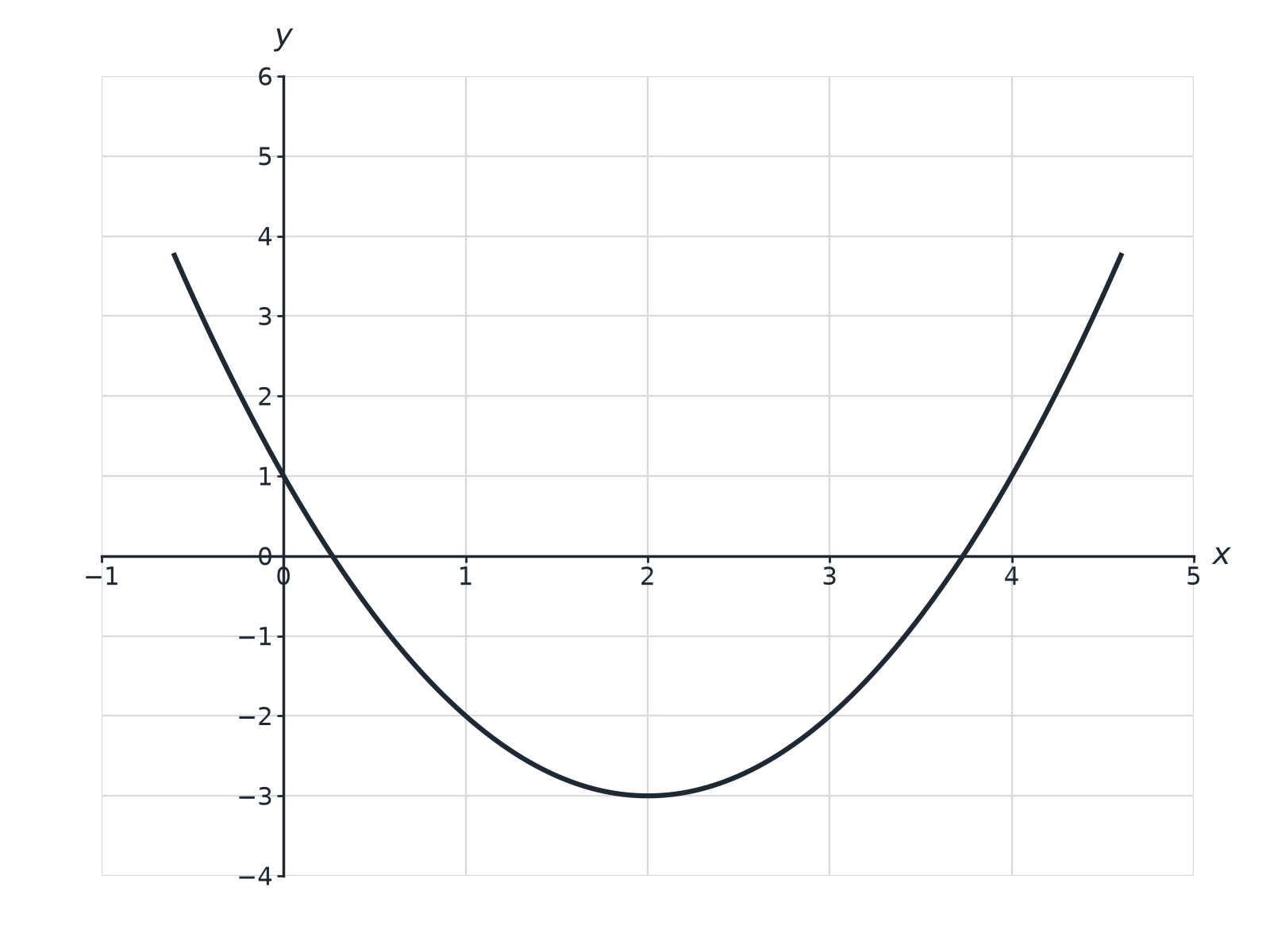
The graph of \(y = x^2 - 4x + 1\) is shown. Use the graph to find estimates for the solutions of \(x^2 - 4x + 1 = 0\).
Show answerHide answer
Model answer
\(x \approx 0.3\) and \(x \approx 3.7\). Accept 0.2 to 0.4 and 3.6 to 3.8.
Mark scheme
- One correct estimate — B1
- Both correct — B1
-
Question 6 Solve 2 marks
Solve \(x^2 = 7x\).
Show answerHide answer
Model answer
\(x^2 - 7x = 0\), \(x(x - 7) = 0\), so \(x = 0\) or \(x = 7\).
Mark scheme
- \(x(x - 7) = 0\) — M1
- 0 and 7 — A1
Quick check
-
How many solutions can a quadratic equation have?
Show answerHide answer
C: Up to two
Up to two.
-
\((x - 4)(x + 1) = 0\) gives...
Show answerHide answer
A: \(x = 4\) or \(-1\)
\(x = 4\) or \(x = -1\).
-
The quadratic formula is...
Show answerHide answer
D: \(\dfrac{-b \pm \sqrt{b^2 - 4ac}}{2a}\)
\(\dfrac{-b \pm \sqrt{b^2 - 4ac}}{2a}\).
-
\(x^2 + 6x\) completed the square is...
Show answerHide answer
B: \((x + 3)^2 - 9\)
\((x + 3)^2 - 9\).
-
To solve \(x^2 = 9x\) you should...
Show answerHide answer
C: Rearrange to 0 and factorise
Rearrange to \(x^2 - 9x = 0\) and factorise; dividing by \(x\) would lose \(x = 0\).
-
The solutions of a quadratic are where its graph...
Show answerHide answer
A: Crosses the x-axis
Crosses the x-axis.
Downloads
Free to keep, print and annotate.
- Quadratic equations.pptx Built from the lesson script on 30 September 2026. View
- Quadratic equations - Completed Notes.docx The full notes for the lesson, to revise from. Built from the lesson script on 30 September 2026. View
- Quadratic equations - Exam Questions.docx Built from the lesson script on 30 September 2026. View
Something here looks wrong?
Tell us what and we will go and look. It goes to whoever writes these pages, nobody else, and we do not ask who you are — so there is nothing to sign and nothing comes back to you.