Viewing as
Teaching this? The teacher view adds 2 files, the mark schemes and the model answers.
Maths · More trigonometry
Accuracy
Find upper and lower bounds of rounded values, write error intervals, and calculate with bounds to find the greatest and least possible answers.
Warm-up
Answer each one, then check.
-
1
Round 3.47 to 1 decimal place.
Show answerHide answer
\(3.5\)
-
2
Round 4650 to the nearest 100.
Show answerHide answer
\(4700\)
-
3
What does \(<\) mean?
Show answerHide answer
Less than
-
4
What does \(\le\) mean?
Show answerHide answer
Less than or equal to
-
5
Round 0.0364 to 2 significant figures.
Show answerHide answer
\(0.036\)
Learning Objectives
- 1Find the upper and lower bounds of a rounded number.
- 2Write an error interval using inequalities.
- 3Find bounds for sums, differences, products and quotients (Higher).
- 4Choose a sensible degree of accuracy for an answer.
BOUNDS
A rounded value could have started anywhere in a range: half a unit either side of it.
If a number is rounded to the nearest 10, the range is 5 either side. Nearest 1: 0.5 either side. Nearest 0.1: 0.05 either side.
Bounds on a Number Line
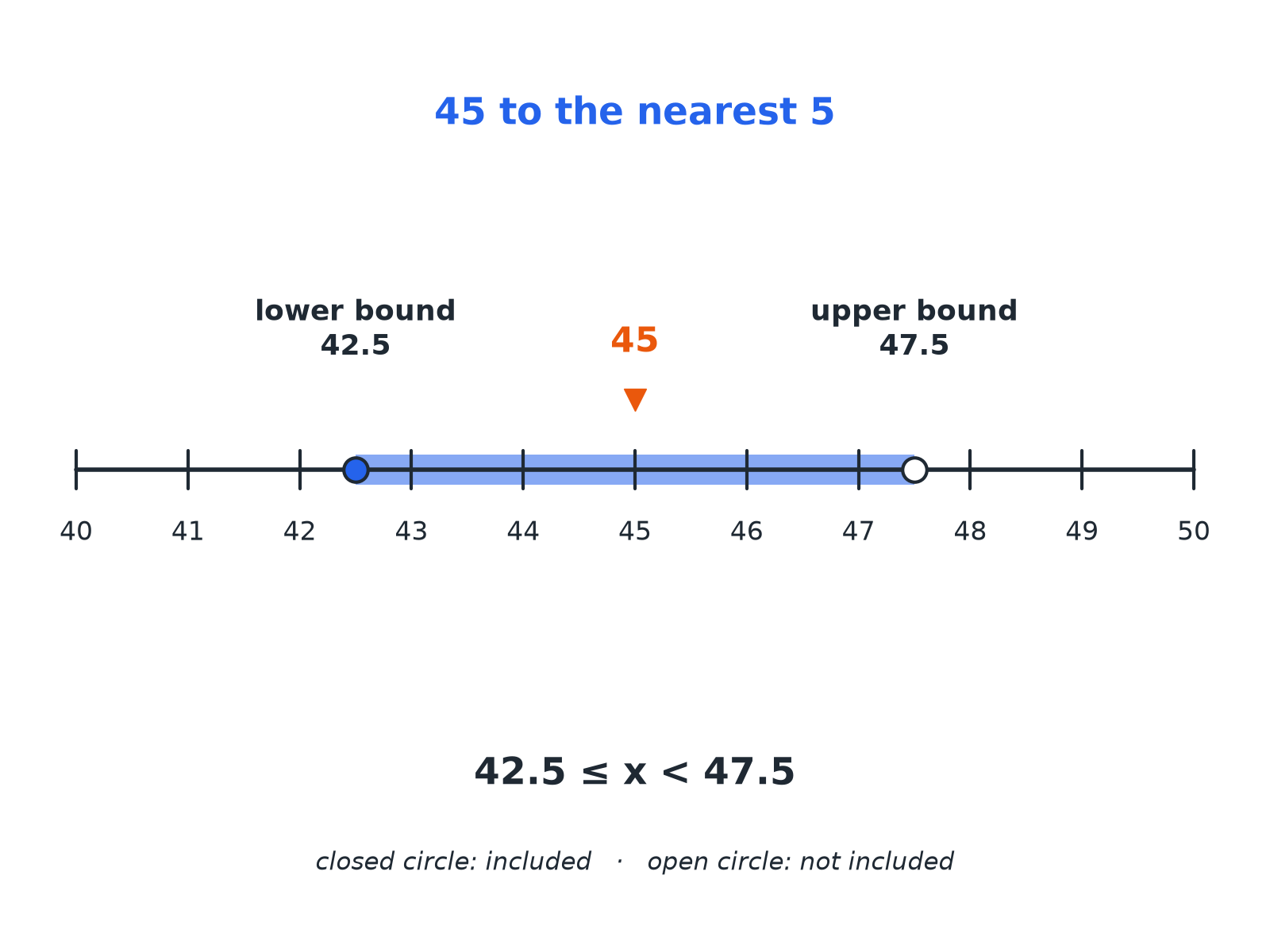
Closed circle: included. Open circle: not included.
Finding Bounds
A length is 8.3 cm, rounded to 1 decimal place. Write down the lower bound and the upper bound.
Show the solutionHide the solution
- 1 Rounding unit \(0.1\), so half a unit is \(0.05\)
- 2 Lower bound \(8.3 - 0.05 = 8.25\)
- 3 Upper bound \(8.3 + 0.05 = 8.35\)
AnswerLower bound \(8.25\) cm, upper bound \(8.35\) cm.
Writing an Error Interval
\(n = 350\) to the nearest 10. Write the error interval for \(n\).
Show the solutionHide the solution
- 1 Half a unit \(5\)
- 2 Lower bound is included \(345 \le n\)
- 3 Upper bound is not included \(n < 355\)
Answer\(345 \le n < 355\)
Rounding and Bounds
Half a unit each way.
-
Nearest 10
Value: 60. Error interval: \(55 \le x < 65\)
-
Nearest whole number
Value: 7. Error interval: \(6.5 \le x < 7.5\)
-
1 decimal place
Value: 2.4. Error interval: \(2.35 \le x < 2.45\)
-
2 significant figures
Value: 0.83. Error interval: \(0.825 \le x < 0.835\)
Bounds in Calculations (Higher)
Biggest possible answer
- Add: use both upper bounds.
- Subtract: upper bound minus lower bound.
- Multiply: upper times upper.
- Divide: upper bound divided by lower bound.
Smallest possible answer
- Add: use both lower bounds.
- Subtract: lower bound minus upper bound.
- Multiply: lower times lower.
- Divide: lower bound divided by upper bound.
Bounds of a Rectangle's Area (Higher)
A rectangle has length 12 cm and width 5 cm, both to the nearest centimetre. Find the greatest possible area.
Show the solutionHide the solution
- 1 Upper bound of length \(12.5\)
- 2 Upper bound of width \(5.5\)
- 3 Multiply \(12.5 \times 5.5 = 68.75\)
Answer\(68.75\) cm\(^2\)
Sensible Accuracy
Do not give an answer more accurately than the data allows.
-
Round at the end
Keep full calculator values until the last step.
-
Match the data
If measurements are to 2 significant figures, do not quote 6 in the answer.
-
Bounds agree
If the upper and lower bounds of an answer round to the same value, that value is the answer to that accuracy.
Bounds Race
Find the error interval for each value. (a) 6.8 to 1 d.p. (b) 1200 to the nearest 100 (c) 0.05 to 1 significant figure (d) 25 to 2 significant figures.
1. Find the rounding unit.
2. Halve it and add and subtract.
A good answer shows: (a) \(6.75 \le x < 6.85\) (b) \(1150 \le x < 1250\) (c) \(0.045 \le x < 0.055\) (d) \(24.5 \le x < 25.5\)
Can I...?
- 1Find the rounding unit.
- 2Write a lower bound.
- 3Write an upper bound.
- 4Write an error interval.
- 5Use the right inequality signs.
- 6Find bounds for an addition or subtraction.
- 7Find bounds for a product or quotient.
- 8Choose a sensible accuracy.
Summary & Exam Focus
- Half a unit each side of the rounded value.
- Lower bound included, upper bound not.
- Bounds calculations: choose the extreme values that make the answer largest or smallest.
- Do not round until the final answer.
Exam focus
\(x = 7.4\) to 1 decimal place. Write down the error interval for \(x\). (2 marks) (2 marks)
Lower bound uses \(\le\); upper bound uses \(<\).
Key terms
The vocabulary this lesson expects you to use. Each one is linked from the first place it appears above.
- Lower bound
- The smallest value that rounds to the given number.
- Upper bound
- The value at the top of the range; not itself included.
- Error interval
- The range of possible values written with inequalities.
- Degree of accuracy
- How precisely a value is given, e.g. 1 d.p. or 2 s.f.
- Truncate
- Cut off digits without rounding.
- Significant figures
- Digits that carry meaning, counting from the first non-zero digit.
Practice questions
Have a go at each one before you open its answer.
-
Question 1 Write down 2 marks
\(x = 7.4\) correct to 1 decimal place. Write down the error interval for \(x\).
Show answerHide answer
Model answer
\(7.35 \le x < 7.45\)
Mark scheme
- \(7.35\) and \(7.45\) — B1
- Correct inequality signs — B1
-
Question 2 Write down 2 marks
The mass of a parcel is 4600 g, correct to the nearest 100 g. Write down the lower bound and the upper bound of the mass.
Show answerHide answer
Model answer
Lower bound \(4550\) g; upper bound \(4650\) g.
Mark scheme
- 4550 — B1
- 4650 — B1
-
Question 3 Write down 2 marks
\(n\) is a number rounded to 2 significant figures. The result is 340. Write down the error interval for \(n\).
Show answerHide answer
Model answer
\(335 \le n < 345\)
Mark scheme
- 335 and 345 — B1
- Correct signs — B1
-
Question 4 Work out 3 marks
A rectangle has length 12 cm and width 5 cm, both correct to the nearest centimetre. Work out the upper bound for the area of the rectangle.
Show answerHide answer
Model answer
\(12.5 \times 5.5 = 68.75\) cm\(^2\)
Mark scheme
- Upper bounds 12.5 and 5.5 — B1
- Multiplies — M1
- 68.75 — A1
-
Question 5 Work out 4 marks
Jo runs 100 m, correct to the nearest metre, in 12.4 seconds, correct to 1 decimal place. Work out the upper bound for her average speed. Give your answer correct to 3 significant figures.
Show answerHide answer
Model answer
\(100.5 \div 12.35 = 8.137...\) so \(8.14\) m/s
Mark scheme
- Upper bound of distance 100.5 — B1
- Lower bound of time 12.35 — B1
- Divides — M1
- 8.14 — A1
-
Question 6 Explain 3 marks
\(a = 9.2\) and \(b = 3.1\), both correct to 1 decimal place. Work out the lower bound of \(a - b\).
Show answerHide answer
Model answer
\(9.15 - 3.15 = 6.00\) (lower bound of \(a\) minus upper bound of \(b\))
Mark scheme
- Lower bound of \(a\) is 9.15 — B1
- Upper bound of \(b\) is 3.15 — B1
- 6 — A1
Quick check
-
A number is 30 to the nearest 10. What is its lower bound?
Show answerHide answer
B: 25
Half of 10 is 5, and \(30 - 5 = 25\).
-
Which error interval is correct for \(6.2\) to 1 d.p.?
Show answerHide answer
C: \(6.15 \le x < 6.25\)
Half of 0.1 is 0.05, so 6.15 up to but not including 6.25.
-
To find the greatest value of \(a \div b\), you use...
Show answerHide answer
A: Upper bound of a, lower bound of b
The biggest \(a\) and the smallest \(b\).
-
\(x\) is 8 to the nearest whole number. Which value could \(x\) be?
Show answerHide answer
D: 8.4
8.4 rounds to 8. 8.5 would round up to 9.
-
The upper bound of 15 rounded to the nearest whole number is...
Show answerHide answer
B: 15.5
\(15 + 0.5 = 15.5\).
-
Lower bound of \(a - b\) uses...
Show answerHide answer
C: Lower a, upper b
Take away as much as possible from as little as possible.
Downloads
Free to keep, print and annotate.
Something here looks wrong?
Tell us what and we will go and look. It goes to whoever writes these pages, nobody else, and we do not ask who you are — so there is nothing to sign and nothing comes back to you.