Viewing as
Teaching this? The teacher view adds 2 files, the mark schemes and the model answers.
Maths · More trigonometry
Graph of the tangent function
Sketch and read the graph of \(y = \tan x\), know its asymptotes and period of \(180^\circ\), and solve \(\tan x = k\) between \(0^\circ\) and \(360^\circ\).
Warm-up
Answer each one, then check.
-
1
What does TOA mean?
Show answerHide answer
\(\tan = \text{opposite} \div \text{adjacent}\)
-
2
What is \(\tan 45^\circ\)?
Show answerHide answer
\(1\)
-
3
What is \(\tan 0^\circ\)?
Show answerHide answer
\(0\)
-
4
What is the period of sine and cosine?
Show answerHide answer
\(360^\circ\)
-
5
Can you divide by zero?
Show answerHide answer
No
Learning Objectives
- 1Sketch the graph of \(y = \tan x\) for \(0^\circ \le x \le 360^\circ\).
- 2Recall key values and the position of the asymptotes.
- 3Use the period of \(180^\circ\) to find a second solution.
- 4Read solutions from the graph.
TANGENT GRAPH
The graph of \(y = \tan x\) repeats every \(180^\circ\) and has vertical asymptotes at \(x = 90^\circ\) and \(x = 270^\circ\).
Unlike sine and cosine, tangent has no maximum or minimum: it goes up to infinity and down to minus infinity.
The Tangent Graph
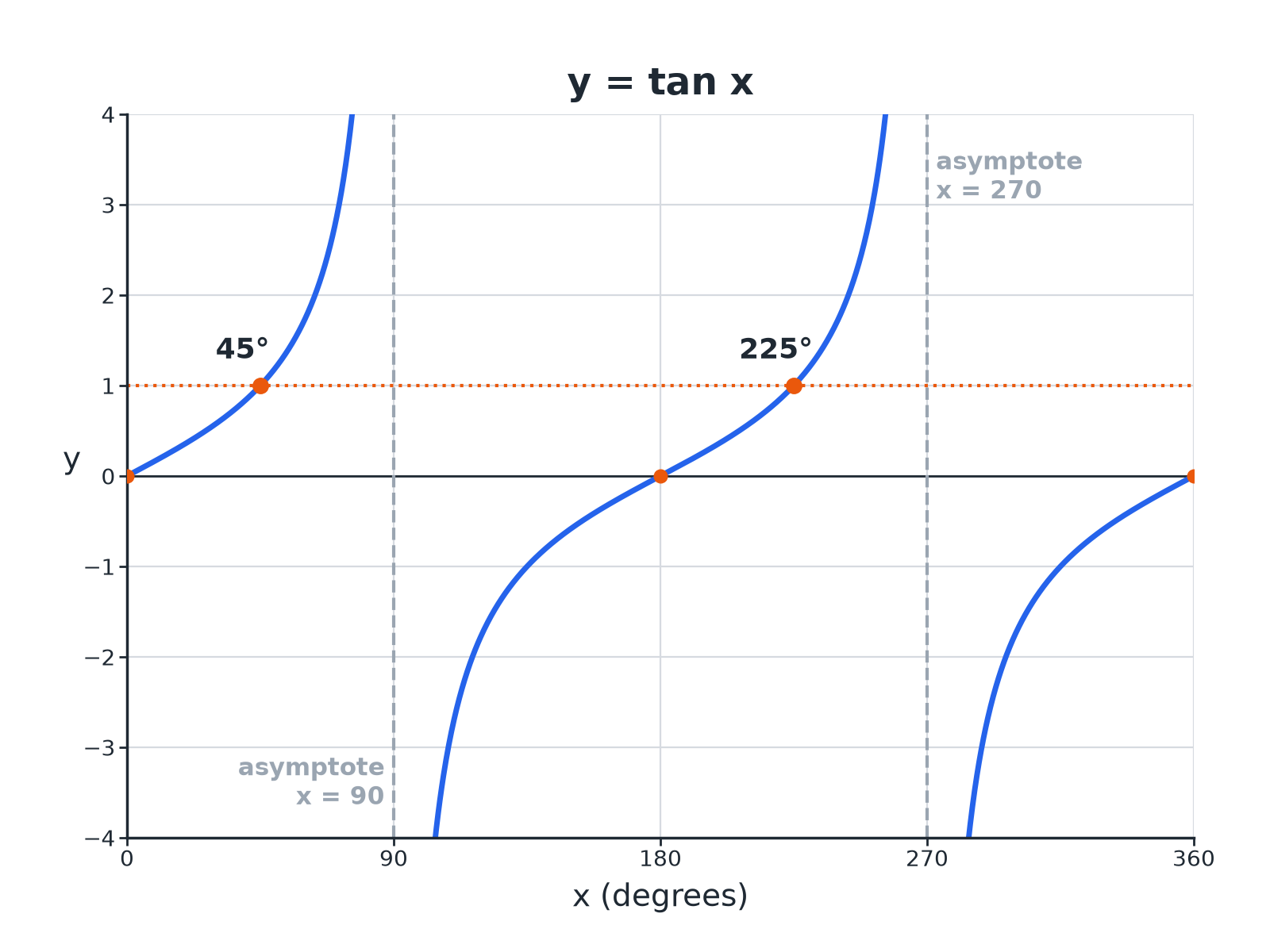
Tan x = 1 has solutions at 45 degrees and 225 degrees.
Key Values of Tangent
Learn these, and note the gaps.
-
\(\tan x\)
\(0^\circ\): \(0\). \(45^\circ\): \(1\). \(90^\circ\): undefined. \(135^\circ\): \(-1\) | \(0\) | \(1\) | undefined | \(-1\) | \(0\)
Features of the Graph
-
Period
Repeats every \(180^\circ\).
-
Asymptotes
Vertical lines at \(x = 90^\circ\) and \(270^\circ\); the graph never touches them.
-
Roots
\(x = 0^\circ,\ 180^\circ,\ 360^\circ\).
-
Range
Every value of \(y\); no maximum or minimum.
-
Shape
Rises steeply through each root.
Finding Two Solutions
The graph repeats every \(180^\circ\).
-
1
Calculator
Find \(x = \tan^{-1}(k)\); this is the first solution
-
2
Add the period
Second solution \(= x + 180^\circ\)
-
3
Negative values
If \(\tan^{-1}(k)\) is negative, add \(180^\circ\) and \(360^\circ\)
-
4
Check the range
Only keep answers between \(0^\circ\) and \(360^\circ\)
Solving tan x = 2
Solve \(\tan x = 2\) for \(0^\circ \le x \le 360^\circ\), correct to 1 decimal place.
Show the solutionHide the solution
- 1 Calculator \(x = \tan^{-1}(2) = 63.4^\circ\)
- 2 Add \(180^\circ\) \(63.4^\circ + 180^\circ = 243.4^\circ\)
Answer\(x = 63.4^\circ\) and \(x = 243.4^\circ\)
Solving a Negative Value
Solve \(\tan x = -1\) for \(0^\circ \le x \le 360^\circ\).
Show the solutionHide the solution
- 1 Calculator gives \(\tan^{-1}(-1) = -45^\circ\)
- 2 Add \(180^\circ\) \(-45^\circ + 180^\circ = 135^\circ\)
- 3 Add \(360^\circ\) \(-45^\circ + 360^\circ = 315^\circ\)
Answer\(x = 135^\circ\) and \(x = 315^\circ\)
Comparing the Three Graphs
sin x and cos x
- Period \(360^\circ\).
- Smooth waves between \(-1\) and \(1\).
- No asymptotes.
- Solutions: \(x\) and \(180^\circ - x\) (sin), \(x\) and \(360^\circ - x\) (cos).
tan x
- Period \(180^\circ\).
- Takes every value.
- Asymptotes at \(90^\circ\) and \(270^\circ\).
- Solutions: \(x\) and \(x + 180^\circ\).
Tangent Table
Use a calculator to fill in \(\tan x\) for \(x = 60^\circ, 80^\circ, 85^\circ, 89^\circ\) (1 d.p.). Then describe what happens as \(x\) gets close to \(90^\circ\).
1. Type each value into the calculator.
2. Describe the pattern.
A good answer shows: \(1.7\), \(5.7\), \(11.4\), \(57.3\). The values get bigger and bigger, which is why there is an asymptote at \(90^\circ\).
Can I...?
- 1Sketch the tangent graph.
- 2State the period.
- 3Mark the asymptotes.
- 4Recall tan 45.
- 5Use tan inverse.
- 6Find the second solution.
- 7Solve for negative values.
- 8Read solutions from a graph.
Summary & Exam Focus
- Tangent repeats every \(180^\circ\).
- Vertical asymptotes at \(90^\circ\) and \(270^\circ\).
- Solutions are \(x\) and \(x + 180^\circ\).
- Tangent takes every value, so \(\tan x = k\) always has solutions.
Exam focus
Solve \(\tan x = 0.5\) for \(0^\circ \le x \le 360^\circ\). Give answers correct to 1 decimal place. (3 marks) (3 marks)
The period is \(180^\circ\), so the second solution is \(x + 180^\circ\).
Key terms
The vocabulary this lesson expects you to use. Each one is linked from the first place it appears above.
- Asymptote
- A line that a graph gets closer to but never touches.
- Period
- The length after which the graph repeats.
- Undefined
- Has no value, e.g. \(\tan 90^\circ\).
- Inverse tangent
- \(\tan^{-1}\), the calculator function that finds an angle.
- Root
- A value of \(x\) where \(y = 0\).
- Range
- The set of values \(y\) can take.
Practice questions
Have a go at each one before you open its answer.
-
Question 1 Solve 3 marks
Solve \(\tan x = 0.5\) for \(0^\circ \le x \le 360^\circ\). Give your answers correct to 1 decimal place.
Show answerHide answer
Model answer
\(x = 26.6^\circ\) and \(x = 206.6^\circ\)
Mark scheme
- \(\tan^{-1}(0.5) = 26.6^\circ\) — B1
- Adds \(180\) — M1
- 206.6 — A1
-
Question 2 Write down 2 marks
Write down the value of (a) \(\tan 45^\circ\) (b) \(\tan 0^\circ\)
Show answerHide answer
Model answer
(a) 1 (b) 0
Mark scheme
- 1 — B1
- 0 — B1
-
Question 3 Use the graph 3 marks
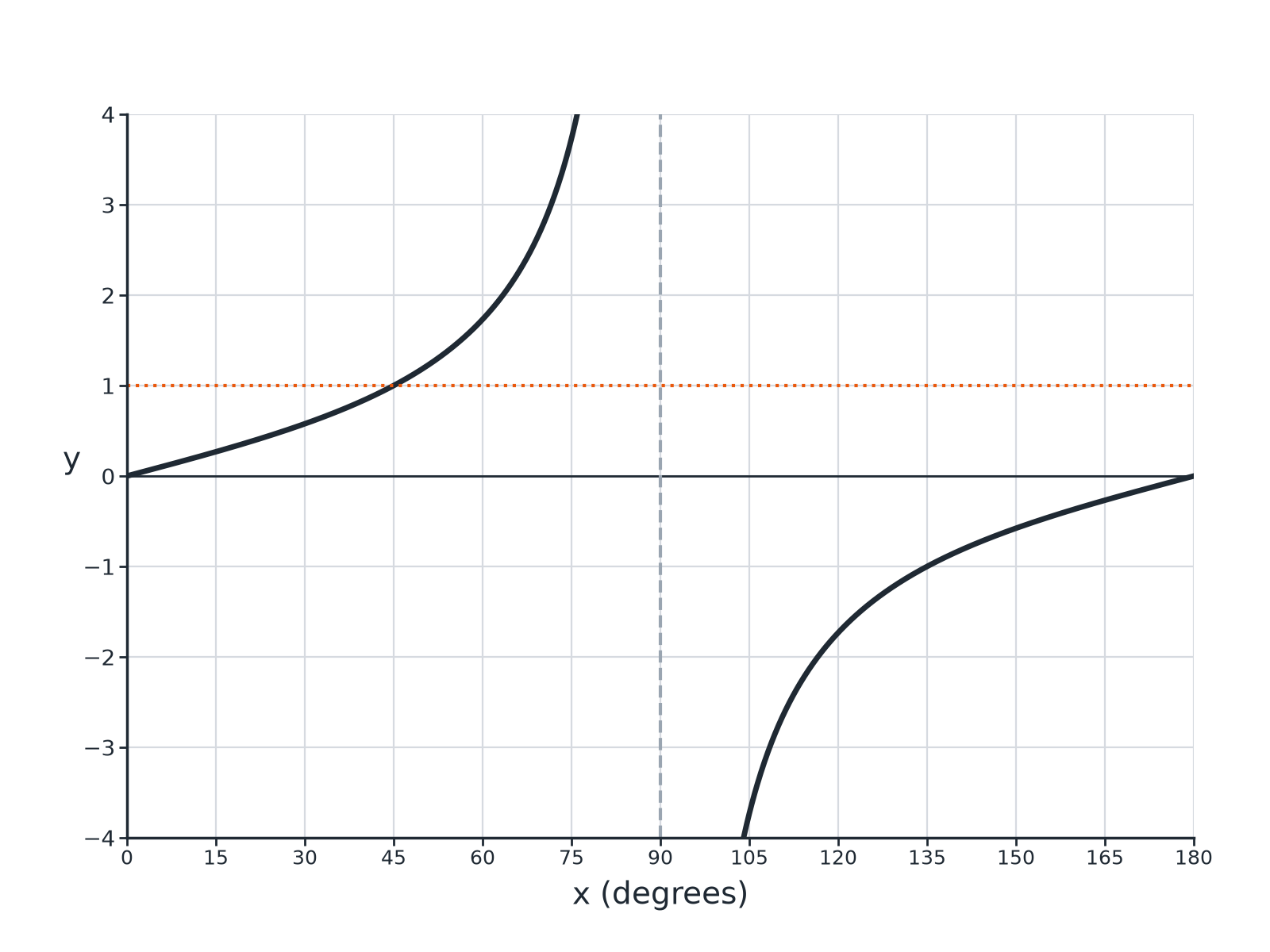
The graph shows \(y = \tan x\) for \(0^\circ \le x \le 180^\circ\). Use the graph to solve \(\tan x = 1\), and write down the equation of the asymptote.
Show answerHide answer
Model answer
\(x = 45^\circ\); the asymptote is \(x = 90^\circ\).
Mark scheme
- 45 — B1
- \(x = 90\) — B1
- Equation written in the form \(x = 90\) — B1
-
Question 4 Solve 3 marks
Solve \(\tan x = -2\) for \(0^\circ \le x \le 360^\circ\). Give your answers correct to 1 decimal place.
Show answerHide answer
Model answer
\(x = 116.6^\circ\) and \(x = 296.6^\circ\)
Mark scheme
- \(\tan^{-1}(-2) = -63.4^\circ\) — B1
- \(-63.4 + 180\) or \(-63.4 + 360\) — M1
- Both answers — A1
-
Question 5 Explain 2 marks
Explain why \(\tan 90^\circ\) has no value.
Show answerHide answer
Model answer
The tangent graph has an asymptote at \(90^\circ\): the values get larger and larger and never reach a value.
Mark scheme
- Refers to the asymptote or the graph — M1
- Values grow without limit — C1
-
Question 6 Write down 2 marks
\(\tan 30^\circ = 0.58\) (to 2 decimal places). Write down another angle between \(0^\circ\) and \(360^\circ\) with tangent 0.58.
Show answerHide answer
Model answer
\(210^\circ\)
Mark scheme
- \(30 + 180\) — M1
- 210 — A1
Quick check
-
What is the period of \(y = \tan x\)?
Show answerHide answer
B: \(180^\circ\)
The graph repeats every 180 degrees.
-
Where are the asymptotes of \(y = \tan x\) between \(0^\circ\) and \(360^\circ\)?
Show answerHide answer
C: 90 and 270
At 90 and 270 degrees.
-
\(\tan 45^\circ = 1\). Another solution between 0 and 360 is...
Show answerHide answer
D: 225
\(45 + 180 = 225\).
-
What is the maximum value of \(\tan x\)?
Show answerHide answer
A: It has no maximum
There is none: the graph goes up without limit.
-
\(\tan^{-1}(-1)\) on a calculator gives...
Show answerHide answer
B: \(-45^\circ\)
The calculator gives \(-45^\circ\); add 180 to get 135 degrees.
-
The roots of \(\tan x\) between \(0^\circ\) and \(360^\circ\) are...
Show answerHide answer
C: 0, 180 and 360
Where the curve crosses the x-axis: 0, 180 and 360 degrees.
Downloads
Free to keep, print and annotate.
- Graph of the tangent function.pptx Built from the lesson script on 30 September 2026. View
- Graph of the tangent function - Completed Notes.docx The full notes for the lesson, to revise from. Built from the lesson script on 30 September 2026. View
- Graph of the tangent function - Exam Questions.docx Built from the lesson script on 30 September 2026. View
Something here looks wrong?
Tell us what and we will go and look. It goes to whoever writes these pages, nobody else, and we do not ask who you are — so there is nothing to sign and nothing comes back to you.