Viewing as
Teaching this? The teacher view adds 2 files, the mark schemes and the model answers.
Maths · Similarity and congruence
Geometric proof and congruence
Write clear geometric proofs, using congruent triangles to prove properties of shapes such as isosceles triangles and parallelograms.
Warm-up
Answer each one, then check.
-
1
Name the four conditions for congruent triangles.
Show answerHide answer
SSS, SAS, ASA, RHS
-
2
What are alternate angles?
Show answerHide answer
Equal angles between parallel lines, in a Z shape
-
3
What do the diagonals of a parallelogram do?
Show answerHide answer
Bisect each other
-
4
What is a proof?
Show answerHide answer
A logical argument that shows a statement is always true
-
5
Are vertically opposite angles equal?
Show answerHide answer
Yes
Learning Objectives
Writing a Proof
A proof is a chain of statements, each with a reason.
-
1
State what you are given
Write down the facts from the question
-
2
Find equal sides and angles
Give a reason for each: "opposite sides of a parallelogram are equal"
-
3
Name the congruence condition
SSS, SAS, ASA or RHS
-
4
State the conclusion
"Therefore triangle ABC is congruent to triangle DEF"
-
5
Use it
Corresponding parts of congruent triangles are equal
Diagonals of a Parallelogram
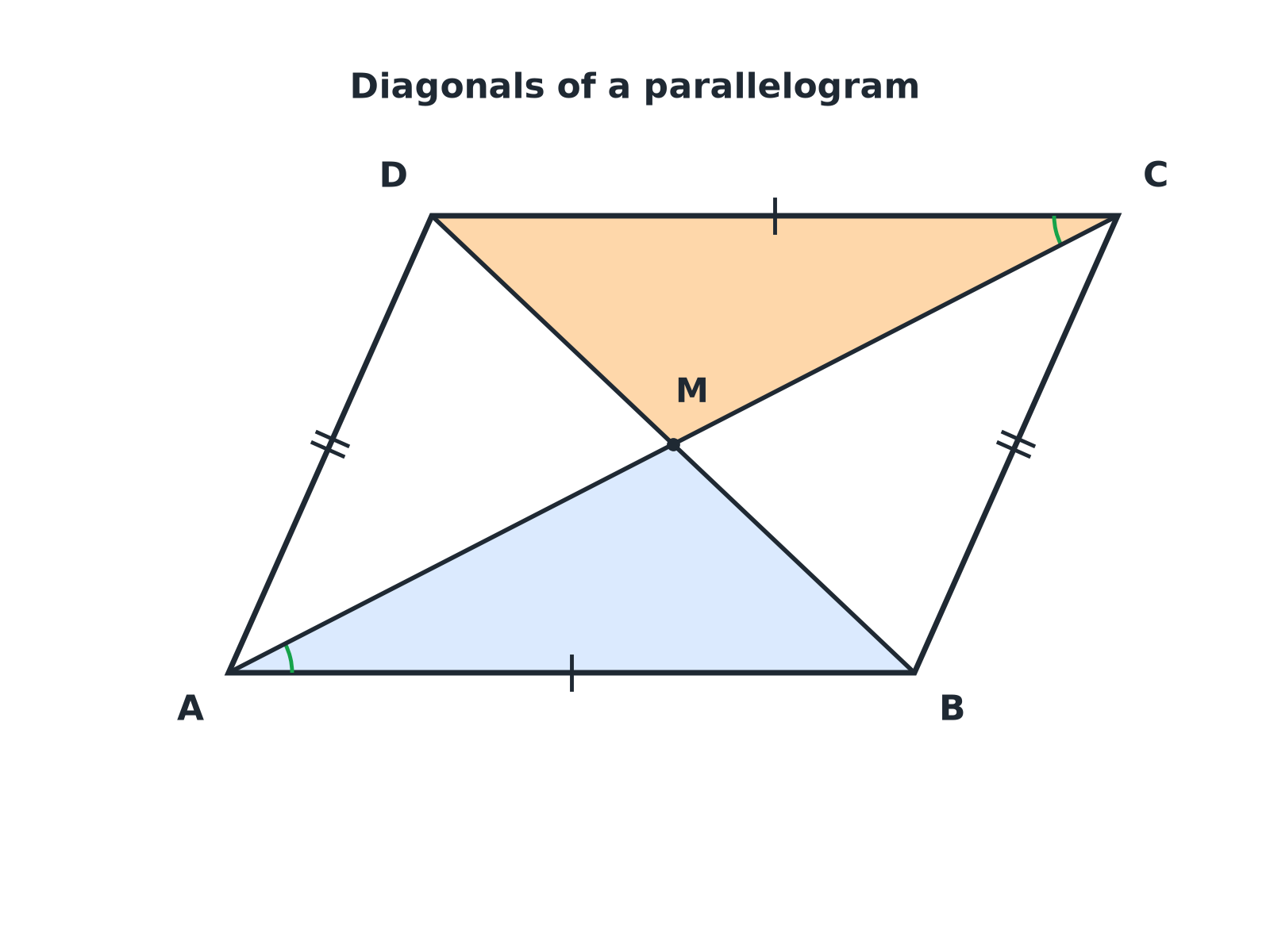
Triangles AMB and CMD are congruent, which shows the diagonals bisect each other.
Proving Diagonals Bisect
ABCD is a parallelogram with diagonals AC and BD meeting at M. Prove that \(AM = MC\) and \(BM = MD\).
Show the solutionHide the solution
- 1 \(AB = DC\) Opposite sides of a parallelogram are equal
- 2 Angle \(BAM\) = angle \(DCM\) Alternate angles (AB parallel to DC)
- 3 Angle \(ABM\) = angle \(CDM\) Alternate angles (AB parallel to DC)
- 4 Triangles AMB and CMD are congruent ASA (two angles and the corresponding side)
- 5 So \(AM = CM\) and \(BM = DM\) Corresponding sides of congruent triangles
AnswerThe diagonals of a parallelogram bisect each other, because triangles AMB and CMD are congruent (ASA).
Base Angles of an Isosceles Triangle
In triangle ABC, \(AB = AC\). D is the midpoint of BC. Prove that angle \(ABC\) = angle \(ACB\).
Show the solutionHide the solution
- 1 \(AB = AC\) Given
- 2 \(BD = DC\) D is the midpoint of BC
- 3 \(AD = AD\) Common side
- 4 Triangles ABD and ACD are congruent SSS
- 5 So angle \(ABD\) = angle \(ACD\) Corresponding angles of congruent triangles
AnswerThe base angles are equal because triangles ABD and ACD are congruent (SSS).
Good Proof, Weak Proof
A good proof
- Every statement has a reason.
- Uses correct mathematical language.
- Names the congruence condition.
- Ends with a clear conclusion.
A weak proof
- Says "it is obvious" or "it looks equal".
- Uses measurements from a drawing.
- Misses out a step.
- Does not say why triangles are congruent.
Reasons You Can Use
Choose the exact words the mark scheme expects.
-
Parallel lines
Alternate angles are equal; corresponding angles are equal; co-interior angles add to \(180^\circ\).
-
Triangles
Angles in a triangle add to \(180^\circ\); base angles of an isosceles triangle are equal.
-
Parallelograms
Opposite sides are equal and parallel; diagonals bisect each other.
-
Common side
Write "AD is common" when two triangles share a side.
Complete the Proof
PQRS is a kite with \(PQ = PS\) and \(RQ = RS\). Prove that triangles PQR and PSR are congruent, and hence that angle \(PQR\) = angle \(PSR\).
1. List equal sides.
2. Name SSS.
3. Conclude.
A good answer shows: \(PQ = PS\) (given), \(RQ = RS\) (given), \(PR = PR\) (common side). The triangles are congruent by SSS. Corresponding angles are equal, so angle \(PQR\) = angle \(PSR\).
Can I...?
- 1Set out statements and reasons.
- 2Use alternate angles in a proof.
- 3Name a common side.
- 4Choose SSS, SAS, ASA or RHS.
- 5Use corresponding parts of congruent triangles.
- 6Prove diagonals bisect.
- 7Prove base angles are equal.
- 8Finish with a conclusion.
Summary & Exam Focus
- Every step needs a reason.
- Give the congruence condition in words or letters.
- Corresponding parts of congruent triangles are equal.
- End with a conclusion that answers the question.
Exam focus
ABCD is a parallelogram. The diagonals AC and BD meet at M. Prove that triangles AMB and CMD are congruent. (4 marks) (4 marks)
Write each fact with its reason: opposite sides equal, alternate angles equal. Then name the condition (ASA here).
Key terms
The vocabulary this lesson expects you to use. Each one is linked from the first place it appears above.
- Proof
- A logical argument showing a statement is always true.
- Statement
- A fact written in a proof.
- Reason
- The rule that justifies a statement.
- Corresponding
- In matching positions in congruent triangles.
- Common side
- A side shared by two triangles.
- Bisect
- Cut exactly in half.
Practice questions
Have a go at each one before you open its answer.
-
Question 1 Prove 4 marks
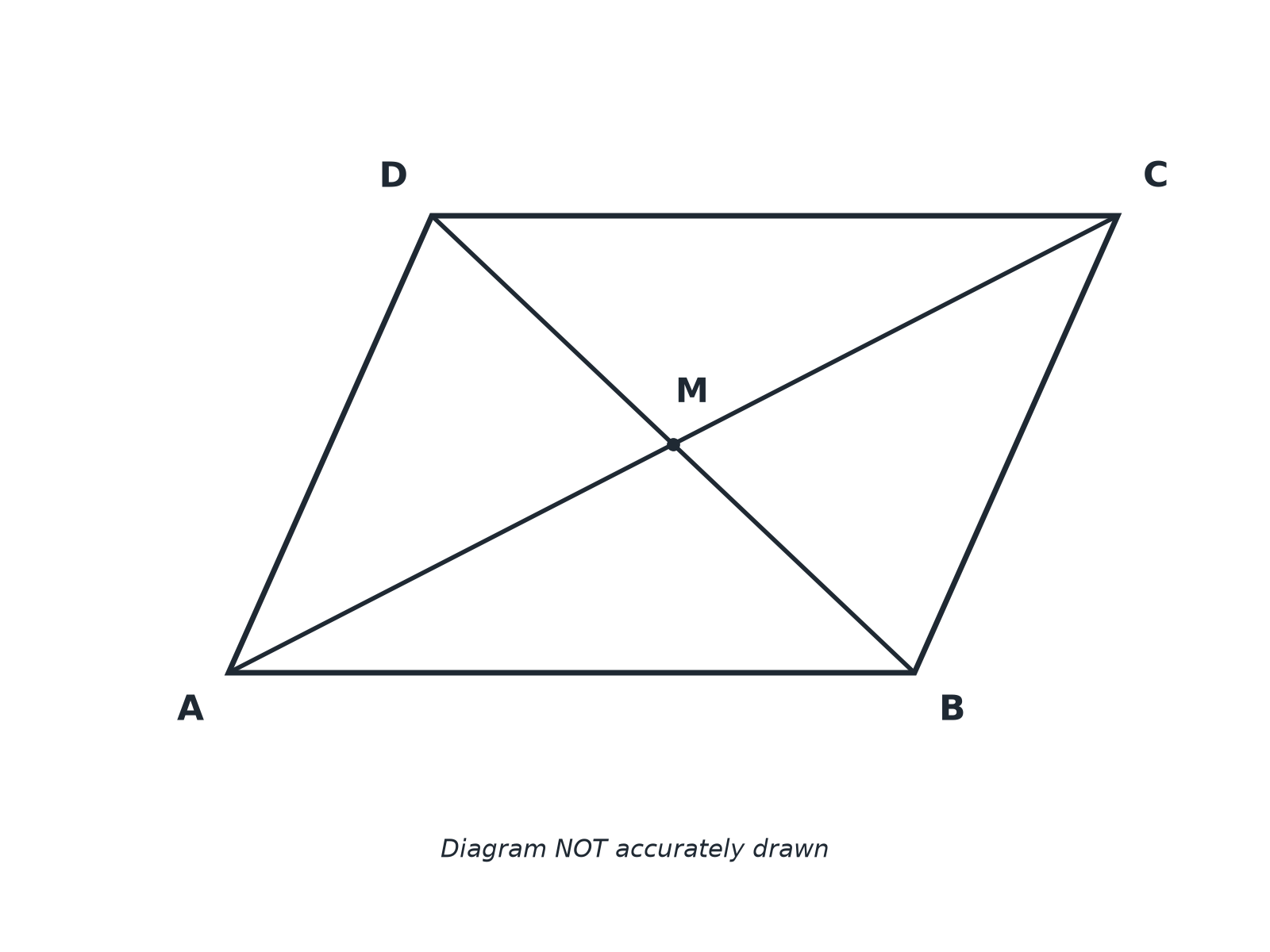
ABCD is a parallelogram. The diagonals AC and BD meet at M. Prove that triangles AMB and CMD are congruent.
Show answerHide answer
Model answer
\(AB = DC\) (opposite sides of a parallelogram). Angle \(BAM\) = angle \(DCM\) (alternate angles, AB parallel to DC). Angle \(ABM\) = angle \(CDM\) (alternate angles). So the triangles are congruent by ASA.
Mark scheme
- \(AB = DC\) with a reason — B1
- One pair of equal angles with a reason — M1
- The second pair of equal angles with a reason — M1
- Congruent by ASA — A1
-
Question 2 Prove 2 marks
Using the congruent triangles from the last question, prove that \(AM = MC\).
Show answerHide answer
Model answer
Triangles AMB and CMD are congruent, so corresponding sides are equal. AM corresponds to CM, so \(AM = MC\).
Mark scheme
- Corresponding sides of congruent triangles — M1
- \(AM = MC\) — A1
-
Question 3 Prove 4 marks
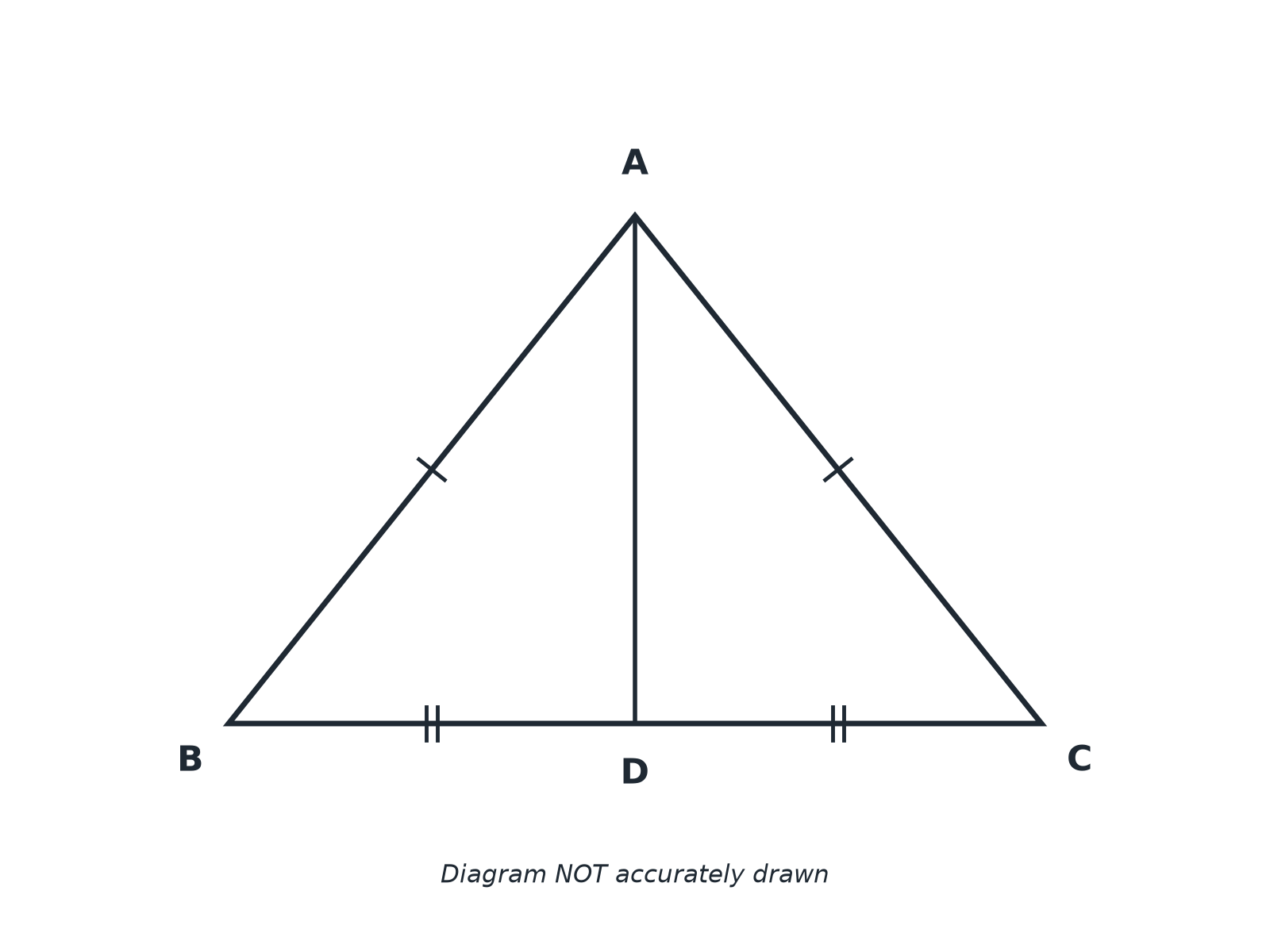
Triangle ABC is isosceles with \(AB = AC\). D is the midpoint of BC. Prove that angle \(ABC\) = angle \(ACB\).
Show answerHide answer
Model answer
\(AB = AC\) (given). \(BD = DC\) (D is the midpoint). \(AD\) is common. So triangles ABD and ACD are congruent by SSS, and angle \(ABC\) = angle \(ACB\) (corresponding angles).
Mark scheme
- \(AB = AC\) and \(BD = DC\) with reasons — M1
- AD common — M1
- SSS — A1
- Conclusion about angles — C1
-
Question 4 Prove 3 marks
PQRS is a kite with \(PQ = PS\) and \(RQ = RS\). Prove that angle \(PQR\) = angle \(PSR\).
Show answerHide answer
Model answer
\(PQ = PS\) and \(RQ = RS\) (given). \(PR\) is common. The triangles PQR and PSR are congruent by SSS, so angle \(PQR\) = angle \(PSR\).
Mark scheme
- Equal sides and common side — M1
- SSS — M1
- Conclusion — A1
-
Question 5 Explain 2 marks
Explain why "the triangles look the same" is not a good reason in a proof.
Show answerHide answer
Model answer
A proof must use exact facts, not appearances or measurements. Each step needs a mathematical reason such as SSS or a parallel-line rule.
Mark scheme
- Not appearances or measurements — M1
- Each step needs a mathematical reason — C1
-
Question 6 Prove 3 marks
ABCD is a rectangle. The diagonals AC and BD are drawn. Prove that AC = BD.
Show answerHide answer
Model answer
\(AB = DC\) (opposite sides of a rectangle). \(BC\) is common to triangles ABC and DCB. Angle \(ABC\) = angle \(DCB = 90^\circ\). So triangles ABC and DCB are congruent by SAS, and \(AC = BD\).
Mark scheme
- Equal sides and right angles — M1
- SAS — M1
- \(AC = BD\) — A1
Quick check
-
In a proof, every statement needs a...
Show answerHide answer
C: Reason
A reason.
-
Which reason justifies angle BAM = angle DCM in a parallelogram?
Show answerHide answer
B: Alternate angles
AB is parallel to DC, so they are alternate angles.
-
When two triangles share a side, you write...
Show answerHide answer
A: The side is common
The shared side is common, so it is equal in both.
-
Corresponding parts of congruent triangles are...
Show answerHide answer
D: Equal
Equal in length or size.
-
To prove the base angles of an isosceles triangle are equal, you can show two triangles are congruent using...
Show answerHide answer
B: SSS
SSS, using the midpoint and the common side.
-
What should the last line of a proof do?
Show answerHide answer
C: State the conclusion
State the conclusion that answers the question.
Downloads
Free to keep, print and annotate.
- Geometric proof and congruence.pptx Built from the lesson script on 30 September 2026. View
- Geometric proof and congruence - Completed Notes.docx The full notes for the lesson, to revise from. Built from the lesson script on 30 September 2026. View
- Geometric proof and congruence - Exam Questions.docx Built from the lesson script on 30 September 2026. View
Something here looks wrong?
Tell us what and we will go and look. It goes to whoever writes these pages, nobody else, and we do not ask who you are — so there is nothing to sign and nothing comes back to you.