Viewing as
Teaching this? The teacher view adds 2 files, the mark schemes and the model answers.
Physics · Atomic structure
Radioactive decay and nuclear radiation
Describe radioactive decay, activity and count rate, and compare alpha, beta and gamma radiation in terms of penetration, range in air and ionising power.
Warm-up
Answer each one, then check.
-
1
What is an unstable nucleus?
Show answerHide answer
A nucleus that will change to become more stable
-
2
What is an ion?
Show answerHide answer
A charged atom
-
3
What is a Geiger-Müller tube used for?
Show answerHide answer
Detecting radiation
-
4
What is a helium nucleus made of?
Show answerHide answer
Two protons and two neutrons
-
5
What is the unit of activity?
Show answerHide answer
The becquerel (Bq)
Learning Objectives
- 1Describe radioactive decay as a random process.
- 2Define activity and count rate.
- 3Name the types of nuclear radiation and describe them.
- 4Compare alpha, beta and gamma in penetration, range in air and ionising power, and apply this to uses.
RADIOACTIVE DECAY
Some atomic nuclei are unstable. The nucleus gives out radiation as it changes to become more stable: this is radioactive decay, and it is a random process.
Activity is the rate at which a source decays, measured in becquerel (Bq). Count rate is the number of decays recorded each second by a detector.
Penetrating Power
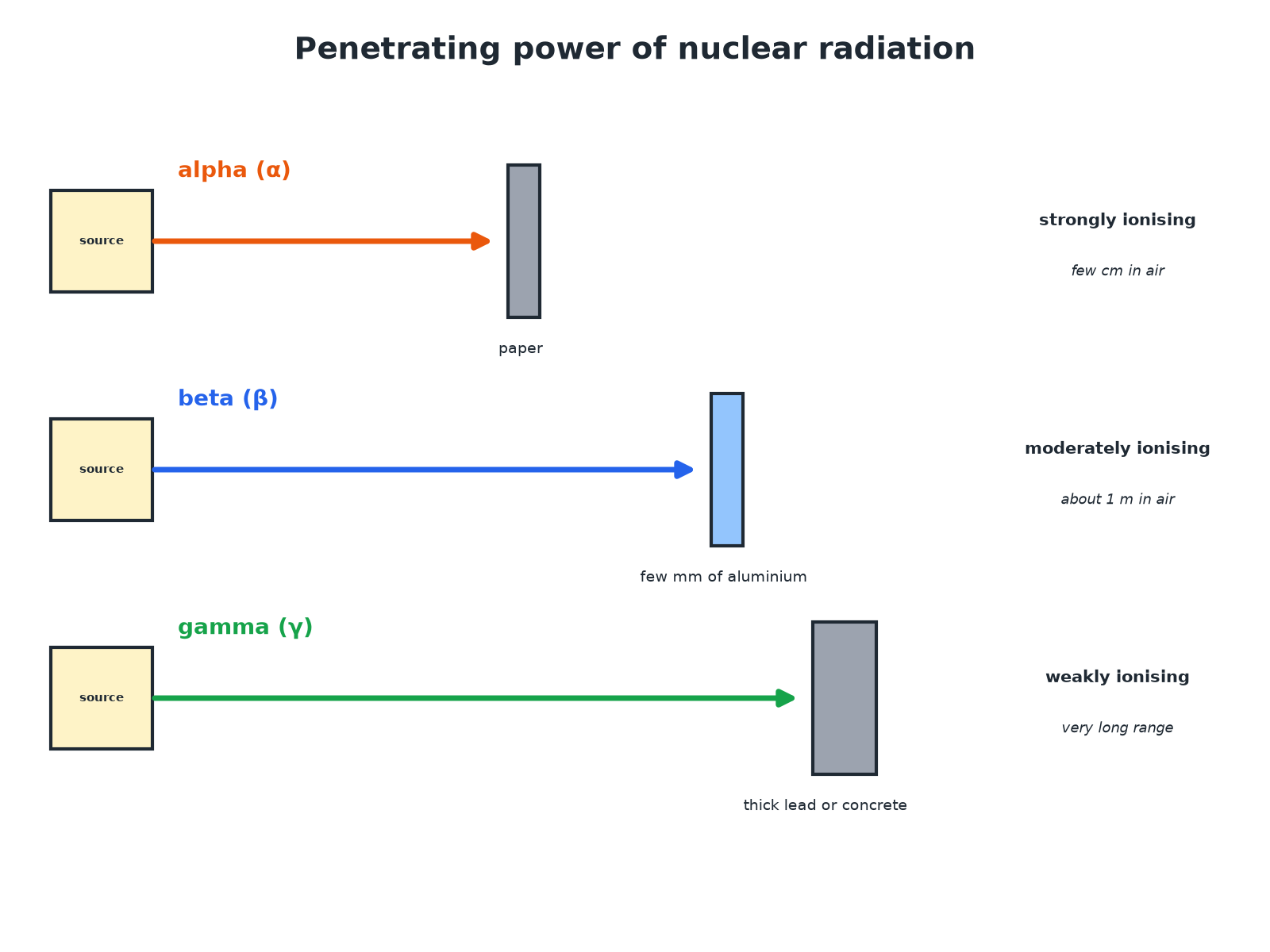
The more ionising, the less penetrating.
Types of Radiation
Learn the properties.
-
Alpha (α)
What it is: Two protons and two neutrons (a helium nucleus). Stopped by: A sheet of paper or a few cm of air. Range in air: A few cm. Ionising power: Strongly ionising
-
Beta (β)
What it is: A high-speed electron from a neutron changing into a proton. Stopped by: A few mm of aluminium. Range in air: About 1 m. Ionising power: Moderately ionising
-
Gamma (γ)
What it is: Electromagnetic radiation from the nucleus. Stopped by: Thick lead or several metres of concrete. Range in air: Very long. Ionising power: Weakly ionising
-
Neutron (n)
What it is: A neutron from the nucleus. Stopped by: Thick concrete or water. Range in air: Long. Ionising power: Indirectly ionising
Choosing a Source
Which radiation would you use for a smoke detector, and why?
Show the solutionHide the solution
- 1 Detector Uses alpha radiation ionising the air between two plates to make a small current
- 2 Why alpha It is strongly ionising but stopped by paper, so is safe outside the detector
- 3 Smoke Absorbs the alpha particles, the current falls and the alarm sounds
AnswerAlpha: it ionises air strongly (to give a current) but cannot escape the device.
Monitoring Thickness
Which radiation could be used to monitor the thickness of aluminium foil? Explain.
Show the solutionHide the solution
- 1 Alpha Absorbed completely by the foil: no use
- 2 Gamma Passes through almost unchanged, so the thickness has little effect
- 3 Beta Partly absorbed: the count on the other side changes with thickness
AnswerBeta radiation: it is partly absorbed by thin foil, so changes in the count rate show changes in thickness.
Key Ideas
Getting the exam points.
-
Random
It is not possible to predict when a particular nucleus will decay.
-
Activity or count rate
Activity in becquerel (Bq); count rate is the number of counts per second on a detector.
-
Ionising
Radiation that removes electrons from atoms to make ions can damage living cells.
-
Choose the radiation
Match penetration and ionising power to the job, and think about safety.
Which Radiation?
For each use, choose alpha, beta or gamma and explain: (a) a smoke detector, (b) checking for a leak in an underground pipe using a tracer, (c) monitoring the thickness of paper in a factory.
1. Match penetration to the job.
2. Consider safety.
A good answer shows: (a) Alpha: strongly ionising, stopped by paper. (b) Gamma: penetrates soil and can be detected above ground. (c) Beta: partly absorbed by paper so the count changes with thickness.
Can I...?
- 1Define radioactive decay.
- 2Say decay is random.
- 3Define activity and count rate.
- 4Describe alpha, beta and gamma.
- 5State what stops each.
- 6Compare ionising powers.
- 7Choose a source for a use.
- 8Explain a choice.
Summary & Exam Focus
- Alpha: helium nucleus; beta: fast electron; gamma: EM wave.
- Penetration: alpha < beta < gamma.
- Ionising power: alpha > beta > gamma.
- Activity in Bq; count rate per second.
Exam focus
Describe what an alpha particle is. (1 mark) (1 marks)
Two protons and two neutrons.
Key terms
The vocabulary this lesson expects you to use. Each one is linked from the first place it appears above.
- Radioactive decay
- The random process in which an unstable nucleus emits radiation.
- Activity
- The rate at which a source decays, in becquerel.
- Count rate
- Number of decays detected each second.
- Ionising
- Able to knock electrons off atoms.
- Alpha particle
- Two protons and two neutrons.
- Gamma ray
- Electromagnetic radiation from the nucleus.
Practice questions
Have a go at each one before you open its answer.
-
Question 1 State 2 marks
Describe what an alpha particle is and what a gamma ray is.
Show answerHide answer
Model answer
An alpha particle is two protons and two neutrons (a helium nucleus). A gamma ray is electromagnetic radiation from the nucleus.
Mark scheme
- Alpha: two protons and two neutrons — 1 mark
- Gamma: electromagnetic radiation — 1 mark
-
Question 2 Complete 3 marks
Complete the sentences. Alpha radiation is stopped by a ______. Beta radiation is stopped by a few millimetres of ______. Gamma radiation is reduced by thick ______.
Show answerHide answer
Model answer
sheet of paper; aluminium; lead (or concrete)
Mark scheme
- Paper — 1 mark
- Aluminium — 1 mark
- Lead or concrete — 1 mark
-
Question 3 Explain 3 marks
A smoke detector contains a source of alpha radiation. Explain why alpha radiation is used and not gamma radiation.
Show answerHide answer
Model answer
Alpha is strongly ionising so it ionises the air to make a current, but is stopped by paper or a few cm of air so it is not a hazard outside the detector. Gamma would pass out of the detector and is weakly ionising.
Mark scheme
- Alpha strongly ionising — 1 mark
- Stopped by paper or air so safe — 1 mark
- Gamma penetrates and weakly ionising — 1 mark
-
Question 4 Explain 3 marks
A factory monitors the thickness of aluminium foil by measuring the radiation that passes through it. Explain why a source of beta radiation is used and not alpha or gamma radiation.
Show answerHide answer
Model answer
Alpha is stopped by the foil so no radiation is detected. Gamma passes through almost unchanged so the thickness makes little difference. Beta is partly absorbed, so the count rate changes as the thickness changes.
Mark scheme
- Alpha absorbed completely — 1 mark
- Gamma passes through unchanged — 1 mark
- Beta partly absorbed so count rate shows the thickness — 1 mark
-
Question 5 Evaluate 6 marks
Radioactive sources are used in industry and medicine. Compare the properties of alpha, beta and gamma radiation and evaluate which is best to use as a tracer inside the body.
Show answerHide answer
Model answer
See levels-of-response scheme.
Mark scheme
- Level 3 (5 to 6 marks): properties of all three (penetration, range, ionising power), the tracer needs to pass out of the body to be detected outside, and a justified conclusion that gamma is best — 5 to 6 marks
- Level 2 (3 to 4 marks): properties of at least two types with some link to use as a tracer — 3 to 4 marks
- Level 1 (1 to 2 marks): simple statements about the radiation — 1 to 2 marks
Quick check
-
Which radiation is the most ionising?
Show answerHide answer
A: Alpha
Alpha particles are large and charged.
-
Which is stopped by a sheet of paper?
Show answerHide answer
B: Alpha
Alpha has a short range.
-
Activity is measured in...
Show answerHide answer
C: becquerel
1 Bq = 1 decay per second.
-
A beta particle is...
Show answerHide answer
D: a fast electron
Ejected from the nucleus.
-
Radioactive decay is...
Show answerHide answer
A: random
You cannot predict when a given nucleus will decay.
Downloads
Free to keep, print and annotate.
- Radioactive decay and nuclear radiation.pptx Built from the lesson script on 30 September 2026. View
- Radioactive decay and nuclear radiation - Completed Notes.docx The full notes for the lesson, to revise from. Built from the lesson script on 30 September 2026. View
- Radioactive decay and nuclear radiation - Exam Questions.docx Built from the lesson script on 30 September 2026. View
Something here looks wrong?
Tell us what and we will go and look. It goes to whoever writes these pages, nobody else, and we do not ask who you are — so there is nothing to sign and nothing comes back to you.