Viewing as
Teaching this? The teacher view adds 2 files, the mark schemes and the model answers.
Physics · Atomic structure
The development of the model of the atom
Describe how the model of the atom has changed with new experimental evidence, including the plum pudding model, the alpha scattering experiment and the nuclear model.
Warm-up
Answer each one, then check.
-
1
Who discovered the electron?
Show answerHide answer
J. J. Thomson
-
2
What is a scientific model?
Show answerHide answer
A simplified representation used to explain observations
-
3
What is an alpha particle?
Show answerHide answer
Two protons and two neutrons (a helium nucleus)
-
4
What is evidence?
Show answerHide answer
Results from experiments that support or reject an idea
-
5
Who discovered the neutron?
Show answerHide answer
James Chadwick
Learning Objectives
- 1Describe how the atomic model has changed over time.
- 2Describe the plum pudding model and the nuclear model.
- 3Explain why the alpha particle scattering experiment led to the nuclear model.
- 4Describe the contributions of Bohr, the discovery of the proton and Chadwick's neutron.
CHANGING MODELS
New experimental evidence may lead to a scientific model being changed or replaced.
The atom has been thought of as a solid sphere, a plum pudding, a nuclear atom, then with electrons in specific orbits, and finally with protons and neutrons in the nucleus.
How the Atom Model Changed
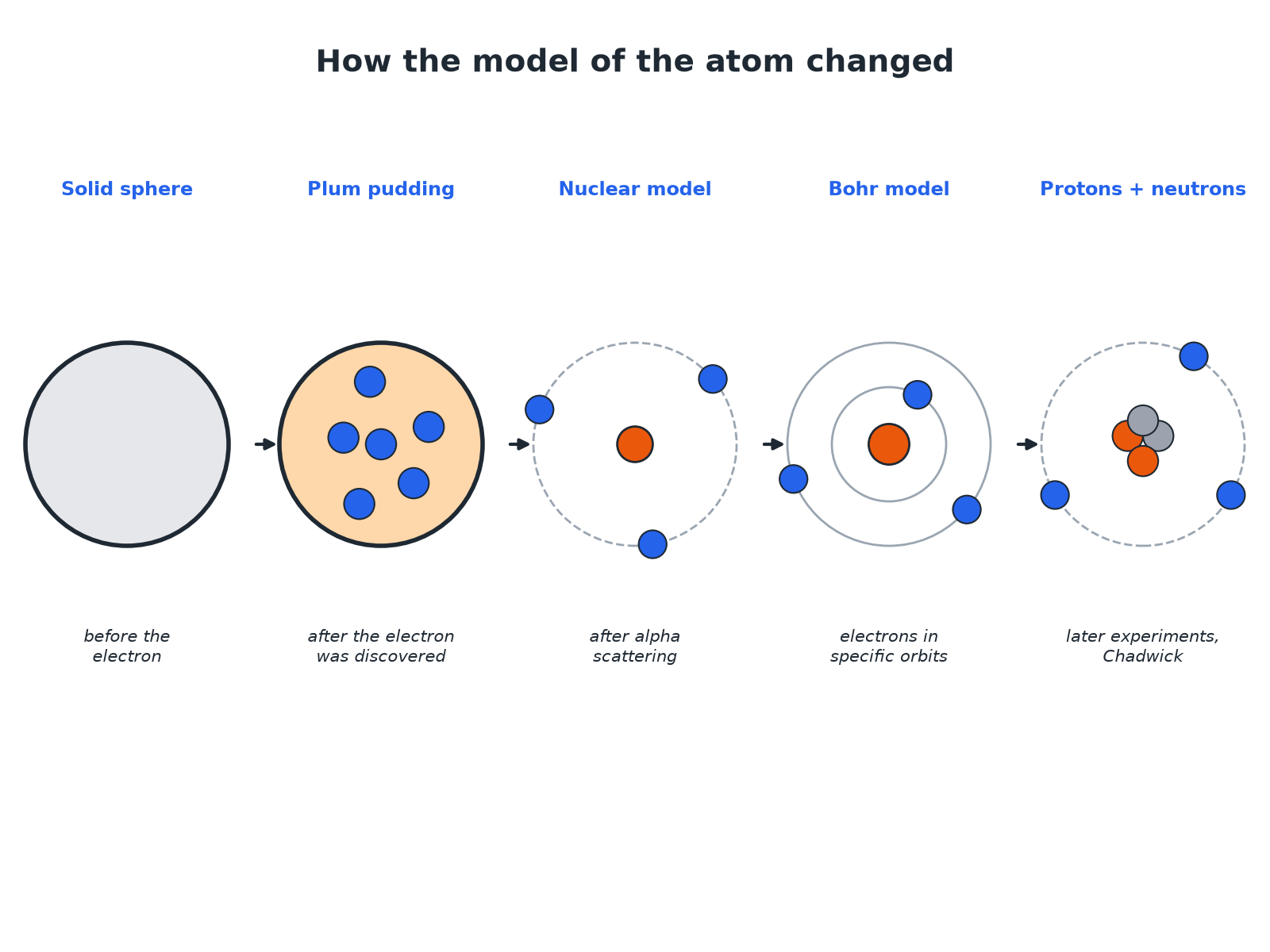
Each new model came from new evidence.
The Alpha Scattering Experiment
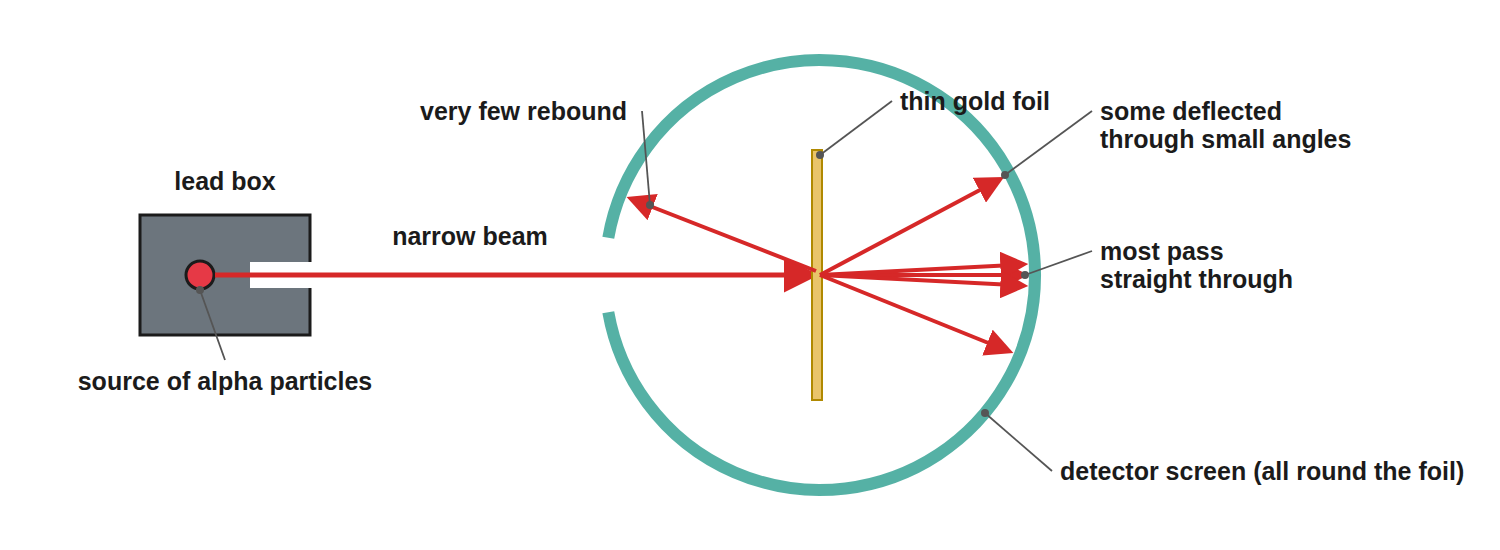
Most alpha particles passed straight through.
Evidence and Conclusions
Match each result to its explanation.
-
Most alpha particles went straight through
Conclusion: Most of the atom is empty space
-
Some were deflected through small angles
Conclusion: The nucleus is positive and repels the positive alpha particles
-
A very few bounced back
Conclusion: The mass is concentrated in a tiny, dense, charged nucleus
Plum Pudding or Nuclear?
Plum pudding model
- A ball of positive charge.
- Negative electrons embedded in it.
- Charge and mass spread throughout the atom.
Nuclear model
- A tiny, positively charged nucleus at the centre.
- Electrons orbit at a distance.
- Most of the atom is empty space.
Why the Model Changed
Explain why the results of the alpha scattering experiment led to the plum pudding model being replaced.
Show the solutionHide the solution
- 1 Plum pudding prediction Alpha particles should pass through with only small deflections
- 2 Result Some were deflected by large angles and a few rebounded
- 3 Conclusion A concentrated, positive nucleus must exist, so the nuclear model replaced the plum pudding model
AnswerThe scattering results could not be explained by the plum pudding model, so the nuclear model replaced it.
The Story
Learn the sequence.
-
Before the electron
Atoms were thought to be tiny spheres that could not be divided.
-
Discovery of the electron
Led to the plum pudding model.
-
Alpha scattering
Led to the nuclear model; the nucleus was charged.
-
Bohr
Adapted the nuclear model with electrons orbiting at specific distances; his calculations agreed with experiments.
-
Protons
The nucleus's charge was divided into whole-number units: protons.
-
Chadwick
Provided evidence for neutrons about 20 years after the nucleus was accepted.
Predict the Result
If the plum pudding model were correct, what would happen to alpha particles fired at gold foil? What actually happened, and what did it show?
1. Predict with plum pudding.
2. Compare with the result.
A good answer shows: They would pass through with small deflections. In fact most passed straight through, some were deflected by large angles and a few bounced back, showing a small dense positive nucleus.
Can I...?
- 1Describe the plum pudding model.
- 2Describe the nuclear model.
- 3Describe the alpha scattering results.
- 4Explain why the model changed.
- 5Say what Bohr added.
- 6Say what Chadwick showed.
- 7Explain why models change.
- 8Order the models.
Summary & Exam Focus
- Plum pudding: ball of positive charge with electrons in it.
- Nuclear: small positive nucleus with electrons around it.
- Alpha scattering evidence changed the model.
- Bohr: specific orbits. Chadwick: neutrons.
Exam focus
Describe the difference between the plum pudding model and the nuclear model of the atom. (3 marks) (3 marks)
Say where the positive charge and mass are in each.
Key terms
The vocabulary this lesson expects you to use. Each one is linked from the first place it appears above.
- Model
- A representation used to explain observations.
- Plum pudding model
- A ball of positive charge with electrons embedded.
- Alpha scattering
- An experiment in which alpha particles are fired at gold foil.
- Nuclear model
- An atom with a small, dense, positive nucleus.
- Bohr model
- Electrons orbit the nucleus at specific distances.
- Evidence
- Experimental results that support or contradict a model.
Practice questions
Have a go at each one before you open its answer.
-
Question 1 Describe 2 marks
Describe the plum pudding model of the atom.
Show answerHide answer
Model answer
The atom is a ball of positive charge with negatively charged electrons embedded in it.
Mark scheme
- Ball of positive charge — 1 mark
- Electrons embedded in it — 1 mark
-
Question 2 Explain 4 marks
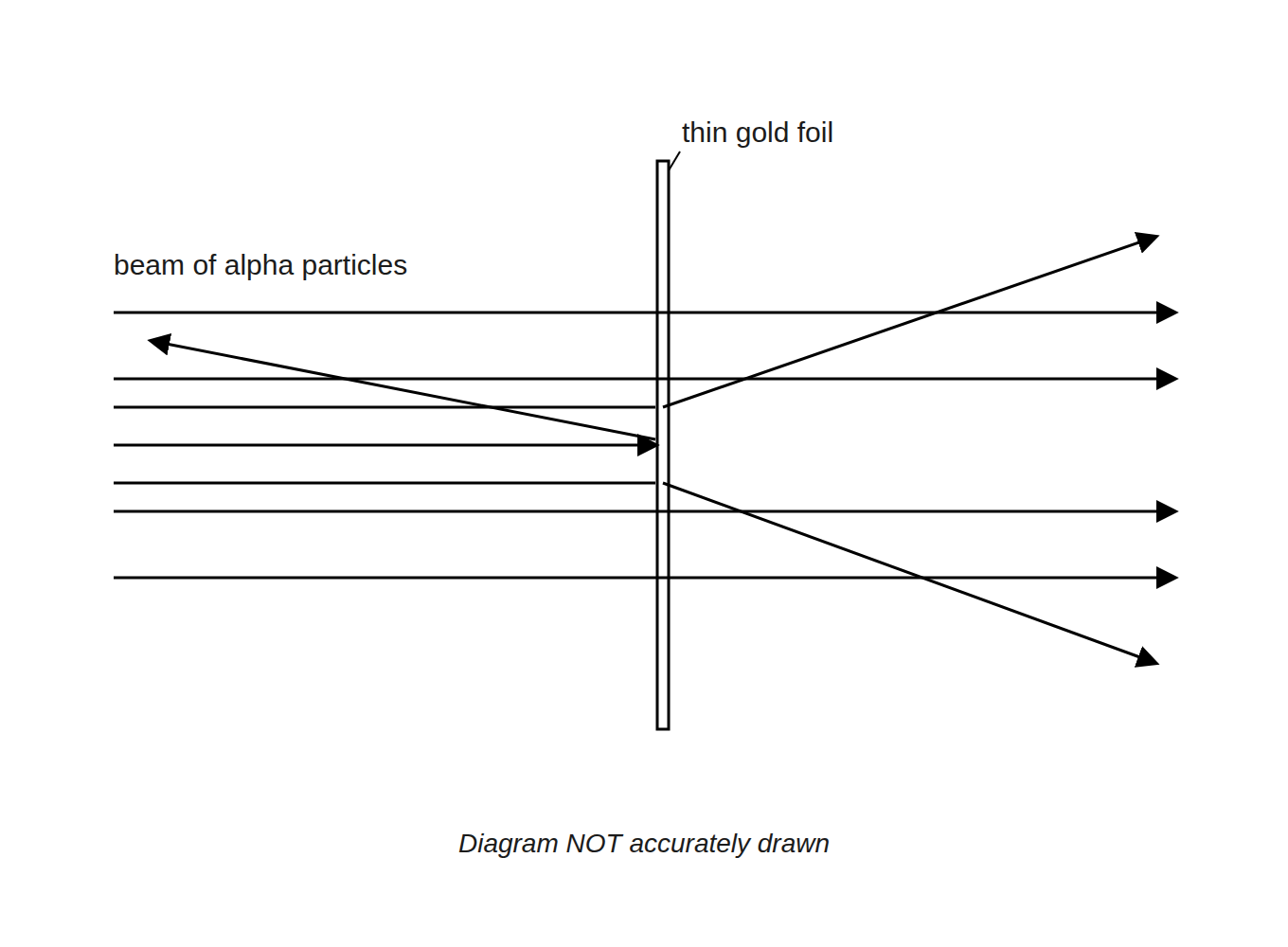
The diagram shows the paths of alpha particles fired at thin gold foil. Explain how these results led to the nuclear model of the atom.
Show answerHide answer
Model answer
Most alpha particles went straight through, so most of the atom is empty space. Some were deflected, so the nucleus is positively charged (repelling alpha particles). A few bounced back, so the mass is concentrated in a small, dense nucleus. The plum pudding model could not explain this.
Mark scheme
- Most went straight through so the atom is mostly empty space — 1 mark
- Some deflected: the nucleus is positive — 1 mark
- A few rebounded: mass concentrated in a small nucleus — 1 mark
- Plum pudding could not explain this — 1 mark
-
Question 3 Describe 3 marks
Describe how the nuclear model of the atom differs from the plum pudding model.
Show answerHide answer
Model answer
In the nuclear model the positive charge and most of the mass are concentrated in a tiny nucleus with electrons around it; in the plum pudding model the positive charge is spread throughout the atom with electrons embedded in it.
Mark scheme
- Nuclear: positive charge and mass in a small nucleus — 1 mark
- Electrons outside the nucleus — 1 mark
- Plum pudding: charge spread out — 1 mark
-
Question 4 State 2 marks
State two ways in which Bohr changed the nuclear model, or what the later experiments showed.
Show answerHide answer
Model answer
Bohr suggested electrons orbit the nucleus at specific distances. Later experiments showed the nucleus contains protons and neutrons (Chadwick for neutrons).
Mark scheme
- Electrons orbit at specific distances — 1 mark
- Protons and neutrons in the nucleus — 1 mark
-
Question 5 Explain 6 marks
Describe how the model of the atom has changed, from the idea of a solid sphere to the model with protons and neutrons in the nucleus. Explain why each change was made.
Show answerHide answer
Model answer
See levels-of-response scheme.
Mark scheme
- Level 3 (5 to 6 marks): a correct sequence (solid sphere, plum pudding, nuclear model, Bohr, protons and neutrons) with the evidence for at least three changes, including alpha scattering — 5 to 6 marks
- Level 2 (3 to 4 marks): at least three models named with some evidence — 3 to 4 marks
- Level 1 (1 to 2 marks): one or two models described — 1 to 2 marks
Quick check
-
The plum pudding model was replaced after...
Show answerHide answer
D: the alpha scattering experiment
The results could not be explained by it.
-
Most alpha particles passed through gold foil because...
Show answerHide answer
A: the atom is mostly empty space
Most of the atom is empty.
-
Some alpha particles bounced back because...
Show answerHide answer
B: the nucleus is small, dense and positive
They hit or were repelled by the nucleus.
-
Bohr suggested that electrons...
Show answerHide answer
C: orbit at specific distances
That is the Bohr model.
-
Neutrons were shown to exist by...
Show answerHide answer
D: James Chadwick
About 20 years after the nucleus was accepted.
Downloads
Free to keep, print and annotate.
- The development of the model of the atom.pptx Built from the lesson script on 30 September 2026. View
- The development of the model of the atom - Completed Notes.docx The full notes for the lesson, to revise from. Built from the lesson script on 30 September 2026. View
- The development of the model of the atom - Exam Questions.docx Built from the lesson script on 30 September 2026. View
Something here looks wrong?
Tell us what and we will go and look. It goes to whoever writes these pages, nobody else, and we do not ask who you are — so there is nothing to sign and nothing comes back to you.