Viewing as
Teaching this? The teacher view adds 2 files, the mark schemes and the model answers.
Physics · Energy
Energy stores and systems
Describe the changes in the way energy is stored when a system changes, using energy stores and transfer pathways.
Warm-up
Answer each one, then check.
-
1
What is the unit of energy?
Show answerHide answer
The joule (J)
-
2
What is a system?
Show answerHide answer
An object or group of objects
-
3
Name the energy store in a stretched spring.
Show answerHide answer
Elastic potential
-
4
Name the energy store in food and fuels.
Show answerHide answer
Chemical
-
5
Can energy be created or destroyed?
Show answerHide answer
No, it can only be transferred, stored or dissipated
Learning Objectives
- 1Define a system and describe changes in the way energy is stored when a system changes.
- 2Name the main energy stores and the four transfer pathways.
- 3Describe the energy changes in common situations, such as an object projected upwards or a kettle boiling water.
- 4Write clear statements using the phrase 'energy is transferred from ... to ...'.
CONSERVATION OF ENERGY
Energy cannot be created or destroyed. It can be transferred usefully, stored or dissipated.
A system is an object or group of objects. When a system changes, there are changes in the way energy is stored.
Energy Changes in Two Systems
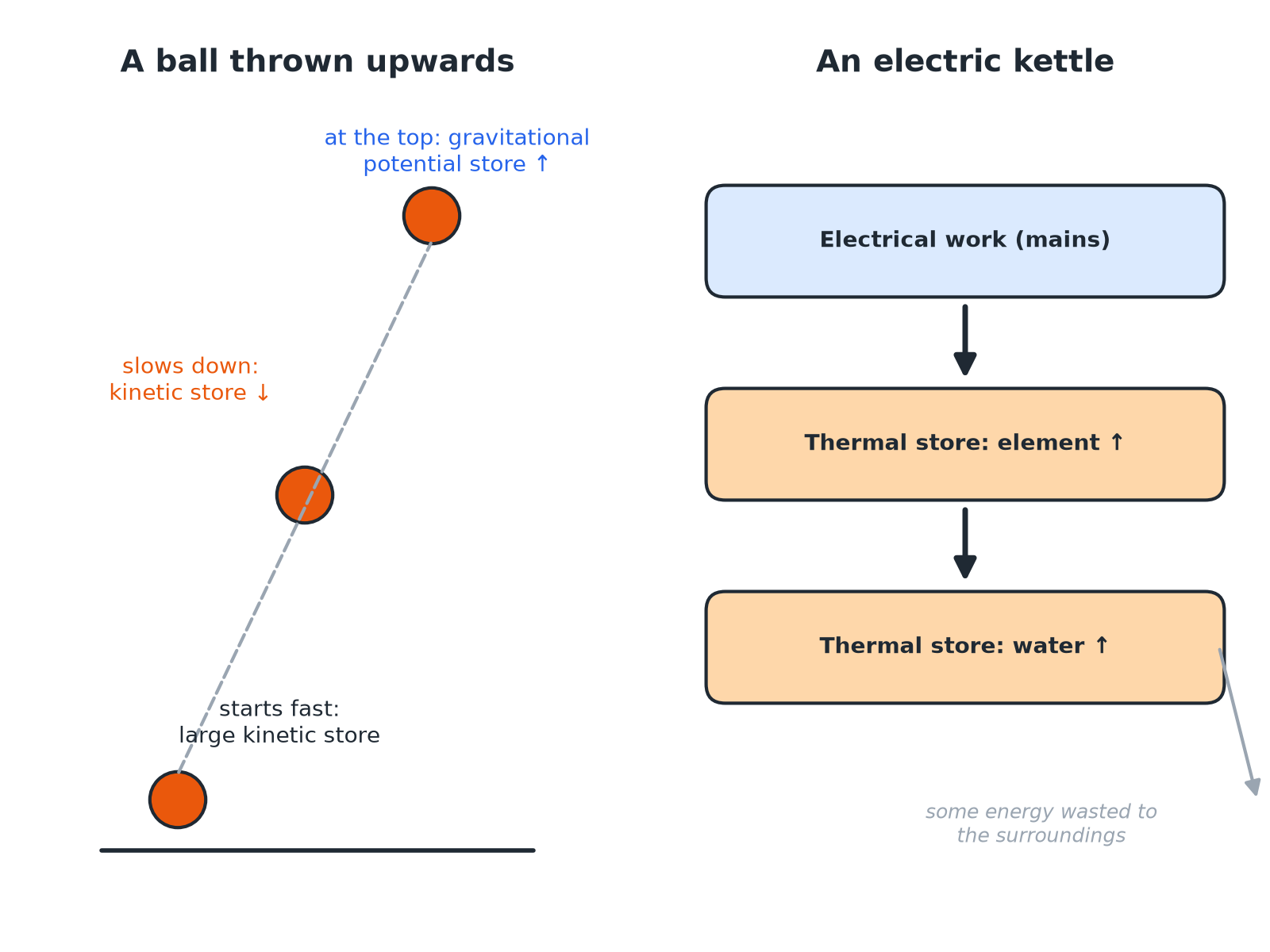
Ask 'which store goes down and which goes up?' for every change.
The Energy Stores
Learn the main stores and an example of each.
-
Kinetic
Examples: Any moving object
-
Gravitational potential
Examples: An object above the ground
-
Elastic potential
Examples: A stretched or compressed spring, an elastic band
-
Thermal
Examples: A hot object; the particles have more energy
-
Chemical
Examples: Fuels, food, batteries
-
Nuclear
Examples: The nucleus of an atom
-
Magnetic
Examples: Magnets and electromagnets
-
Electrostatic
Examples: Charged objects, such as a charged balloon
Ways Energy Is Transferred
-
Mechanically
A force moves an object through a distance (work done).
-
Electrically
Charge flows in a circuit (work done by the current).
-
By heating
Energy flows from a hotter object to a cooler one.
-
By radiation
Energy is carried by waves, such as light and sound.
A Ball Thrown Upwards
Describe the changes in the way energy is stored when a ball is thrown upwards, until it reaches its highest point.
Show the solutionHide the solution
- 1 Just after leaving the hand The ball has a large kinetic energy store
- 2 As it rises It slows down, so the kinetic energy store decreases
- 3 At the same time Its height increases, so the gravitational potential energy store increases
- 4 Small effect Some energy is transferred to the thermal store of the air by friction
AnswerEnergy is transferred mechanically from the kinetic store to the gravitational potential store, with a little dissipated to the thermal store of the air.
Boiling Water in a Kettle
Describe the changes in the way energy is stored when a kettle boils water.
Show the solutionHide the solution
- 1 Electrical work Charge flowing through the heating element transfers energy from the mains
- 2 Heating element The thermal energy store of the element increases
- 3 By heating Energy is transferred to the thermal energy store of the water, which increases
- 4 Wasted Some energy heats the kettle and the surroundings
AnswerEnergy is transferred electrically and then by heating to the thermal store of the water; some is dissipated to the surroundings.
Writing Good Answers
Use the language of stores and transfers.
-
Name the stores
Say 'the kinetic energy store decreases', not 'kinetic energy is lost'.
-
Say how
Give the pathway: mechanically, electrically, by heating or by radiation.
-
Say where the rest goes
Mention dissipation to the surroundings if the system is not perfectly efficient.
-
Total energy
The total energy after the change is the same as before.
Store to Store
For each situation, name the store that decreases and the store that increases. (a) A car braking. (b) A book falling off a shelf. (c) A battery powering a motor lifting a weight. (d) A bow being drawn and released.
1. Name the store before.
2. Name the store after.
A good answer shows: (a) Kinetic decreases; thermal (brakes) increases. (b) Gravitational potential decreases; kinetic increases. (c) Chemical decreases; gravitational potential increases (plus some thermal). (d) Chemical (archer) to elastic potential, then elastic decreases; kinetic of the arrow increases.
Can I...?
- 1Name the main energy stores.
- 2Name the four transfer pathways.
- 3Define a system.
- 4Describe energy changes for an object projected upwards.
- 5Describe energy changes when a vehicle slows down.
- 6Describe how a kettle heats water.
- 7Use 'increases' and 'decreases' correctly.
- 8State that total energy is conserved.
Summary & Exam Focus
- Energy can be transferred, stored or dissipated but not created or destroyed.
- Describe changes with 'store decreases' and 'store increases'.
- Pathways: mechanically, electrically, by heating, by radiation.
- In a closed system the total energy does not change.
Exam focus
A car slows down to a stop using its brakes. Describe the changes in the way energy is stored. (2 marks) (2 marks)
Say which store decreases and which increases.
Key terms
The vocabulary this lesson expects you to use. Each one is linked from the first place it appears above.
- System
- An object or group of objects.
- Energy store
- A way energy is held, such as kinetic or thermal.
- Transfer
- Energy moving from one store to another.
- Dissipated
- Spread out to the surroundings in less useful stores.
- Closed system
- A system where no energy enters or leaves.
- Work done
- Energy transferred by a force or a current.
Practice questions
Have a go at each one before you open its answer.
-
Question 1 Which 1 mark
A ball is thrown upwards. Which energy store increases as the ball rises? Tick one box. kinetic / gravitational potential / thermal / chemical
Show answerHide answer
Model answer
Gravitational potential.
Mark scheme
- Gravitational potential — 1 mark
-
Question 2 Describe 2 marks
A car slows down to a stop using its brakes. Describe the changes in the way energy is stored.
Show answerHide answer
Model answer
The kinetic energy store of the car decreases. The thermal energy store of the brakes (and surroundings) increases.
Mark scheme
- Kinetic energy store decreases — 1 mark
- Thermal energy store of the brakes or surroundings increases — 1 mark
-
Question 3 Describe 3 marks
An electric kettle is used to bring water to the boil. Describe the changes in the way energy is stored.
Show answerHide answer
Model answer
Energy is transferred electrically to the thermal energy store of the heating element and then by heating to the thermal energy store of the water, which increases. Some energy is transferred to the thermal energy store of the surroundings.
Mark scheme
- Electrical transfer from the mains — 1 mark
- Thermal store of the water increases — 1 mark
- Some energy dissipated to the surroundings — 1 mark
-
Question 4 Describe 2 marks
A box slides across a rough floor and comes to rest. Describe the changes in the way energy is stored.
Show answerHide answer
Model answer
The kinetic energy store of the box decreases. The thermal energy stores of the box and floor increase because of friction.
Mark scheme
- Kinetic store decreases — 1 mark
- Thermal stores of box, floor or surroundings increase — 1 mark
-
Question 5 Describe 4 marks
A bungee jumper steps off a platform, falls, and comes to rest momentarily at the lowest point when the cord is stretched. Describe the changes in the way energy is stored during the fall.
Show answerHide answer
Model answer
The gravitational potential energy store decreases as the jumper falls. The kinetic energy store increases. As the cord stretches, the elastic potential energy store of the cord increases while the kinetic store decreases to zero at the lowest point. A small amount of energy is dissipated to the thermal energy store of the air.
Mark scheme
- Gravitational potential store decreases — 1 mark
- Kinetic store increases then decreases to zero — 1 mark
- Elastic potential energy store of the cord increases — 1 mark
- Some energy dissipated to the surroundings — 1 mark
Quick check
-
Which of these is an energy store?
Show answerHide answer
B: Kinetic
Kinetic is a store; force, speed and weight are not.
-
A bow is drawn back. Which store increases?
Show answerHide answer
C: Elastic potential
The bow is stretched, so its elastic potential energy store increases.
-
Which is NOT a way of transferring energy?
Show answerHide answer
D: By insulation
The pathways are mechanically, electrically, by heating and by radiation.
-
In a closed system the total energy...
Show answerHide answer
A: stays the same
Energy is conserved.
-
A falling apple: which store decreases?
Show answerHide answer
B: Gravitational potential
As it falls, gravitational potential energy is transferred to kinetic energy.
Downloads
Free to keep, print and annotate.
- Energy stores and systems.pptx Built from the lesson script on 30 September 2026. View
- Energy stores and systems - Completed Notes.docx The full notes for the lesson, to revise from. Built from the lesson script on 30 September 2026. View
- Energy stores and systems - Exam Questions.docx Built from the lesson script on 30 September 2026. View
Something here looks wrong?
Tell us what and we will go and look. It goes to whoever writes these pages, nobody else, and we do not ask who you are — so there is nothing to sign and nothing comes back to you.