Viewing as
Teaching this? The teacher view adds 2 files, the mark schemes and the model answers.
Physics · Forces
Changes in momentum
Use \(F = m\Delta v \div \Delta t\) and explain safety features such as air bags, seat belts, crumple zones and helmets in terms of rate of change of momentum (Higher tier).
Warm-up
Answer each one, then check.
-
1
What is momentum?
Show answerHide answer
Mass times velocity
-
2
What is acceleration?
Show answerHide answer
Change in velocity divided by time, \(a = \Delta v \div t\)
-
3
What is F = ma?
Show answerHide answer
Resultant force equals mass times acceleration
-
4
Give a safety device in a car.
Show answerHide answer
Seat belt, airbag or crumple zone
-
5
What is a collision?
Show answerHide answer
Two objects hitting each other
Learning Objectives
- 1Explain that force equals the rate of change of momentum.
- 2Apply \(F = m\Delta v \div \Delta t\).
- 3Explain safety features in terms of increasing the time of a collision.
- 4Explain how changes in force, mass, velocity and time are related.
RATE OF CHANGE OF MOMENTUM
force \(=\) change in momentum \(\div\) time taken \(F = \dfrac{m\Delta v}{\Delta t}\)
Combining \(F = ma\) and \(a = \dfrac{v - u}{t}\) gives \(F = \dfrac{m\Delta v}{\Delta t}\), where \(m\Delta v\) is the change in momentum. This equation is given on the equation sheet.
Why Crumple Zones Help
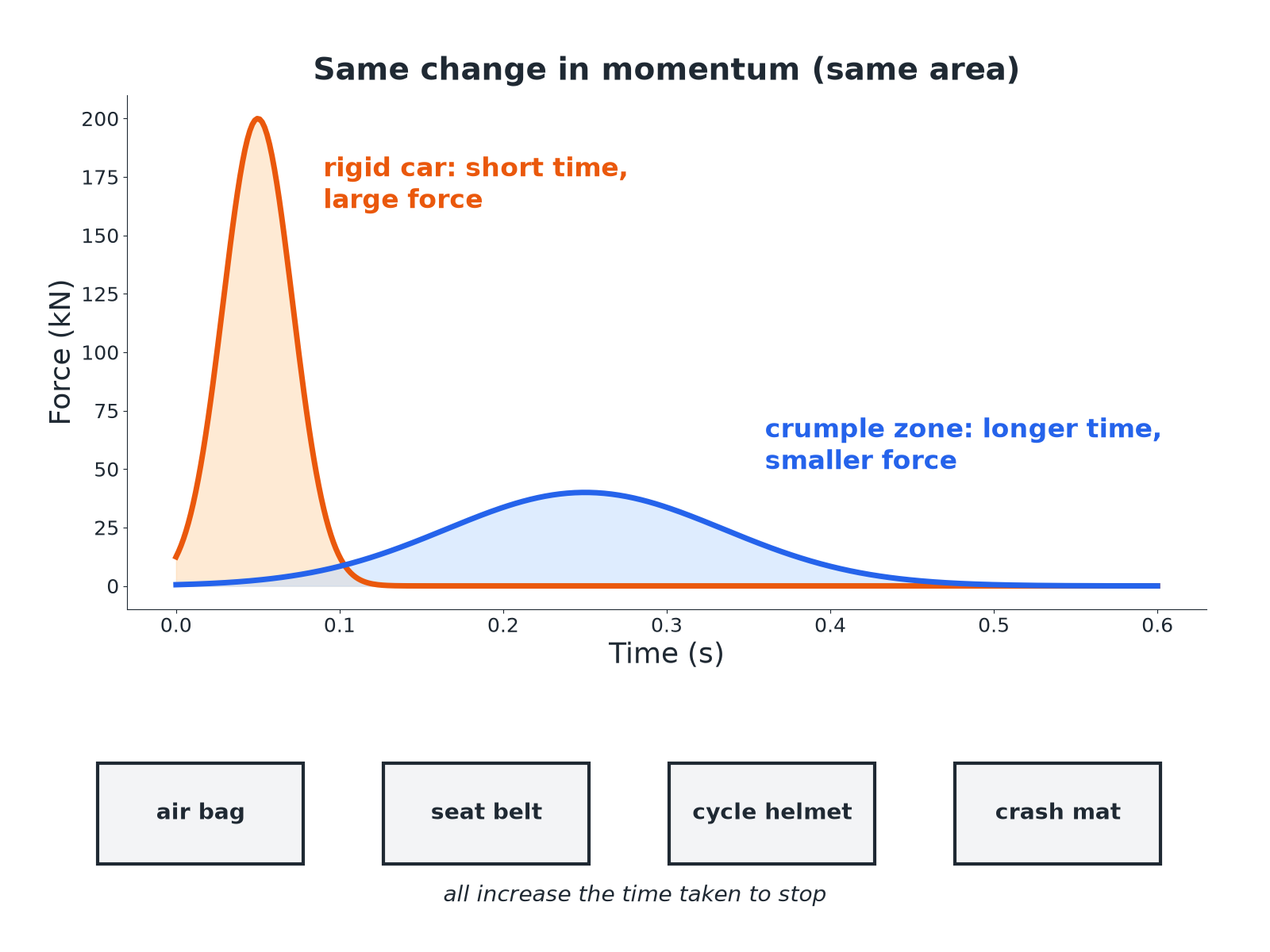
A longer time means a smaller force for the same momentum change.
Force in a Crash
A car of mass 1000 kg travelling at 20 m/s stops in 0.50 s. Calculate the average force.
Show the solutionHide the solution
- 1 Change in momentum \(1000 \times 20 = 20\,000\) kg m/s
- 2 Substitute \(F = 20\,000 \div 0.50\)
- 3 Answer \(F = 40\,000\) N
Answer40 000 N
Increasing the Time
The same car is stopped in 0.10 s by hitting a wall. Calculate the average force and compare with the answer above.
Show the solutionHide the solution
- 1 Substitute \(F = 20\,000 \div 0.10 = 200\,000\) N
- 2 Compare Five times greater
Answer200 000 N: a much shorter time gives a much greater force.
Safety Features
Explain how an air bag reduces injury in a collision.
Show the solutionHide the solution
- 1 Momentum The change in the person's momentum is the same
- 2 Time The air bag increases the time for the person to stop
- 3 Force \(F = m\Delta v \div \Delta t\): longer time gives a smaller force
AnswerIt increases the collision time so the average force on the person is smaller.
Other Safety Features
-
Seat belts
Stretch slightly, increasing the stopping time.
-
Crumple zones
Deform on impact, increasing the stopping time.
-
Cycle helmets
The foam compresses, increasing the stopping time.
-
Crash mats and playground surfaces
Cushion the landing, increasing the time.
Key Points
For exam answers.
-
Same momentum change
The change in momentum is the same, whatever the time.
-
Force depends on time
Smaller rate of change of momentum means smaller force.
-
Say it clearly
'Increases the time of the collision, so decreases the force.'
-
Units
Force in N, momentum in kg m/s, time in s.
Ball Catch
A 0.40 kg ball moving at 15 m/s is stopped by a catcher in 0.020 s. A second catcher uses a glove that stops it in 0.10 s. Calculate the force in each case.
1. Find the momentum change.
2. Divide by time.
A good answer shows: Change in momentum = 6.0 kg m/s. First: 300 N. Second: 60 N.
Can I...?
- 1State F = mΔv ÷ Δt.
- 2Calculate a change in momentum.
- 3Calculate a force.
- 4Explain an air bag.
- 5Explain a seat belt.
- 6Explain a crumple zone.
- 7Explain a cycle helmet.
- 8Explain a crash mat.
Summary & Exam Focus
- \(F = m\Delta v \div \Delta t\).
- Longer collision time means a smaller force.
- Air bags, seat belts, crumple zones, helmets, crash mats.
- Change in momentum is the same.
Exam focus
Explain how a crumple zone reduces the force on the passengers. (3 marks) (3 marks)
Increases the time of the collision.
Key terms
The vocabulary this lesson expects you to use. Each one is linked from the first place it appears above.
- Rate of change of momentum
- Change in momentum divided by time.
- Air bag
- A cushion that inflates in a collision.
- Crumple zone
- Part of a vehicle designed to deform in a crash.
- Seat belt
- A strap that holds a passenger and stretches slightly.
- Impact time
- The time a collision lasts.
- Average force
- The mean force over the collision time.
Practice questions
Have a go at each one before you open its answer.
-
Question 1 Calculate 3 marks
A car of mass 1000 kg travelling at 20 m/s stops in 0.50 s. Calculate the average force on the car. Use the equation: force = mass × change in velocity ÷ time
Show answerHide answer
Model answer
\(F = 1000 \times 20 \div 0.50 = 40\,000\) N
Mark scheme
- Change in momentum 20 000 kg m/s — 1 mark
- Correct substitution — 1 mark
- 40 000 N — 1 mark
-
Question 2 Explain 3 marks
Explain how an air bag reduces the force on a driver in a collision.
Show answerHide answer
Model answer
The air bag increases the time taken for the driver to come to rest. The change in momentum is the same, so the force (change in momentum ÷ time) is smaller.
Mark scheme
- Increases the time to stop — 1 mark
- Same change in momentum — 1 mark
- Force = change in momentum ÷ time, so smaller force — 1 mark
-
Question 3 Explain 3 marks
A cyclist wears a helmet containing soft foam. Explain how the helmet reduces the risk of head injury in a fall.
Show answerHide answer
Model answer
The foam compresses, so the head takes longer to stop. The change in momentum is the same, so the force on the head is smaller.
Mark scheme
- Foam compresses — 1 mark
- Increases the stopping time — 1 mark
- Reduces the force — 1 mark
-
Question 4 Calculate 4 marks
A ball of mass 0.40 kg moving at 15 m/s is caught and stopped in 0.020 s. Calculate the average force on the ball. Then state the force if a soft glove makes the stopping time 0.10 s.
Show answerHide answer
Model answer
Change in momentum \(= 0.40 \times 15 = 6.0\); \(F = 6.0 \div 0.020 = 300\) N; with the glove \(6.0 \div 0.10 = 60\) N
Mark scheme
- 6.0 kg m/s — 1 mark
- 300 N — 1 mark
- 60 N — 1 mark
- Comparison: longer time, smaller force — 1 mark
-
Question 5 Explain 3 marks
A gymnast lands on a thick crash mat rather than a hard floor. Use the idea of rate of change of momentum to explain why the mat reduces the risk of injury.
Show answerHide answer
Model answer
The mat increases the time taken to stop the gymnast. The change in momentum is the same so the rate of change of momentum, and therefore the force, is smaller.
Mark scheme
- Mat increases the stopping time — 1 mark
- Same change in momentum — 1 mark
- Smaller rate of change of momentum, smaller force — 1 mark
Quick check
-
Force equals...
Show answerHide answer
A: rate of change of momentum
F = mΔv ÷ Δt.
-
A longer collision time means a...
Show answerHide answer
B: smaller force
Same change in momentum.
-
Which is NOT a safety feature that increases stopping time?
Show answerHide answer
C: A sharper bumper
A rigid stop shortens the time.
-
A change in momentum of 20 000 kg m/s in 0.5 s gives a force of...
Show answerHide answer
D: 40 000 N
20 000 ÷ 0.5.
-
A cycle helmet works by...
Show answerHide answer
A: increasing the stopping time
The foam compresses.
Downloads
Free to keep, print and annotate.
- Changes in momentum.pptx Built from the lesson script on 30 September 2026. View
- Changes in momentum - Completed Notes.docx The full notes for the lesson, to revise from. Built from the lesson script on 30 September 2026. View
- Changes in momentum - Exam Questions.docx Built from the lesson script on 30 September 2026. View
Something here looks wrong?
Tell us what and we will go and look. It goes to whoever writes these pages, nobody else, and we do not ask who you are — so there is nothing to sign and nothing comes back to you.