Viewing as
Teaching this? The teacher view adds 2 files, the mark schemes and the model answers.
Physics · Forces
Gravity, mass and weight
Use \(W = mg\) to calculate weight, and describe how weight and mass are related.
Warm-up
Answer each one, then check.
-
1
What is the unit of mass?
Show answerHide answer
Kilogram
-
2
What is the unit of weight?
Show answerHide answer
Newton
-
3
What does g stand for?
Show answerHide answer
-
4
What is gravity?
Show answerHide answer
An attractive force between objects with mass
-
5
What instrument measures force?
Show answerHide answer
A newtonmeter (spring balance)
Learning Objectives
- 1Define weight and explain how it depends on gravitational field strength.
- 2Recall and apply \(W = mg\).
- 3Explain that weight and mass are directly proportional.
- 4Describe the centre of mass.
WEIGHT
weight \(=\) mass \(\times\) gravitational field strength \(W = mg\)
Weight is the force on an object due to gravity. On Earth g is about 9.8 N/kg, but in any calculation the value of g will be given.
Weight Against Mass
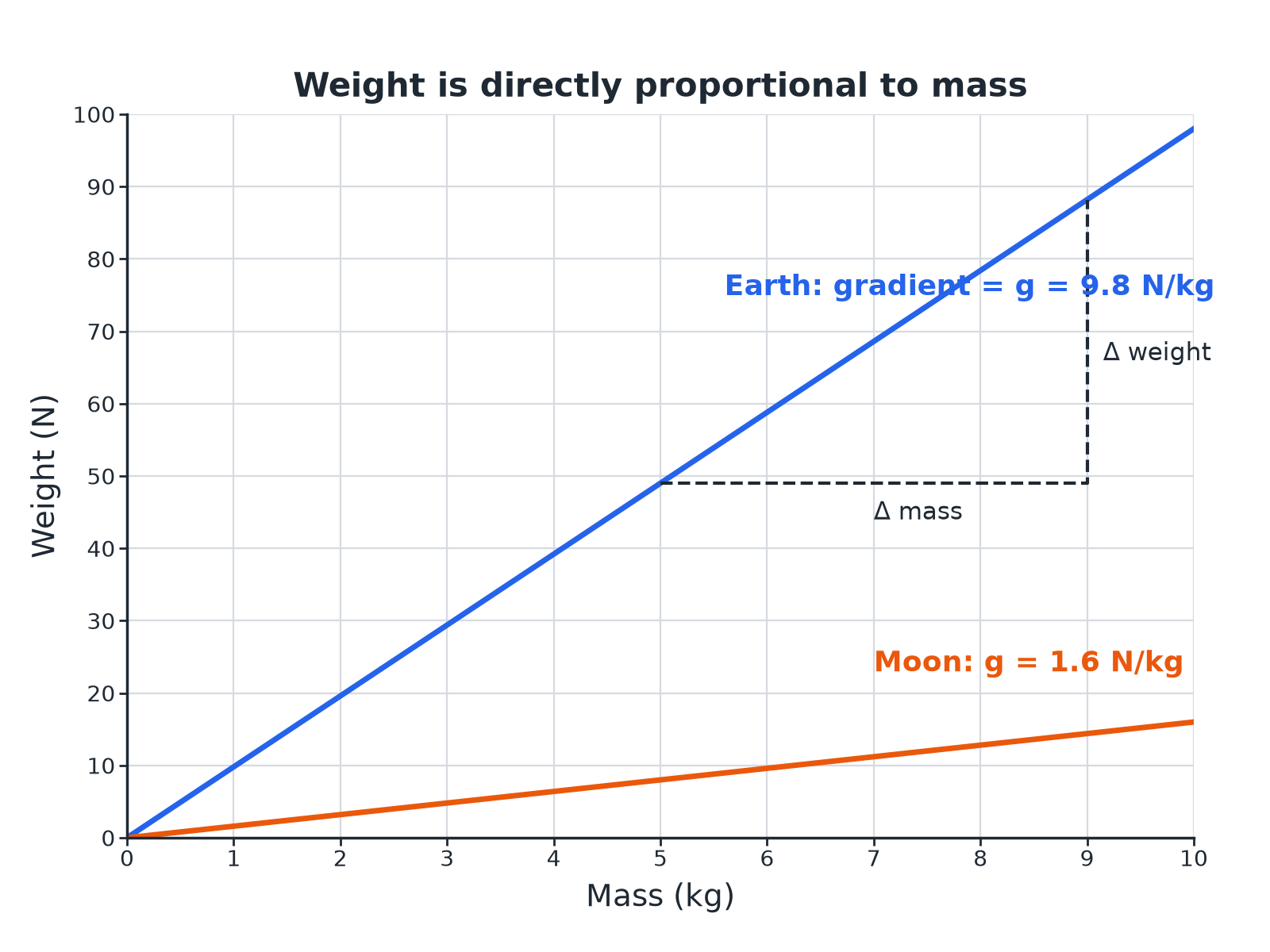
Weight is directly proportional to mass.
Gravitational Field Strength
g varies from place to place.
-
Earth
g (N/kg): 9.8
-
Moon
g (N/kg): 1.6
-
Mars
g (N/kg): 3.7
-
Jupiter
g (N/kg): 25
Weight on Earth
A person has a mass of 60 kg. Calculate their weight on Earth. g = 9.8 N/kg.
Show the solutionHide the solution
- 1 Write the equation \(W = mg\)
- 2 Substitute \(W = 60 \times 9.8\)
- 3 Answer \(W = 588\) N
Answer588 N
Weight on the Moon
The same person goes to the Moon, where g = 1.6 N/kg. Calculate their mass and weight.
Show the solutionHide the solution
- 1 Mass Mass does not change: 60 kg
- 2 Weight \(W = 60 \times 1.6 = 96\) N
AnswerMass 60 kg; weight 96 N.
Finding g
An object of mass 3.0 kg has a weight of 12 N on a planet. Calculate g.
Show the solutionHide the solution
- 1 Rearrange \(g = W \div m\)
- 2 Substitute \(g = 12 \div 3.0\)
- 3 Answer \(g = 4.0\) N/kg
Answer4.0 N/kg
Key Ideas
Mass and weight are different.
-
Mass
The amount of matter in an object; in kg; does not change with place.
-
Weight
A force in newtons; depends on g; measured with a newtonmeter.
-
Proportional
\(W \propto m\): doubling the mass doubles the weight.
-
Centre of mass
The single point at which the weight of an object may be considered to act.
Weigh It
A rock has a mass of 5.0 kg. Calculate its weight on Earth (g = 9.8 N/kg), on the Moon (g = 1.6 N/kg) and on Jupiter (g = 25 N/kg).
1. Use W = mg.
2. Compare the answers.
A good answer shows: Earth 49 N; Moon 8.0 N; Jupiter 125 N. The mass is 5.0 kg everywhere.
Can I...?
- 1Define weight.
- 2Use \(W = mg\).
- 3Rearrange for g or m.
- 4Say why weight changes but mass does not.
- 5Recall the unit of weight.
- 6Describe a newtonmeter.
- 7Explain proportionality.
- 8Describe the centre of mass.
Summary & Exam Focus
- \(W = mg\).
- Mass in kg; weight in N.
- Weight is proportional to mass.
- Mass is the same everywhere; weight depends on g.
Exam focus
A person has a mass of 60 kg. Calculate their weight. g = 9.8 N/kg. (2 marks) (2 marks)
Substitute into W = mg and include N.
Key terms
The vocabulary this lesson expects you to use. Each one is linked from the first place it appears above.
- Weight
- The force acting on an object due to gravity.
- Mass
- The amount of matter in an object.
- Gravitational field strength
- The force per kilogram near a planet.
- Newtonmeter
- A calibrated spring balance for measuring force.
- Centre of mass
- The point where the weight of an object may be considered to act.
- Directly proportional
- Doubling one quantity doubles the other.
Practice questions
Have a go at each one before you open its answer.
-
Question 1 Calculate 2 marks
A person has a mass of 60 kg. Gravitational field strength = 9.8 N/kg. Calculate the weight of the person. Use the equation: weight = mass × gravitational field strength
Show answerHide answer
Model answer
\(60 \times 9.8 = 588\) N
Mark scheme
- Correct substitution — 1 mark
- 588 N — 1 mark
-
Question 2 Explain 3 marks
An astronaut travels from Earth to the Moon. Explain what happens to the astronaut's mass and weight.
Show answerHide answer
Model answer
The mass stays the same because it is the amount of matter. The weight decreases because the gravitational field strength on the Moon is less than on Earth.
Mark scheme
- Mass unchanged — 1 mark
- Weight decreases — 1 mark
- Moon has a weaker gravitational field — 1 mark
-
Question 3 Use the graph 4 marks
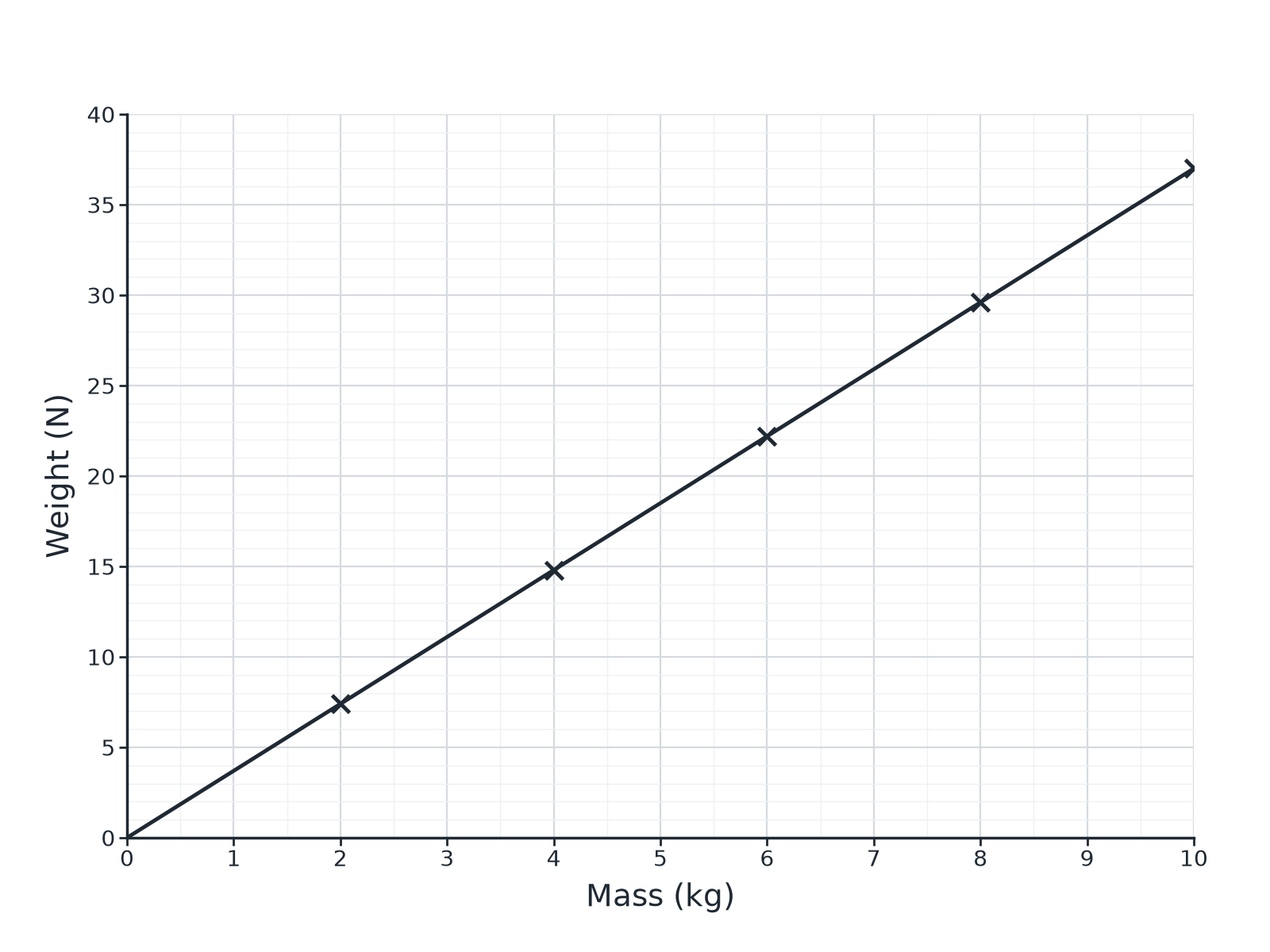
The graph shows how the weight of objects on a planet depends on their mass. (a) Describe the relationship between weight and mass. (b) Use the graph to calculate the gravitational field strength of the planet.
Show answerHide answer
Model answer
(a) Weight is directly proportional to mass (a straight line through the origin). (b) Gradient \(= 18.5 \div 5.0 = 3.7\) N/kg
Mark scheme
- Straight line through the origin — 1 mark
- Directly proportional — 1 mark
- Uses the gradient — 1 mark
- 3.7 N/kg (accept 3.5 to 3.9) — 1 mark
-
Question 4 Calculate 3 marks
A rock has a weight of 12 N on a planet. Its mass is 3.0 kg. Calculate the gravitational field strength of the planet.
Show answerHide answer
Model answer
\(g = W \div m = 12 \div 3.0 = 4.0\) N/kg
Mark scheme
- Rearranges to g = W ÷ m — 1 mark
- Correct substitution — 1 mark
- 4.0 N/kg — 1 mark
-
Question 5 Explain 2 marks
A newtonmeter is used to measure the weight of an object. State what the newtonmeter actually measures and the unit used.
Show answerHide answer
Model answer
The force (weight) acting on the object due to gravity, in newtons.
Mark scheme
- Force or weight — 1 mark
- In newtons — 1 mark
Quick check
-
Weight is measured in...
Show answerHide answer
C: newtons
It is a force.
-
Weight is calculated using...
Show answerHide answer
D: \(W = mg\)
Mass times g.
-
A 2 kg mass where g = 10 N/kg weighs...
Show answerHide answer
A: 20 N
2 × 10.
-
On the Moon an object's mass is...
Show answerHide answer
B: the same as on Earth
Mass does not change.
-
Weight and mass are...
Show answerHide answer
C: directly proportional
W ∝ m.
Downloads
Free to keep, print and annotate.
- Gravity mass and weight.pptx Built from the lesson script on 30 September 2026. View
- Gravity mass and weight - Completed Notes.docx The full notes for the lesson, to revise from. Built from the lesson script on 30 September 2026. View
- Gravity mass and weight - Exam Questions.docx Built from the lesson script on 30 September 2026. View
Something here looks wrong?
Tell us what and we will go and look. It goes to whoever writes these pages, nobody else, and we do not ask who you are — so there is nothing to sign and nothing comes back to you.