Viewing as
Teaching this? The teacher view adds 2 files, the mark schemes and the model answers.
Physics · Space physics
Orbital motion and satellites
Explain how a satellite can move at constant speed but with changing velocity, and how orbital radius and speed are linked (Higher tier only; Physics only).
Warm-up
Answer each one, then check.
-
1
What is speed?
Show answerHide answer
Distance travelled per unit time
-
2
What is velocity?
Show answerHide answer
Speed in a given direction
-
3
What is gravity?
Show answerHide answer
An attractive force between masses
-
4
What is an orbit?
Show answerHide answer
The curved path round a planet or star
-
5
What is a satellite?
Show answerHide answer
An object that orbits a larger object
Learning Objectives
CIRCULAR ORBITS
An object in a circular orbit moves at constant speed but its velocity is always changing because its direction is changing. The resultant force is gravity, which acts towards the centre of the orbit.
For an orbit of a given radius, the speed must be a particular value. If the speed changes, the radius changes.
A Satellite in Orbit
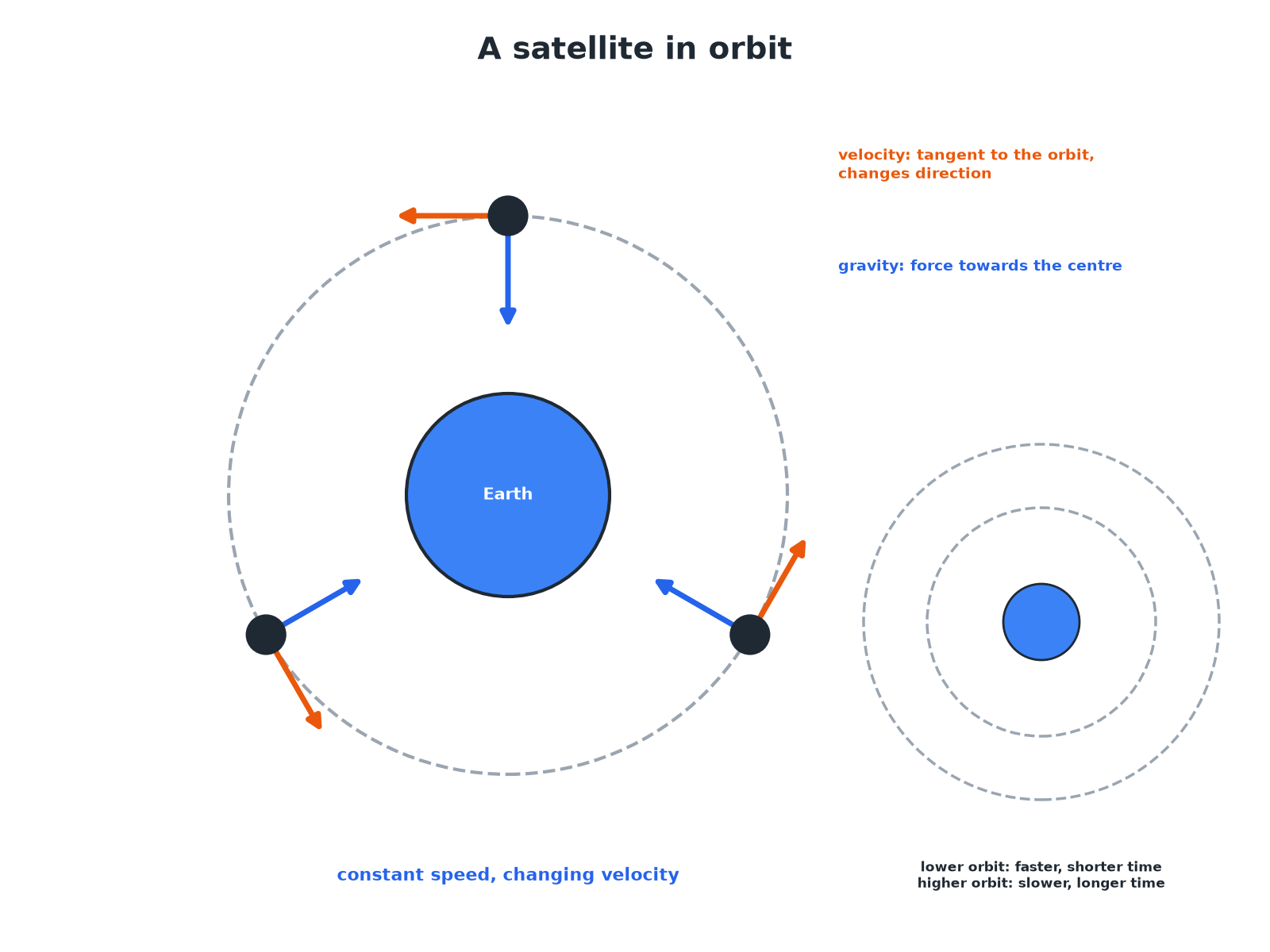
Velocity is tangent; force is towards the centre.
Orbits at Different Heights
Learn the links.
-
Low orbit (closer)
Speed: Faster. Time for one orbit: Shorter
-
High orbit (further away)
Speed: Slower. Time for one orbit: Longer
-
Geostationary (about 36 000 km)
Speed: Matches the Earth's rotation. Time for one orbit: 24 hours
-
If the speed changes
Speed: Radius must change too. Time for one orbit: Time changes
Constant Speed, Changing Velocity
Explain why a satellite moving at constant speed in a circle is accelerating.
Show the solutionHide the solution
- 1 Speed Constant
- 2 Direction Always changing
- 3 Velocity Has speed and direction, so it changes
- 4 Acceleration A change in velocity is an acceleration, towards the centre
AnswerVelocity changes because direction changes, so it accelerates.
Orbital Speed
A satellite orbits at a radius of 7000 km and completes one orbit in 5800 s. Calculate its speed.
Show the solutionHide the solution
- 1 Distance circumference \(= 2\pi r = 2 \times \pi \times 7.0 \times 10^6 = 4.4 \times 10^7\) m
- 2 Speed \(v = d \div t = 4.4 \times 10^7 \div 5800\)
- 3 Answer \(v \approx 7600\) m/s
AnswerAbout 7600 m/s.
Key Points
Learn these.
-
Gravity
Provides the force towards the centre.
-
Constant speed
But velocity changes.
-
Closer orbit
Faster and a shorter orbit time.
-
Change of speed
Changes the radius of the orbit.
Orbit Sums
Explain why a satellite does not fall to Earth even though gravity pulls on it. Then calculate its speed if one orbit of radius 7000 km takes 5800 s.
1. Speed = distance ÷ time.
A good answer shows: It is falling but moves sideways fast enough to keep missing the Earth. v = 2π × 7.0 × 10^6 ÷ 5800 ≈ 7600 m/s.
Can I...?
- 1Define orbit.
- 2Explain changing velocity.
- 3Explain the force.
- 4Link radius and speed.
- 5Describe geostationary.
- 6Calculate orbital speed.
- 7Explain a change in speed.
- 8Give examples.
Summary & Exam Focus
- Constant speed but changing direction means changing velocity.
- Gravity acts towards the centre.
- Lower orbit: faster; higher orbit: slower.
- Change of speed gives a change of radius.
Exam focus
Explain why the velocity of a satellite moving at constant speed is changing. (2 marks) (2 marks)
Direction changes.
Key terms
The vocabulary this lesson expects you to use. Each one is linked from the first place it appears above.
- Orbit
- The curved path of an object round a planet or star.
- Orbital speed
- The speed of an object as it moves in its orbit.
- Velocity
- Speed in a given direction.
- Geostationary orbit
- An orbit with a period of 24 hours, so the satellite stays above one point on Earth.
- Acceleration
- A change in velocity.
- Satellite
- An object in orbit around a larger object.
Practice questions
Have a go at each one before you open its answer.
-
Question 1 Explain 2 marks
A satellite orbits the Earth at constant speed. Explain why its velocity is not constant.
Show answerHide answer
Model answer
Velocity is speed in a given direction. The direction of motion is always changing, so the velocity changes even though the speed is constant.
Mark scheme
- Velocity has direction — 1 mark
- Direction is changing — 1 mark
-
Question 2 Explain 3 marks
Explain what provides the force that keeps a satellite in a circular orbit and state the direction of the force.
Show answerHide answer
Model answer
The force is gravity between the Earth and the satellite. It acts towards the centre of the orbit (the centre of the Earth).
Mark scheme
- Gravity — 1 mark
- Between Earth and satellite — 1 mark
- Towards the centre — 1 mark
-
Question 3 Calculate 3 marks
A satellite completes one circular orbit of circumference 4.4 × 10^7 m in 5800 s. Calculate its orbital speed.
Show answerHide answer
Model answer
\(v = 4.4 \times 10^7 \div 5800 = 7600\) m/s (about)
Mark scheme
- Distance ÷ time — 1 mark
- Correct substitution — 1 mark
- About 7600 m/s — 1 mark
-
Question 4 Explain 3 marks
Satellite A orbits the Earth at a smaller radius than satellite B. Compare the orbital speeds and the times taken for one orbit, and explain the difference in speed.
Show answerHide answer
Model answer
A moves faster than B and takes less time to complete an orbit. Gravity is stronger closer to the Earth, so a greater orbital speed is needed for a stable orbit at a smaller radius; A also has a shorter path.
Mark scheme
- A faster than B — 1 mark
- A has a shorter orbit time — 1 mark
- Gravity is stronger at smaller radius, so a higher speed is needed — 1 mark
-
Question 5 Explain 2 marks
A geostationary satellite stays above the same point on the Earth. State the time taken for one orbit and explain why this is useful.
Show answerHide answer
Model answer
24 hours. It stays above one place, so a fixed dish can communicate with it.
Mark scheme
- 24 hours — 1 mark
- Fixed position above the Earth: useful for communications — 1 mark
Quick check
-
A satellite in a circular orbit has constant...
Show answerHide answer
D: speed
Speed is constant.
-
The force keeping a satellite in orbit is...
Show answerHide answer
A: gravity
Attracts to the centre.
-
The force acts...
Show answerHide answer
B: towards the centre of the orbit
Centripetal.
-
A lower orbit has a...
Show answerHide answer
C: shorter orbit time
Faster.
-
A geostationary orbit takes...
Show answerHide answer
D: 24 hours
Same as Earth's rotation.
Downloads
Free to keep, print and annotate.
- Orbital motion and satellites.pptx Built from the lesson script on 30 September 2026. View
- Orbital motion and satellites - Completed Notes.docx The full notes for the lesson, to revise from. Built from the lesson script on 30 September 2026. View
- Orbital motion and satellites - Exam Questions.docx Built from the lesson script on 30 September 2026. View
Something here looks wrong?
Tell us what and we will go and look. It goes to whoever writes these pages, nobody else, and we do not ask who you are — so there is nothing to sign and nothing comes back to you.