Viewing as
Teaching this? The teacher view adds 2 files, the mark schemes and the model answers.
Physics · Waves
The electromagnetic spectrum
Name the groups of electromagnetic waves in order of wavelength and frequency, and describe their common properties.
Warm-up
Answer each one, then check.
-
1
What is a wave?
Show answerHide answer
A way of transferring energy
-
2
What is frequency?
Show answerHide answer
Number of waves per second
-
3
Name a colour of the rainbow.
Show answerHide answer
Red, orange, yellow, green, blue, indigo or violet
-
4
What is the speed of light in a vacuum?
Show answerHide answer
\(3.0 \times 10^{8}\) m/s
-
5
What type of wave is light?
Show answerHide answer
Transverse
Learning Objectives
- 1List the seven types of electromagnetic wave in order.
- 2State that all EM waves are transverse and travel at the same speed in a vacuum or air.
- 3Relate wavelength to frequency across the spectrum.
- 4Give examples of energy transfer by EM waves.
THE EM SPECTRUM
Electromagnetic waves are transverse waves that transfer energy from a source to an absorber. They form a continuous spectrum and all travel at the same speed through a vacuum or air.
From long to short wavelength (or low to high frequency): radio, microwave, infrared, visible light (red to violet), ultraviolet, X-rays, gamma rays.
The Electromagnetic Spectrum
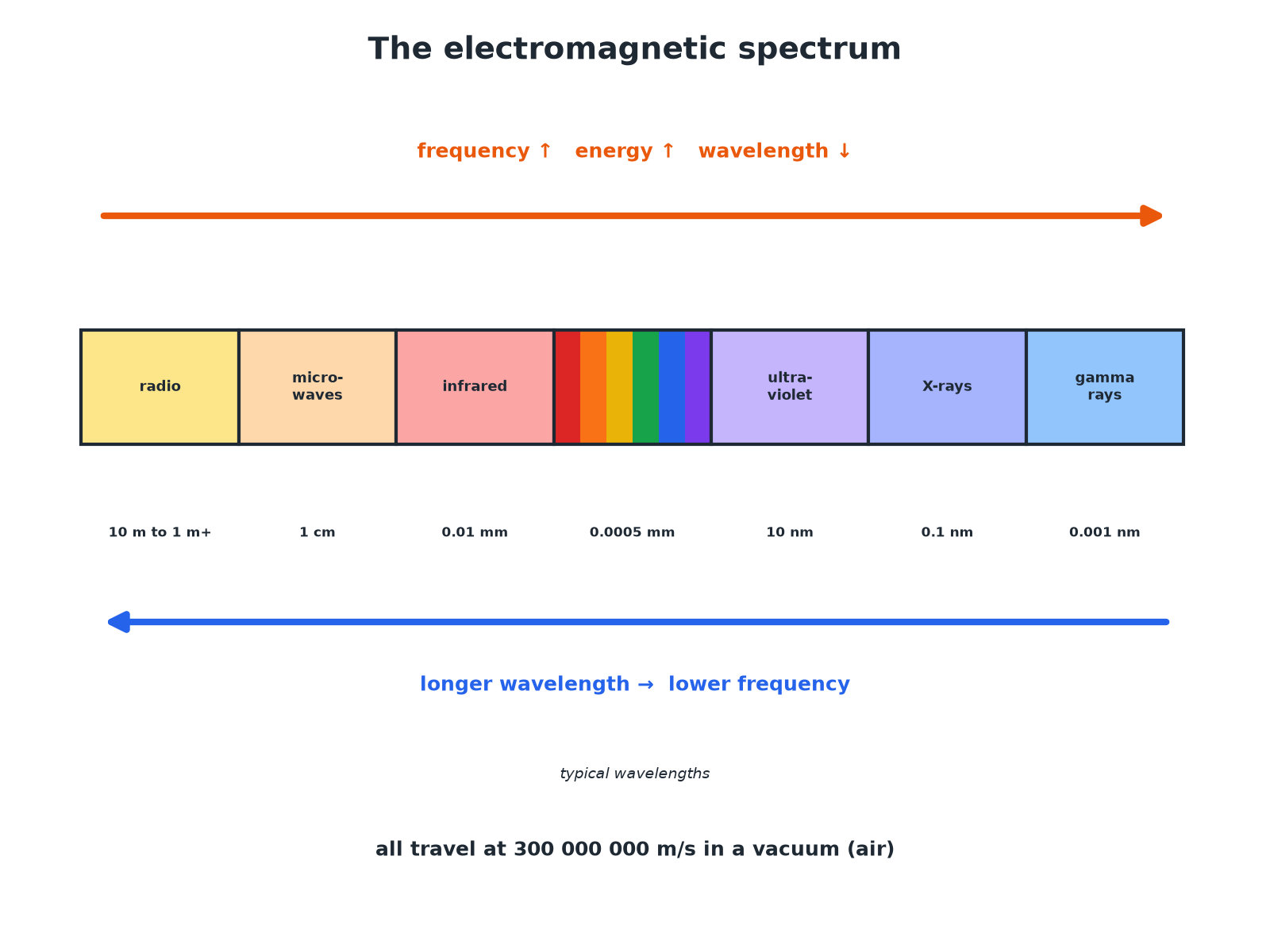
Longer wavelength means lower frequency.
The Seven Groups
Learn the order.
-
Radio waves
Wavelength: Longest. Frequency: Lowest
- Microwaves
- Infrared
- Visible light (red to violet)
- Ultraviolet
- X-rays
-
Gamma rays
Wavelength: Shortest. Frequency: Highest
Using the Wave Equation
A radio wave has a frequency of 100 MHz. Calculate its wavelength. Speed of EM waves = 3.0 × 10⁸ m/s.
Show the solutionHide the solution
- 1 Convert \(100\) MHz \(= 1.0 \times 10^{8}\) Hz
- 2 Rearrange \(\lambda = v \div f\)
- 3 Substitute \(\lambda = 3.0 \times 10^{8} \div 1.0 \times 10^{8}\)
- 4 Answer \(\lambda = 3.0\) m
Answer3.0 m
Memory Aid
Give a way to remember the order of the EM spectrum.
Show the solutionHide the solution
- 1 Initials Radio, Microwave, Infrared, Visible, Ultraviolet, X-ray, Gamma
- 2 Sentence Rabbits Mate In Very Unusual eXpensive Gardens
AnswerUse a mnemonic such as 'Rabbits Mate In Very Unusual eXpensive Gardens'.
Energy Transfer
Give examples that show EM waves transfer energy from a source to an absorber.
Show the solutionHide the solution
- 1 Microwaves Heat food
- 2 Infrared Warm your skin from a fire
- 3 Light Provides energy to plants and to solar cells
- 4 Gamma rays Transfer energy to cells
AnswerEach wave carries energy from its source to an absorber, where it increases a thermal or other energy store.
Key Facts
Remember these.
-
Transverse
All EM waves are transverse.
-
Same speed
They all travel at 3.0 × 10⁸ m/s in a vacuum.
-
Continuous
There are no gaps between the groups.
-
Our eyes
Detect only visible light, a limited range of the spectrum.
Order the Waves
Put these in order of increasing frequency: X-rays, radio waves, visible light, microwaves, gamma rays, infrared, ultraviolet.
1. Use the mnemonic.
A good answer shows: Radio waves, microwaves, infrared, visible light, ultraviolet, X-rays, gamma rays.
Can I...?
- 1List the EM spectrum in order.
- 2Say they are transverse.
- 3State the common speed.
- 4Link wavelength and frequency.
- 5Use \(v = f\lambda\) for EM waves.
- 6Name the visible colours.
- 7Say eyes detect only visible light.
- 8Give an example of energy transfer.
Summary & Exam Focus
- Order: radio, microwave, infrared, visible, ultraviolet, X-rays, gamma.
- All are transverse and travel at the same speed in a vacuum.
- Wavelength decreases as frequency increases.
- Eyes detect only visible light.
Exam focus
List the electromagnetic waves in order of increasing frequency, starting with radio waves. (2 marks) (2 marks)
Radio, microwave, infrared, visible, ultraviolet, X-ray, gamma.
Key terms
The vocabulary this lesson expects you to use. Each one is linked from the first place it appears above.
- Electromagnetic wave
- A transverse wave that can travel through a vacuum.
- Spectrum
- A continuous range of wavelengths or frequencies.
- Radio wave
- The electromagnetic wave with the longest wavelength.
- Gamma ray
- The electromagnetic wave with the shortest wavelength.
- Visible light
- The part of the spectrum our eyes detect.
- Absorber
- An object that takes in the energy of a wave.
Practice questions
Have a go at each one before you open its answer.
-
Question 1 Complete 2 marks
The electromagnetic spectrum is shown in order of increasing frequency. Radio waves, microwaves, infrared, visible light, ___, X-rays, gamma rays. Name the missing wave.
Show answerHide answer
Model answer
Ultraviolet.
Mark scheme
- Ultraviolet — 1 mark
- Correct position in order — 1 mark
-
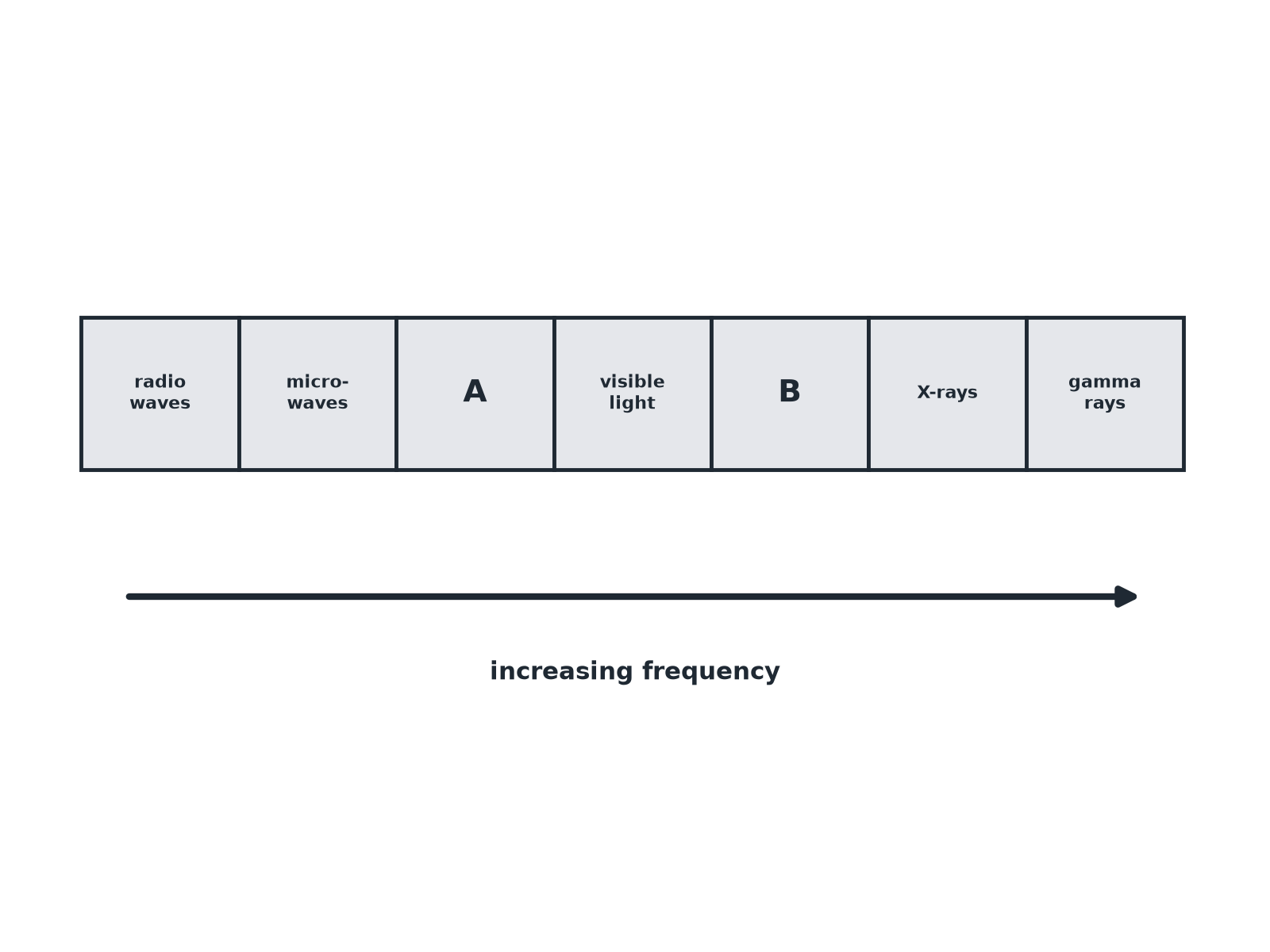
Question 2 Use the diagram 3 marks
The diagram shows the electromagnetic spectrum with some waves missing. (a) Name the waves labelled A and B. (b) State one property that all electromagnetic waves have.
Show answerHide answer
Model answer
(a) A: infrared. B: ultraviolet. (b) They are transverse, or they travel at the same speed in a vacuum.
Mark scheme
- A: infrared — 1 mark
- B: ultraviolet — 1 mark
- A common property — 1 mark
-
Question 3 Calculate 3 marks
A radio wave has a frequency of 100 MHz. The speed of electromagnetic waves in air is 3.0 × 10⁸ m/s. Calculate the wavelength. (1 MHz = 10⁶ Hz)
Show answerHide answer
Model answer
\(\lambda = 3.0 \times 10^8 \div 1.0 \times 10^8 = 3.0\) m
Mark scheme
- Converts to 1.0 × 10⁸ Hz — 1 mark
- Correct substitution — 1 mark
- 3.0 m — 1 mark
-
Question 4 State 2 marks
State two properties that are the same for all electromagnetic waves.
Show answerHide answer
Model answer
They are all transverse. They all travel at the same speed in a vacuum (or air).
Mark scheme
- Transverse waves — 1 mark
- Same speed in a vacuum — 1 mark
-
Question 5 Explain 3 marks
Gamma rays have a much higher frequency than radio waves. Explain why their wavelength is much shorter.
Show answerHide answer
Model answer
All electromagnetic waves travel at the same speed in a vacuum. Since v = fλ, a greater frequency means a shorter wavelength.
Mark scheme
- Same speed — 1 mark
- v = fλ — 1 mark
- Higher frequency means shorter wavelength — 1 mark
Quick check
-
Which has the longest wavelength?
Show answerHide answer
D: Radio waves
Radio waves.
-
Which has the highest frequency?
Show answerHide answer
A: Gamma rays
Gamma rays.
-
All electromagnetic waves are...
Show answerHide answer
B: transverse
Transverse.
-
Between infrared and ultraviolet is...
Show answerHide answer
C: visible light
The visible part.
-
In a vacuum all EM waves travel at...
Show answerHide answer
D: the same speed
3.0 × 10⁸ m/s.
Downloads
Free to keep, print and annotate.
- The electromagnetic spectrum.pptx Built from the lesson script on 30 September 2026. View
- The electromagnetic spectrum - Completed Notes.docx The full notes for the lesson, to revise from. Built from the lesson script on 30 September 2026. View
- The electromagnetic spectrum - Exam Questions.docx Built from the lesson script on 30 September 2026. View
Something here looks wrong?
Tell us what and we will go and look. It goes to whoever writes these pages, nobody else, and we do not ask who you are — so there is nothing to sign and nothing comes back to you.