Biology · Cells and Microscopy
Knowledge organiser
The whole chapter on two pages. Print it on A4 — they are already landscape — or cover a box and see how much of it you can say from memory.
Biology · AQA Paper 1
Cells and Microscopy
Eukaryotic and Prokaryotic Cells
Bacteria do have DNA. It is just not shut inside a nucleus.
- Eukaryotic cell A cell whose genetic material is enclosed in a nucleus, such as an animal or plant cell.
- Prokaryotic cell A cell with no nucleus, whose genetic material lies free in the cytoplasm, such as a bacterium.
- Nucleus The part of a eukaryotic cell that contains the genetic material and controls the cell's activities.
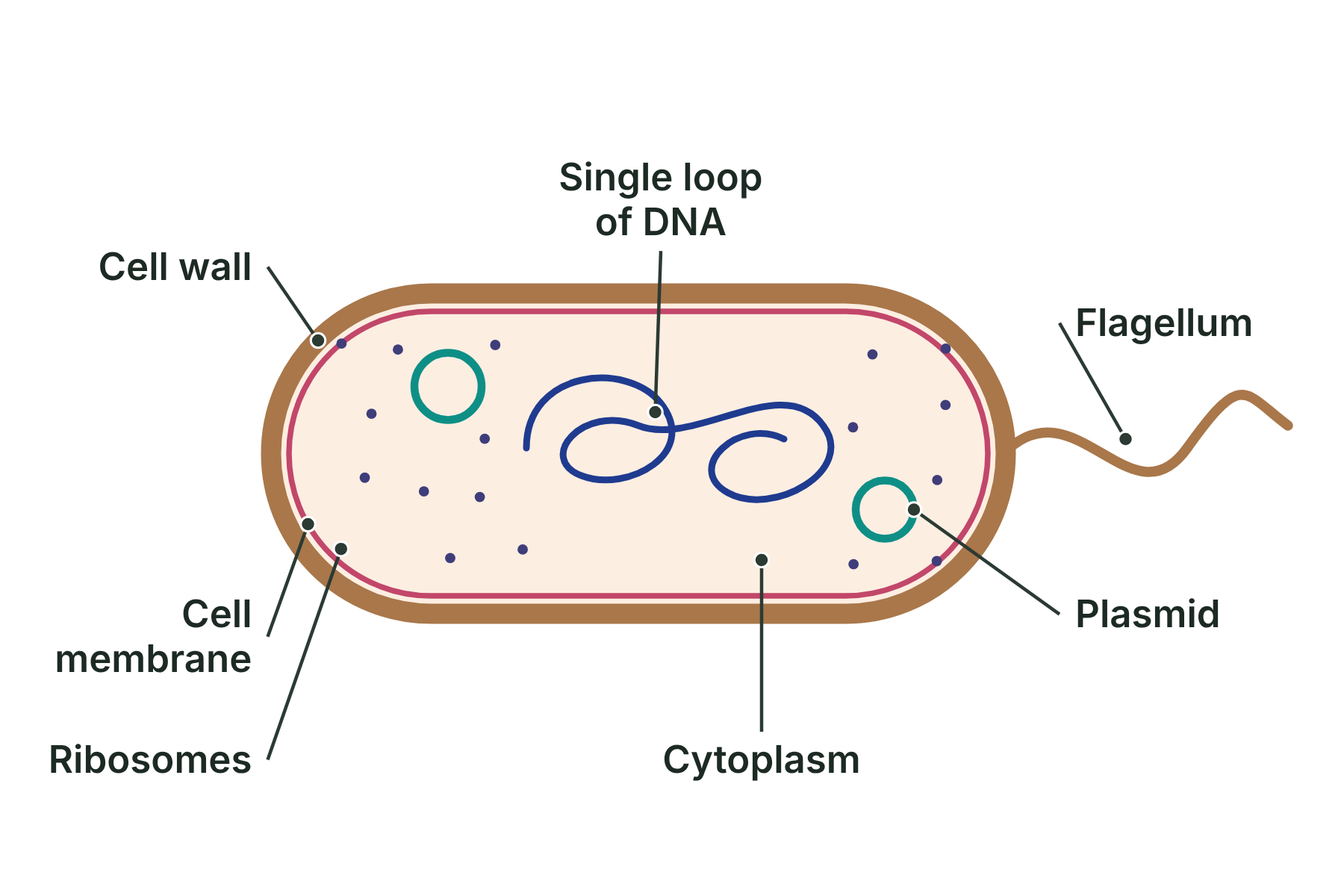
Eukaryotic and prokaryotic cells compared
- Eukaryotic cell (animal or plant) Genetic material is enclosed in a nucleus; Larger, often 10 to 100 µm across; Has a cell membrane, cytoplasm, mitochondria and ribosomes
- Prokaryotic cell (bacterium) No nucleus: a single loop of DNA lies in the cytoplasm; Much smaller, often 1 to 5 µm long; Has a cell membrane, cytoplasm and ribosomes, with a cell wall outside
Animal and Plant Cells
Structure always fits function: a cell has more of whatever its job needs most.
- Sub-cellular structure A structure inside a cell, such as the nucleus or a mitochondrion.
- Mitochondria Structures where aerobic respiration takes place, releasing energy for the cell.
- Ribosome A tiny structure where proteins are made.
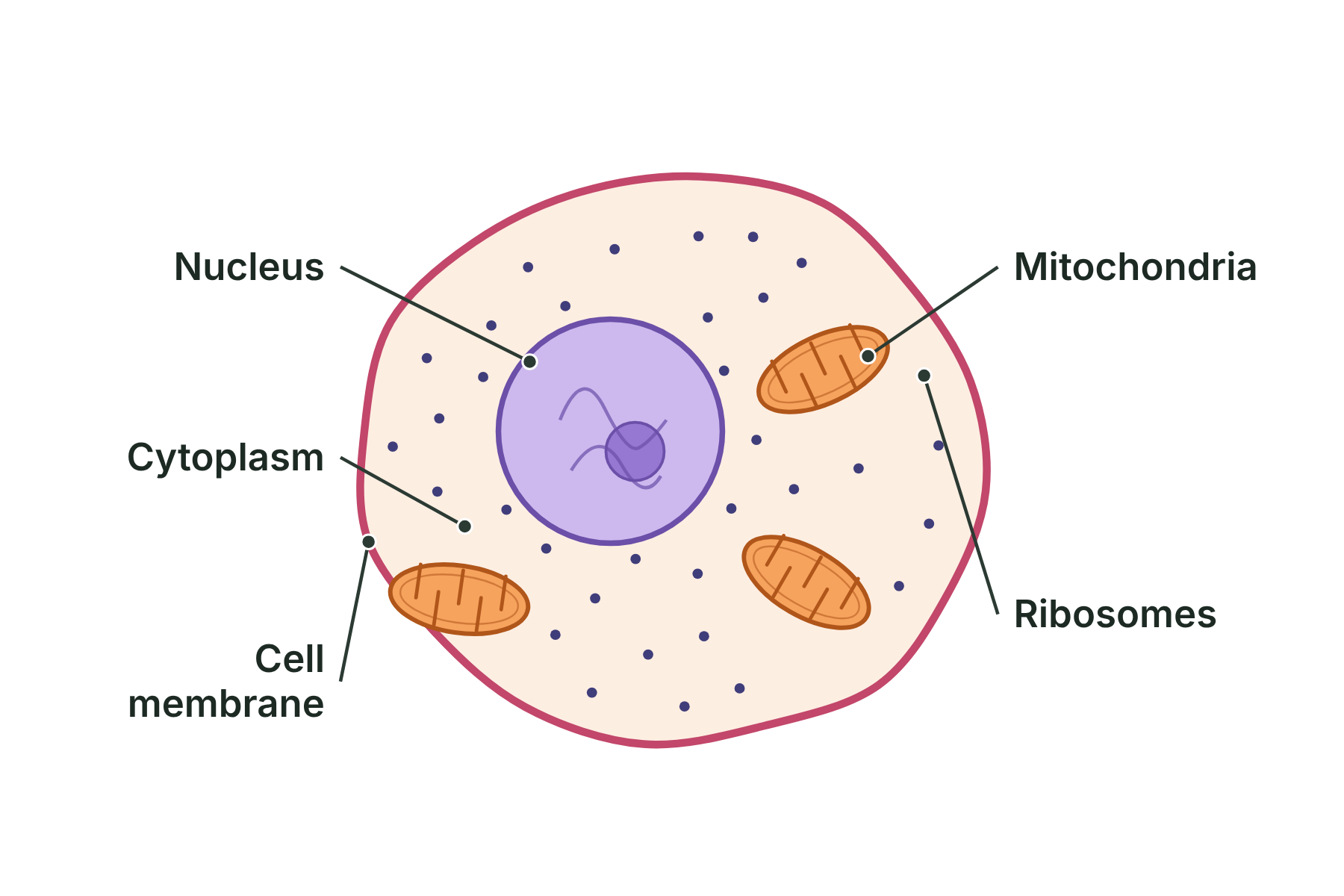
Animal cells and plant cells compared
- Animal cell Nucleus, cytoplasm, cell membrane, mitochondria, ribosomes; No cell wall, so the shape can change; No chloroplasts, so it cannot photosynthesise
- Plant cell Has all of those structures too; Cellulose cell wall gives a fixed shape; Chloroplasts in the green parts, for photosynthesis
Microscopy and Magnification
Magnification makes an image bigger. Resolution makes it clearer.
- Magnification How many times bigger an image is than the real object.
- Resolution The ability to see two points that are close together as separate. Also called resolving power.
- Light microscope A microscope that uses light and glass lenses to magnify a specimen.
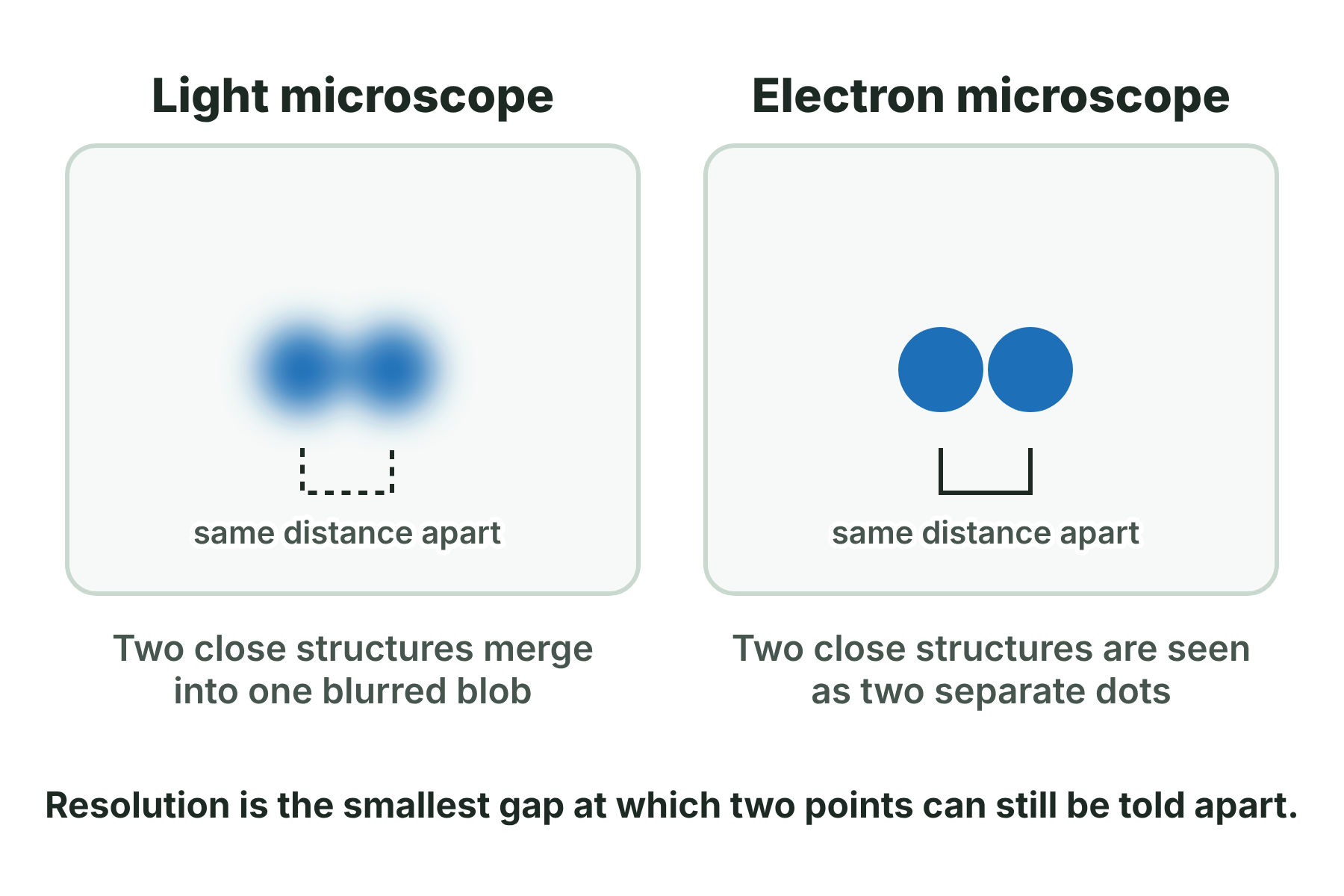
Light microscope and electron microscope compared
- Light microscope Magnifies up to about ×1500; Resolution about 0.2 µm (200 nm); Specimen can be alive, and colour stains can be used
- Electron microscope Magnifies up to about ×2 000 000; Resolution about 0.2 nm, about 1000 times better; Specimen is dead and the image is black and white
Biology · AQA Paper 1
Cells and Microscopy continued
Using a light microscope (core practical)
- Prepare the slide Put a thin piece of tissue, such as onion skin, on a slide, add…
- Clip it on the stage Place the slide on the stage and secure it with the clips.
- Choose the lowest power Turn the nosepiece to the ×4 objective lens.
- Focus Looking from the side, use the coarse focus wheel to raise the…
Cell Specialisation and Differentiation
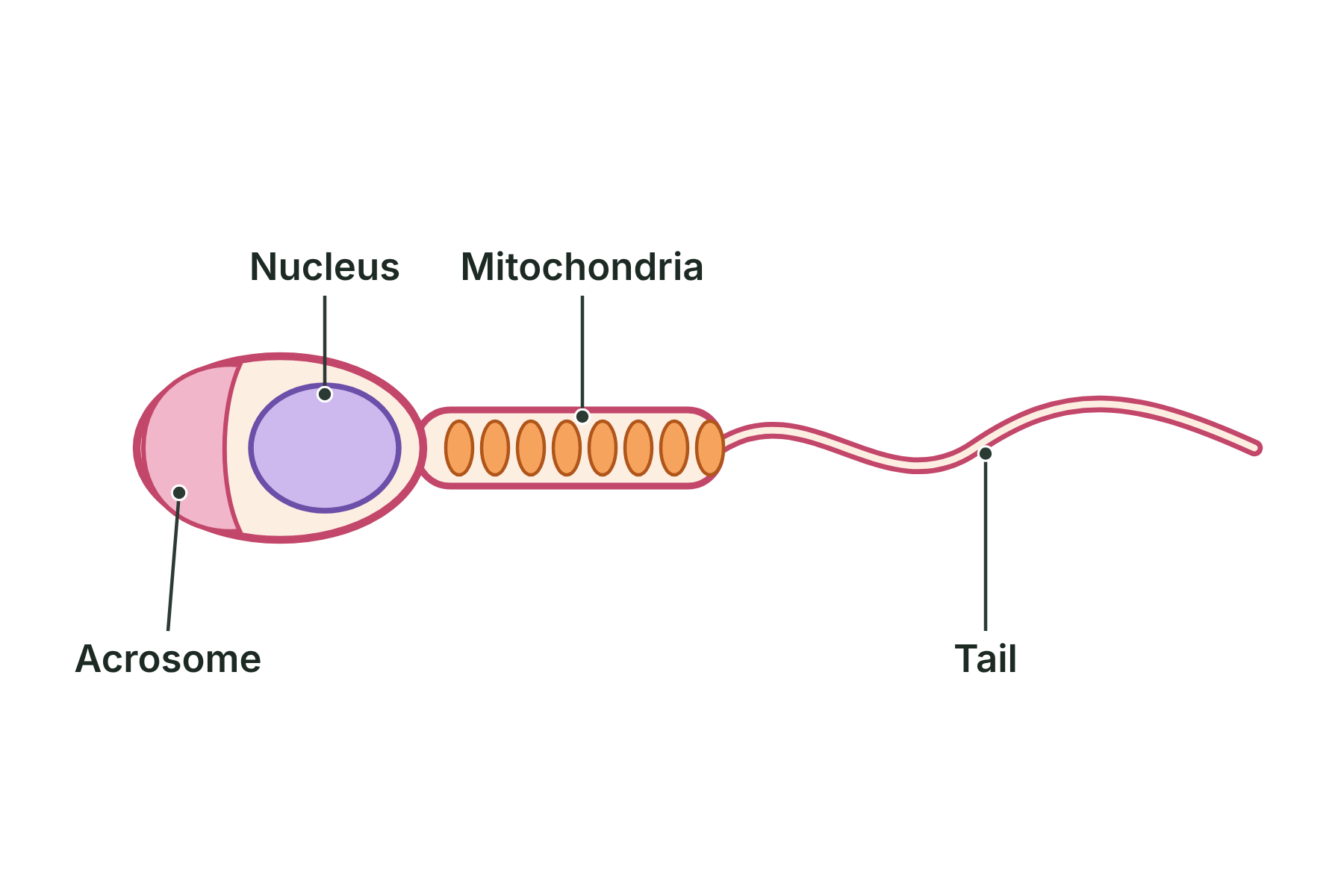
Every adaptation of a specialised cell helps it do its job.
- Specialised cell A cell that has a structure suited to its particular job.
- Differentiation The process by which a cell changes to become specialised.
- Adaptation A feature of a cell that helps it carry out its function.
Xylem and phloem compared
- Xylem Carries water and mineral ions from the roots upwards; Made of dead cells with no end walls, so it is a hollow tube; Walls strengthened with rings of lignin
- Phloem Carries dissolved sugars to where they are needed, in both directions; Made of living cells with sieve plates between them; Companion cells with mitochondria supply the energy
Levels of organisation
- Cell The basic unit, for example a muscle cell.
- Tissue A group of similar cells working together, for example muscular tissue.
- Organ A group of different tissues doing a job, for example the heart.
- Organ system A group of organs working together, for example the circulatory system.
Culturing Microorganisms (Separate only)
Every step of aseptic technique has one aim: to keep unwanted microorganisms out of the culture.
- Culture A population of microorganisms grown in controlled conditions in the laboratory.
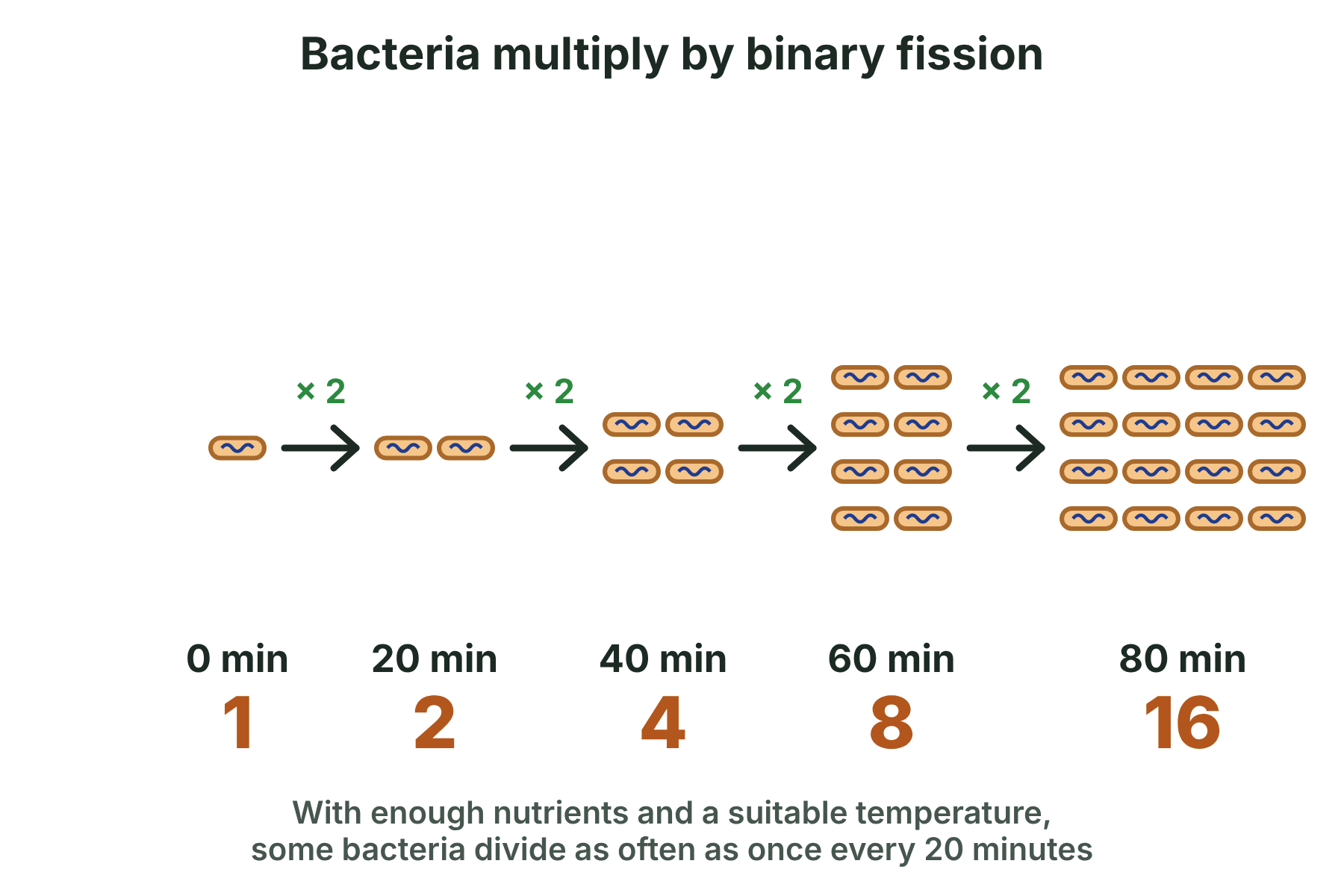
- Binary fission The way bacteria multiply: one cell divides into two identical cells.
- Mean division time The average time a bacterium takes to divide into two.
Antiseptics, antibiotics and disinfectants
- Used on or in living things Antiseptics are put on skin or wounds to kill bacteria
- Used on objects They are too harsh to put on living tissue
Preparing an uncontaminated culture
- Sterilise the equipment The Petri dish and the agar are sterilised before use.
- Sterilise the loop The inoculating loop is passed through a flame to kill…
- Inoculate Lift the lid only slightly, spread the bacteria over the agar with the loop.
- Tape the lid Seal the lid with adhesive tape so microorganisms from the air…