Biology · Plant Tissues and Transport
Knowledge organiser
The whole chapter on two pages. Print it on A4 — they are already landscape — or cover a box and see how much of it you can say from memory.
Biology · AQA Paper 1
Plant Tissues and Transport
Plant Tissues and Organs
Every tissue in a leaf has a structure that fits its function.
- Epidermis The thin outer layer of cells that covers a leaf.
- Waxy cuticle A waxy layer on the upper surface of a leaf that reduces water loss.
- Palisade mesophyll A layer of tall, tightly packed cells full of chloroplasts, where most photosynthesis takes place.
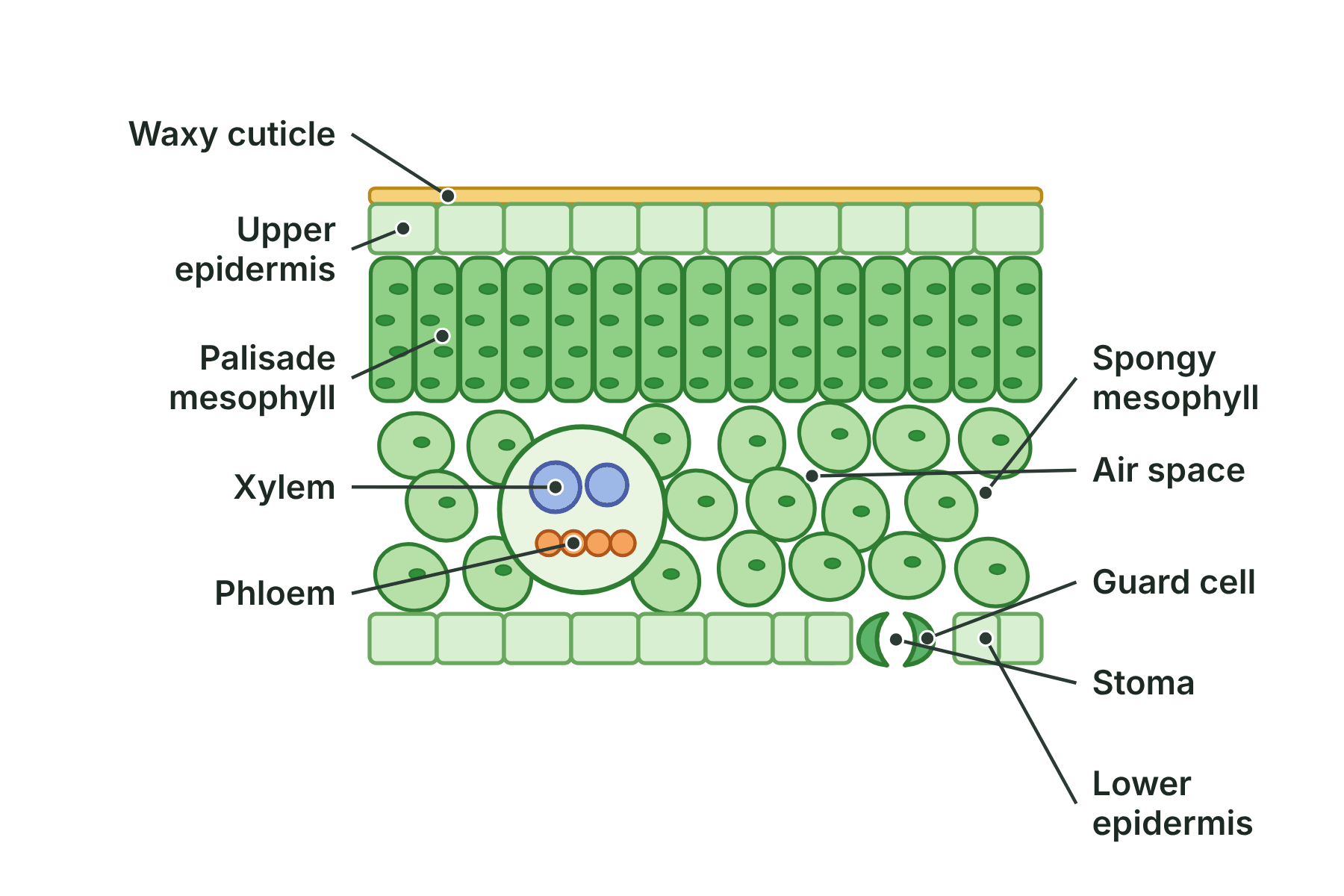
Palisade and spongy mesophyll compared
- Palisade mesophyll Tall cells packed tightly together; Many chloroplasts; Near the top of the leaf, where most light arrives
- Spongy mesophyll Rounded cells loosely packed; Fewer chloroplasts; Large air spaces between the cells
How guard cells control the stomata
- Plenty of water Water enters the guard cells by osmosis, so they swell and become turgid.
- The stoma opens The thin inner walls of the guard cells are stretched.
- Gases move Carbon dioxide diffuses in for photosynthesis and oxygen and…
- Little water If the plant loses too much water, the guard cells become flaccid and close the stoma.
Transpiration and the Xylem
Transpiration is the loss of water vapour from the leaves, which pulls water up the xylem from the roots.
- Root hair cell A cell on the surface of a root with a long thin extension that takes up water and mineral ions.
- Xylem Tissue made of dead hollow cells strengthened with lignin that carries water and mineral ions from the roots to the leaves.
- Lignin A strong material that strengthens the walls of the xylem.
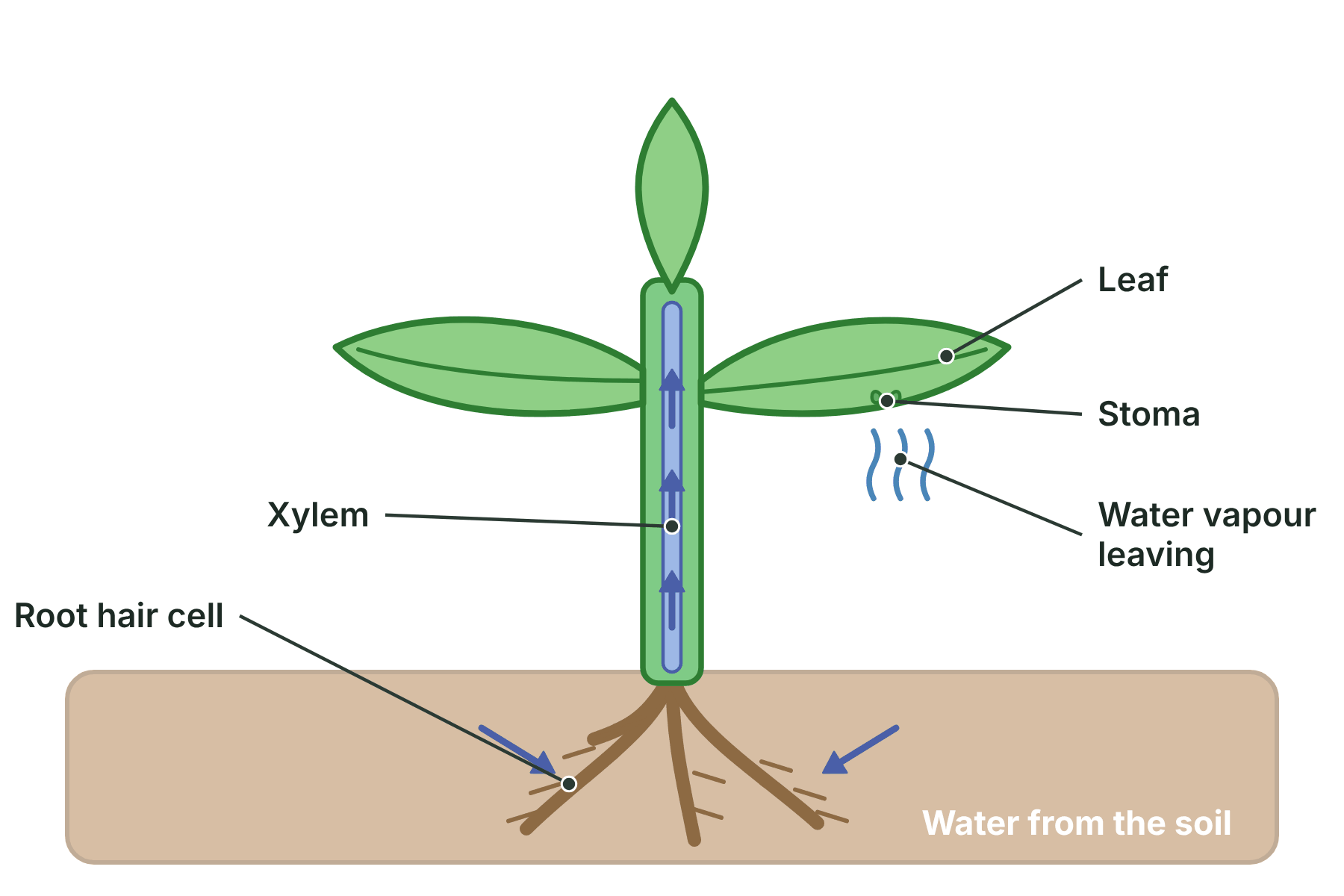
Factors that increase and decrease transpiration
- Faster transpiration A higher temperature; Lower humidity (drier air); More air movement (windy)
- Slower transpiration A lower temperature; Higher humidity (damp air); Still air
How transpiration works
- Evaporation Water evaporates from the surface of the cells inside the leaf…
- Diffusion The water vapour diffuses out of the leaf through the open…
- Water is pulled up Water leaving the leaf pulls more water up the xylem to replace it.
- Water enters the roots More water moves into the root hair cells from the soil.
Biology · AQA Paper 1
Plant Tissues and Transport continued
Translocation and the Phloem
Xylem carries water up. Phloem carries sugars up and down.
- Phloem Living tissue made of tubes of elongated cells that carries dissolved sugars around a plant.
- Translocation The movement of dissolved sugars through the phloem from the leaves to the rest of the plant.
- Sucrose The sugar in which the glucose made in photosynthesis is transported.
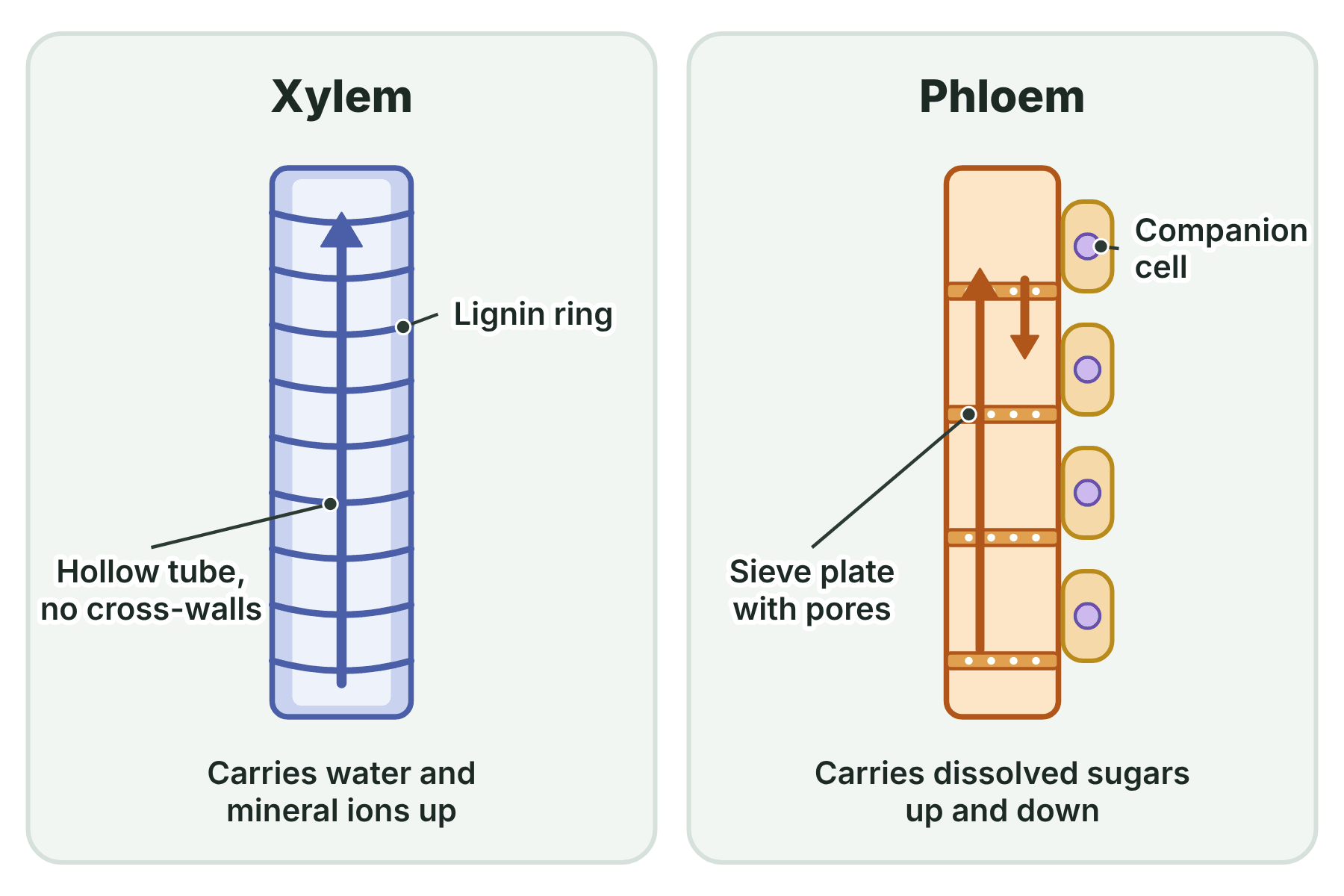
Xylem and phloem compared
- Xylem Carries water and mineral ions; From the roots to the leaves; Dead cells, hollow tubes with no end walls
- Phloem Carries dissolved sugars (food); From the leaves to where they are needed; Living cells, with pores in the end walls
The journey of the sugars
- Made in the leaf Photosynthesis in the palisade cells makes glucose.
- Loaded into the phloem The sucrose is moved into the phloem in the veins of the leaf.
- Carried round the plant Translocation carries it through the phloem to all other parts…
- Used or stored Cells use it for respiration and growth, or store it.
Measuring Transpiration
Water uptake in a potometer is a measure of the rate of transpiration.
- Potometer Apparatus that measures the rate at which a plant shoot takes up water.
- Capillary tube A very thin tube in which the bubble moves in a potometer.
- Independent variable The variable that is changed in an investigation.
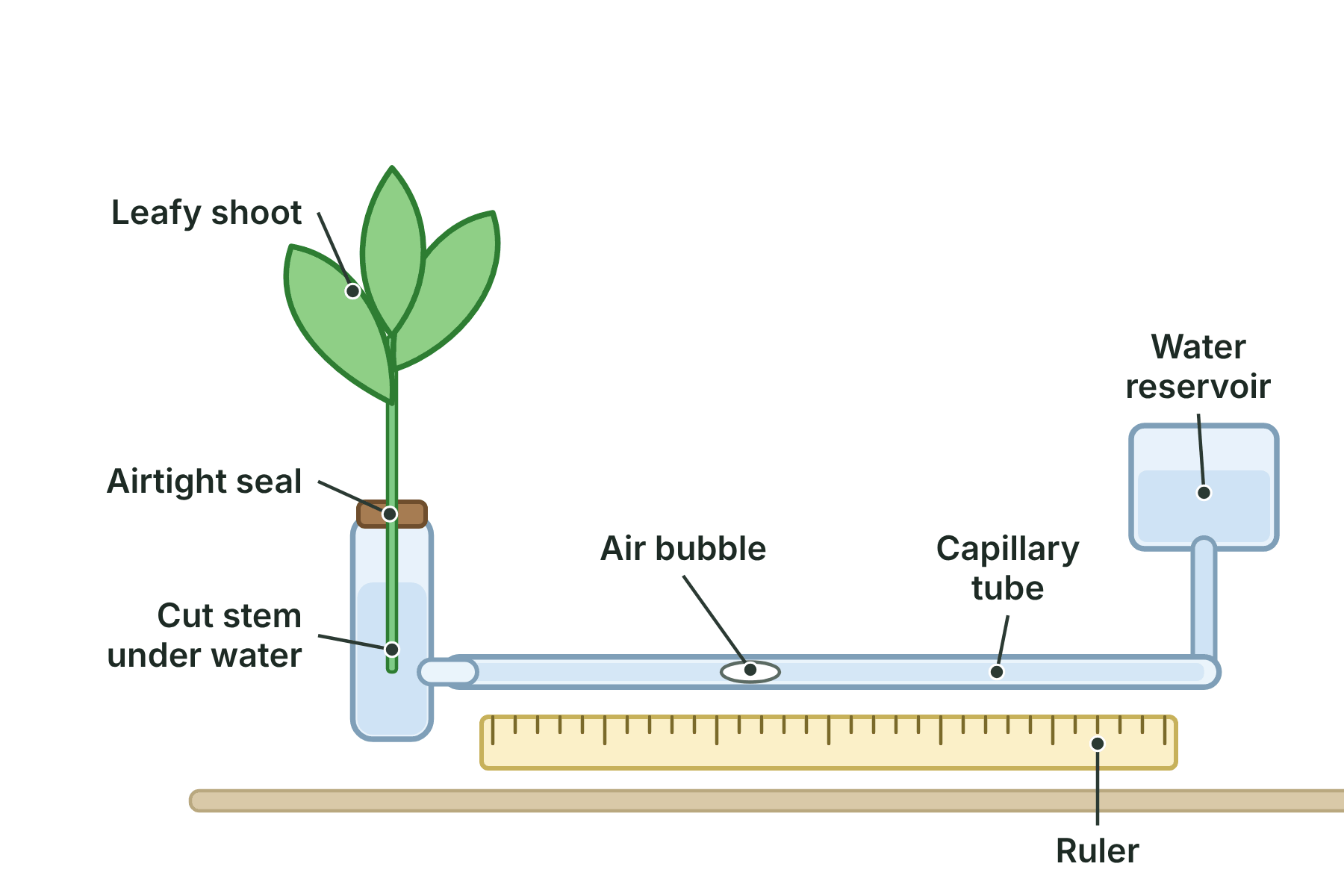
Investigating the effect of a factor
- Set up Cut a shoot under water and join it to the potometer under water.
- Dry the leaves Dry the leaf surface and let the shoot adjust to the room.
- Start Make an air bubble in the capillary tube and note its starting…
- Measure After a set time, such as 5 minutes, record how far the bubble has moved.