Biology · Plant Tissues and Transport
Transpiration and the Xylem
Plants take up water through their roots and lose it from their leaves. This lesson follows the water from the soil to the stomata, and explains how root hair cells and xylem are adapted and what changes the rate of transpiration.
Learning Objectives
- 1Explain how root hair cells and the xylem are adapted to their functions.
- 2Describe the process of transpiration and the transpiration stream.
- 3Explain the role of the stomata and guard cells in gas exchange and water loss.
- 4Explain the effect of temperature, humidity, air movement and light intensity on the rate of transpiration.
Retrieval practice
-
1
What is osmosis?
Show answerHide answer
The diffusion of water from a dilute solution to a concentrated solution through a partially permeable membrane.
-
2
What is active transport?
Show answerHide answer
The movement of substances against a concentration gradient, using energy from respiration.
-
3
What do guard cells control?
Show answerHide answer
The opening of the stomata.
-
4
Which tissue carries water up a plant?
Show answerHide answer
Xylem.
Water through the plant
A plant needs a constant supply of water for photosynthesis and to keep its cells firm. It takes the water from the soil through its roots, and a very large amount of water is lost again as vapour from the leaves. The roots, stem and leaves form a plant organ system for the transport of substances around the plant.
Taking up water and minerals
The root hair cells are on the surface of the roots, in contact with the soil.
-
Large surface area
Each root hair cell has a long, thin extension that sticks out into the soil, which gives a large surface area for absorbing water and ions.
-
Water by osmosis
The soil water is more dilute than the cytoplasm of the root hair cell, so water moves in by osmosis.
-
Minerals by active transport
The concentration of mineral ions in the soil is lower than in the cell, so ions are taken up by active transport. This needs energy from respiration.
-
Many mitochondria
Root hair cells contain many mitochondria to release the energy for active transport.
The xylem
Xylem tissue carries water and mineral ions from the roots to the stem and leaves.
-
Hollow tubes
Xylem is made of dead cells joined end to end with no cross-walls, which forms long hollow tubes that water can flow through easily.
-
Strengthened with lignin
The walls contain lignin, which makes them strong and stops the tubes collapsing under the pull of the water.
-
The transpiration stream
The movement of water up the xylem from the roots to the leaves is called the transpiration stream.
Water moving through a plant
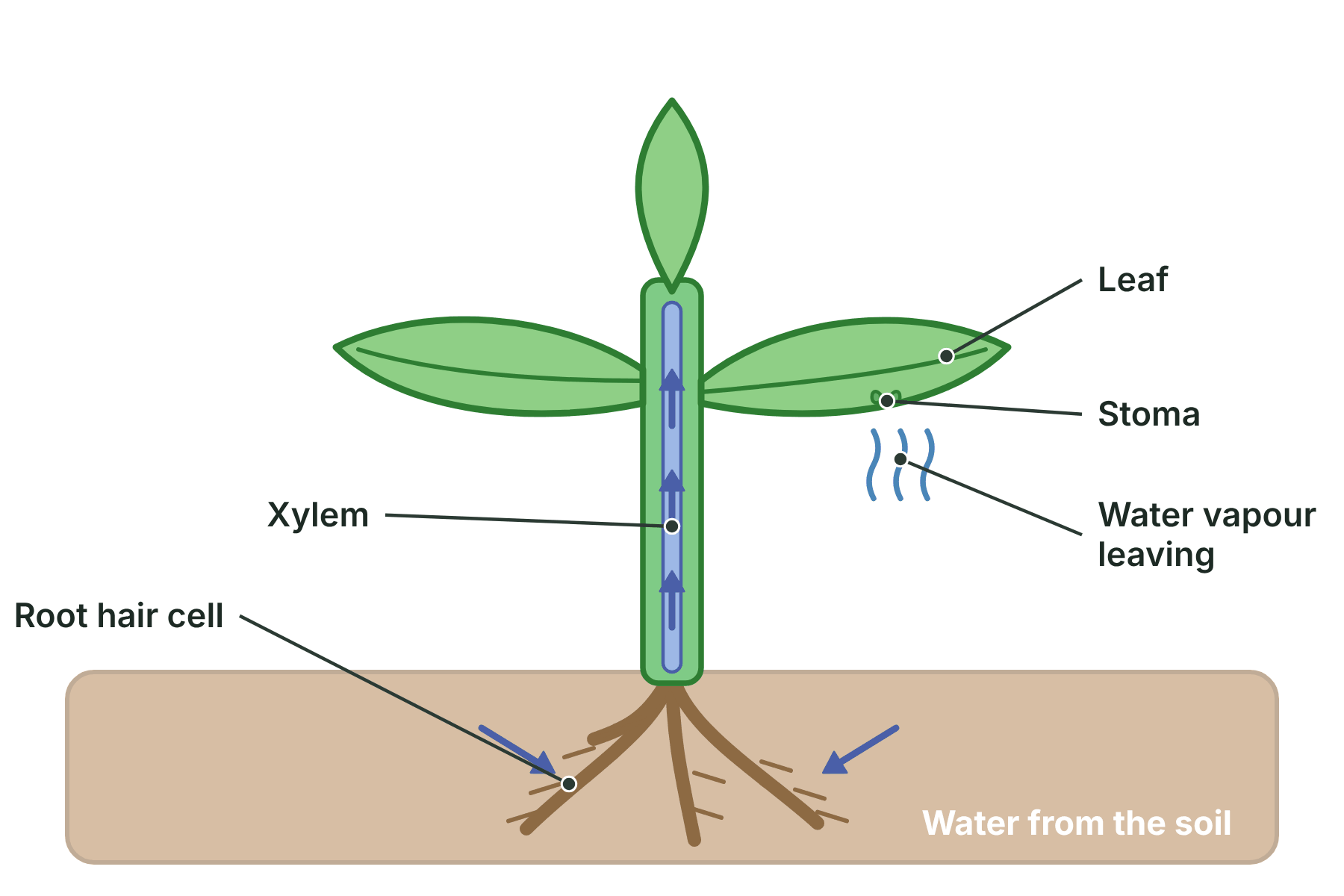
Water enters the roots, rises through the xylem and evaporates from the leaves.
How transpiration works
Transpiration is the loss of water vapour from the leaves, mainly through the stomata.
-
1
Evaporation
Water evaporates from the surface of the cells inside the leaf into the air spaces.
-
2
Diffusion
The water vapour diffuses out of the leaf through the open stomata into the drier air outside.
-
3
Water is pulled up
Water leaving the leaf pulls more water up the xylem to replace it, as a continuous stream.
-
4
Water enters the roots
More water moves into the root hair cells from the soil.
Why transpiration is useful
Transpiration is a side effect of keeping the stomata open, but it does have benefits.
-
Water for photosynthesis
The transpiration stream brings the water that the leaves need to make glucose.
-
Minerals
It carries mineral ions up from the roots.
-
Cooling
Evaporation cools the leaves.
-
Firm cells
The water keeps the cells turgid, which supports the plant.
What changes the rate of transpiration
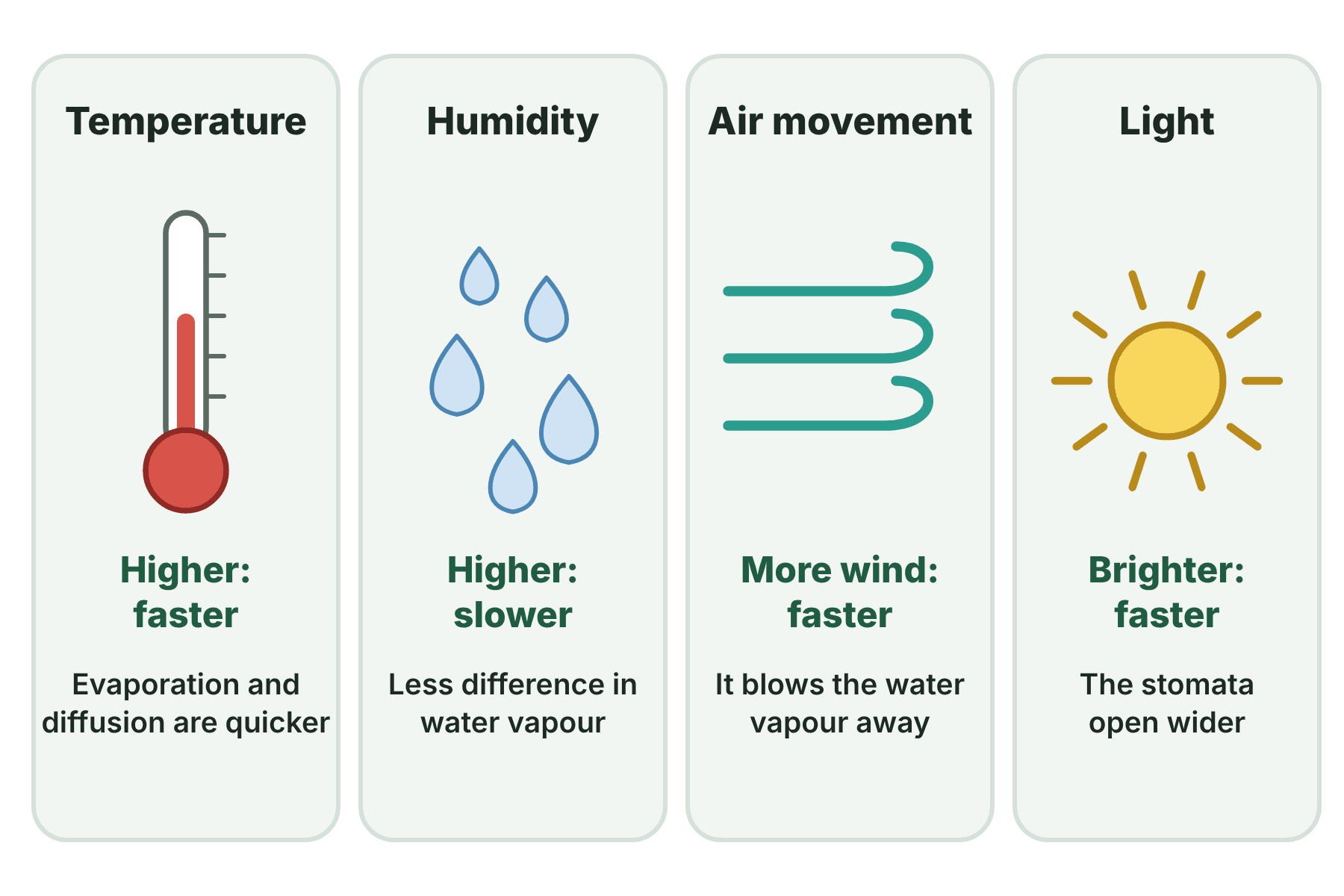
Each factor changes the rate at which water vapour leaves the leaf.
Factors that increase and decrease transpiration
Faster transpiration
- A higher temperature
- Lower humidity (drier air)
- More air movement (windy)
- Brighter light
Slower transpiration
- A lower temperature
- Higher humidity (damp air)
- Still air
- Dim light or darkness
Explaining a change in the rate
A plant loses water faster on a warm, windy day than on a cool, still day. Explain why.
Show the solutionHide the solution
- 1 Temperature A higher temperature gives the water molecules more energy, so water evaporates and diffuses out faster.
- 2 Air movement Wind removes water vapour from around the stomata, so the concentration gradient from inside the leaf to outside stays steep.
- 3 Conclude A steeper gradient and faster movement increase the rate of transpiration.
AnswerWarm air makes water evaporate and diffuse faster. Wind carries the water vapour away from the leaf, keeping the concentration gradient steep.
Case study
How much water does a plant lose?
A single large tree can lose hundreds of litres of water from its leaves on a hot day. Almost all of the water a plant takes up passes straight through it and is lost as vapour, and only a tiny fraction is used in photosynthesis. When the soil is dry and the plant cannot replace the water fast enough, the guard cells close the stomata and the plant may wilt.
The big idea
Transpiration is the loss of water vapour from the leaves, which pulls water up the xylem from the roots.
Transport in the xylem
Transport in the xylem
-
Root hair cells
- large surface area
- osmosis
- active transport
- many mitochondria
-
Xylem
- hollow dead cells
- lignin
- water and minerals upwards
-
Transpiration
- evaporation
- diffusion out of stomata
- pulls the stream
-
Stomata
- guard cells
- gas exchange
- water loss
-
Factors
- temperature
- humidity
- air movement
- light
Summary and exam focus
- Root hair cells take in water by osmosis and mineral ions by active transport.
- Xylem is made of dead, hollow cells strengthened with lignin that carry water and ions upwards.
- Transpiration is the evaporation and diffusion of water vapour from the leaves, mainly through the stomata.
- Guard cells control the stomata, which control gas exchange and water loss.
- Higher temperature, drier air, more wind and brighter light all speed up transpiration.
Exam focus
Explain why a plant loses water faster on a hot, dry, windy day. (4 marks) (4 marks)
Treat each factor separately. For each one say what it changes: high temperature speeds up evaporation, dry air steepens the concentration gradient, wind removes the vapour, and bright light opens the stomata.
Key terms
The words this lesson expects you to use. Each one is linked from the first place it appears above.
- Root hair cell
- A cell on the surface of a root with a long thin extension that takes up water and mineral ions.
- Xylem
- Tissue made of dead hollow cells strengthened with lignin that carries water and mineral ions from the roots to the leaves.
- Lignin
- A strong material that strengthens the walls of the xylem.
- Transpiration
- The loss of water vapour from the leaves of a plant, mainly through the stomata.
- Transpiration stream
- The movement of water up the xylem from the roots to the leaves.
- Stoma
- A tiny pore in the leaf surface, controlled by two guard cells. The plural is stomata.
- Humidity
- The amount of water vapour in the air.
- Mineral ions
- Substances such as nitrate and magnesium that plants take up from the soil for healthy growth.
You've finished the notes
Check your understanding
Test yourself while it is fresh. Start with the flashcards, then try the exam questions.
Something here looks wrong?
Tell us what and we will go and look. It goes to whoever writes these pages, nobody else, and we do not ask who you are — so there is nothing to sign and nothing comes back to you.