Biology · Evidence for Evolution and Classification
Knowledge organiser
The whole chapter on two pages. Print it on A4 — they are already landscape — or cover a box and see how much of it you can say from memory.
Biology · AQA Paper 2
Evidence for Evolution and Classification
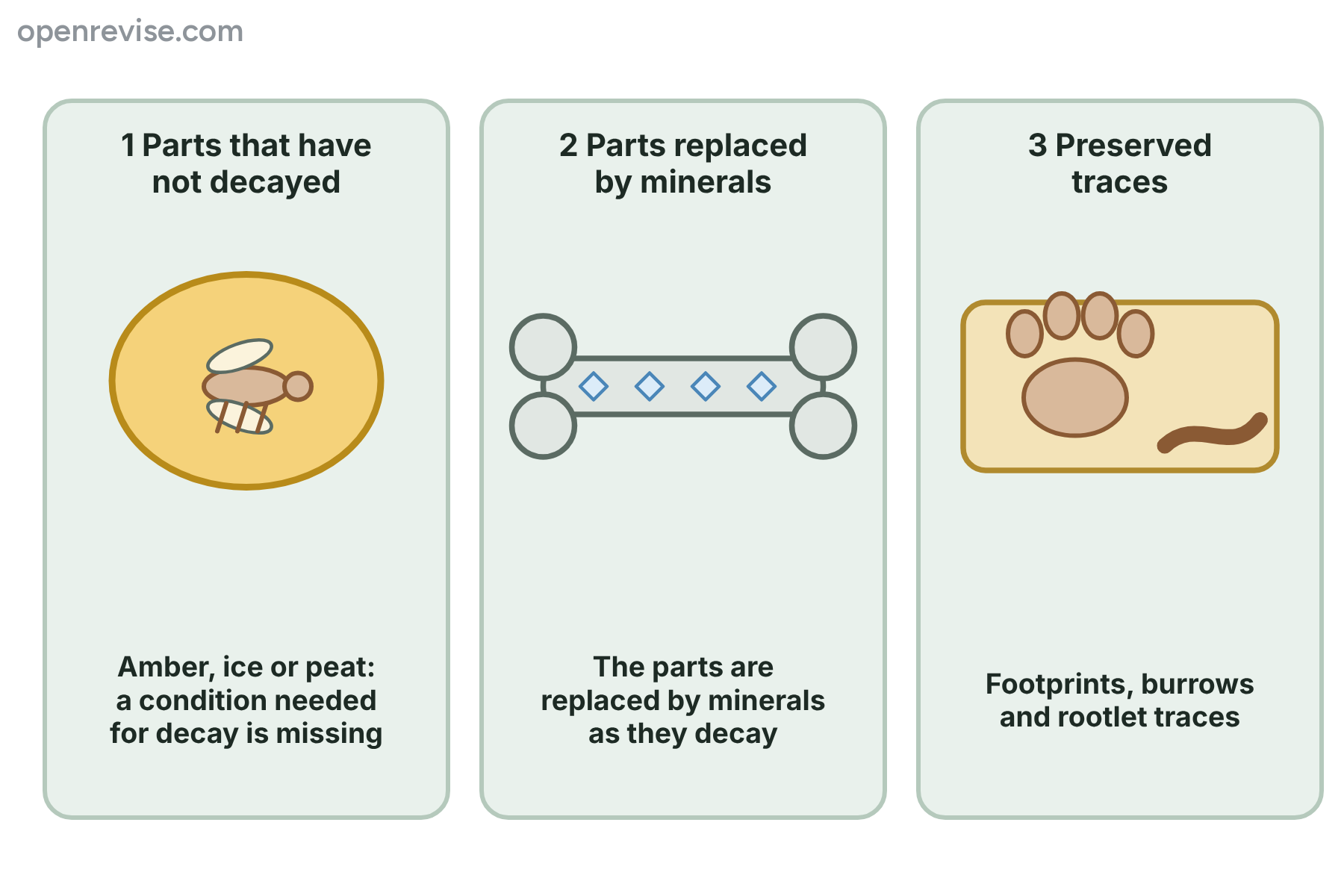
Fossils and the Fossil Record
Fossils show us how organisms have changed over millions of years, but the record is incomplete because most organisms never become fossils.
- Fossil The remains of an organism from millions of years ago, found in rock.
- Fossil record All the fossils that have been found, which shows how life has changed.
- Decay The breakdown of dead material by microorganisms.
Extinction
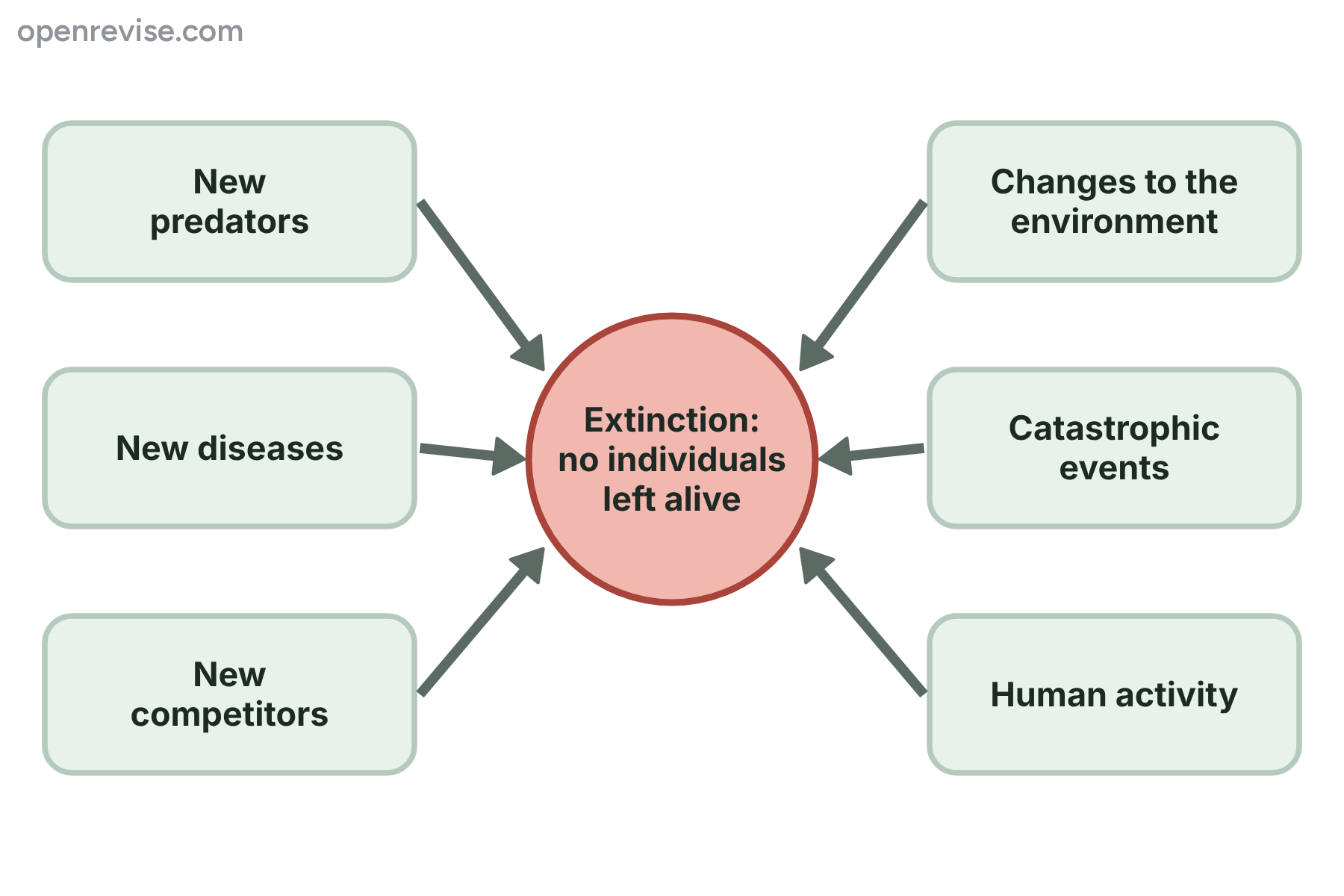
A species goes extinct when its members cannot survive, breed and adapt to a change in their environment quickly enough.
- Extinction When there are no remaining individuals of a species still alive.
- Mass extinction An event in which a large proportion of the world's species die out at the same time.
- Predator An animal that kills and eats other animals.
Natural and human causes
- Natural causes Climate change over geological time; Volcanic eruptions and asteroid impacts; New diseases, predators and competitors arriving naturally
- Human causes Hunting; Habitat destruction and deforestation; Pollution and global warming
Antibiotic-resistant Bacteria
Every time an antibiotic is used, it selects the bacteria that can survive it, so careless use of antibiotics makes resistance more common.
- Antibiotic A drug that kills bacteria or stops them growing, without harming human cells.
- Resistant Not killed by an antibiotic.
- Strain A genetically different type of the same species of microorganism.
Resistant and non-resistant bacteria
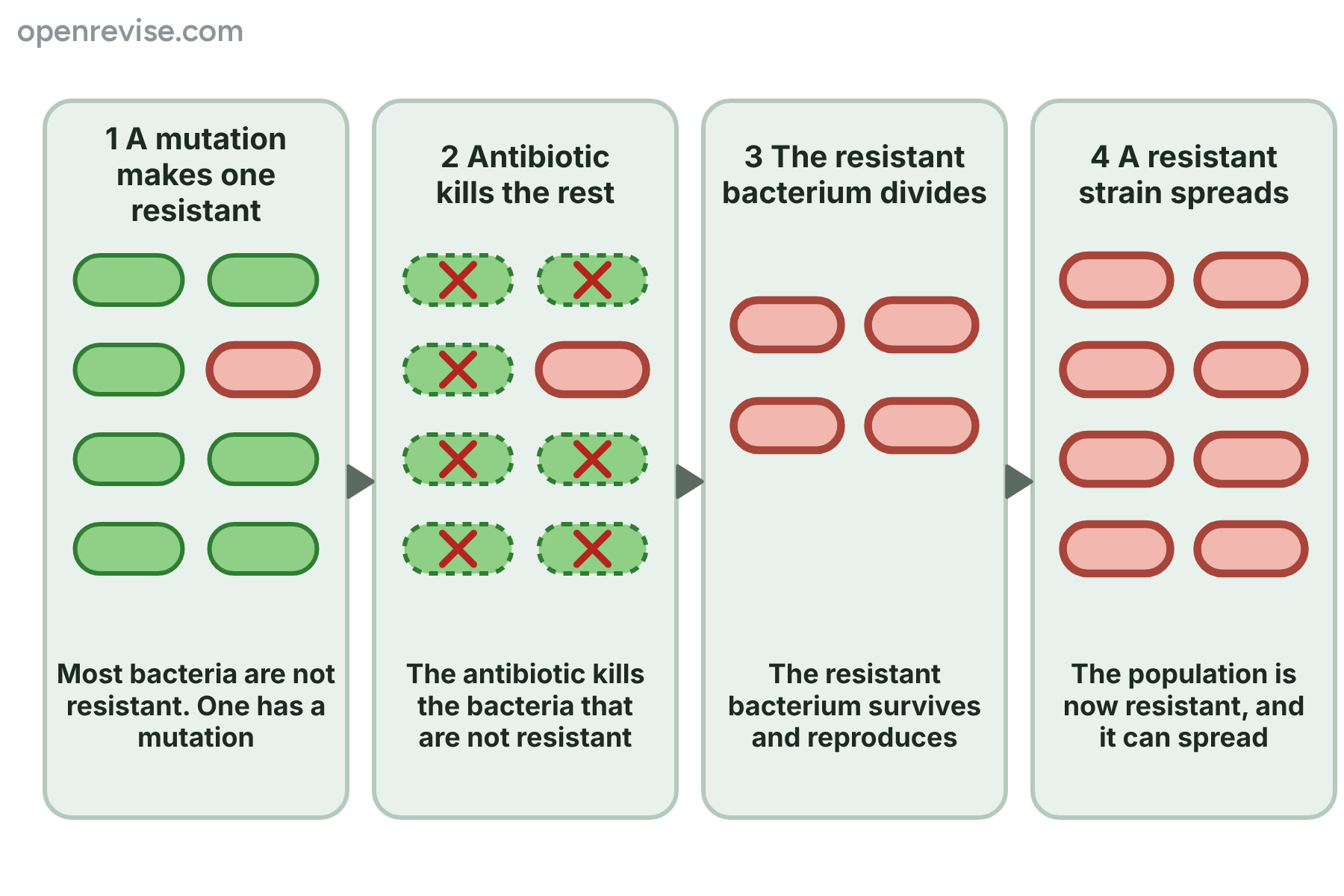
- Non-resistant bacteria Killed by the antibiotic; Survive only if the antibiotic is not present; Their alleles become less common when the antibiotic is used
- Resistant bacteria Not killed by the antibiotic; Survive and reproduce when the antibiotic is used; Their alleles become more common
How a resistant strain evolves
- Variation Mutations of bacterial pathogens produce new strains.
- Selection pressure When the antibiotic is used, bacteria that are not resistant are killed.
- Survival Strains that are resistant are not killed. They survive.
- Reproduction The survivors reproduce, so the population of the resistant strain rises.
Biology · AQA Paper 2
Evidence for Evolution and Classification continued
Classification and the Linnaean System
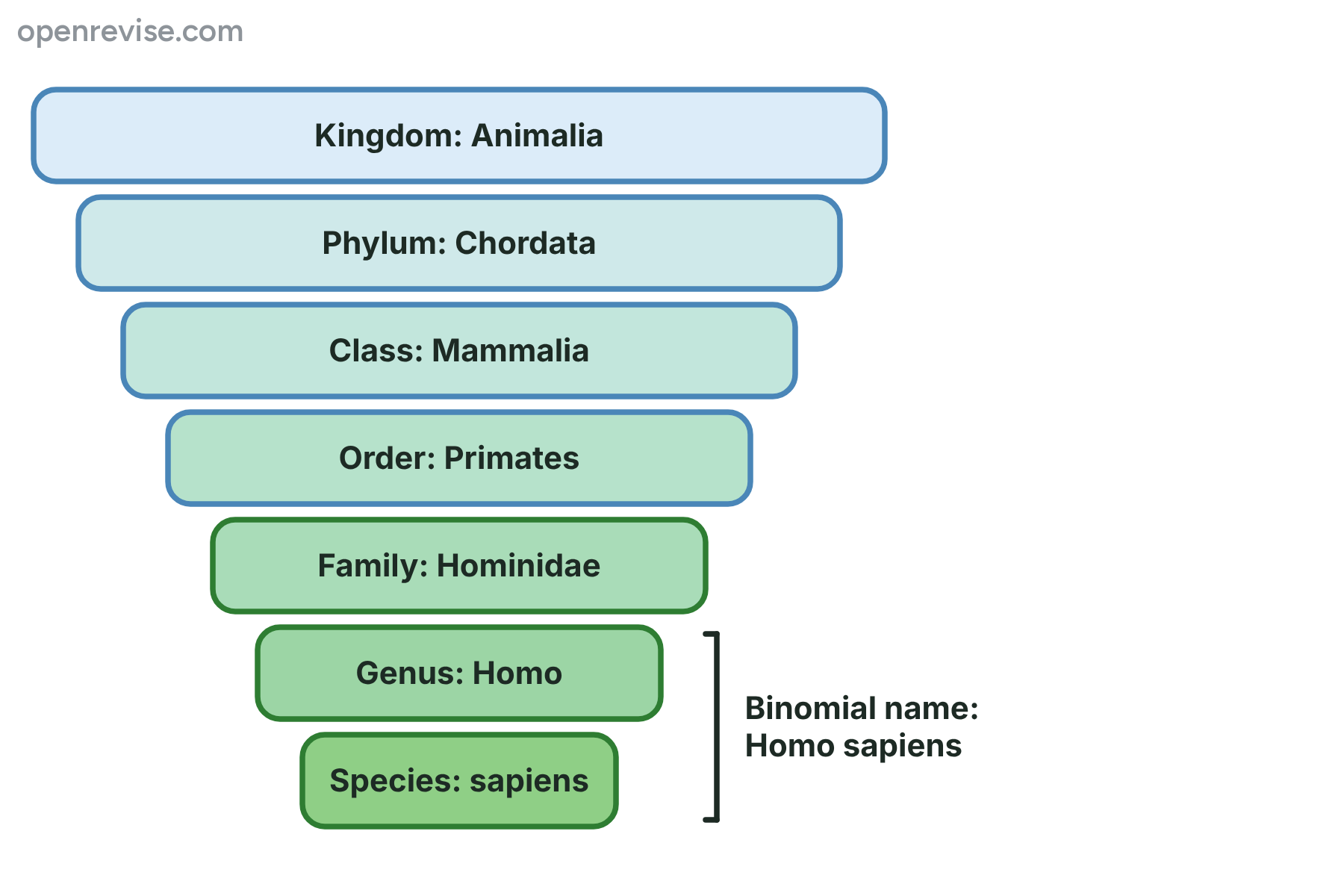
The Linnaean system sorts organisms into groups inside groups, and every species has a two-part name made of its genus and species.
- Classification Sorting living things into groups according to their characteristics.
- Linnaean system A system that classifies living things into kingdom, phylum, class, order, family, genus and species.
- Kingdom The largest group in the Linnaean system, such as animals or plants.
Features of the system
- Strengths A standard way of naming and sorting organisms; Scientists everywhere use the same name; Shows how closely related organisms are
- Limits Based on structure, so may group organisms by appearance, not ancestry; Cannot show how recently species diverged; New evidence has led to changes in classification
Remembering the order
- Kingdom The biggest group, so the least in common.
- Phylum The next group down.
- Class Includes animals such as mammals, birds and reptiles.
- Order Includes groups such as the primates and the carnivores.
The Three-domain System and Evolutionary Trees
Classification and evolutionary trees are scientific models, and they are changed whenever better evidence comes along.
- Domain The highest level of classification, above the kingdom, in the three-domain system.
- Archaea Primitive bacteria, usually living in extreme environments.
- Bacteria The true bacteria, in one of the three domains.
Linnaean system and three-domain system
- Linnaean system Developed by Carl Linnaeus; Based on structure and characteristics; Starts with the kingdom
- Three-domain system Developed by Carl Woese; Based on evidence from chemical analysis; Sits above the kingdoms, with three domains
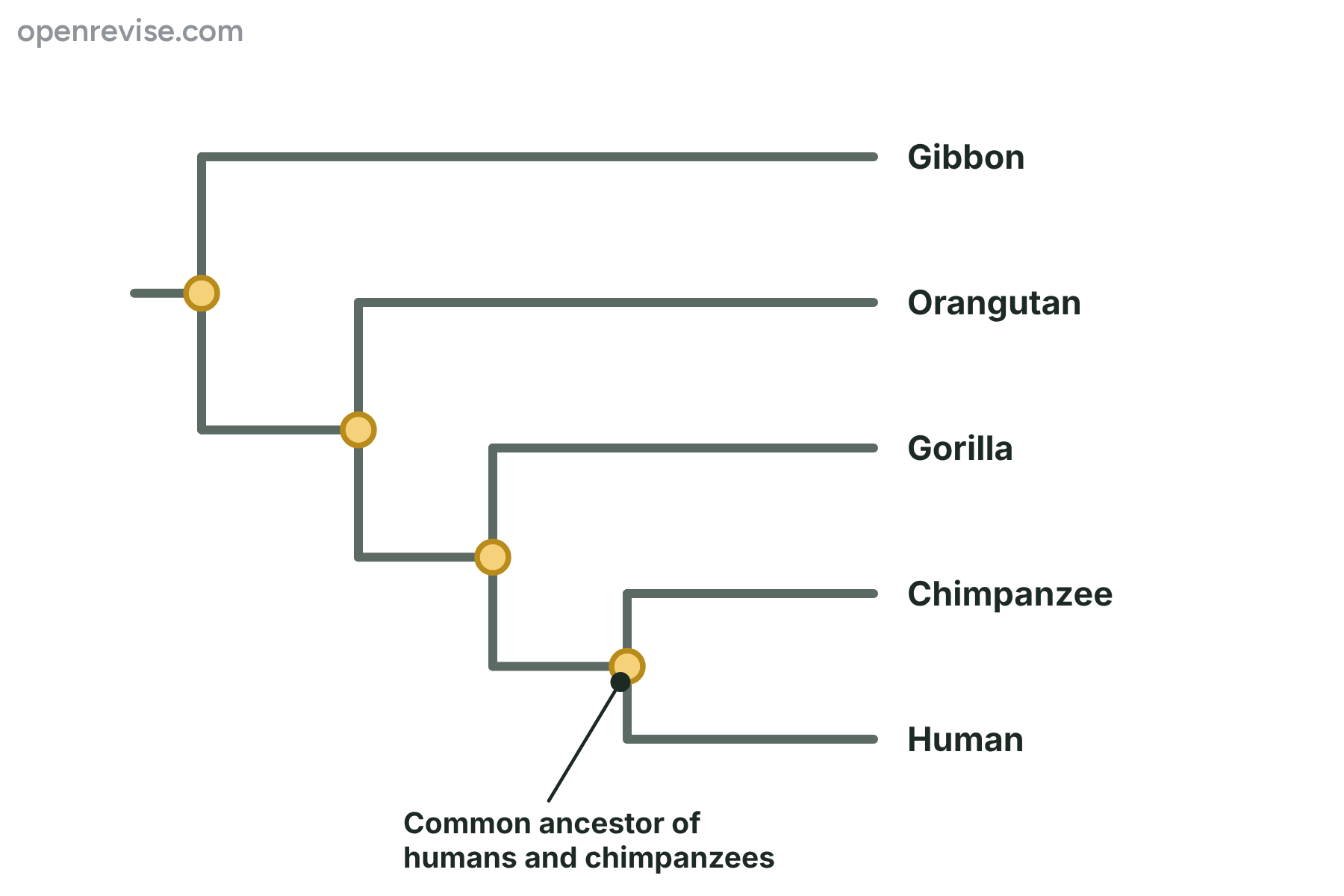
How to read an evolutionary tree
- Find the tips The organisms alive today, or extinct organisms known from…
- Trace back Follow each branch back to the point where it joins another…
- Compare the branch points Two organisms that share a recent branch point are closely related.
- Do not read across The order of the tips along the side does not show closeness.
Darwin, Lamarck and the Theory of Evolution (Separate only)
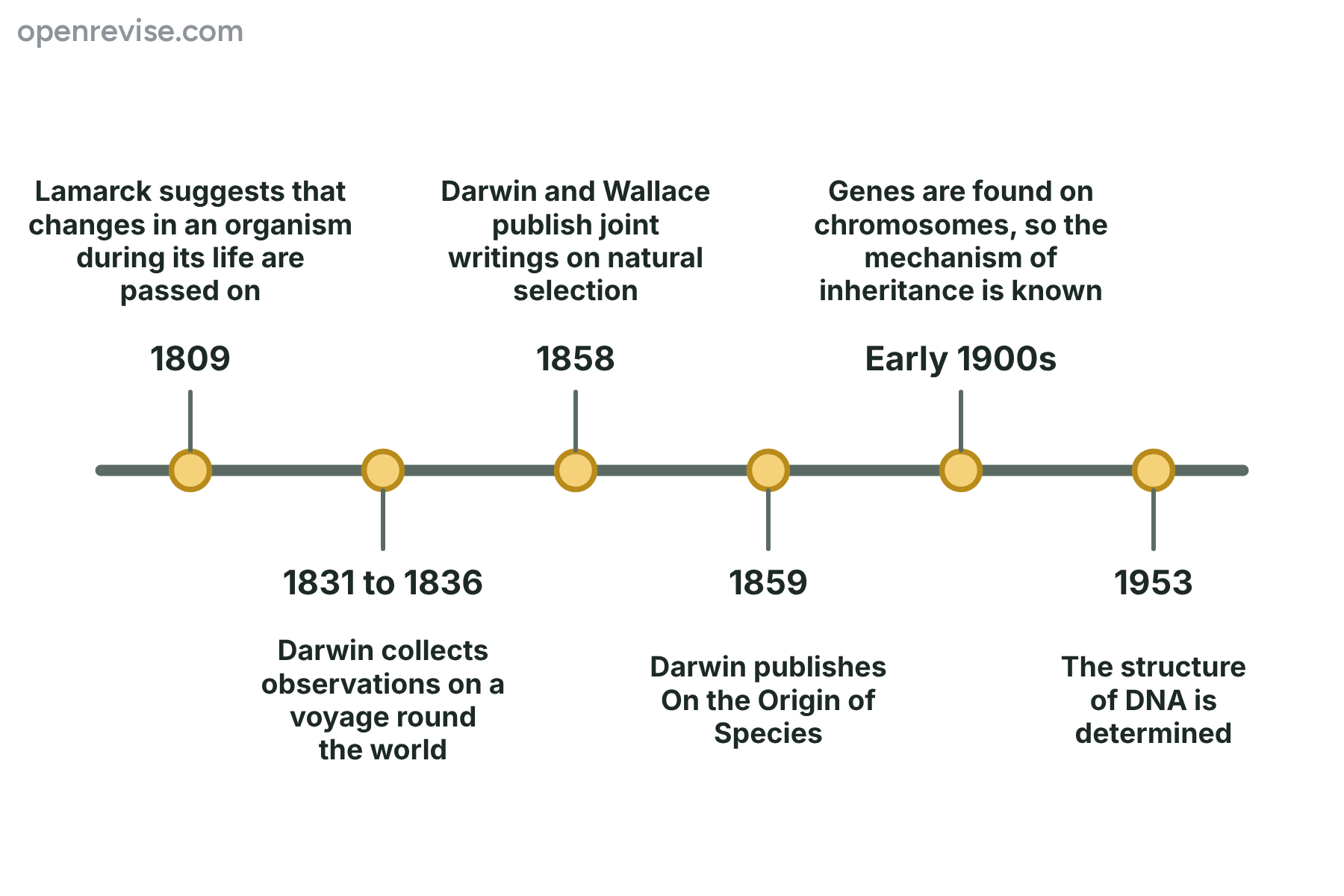
Darwin proposed that natural selection acts on the variation between individuals.
- Theory of evolution The idea that all species have evolved from simple life forms by natural selection.
- Charles Darwin The scientist who proposed the theory of evolution by natural selection.
- On the Origin of Species The book Darwin published in 1859 to set out his theory.
Lamarck and Darwin
- Lamarck Changes during an organism's life are inherited; Use of a body part makes it bigger; Offspring inherit the changes
- Darwin There is variation in a population; The best-suited individuals survive and breed; The alleles for helpful features are passed on