Biology · Genetic Inheritance
Knowledge organiser
The whole chapter on two pages. Print it on A4 — they are already landscape — or cover a box and see how much of it you can say from memory.
Biology · AQA Paper 2
Genetic Inheritance
Genes, Alleles and Genetic Terms
Genotype plus environment gives phenotype, and a dominant allele shows even when only one copy is present.
- Gamete A sex cell, such as a sperm cell or egg cell, that carries one copy of each gene.
- Chromosome A long molecule of DNA in the nucleus that carries many genes.
- Gene A small section of DNA on a chromosome that codes for a particular protein.
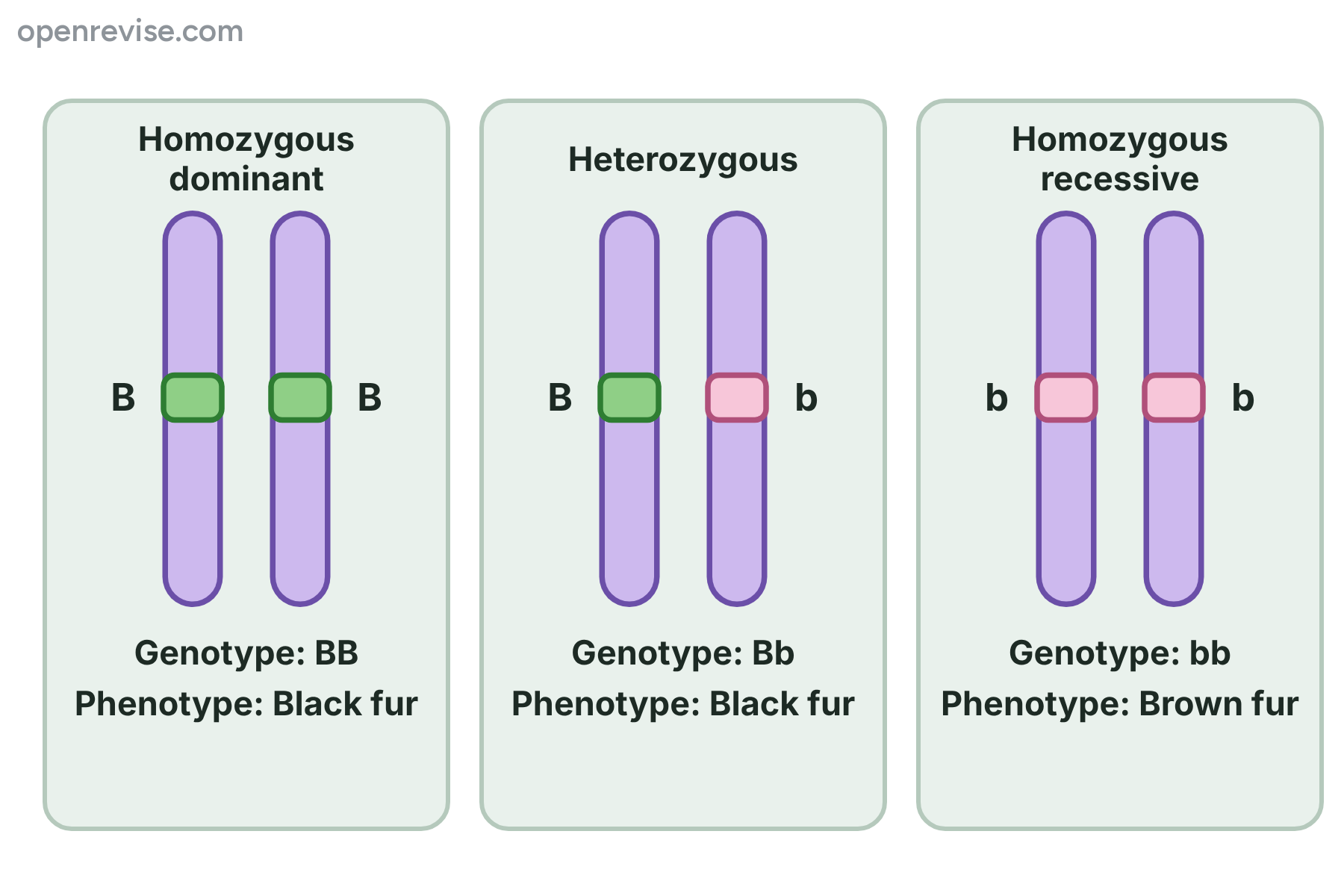
Homozygous or heterozygous?
- Homozygous The two alleles are the same; BB (dominant) or bb (recessive); Only one kind of gamete can be made
- Heterozygous The two alleles are different; Bb; Two kinds of gamete can be made, B and b
Single Gene Crosses and Punnett Squares
A Punnett square shows every possible combination of gametes, so it predicts how likely each outcome is, not what will actually happen.
- Punnett square A diagram that shows all the possible combinations of gametes in a genetic cross.
- Genetic cross A mating between two parents, used to predict the genotypes and phenotypes of the offspring.
- Gamete A sex cell that carries one allele of each gene.
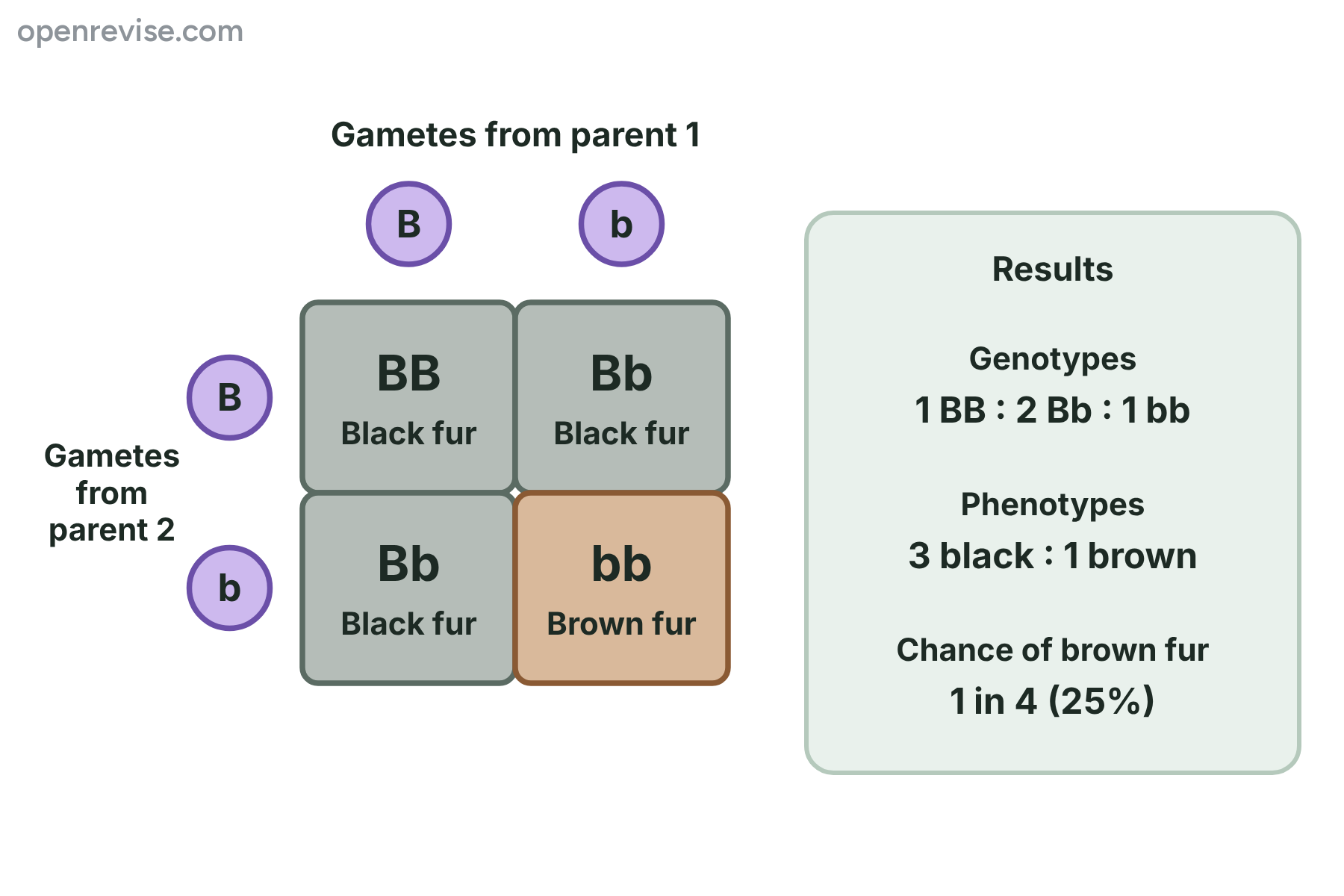
Two common crosses
- Bb x Bb Gametes B, b and B, b; Offspring 1 BB : 2 Bb : 1 bb; 3 show the dominant phenotype to 1 recessive
- Bb x bb Gametes B, b and b, b; Offspring 2 Bb : 2 bb; 1 dominant phenotype to 1 recessive
Completing a Punnett square
- Write the parents' genotypes For example Bb and Bb, with B for black fur.
- Write the gametes Each gamete has one allele from each parent.
- Fill in the squares Copy the allele from the top and the allele from the side into…
- Read off the phenotypes Use the rule that the dominant allele is expressed.
Biology · AQA Paper 2
Genetic Inheritance continued
Inherited Disorders and Family Trees
Inherited disorders are caused by alleles, and whether the allele is dominant or recessive decides how the disorder moves through a family.
- Inherited disorder A disorder caused by alleles that are passed from parents to offspring.
- Polydactyly An inherited disorder in which a person has extra fingers or toes, caused by a dominant allele.
- Cystic fibrosis An inherited disorder of cell membranes, caused by a recessive allele, that produces thick sticky mucus.
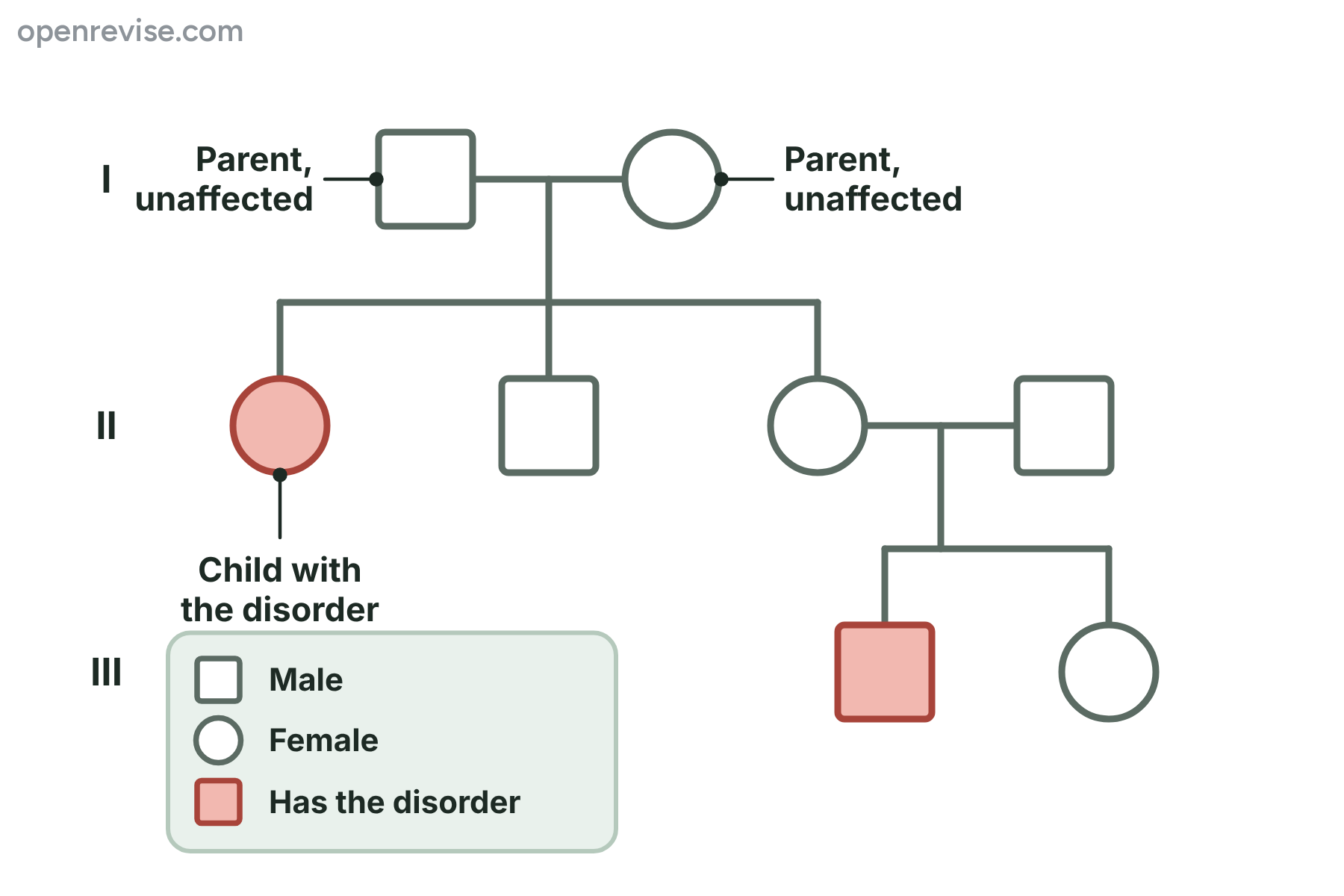
Polydactyly and cystic fibrosis
- Polydactyly Caused by a dominant allele; One copy is enough to have the disorder; An affected person must have an affected parent
- Cystic fibrosis Caused by a recessive allele; Two copies are needed to have the disorder; Two unaffected carrier parents can have an affected child
Working out genotypes from a family tree
- Decide if the allele is dominant or recessive Unaffected parents with an affected child means it is recessive.
- Write the genotypes of affected people An affected person with a recessive disorder is nn.
- Work out their parents Each parent passed on one n, and as they are unaffected they also have an N.
- Use a Punnett square for the probability Cross the parents' genotypes and read off the chance for the next child.
Sex Determination
Every egg carries an X chromosome, so the father's sperm, carrying X or Y, decides the sex of the baby, with an equal chance of each.
- Sex chromosomes The pair of chromosomes that determines the sex of a person: XX in females and XY in males.
- X chromosome A sex chromosome carried by all eggs and by half of sperm.
- Y chromosome The shorter sex chromosome, carried by half of sperm, which makes an embryo develop as male.
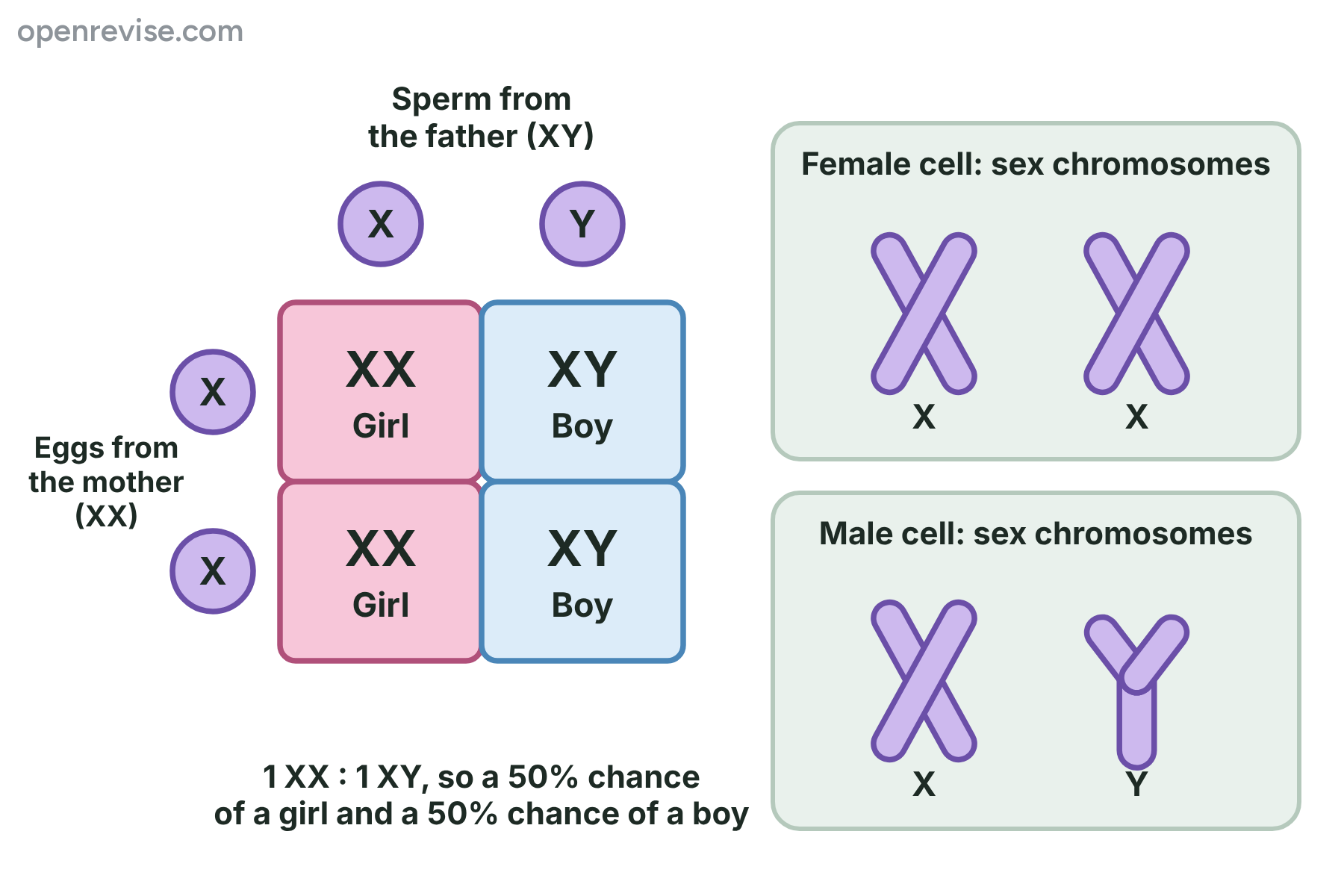
Female and male cells
- Female (XX) Two X chromosomes in every body cell; Every egg carries one X; Cannot pass on a Y chromosome
- Male (XY) One X and one Y in every body cell; Half of sperm carry X and half carry Y; Decides the sex of the baby
How the sex of a baby is decided
- Eggs A woman is XX, so every egg cell she makes carries one X chromosome.
- Sperm A man is XY, so half of his sperm carry an X chromosome and half…
- Fertilisation An egg is fertilised by one sperm.
- Chance Either kind of sperm is equally likely to reach the egg.