Biology · Reproduction and Meiosis
Advantages and Disadvantages of Sexual and Asexual Reproduction
Some organisms reproduce only one way, but many use both, depending on the circumstances. This lesson is for separate Biology only: Trilogy students do not need it. It covers the advantages and disadvantages of sexual and asexual reproduction, and examples of organisms that use both methods, so that you can explain the advantages and disadvantages for any organism, if you are given the information.
Learning Objectives
- 1Describe the advantages of sexual reproduction, including variation and its link with natural selection and selective breeding.
- 2Describe the advantages of asexual reproduction, including that it is faster and needs only one parent.
- 3Give examples of organisms that reproduce by both methods: malarial parasites, fungi, strawberry plants and daffodils.
- 4Explain the advantages and disadvantages of sexual and asexual reproduction for an organism, when given appropriate information.
Retrieval practice
-
1
What is a clone?
Show answerHide answer
An organism that is genetically identical to its parent.
-
2
What is natural selection?
Show answerHide answer
The process in which organisms that are best adapted to their environment survive and reproduce, and pass on their characteristics.
-
3
What is selective breeding?
Show answerHide answer
The process in which humans choose organisms with desired characteristics, and breed them.
-
4
What is variation?
Show answerHide answer
Differences between the individuals of a population.
Weighing the methods
Neither method of reproduction is better in every situation. Sexual reproduction produces variation, which can help a species to survive when the environment changes, but it takes time and energy to find a mate. Asexual reproduction is quick, and needs only one parent, but all the offspring are clones, so they are all affected in the same way by a change in the environment, or by a disease. For the exam you are expected to explain the advantages and disadvantages of each method for any organism, if you are given information about it.
Advantages of sexual reproduction
The benefits all come from the variation in the offspring.
-
Variation
The offspring are different from each other, because of the mixing of genetic information.
-
Survival
If the environment changes, variation gives a survival advantage. Some of the offspring may be better adapted to the new conditions, so they survive and reproduce, by natural selection.
-
Selective breeding
Humans can speed up natural selection by selective breeding, to increase food production, because there is variation in the characteristics to choose from.
-
Disadvantage
Two parents are needed, it takes more time and energy to find a mate, and it is slower than asexual reproduction, with fewer offspring.
Advantages of asexual reproduction
The benefits come from the simplicity and the speed of the method.
-
One parent
Only one parent is needed, so there is no need for a mate.
-
Efficient
It is more time and energy efficient, because the organism does not need to find a mate, or make gametes.
-
Faster
It is faster than sexual reproduction.
-
Many offspring
Many identical offspring can be produced when the conditions are favourable.
-
Disadvantage
There is no variation, so all the offspring are equally affected by a change in the environment, or a disease.
Organisms that use both methods
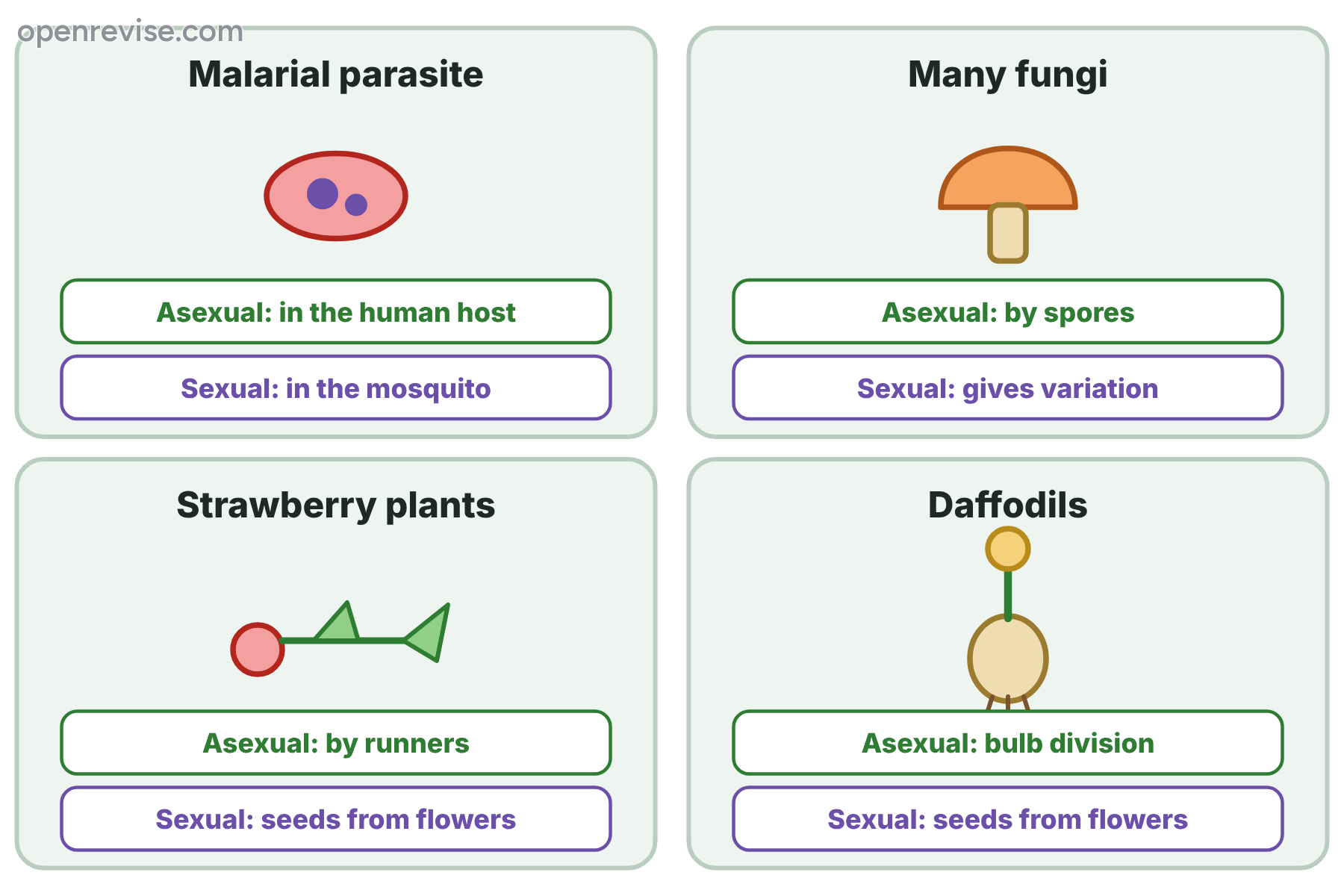
Many organisms use both asexual and sexual reproduction, depending on the circumstances.
Organisms that use both methods
The specification names four examples, and you are not expected to know others.
-
Malarial parasites
They reproduce asexually in the human host, and sexually in the mosquito.
-
Many fungi
They reproduce asexually by releasing spores, which gives many identical offspring quickly. They also reproduce sexually, which gives variation.
-
Strawberry plants
They produce seeds sexually, from flowers, and they also reproduce asexually by runners, which are stems that grow along the ground and form new plants.
-
Daffodils
They produce seeds sexually, and also reproduce asexually, by bulb division, when a bulb divides to form new bulbs.
Sexual and asexual reproduction
Sexual reproduction
- Produces variation in the offspring
- Gives a survival advantage if the environment changes
- Can be speeded up by selective breeding
- Needs two parents, and is slower
Asexual reproduction
- Only one parent is needed
- More time and energy efficient
- Faster
- Many identical offspring when conditions are favourable
Explaining for an unfamiliar organism
A species of fungus reproduces asexually in the summer, by releasing millions of spores, and sexually in the autumn. Explain the advantages to the fungus of using both methods.
Show the solutionHide the solution
- 1 Asexual Fast, and many offspring, when conditions are favourable.
- 2 No mate It saves time and energy, because no mate is needed.
- 3 Sexual It gives variation among the offspring.
- 4 Survival If the environment changes, some of the variants may survive, by natural selection.
AnswerIn the summer, when conditions are good, asexual reproduction by spores produces many identical offspring quickly, with no need to find a mate. In the autumn, sexual reproduction gives variation, so if conditions change, some of the offspring may be better adapted to the new conditions, and survive.
Case study
Malaria and the mosquito
The parasite that causes malaria has a complicated life cycle that uses both kinds of reproduction. In the human host, it reproduces asexually, in the liver and in the red blood cells, which makes huge numbers of parasites, and causes the fever. When a mosquito bites an infected person, it takes up parasites, and in the mosquito the parasites reproduce sexually. This produces new combinations of genes, and the variation can lead to parasites that are resistant to antimalarial drugs. Controlling the mosquito, for example with bed nets, can break the life cycle of the parasite.
Summary and exam focus
- Sexual reproduction gives variation, which helps survival when the environment changes.
- Sexual reproduction can be speeded up by selective breeding.
- Asexual reproduction needs one parent, and is faster and more efficient.
- Asexual reproduction can give many identical offspring when conditions are favourable.
- Malarial parasites, fungi, strawberry plants and daffodils use both methods.
Exam focus
Explain the advantages and disadvantages of asexual reproduction and of sexual reproduction for a named organism. (6 marks) (6 marks)
Choose one of the four named organisms, and give one advantage and one disadvantage for each method, linking each to variation, speed, the number of parents or the survival of the offspring.
Key terms
The words this lesson expects you to use. Each one is linked from the first place it appears above.
- Variation
- Differences between the individuals of a population.
- Natural selection
- The process by which the best adapted organisms survive and reproduce.
- Selective breeding
- The process by which humans breed plants and animals for particular characteristics.
- Spore
- A tiny reproductive structure of a fungus, which grows into a new fungus.
- Runner
- A stem that grows along the ground and forms a new plant.
- Bulb division
- The division of a bulb into new bulbs, which grow into new plants.
- Malarial parasite
- The microorganism that causes malaria.
- Host
- An organism that a parasite lives in or on.
- Clone
- An organism that is genetically identical to its parent.
You've finished the notes
Check your understanding
Test yourself while it is fresh. Start with the flashcards, then try the exam questions.
Something here looks wrong?
Tell us what and we will go and look. It goes to whoever writes these pages, nobody else, and we do not ask who you are — so there is nothing to sign and nothing comes back to you.