Biology · Variation and Evolution
Knowledge organiser
The whole chapter on two pages. Print it on A4 — they are already landscape — or cover a box and see how much of it you can say from memory.
Biology · AQA Paper 2
Variation and Evolution
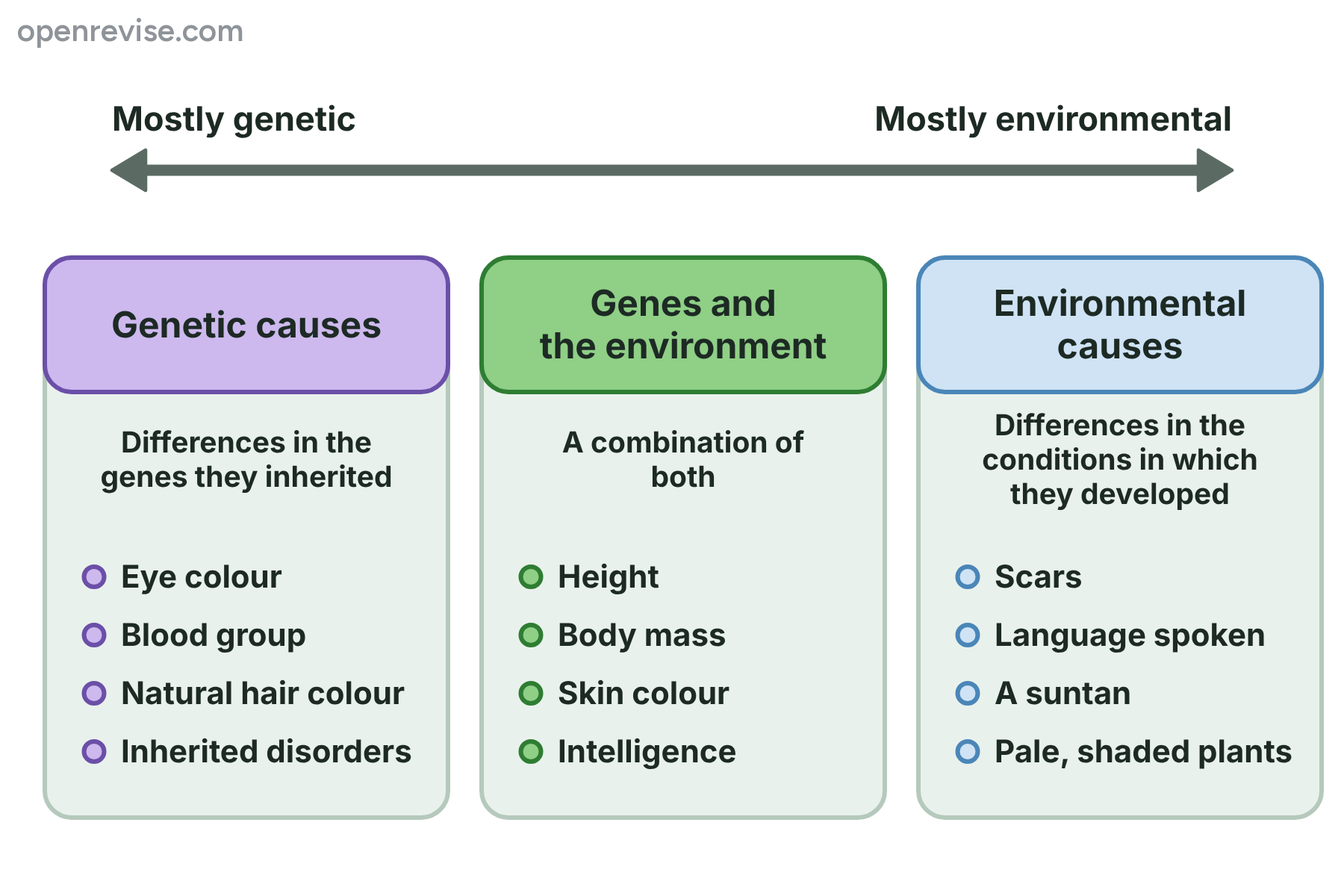
Variation
Variation comes from genes and the environment, and mutations are the original source of every new allele.
- Variation The differences in the characteristics of individuals in a population.
- Population All the organisms of one species living in the same area.
- Genetic variation Variation caused by differences in the genes individuals inherit.
Evolution and Natural Selection
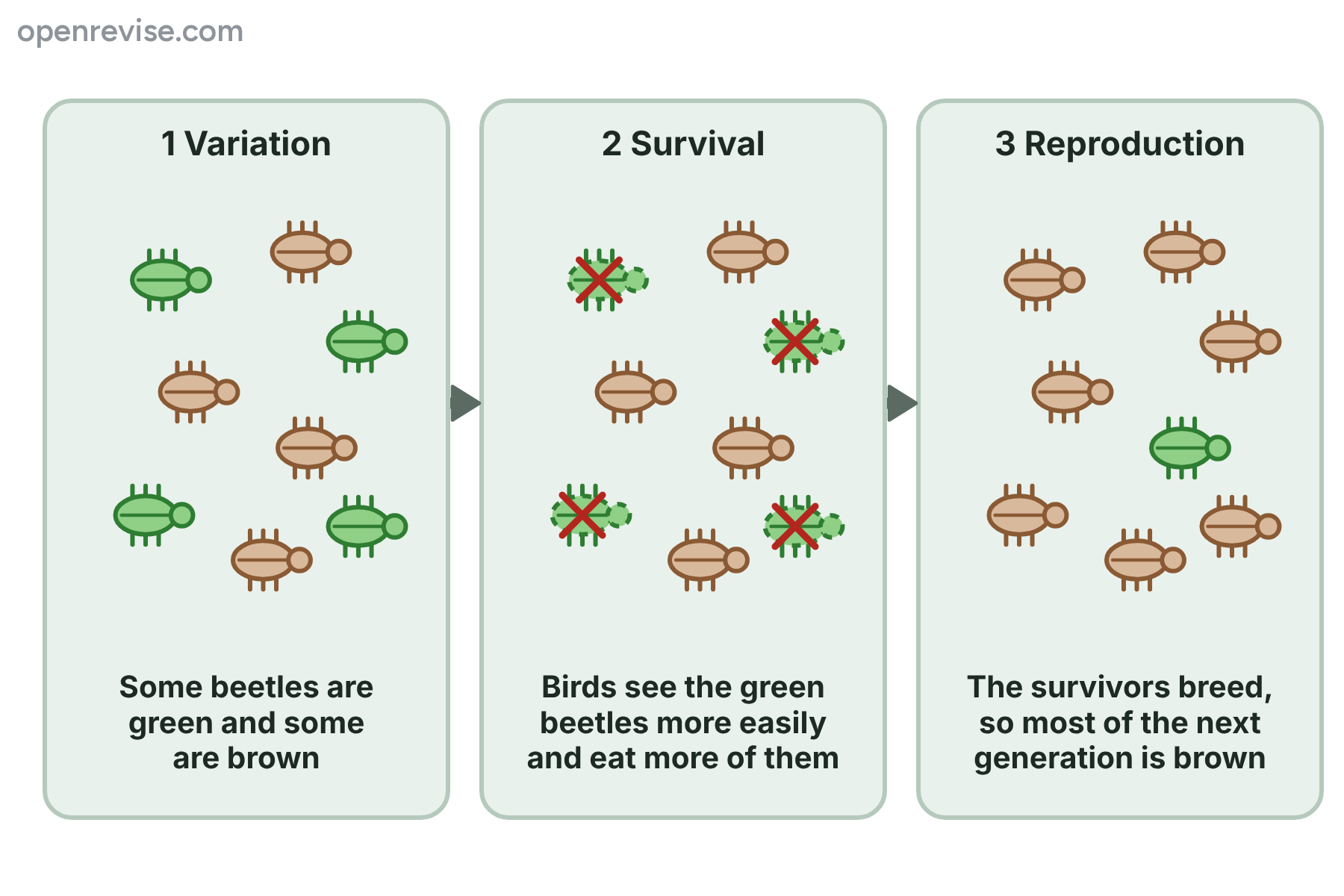
Individuals with phenotypes best suited to their environment survive and breed, so their alleles become more common in the next generation.
- Evolution A change in the inherited characteristics of a population over time, through natural selection.
- Natural selection The process in which individuals best suited to their environment survive and breed, passing on their alleles.
- Selection pressure A factor in the environment, such as predators or disease, that affects which individuals survive.
Natural selection and selective breeding
- Natural selection The environment selects; Individuals best suited survive and breed; Happens without human choice
- Selective breeding Humans choose the parents; Individuals with the desired characteristic breed; Aims at a characteristic that humans want
The steps of natural selection
- Variation Individuals in a population show a wide range of variation in a characteristic.
- A change or a struggle There is a selection pressure, such as a predator, a disease…
- Survival of the best suited Individuals with the characteristics best suited to the…
- Passing on alleles The alleles that gave them an advantage are passed on to their…
Selective Breeding
Selective breeding is artificial selection: humans choose which individuals breed, so the desired characteristic becomes more common in each generation.
- Selective breeding The process by which humans breed plants and animals for particular genetic characteristics.
- Artificial selection Another name for selective breeding, in which humans choose which individuals reproduce.
- Domesticated Bred by humans to be kept as farm animals or pets.
Benefits and risks of selective breeding
- Benefits Higher yields of crops, milk and meat; Disease-resistant crops; Useful characteristics, such as a gentle nature
- Risks Inbreeding reduces the number of alleles; Breeds prone to disease or inherited defects; A whole population may be at risk from one disease
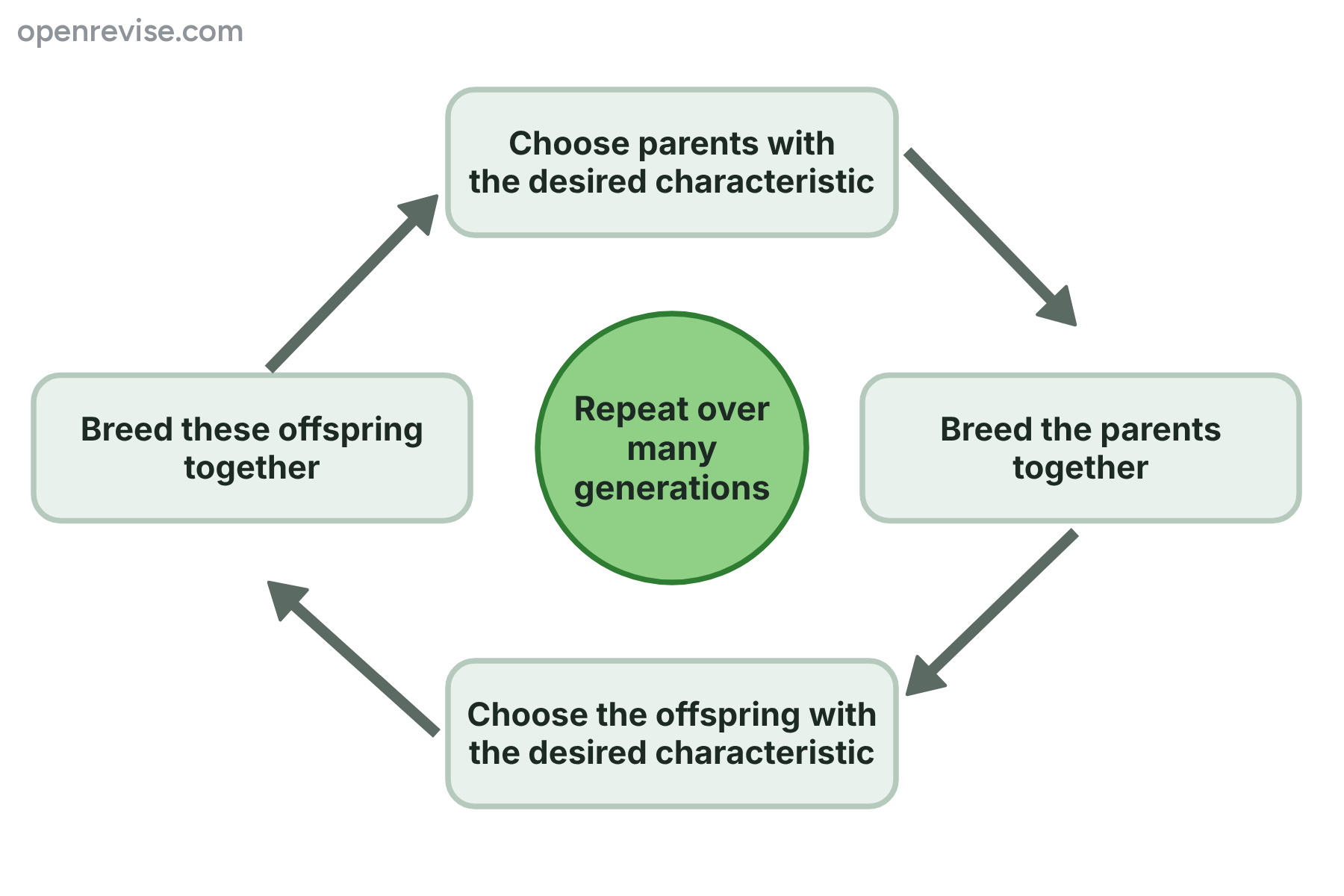
How selective breeding works
- Choose the parents Select parents with the desired characteristic from a mixed population.
- Breed them together The chosen parents are bred together.
- Select from the offspring From the offspring, choose those with the desired characteristic…
- Repeat over generations This continues over many generations, until all the offspring…
Biology · AQA Paper 2
Variation and Evolution continued
Genetic Engineering
Genetic engineering transfers a gene from one organism into another, so that the organism has a new characteristic.
- Genetic engineering Modifying the genome of an organism by introducing a gene from another organism to give a desired characteristic.
- Genetically modified (GM) Having had its genes changed by genetic engineering.
- GM crop A crop plant that has had a gene added, for example for insect or herbicide resistance.
Benefits and risks of GM crops
- Benefits Increased yields; Resistance to insects and herbicides; Crops can be grown with fewer chemicals
- Risks and concerns Possible effects on wild flowers and insects; Effects on human health not fully explored; Ethical objections from some people
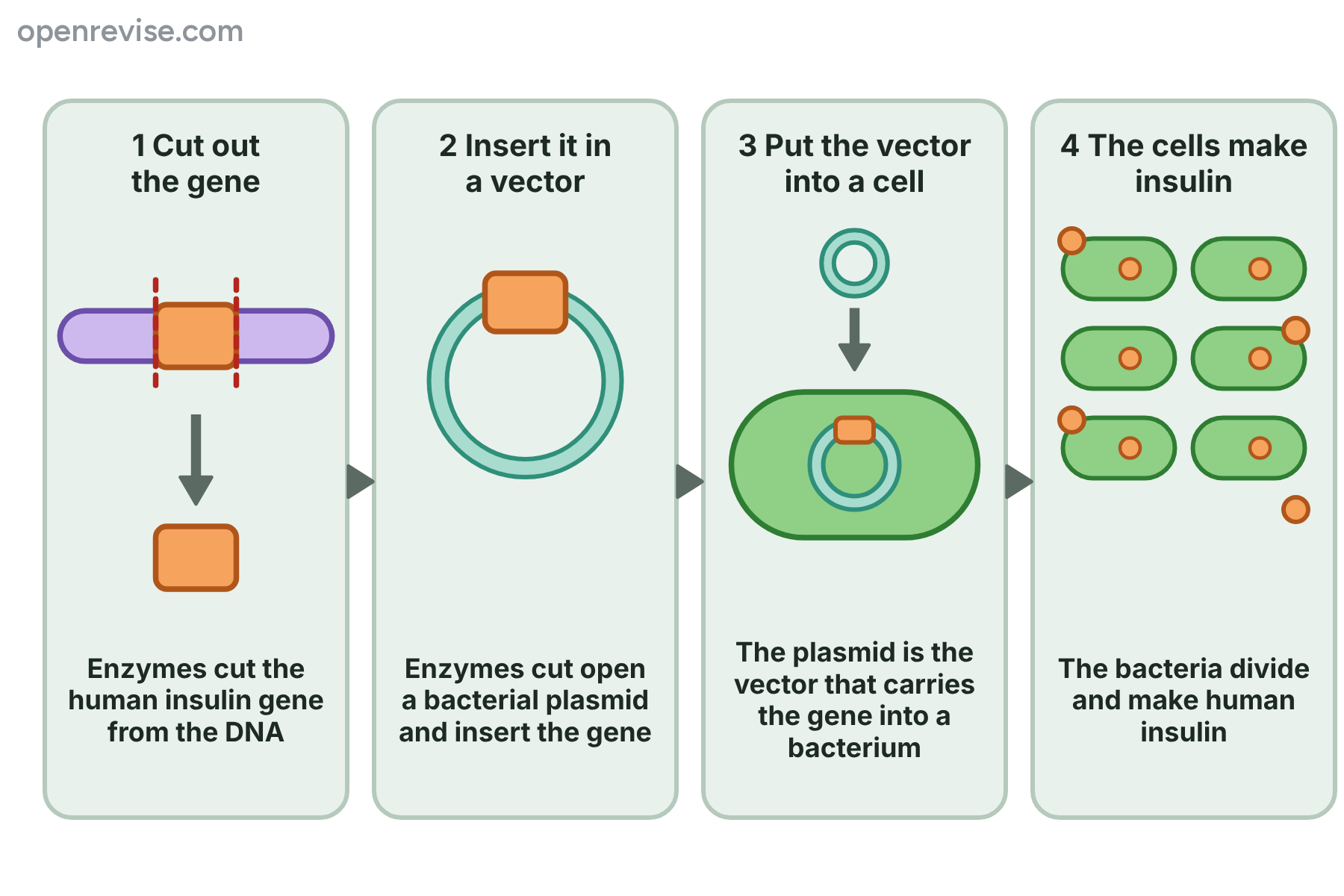
From a human gene to human insulin (Higher tier)
- Find the gene The gene for human insulin is located on a human chromosome.
- Cut it out Enzymes cut the gene from the DNA, and cut open a bacterial plasmid.
- Insert it The gene is inserted into the plasmid, which acts as the vector.
- Transfer The vector carries the gene into bacterial cells.
Cloning Plants (Separate only)
Plant clones are made by mitosis, so every new plant is genetically identical to its parent, which keeps a good characteristic but removes variation.
- Cloning Producing genetically identical copies of an organism.
- Clone An organism that is genetically identical to its parent.
- Tissue culture Growing identical new plants from small groups of cells on agar jelly.
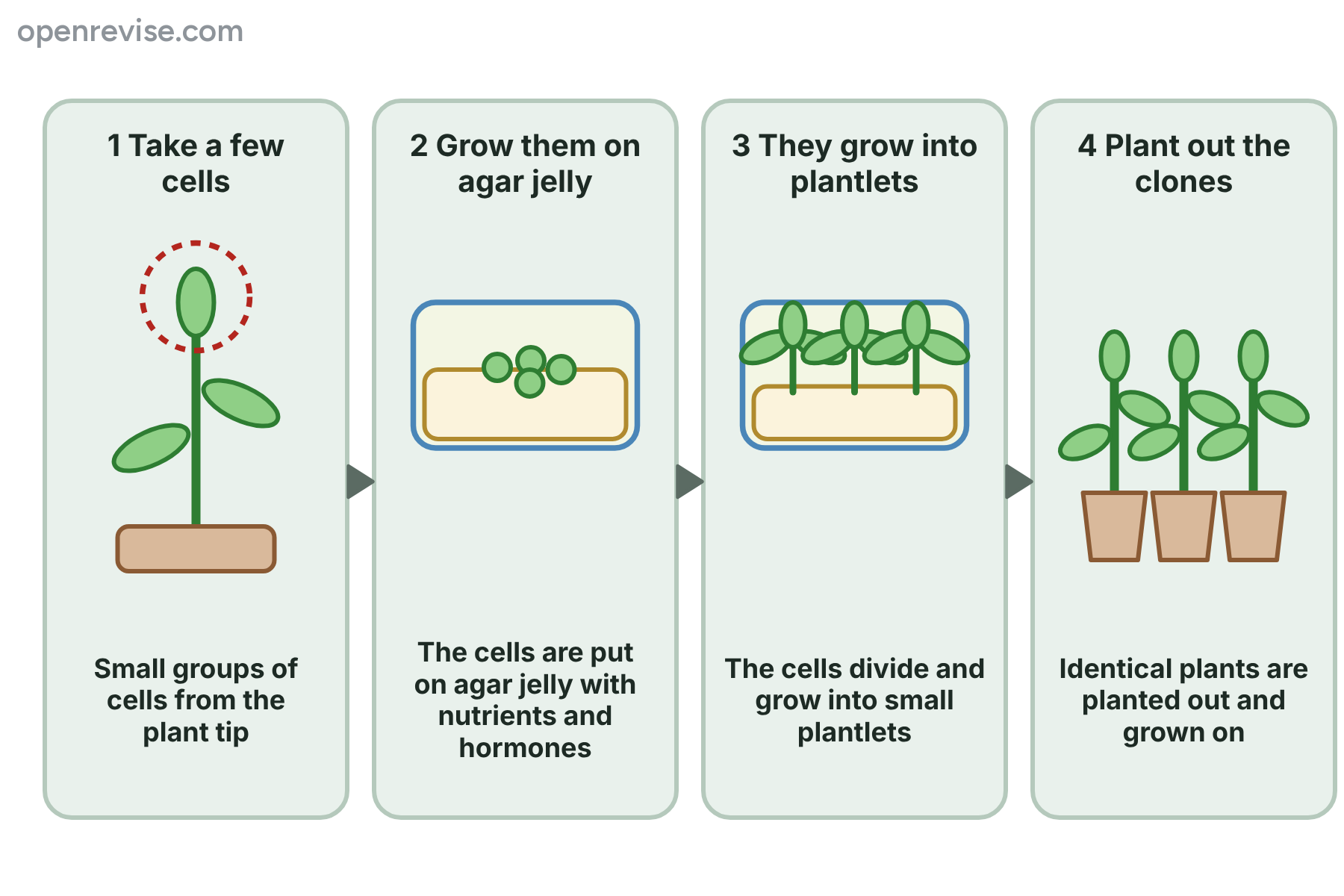
Cuttings and tissue culture
- Cuttings A piece of stem planted in compost; Cheap and simple, done by gardeners; A few new plants from each parent
- Tissue culture A few cells grown on agar jelly; Needs sterile conditions and equipment; Thousands of plants from a tiny piece
Cloning Animals (Separate only)
Cloning an animal gives offspring that are genetically identical to each other, or to the adult whose cell nucleus was used.
- Cloning Producing genetically identical copies of an organism.
- Embryo transplant Splitting an early embryo into identical embryos and transplanting them into host mothers.
- Adult cell cloning Producing a clone by putting the nucleus of an adult body cell into an egg cell with its nucleus removed.
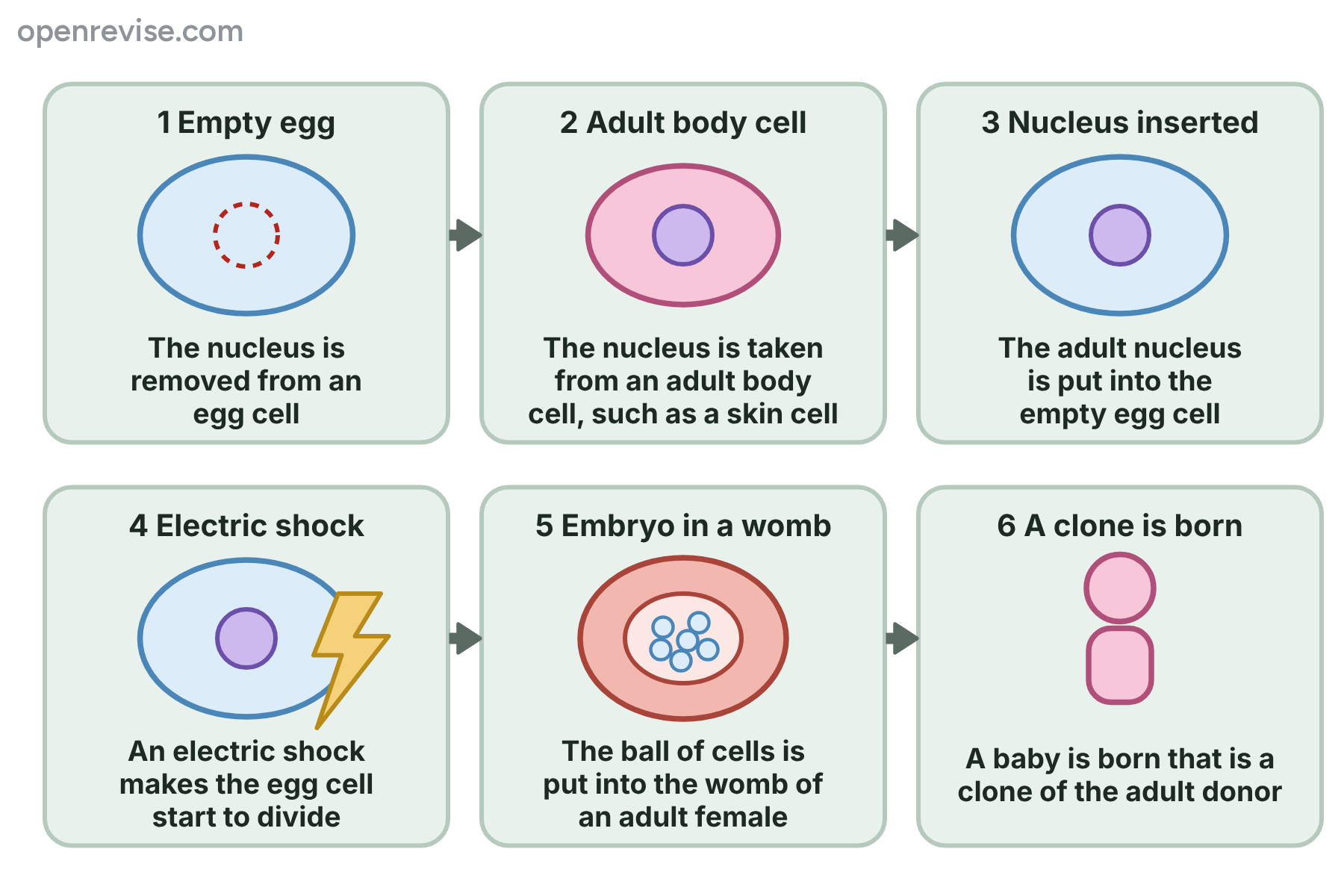
Embryo transplants and adult cell cloning
- Embryo transplants Cells of an early embryo are split apart; The embryos come from sexual reproduction; Several animals identical to each other
- Adult cell cloning A nucleus from an adult body cell is used; An egg with its nucleus removed; An animal identical to the adult donor