Biology · Cell Structure
Viewing as
Teacher view: every answer and mark scheme set out in full.
Culturing Microorganisms
Bacteria can be grown in the laboratory to study them and to test which chemicals kill them. This lesson covers how bacteria multiply, how an uncontaminated culture is prepared, and how to measure the effect of antibiotics. It is Biology only: Combined Science students do not need it.
Learning Objectives
- 1Describe how bacteria multiply by binary fission and what they need to grow.
- 2Describe how to prepare an uncontaminated culture using aseptic technique, and explain each precaution.
- 3Calculate the number of bacteria in a population after a given time, using the mean division time.
- 4Investigate the effect of antiseptics or antibiotics on bacterial growth, and calculate the area of a clear zone.
Retrieval practice
-
1
What kind of cell is a bacterium?
Show answerHide answer
A prokaryotic cell, with no nucleus.
-
2
Where is the genetic material in a bacterial cell?
Show answerHide answer
In a single loop of DNA in the cytoplasm, plus plasmids.
-
3
Write 4000 in standard form.
Show answerHide answer
\(4 \times 10^{3}\).
-
4
How many micrometres are there in 1 mm?
Show answerHide answer
1000.
Why grow bacteria?
To study how bacteria behave, or to test whether a disinfectant or an antibiotic kills them, scientists need a large number of identical bacteria growing in controlled conditions. A group of microorganisms grown in this way is called a culture. The challenge is to keep out all the other microorganisms that are floating around in the air and on every surface.
How bacteria multiply
-
Binary fission
A bacterial cell copies its DNA and then splits into two identical cells. This is how bacteria multiply.
-
How fast
With plenty of nutrients and a suitable temperature, some bacteria can divide as often as once every 20 minutes. The time between divisions is the mean division time.
-
What they need
Nutrients, a suitable temperature and the right conditions, which is why they can be grown in the lab.
-
Two ways to grow them
In a liquid called nutrient broth, or as colonies on a jelly called agar in a Petri dish.
Doubling every 20 minutes
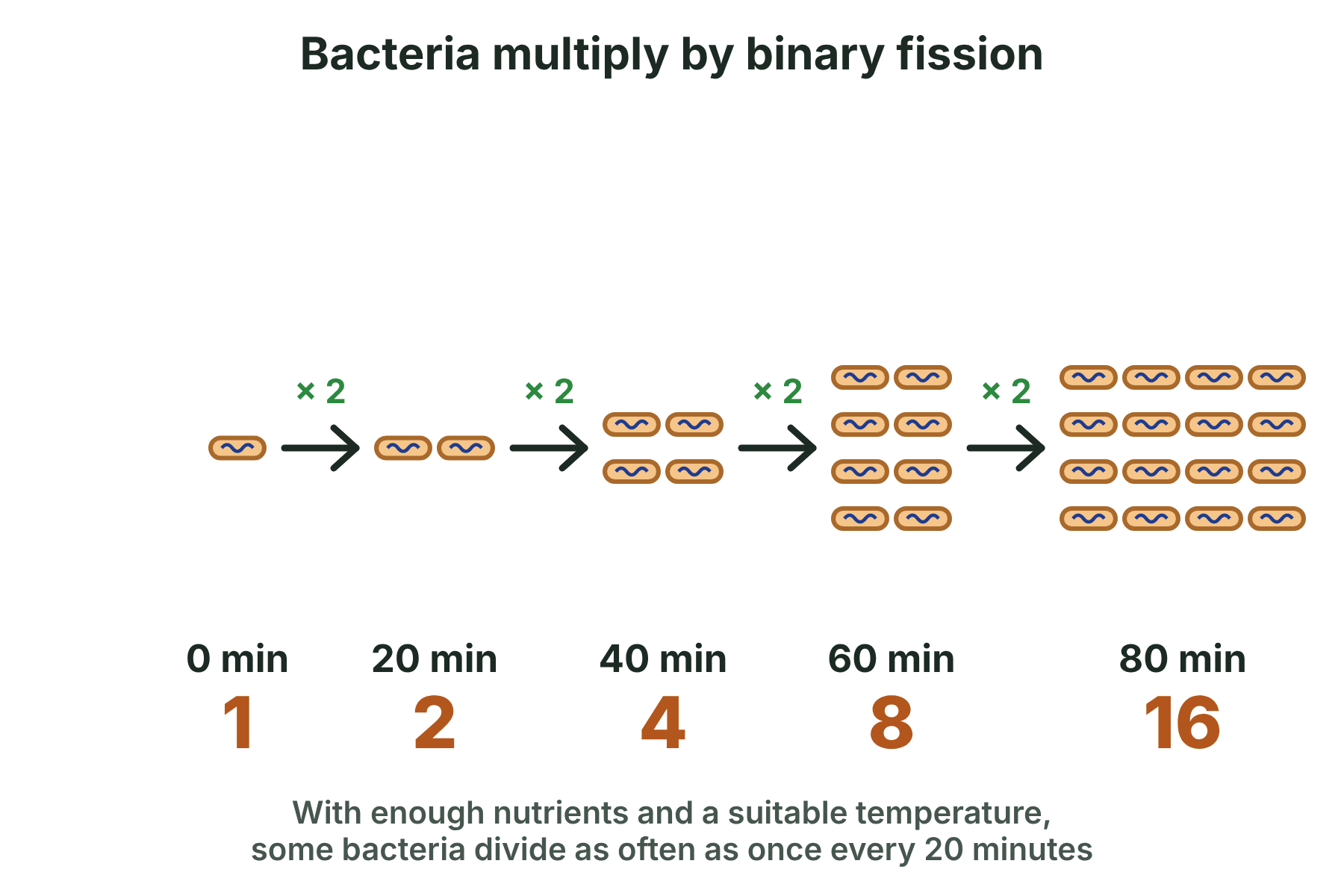
The population doubles with every division, so it grows very quickly.
How many bacteria after a given time?
One bacterium divides every 20 minutes. How many bacteria will there be after 3 hours?
Show the solutionHide the solution
- 1 Convert the time to minutes 3 hours = 180 minutes.
- 2 Work out the number of divisions 180 ÷ 20 = 9 divisions.
- 3 Double once for each division \(1 \times 2^{9} = 512\) bacteria.
AnswerThere will be 512 bacteria.
Giving the answer in standard form (Higher tier)
A culture starts with 500 bacteria. The mean division time is 30 minutes. How many bacteria are there after 8 hours? Give your answer in standard form.
Show the solutionHide the solution
- 1 Find the number of divisions 8 hours = 480 minutes. 480 ÷ 30 = 16 divisions.
- 2 Double for each division \(500 \times 2^{16} = 500 \times 65\,536 = 32\,768\,000\).
- 3 Write it in standard form \(32\,768\,000 = 3.28 \times 10^{7}\) (to 3 significant figures).
AnswerThere are about \(3.28 \times 10^{7}\) bacteria.
Preparing an uncontaminated culture
This is called aseptic technique. Its job is to keep out every microorganism except the one you are growing.
-
1
Sterilise the equipment
The Petri dish and the agar are sterilised before use, to kill any microorganisms already on them.
-
2
Sterilise the loop
The inoculating loop is passed through a flame to kill microorganisms, then allowed to cool.
-
3
Inoculate
Lift the lid only slightly, spread the bacteria over the agar with the loop, and close the lid at once.
-
4
Tape the lid
Seal the lid with adhesive tape so microorganisms from the air cannot get in. The tape is not run all the way round.
-
5
Incubate
Store the dish upside down, at 25 °C or below in school and college laboratories.
Aseptic technique
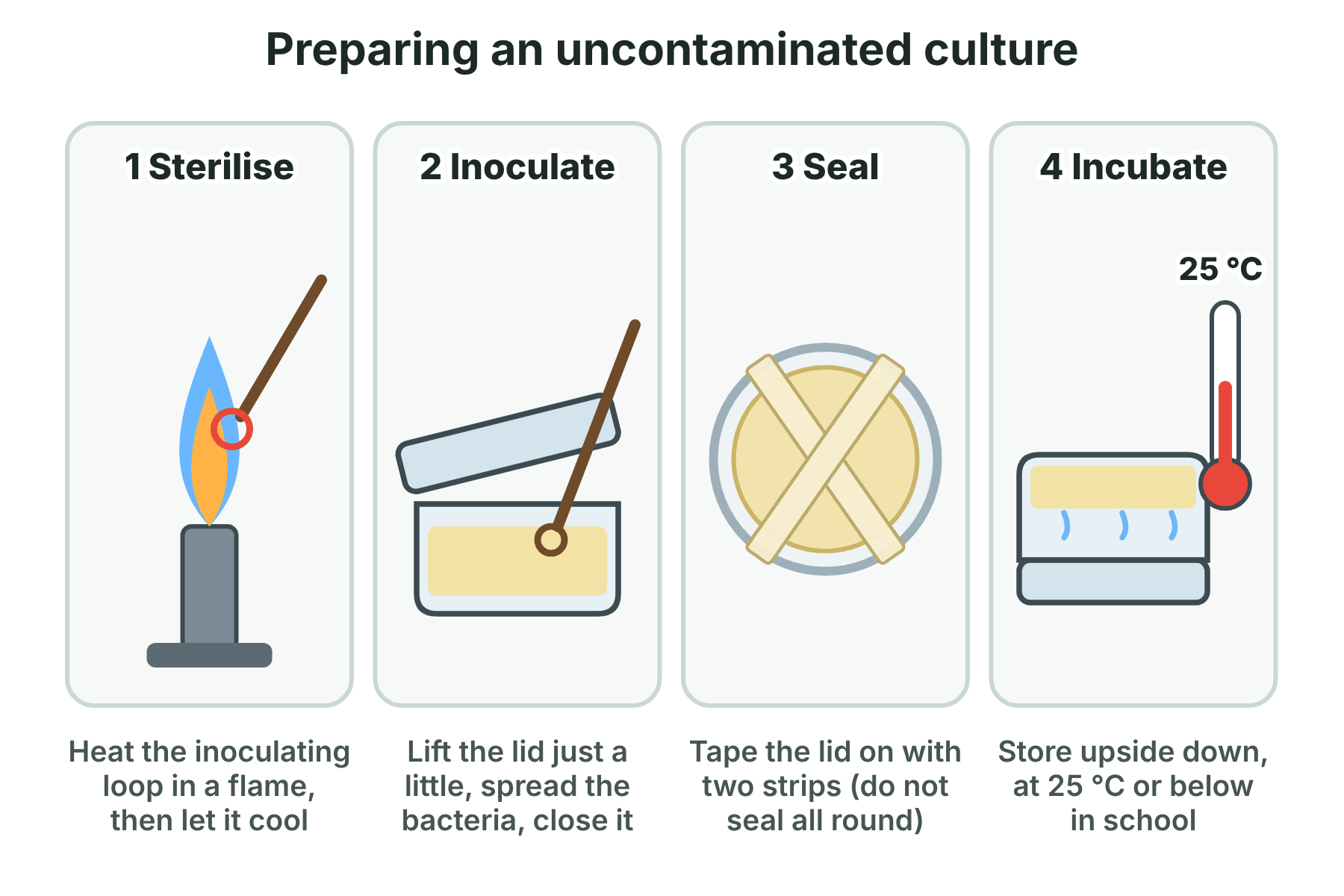
Each step stops unwanted microorganisms getting into the culture.
Why each precaution matters
The exam asks you to explain, not just list, so learn the reason with each step.
-
Sterilise the dish and agar
Kills any microorganisms that were already there, which could be harmful or crowd out the bacteria you want.
-
Flame the loop
Kills microorganisms on the loop so that only the bacteria you want are transferred.
-
Tape the lid
Stops microorganisms in the air from getting in. It is not sealed all the way round so oxygen can still get in and harmful anaerobic bacteria cannot grow.
-
Incubate at 25 °C or below
At higher temperatures, such as body temperature, harmful pathogens are more likely to grow.
Testing antibiotics (required practical)
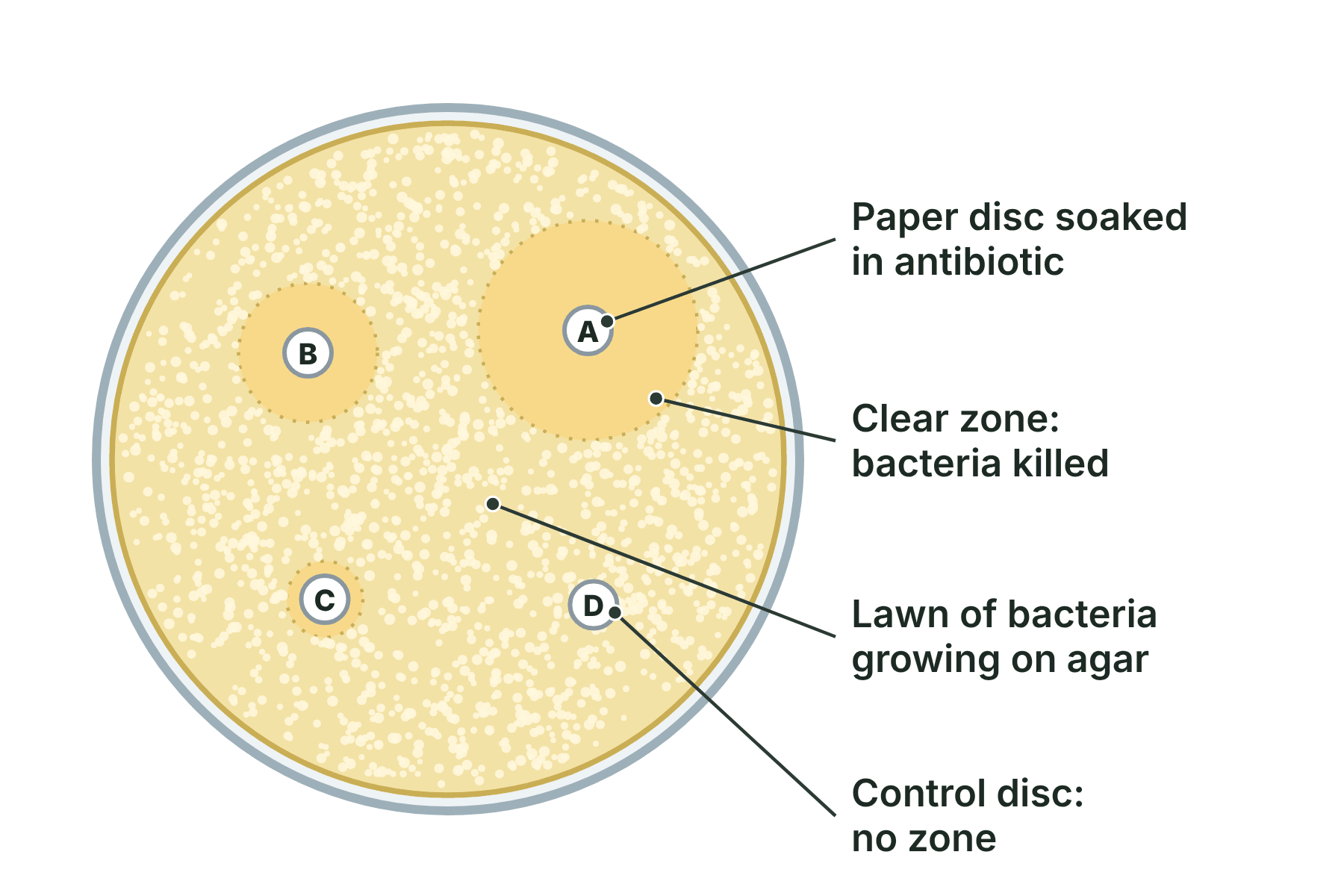
The larger the clear zone, the more effective the antibiotic is at killing the bacteria.
How to read the plate
To test antiseptics or antibiotics, paper discs soaked in each one are placed on an agar plate that has been spread with bacteria. After incubation, a clear zone appears around a disc where the chemical has stopped the bacteria growing.
-
Clear zone
An area where no bacteria have grown, because the chemical killed them or stopped them growing.
-
Bigger zone
A bigger clear zone means a more effective antibiotic or antiseptic.
-
Control disc
A disc soaked in sterile water shows that the paper itself does not stop bacteria growing.
Calculating the area of a clear zone
The clear zone around an antibiotic disc has a diameter of 28 mm. Calculate the cross-sectional area of the zone.
Show the solutionHide the solution
- 1 Find the radius Radius = diameter ÷ 2 = 28 ÷ 2 = 14 mm.
- 2 Write the formula Area of a circle: \(A = \pi r^{2}\)
- 3 Substitute and calculate \(A = \pi \times 14^{2} = \pi \times 196 = 615.8\text{ mm}^{2}\), which is 616 mm² to 3 significant figures.
AnswerThe area of the zone is about 616 mm².
Antiseptics, antibiotics and disinfectants
Used on or in living things
- Antibiotics are medicines that kill bacteria inside the body, for example penicillin
- Antiseptics are put on skin or wounds to kill bacteria
Used on objects
- Disinfectants are used on surfaces and equipment, such as a kitchen worktop
- They are too harsh to put on living tissue
Case study
Alexander Fleming and the clear zone
In 1928 the scientist Alexander Fleming noticed that a plate of bacteria had been contaminated by a mould, Penicillium. Around the mould there was a clear zone where the bacteria had not grown. He realised that the mould was making a substance that killed bacteria, and that substance became the antibiotic penicillin. A clear zone on an agar plate is exactly what you look for in this practical.
The big idea
Every step of aseptic technique has one aim: to keep unwanted microorganisms out of the culture.
Culturing microorganisms
Culturing microorganisms
-
Growth
- binary fission
- as often as every 20 minutes
- nutrient broth or agar
-
Aseptic technique
- sterilise dish and agar
- flame the loop
- tape the lid
- incubate upside down
-
Temperature
- 25 °C or below in school
-
Antibiotic testing
- paper discs
- clear zones
- control disc
-
Calculations
- divisions and doubling
- area of a clear zone, πr²
Summary and exam focus
- Bacteria multiply by binary fission, as often as once every 20 minutes in good conditions.
- Dishes and agar are sterilised, and the loop is flamed, to kill unwanted microorganisms.
- The lid is taped on and the dish is incubated at 25 °C or below, to avoid growing pathogens.
- A larger clear zone around a disc means a more effective antibiotic or antiseptic.
- Area of a clear zone is calculated with the formula \(A = \pi r^{2}\).
Exam focus
Describe how to prepare an uncontaminated culture of bacteria on an agar plate, and explain why each step is carried out. (6 marks) (6 marks)
Put the steps in order, and give a reason for each one. "The loop is passed through a flame to kill other microorganisms" earns a mark, but "the loop is flamed" does not.
Key terms
The words this lesson expects you to use. Each one is linked from the first place it appears above.
- Culture
- A population of microorganisms grown in controlled conditions in the laboratory.
- Binary fission
- The way bacteria multiply: one cell divides into two identical cells.
- Mean division time
- The average time a bacterium takes to divide into two.
- Agar
- A jelly, containing nutrients, that bacteria are grown on in a Petri dish.
- Nutrient broth
- A liquid containing the nutrients that bacteria need to grow.
- Aseptic technique
- Methods used to prevent unwanted microorganisms contaminating a culture.
- Inoculate
- To transfer microorganisms onto the agar or broth.
- Colony
- A visible group of bacteria growing together on agar.
- Antibiotic
- A medicine that kills or stops the growth of bacteria.
- Antiseptic
- A chemical applied to skin or wounds to kill bacteria.
- Disinfectant
- A chemical used on surfaces and objects to kill microorganisms.
- Clear zone
- An area on an agar plate where no bacteria have grown, because of an antibiotic or antiseptic.
Questions and answers
16 questions set on this lesson, with the mark schemes and model answers open.
Petri dishes and agar are sterilised before use. Explain why.
Mark scheme — 2 marks available
- Kill microorganisms already present — 1 mark
- Prevents contamination of the culture — 1 mark
Model answer
To kill any microorganisms that are already on them. If they were not sterilised, these microorganisms could grow and contaminate the culture.
Describe how to prepare an uncontaminated culture of bacteria on an agar plate.
Mark scheme — 4 marks available
- Petri dish and agar sterilised first — 1 mark
- Inoculating loop passed through a flame — 1 mark
- Lid taped on to keep microorganisms out — 1 mark
- Incubated at 25 °C (or below), upside down — 1 mark
Model answer
Sterilise the Petri dish and the agar before use. Sterilise the inoculating loop by passing it through a flame. Use the loop to spread the bacteria over the agar, lifting the lid only as little as needed. Seal the lid with adhesive tape and incubate the dish upside down at no more than 25 °C.
In school, cultures of bacteria are incubated at no more than 25 °C. Explain why.
Mark scheme — 2 marks available
- At higher temperatures pathogens are more likely to grow — 1 mark
- This could harm humans / is a safety risk — 1 mark
Model answer
At higher temperatures, such as 37 °C, harmful pathogens are more likely to grow. Keeping the temperature lower makes the culture safer.
A bacterium divides every 20 minutes. Starting with one bacterium, calculate how many bacteria there will be after 2 hours.
Mark scheme — 2 marks available
- 120 ÷ 20 = 6 divisions — 1 mark
- \(2^{6} = 64\) — 1 mark
Model answer
2 hours = 120 minutes, which is 6 divisions. 2 to the power 6 = 64 bacteria.
A culture contains 200 bacteria. The mean division time is 30 minutes. Calculate how many bacteria there will be after 6 hours. Give your answer in standard form to 3 significant figures.
Mark scheme — 3 marks available
- 360 ÷ 30 = 12 divisions — 1 mark
- \(200 \times 2^{12} = 819\,200\) — 1 mark
- \(8.19 \times 10^{5}\) — 1 mark
Model answer
6 hours = 360 minutes, which is 12 divisions. \(200 \times 2^{12} = 200 \times 4096 = 819\,200\), which is \(8.19 \times 10^{5}\).
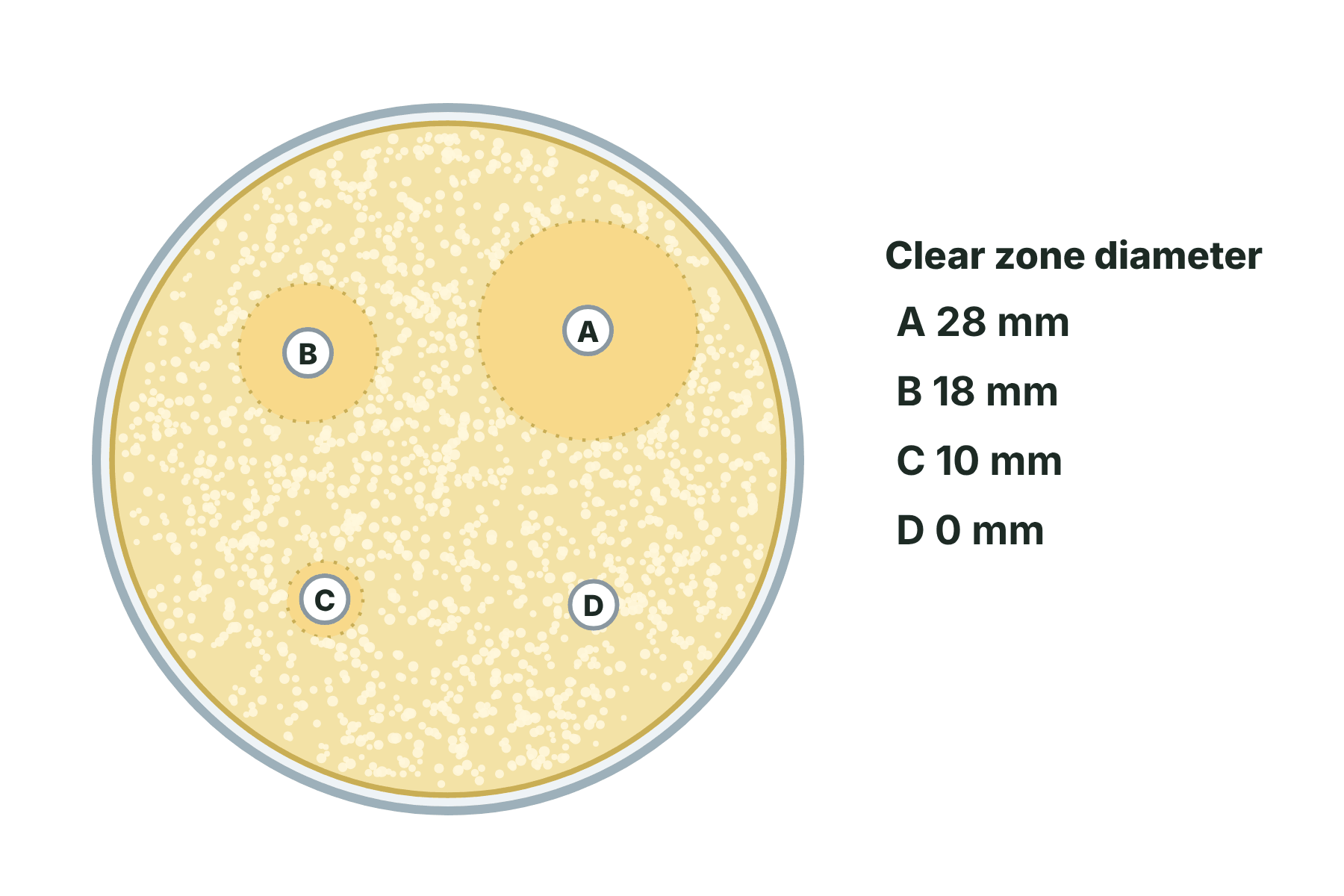
Figure 1 shows an agar plate with three antibiotic discs, A, B and C, and a control disc, D. The clear zone around disc A has a diameter of 28 mm. Calculate the cross-sectional area of this zone. Use the formula area = πr².
Mark scheme — 2 marks available
- Radius = 14 mm — 1 mark
- \(\pi \times 14^{2} = 616\text{ mm}^{2}\) — 1 mark
Model answer
radius = 28 ÷ 2 = 14 mm. area = π × 14² = π × 196 = 616 mm² (to 3 significant figures).
Use Figure 1 to state which antibiotic is the most effective at killing the bacteria, and explain how you can tell.
Mark scheme — 2 marks available
- Antibiotic A — 1 mark
- Largest clear zone / killed the most bacteria — 1 mark
Model answer
Antibiotic A is the most effective. It has the largest clear zone, which means it killed or stopped the growth of the most bacteria.
Describe how you would carry out an investigation to compare the effectiveness of three different antibiotics on the growth of bacteria.
What the examiner wants: A six-mark answer is a plan someone else could follow. Include the equipment, the order of the steps, the control, what you measure and how you make it a fair test.
Mark scheme — 6 marks available
- Aseptic technique used to prepare the plate and spread the bacteria — 1 mark
- Discs soaked in each antibiotic, placed on the agar — 1 mark
- Control disc soaked in sterile water — 1 mark
- Incubated upside down at 25 °C or below, with the lid taped on — 1 mark
- Measures the diameter (or area) of the clear zones — 1 mark
- Largest zone means most effective, with a control variable to make it a fair test — 1 mark
Model answer
Use aseptic technique to spread a lawn of bacteria over a sterile agar plate. Soak identical paper discs in each of the three antibiotics, and one in sterile water as a control. Place the discs, evenly spaced, on the agar, then tape the lid on and incubate the plate upside down at 25 °C for 48 hours. Measure the diameter of the clear zone around each disc with a ruler. The antibiotic with the largest clear zone is the most effective. To make it a fair test, use the same type and size of discs, the same concentration of antibiotic and the same incubation time and temperature.
How do bacteria multiply?
Why: Bacteria multiply by binary fission, in which one cell splits into two identical cells.
Why is an inoculating loop passed through a flame?
Why: The flame sterilises the loop by killing any microorganisms on it, so only the wanted bacteria are transferred.
Why is the lid of a Petri dish taped on?
Why: The tape stops microorganisms from the air getting into the culture.
What is the highest temperature at which cultures are normally incubated in school?
Why: School cultures are kept at 25 °C or below, because higher temperatures make it more likely that harmful pathogens grow.
A bacterium divides every 20 minutes. How many bacteria are there after 1 hour, starting with one?
Why: In 60 minutes there are 3 divisions, so \(1 \to 2 \to 4 \to 8\).
What does a large clear zone around an antibiotic disc show?
Why: A clear zone is where bacteria have been killed or stopped from growing, so a larger zone means the antibiotic is more effective.
The clear zone around a disc has a radius of 10 mm. What is its area, to the nearest whole number?
Why: Area = \(\pi r^{2} = \pi \times 10^{2} = 314\text{ mm}^{2}\) (to the nearest whole number).
A culture of 100 bacteria has a mean division time of 30 minutes. How many bacteria are there after 2 hours?
Why: 2 hours is 120 minutes, which is 4 divisions, so \(100 \times 2^{4} = 1600\).