Biology · Cell Structure
Viewing as
Teacher view: every answer and mark scheme set out in full.
Eukaryotic and Prokaryotic Cells
Every living thing is made of cells, but not every cell is built the same way. This lesson compares eukaryotic cells with prokaryotic cells such as bacteria, and shows how to describe how small cells are.
Learning Objectives
- 1Describe the main features of eukaryotic cells and prokaryotic cells.
- 2Compare the structure of a bacterial cell with an animal cell and a plant cell.
- 3Use the prefixes centi, milli, micro and nano to describe the size of cells.
- 4Calculate how many times bigger one cell is than another, using standard form and orders of magnitude.
The building blocks of life
A cell is the smallest unit of a living thing that can carry out the processes of life. Some organisms, such as bacteria, are a single cell. Others, such as humans and oak trees, are made of billions of cells working together. All cells fall into one of two types, and the difference between them is where they keep their genetic material.
Two kinds of cell
The key question is whether the DNA is shut away inside a nucleus.
-
Eukaryotic cells
The genetic material is enclosed in a nucleus. Animal cells and plant cells are eukaryotic, and so are the cells of fungi, such as yeast, and of single-celled organisms such as Amoeba.
-
Prokaryotic cells
There is no nucleus, so the genetic material lies free in the cytoplasm. Bacteria are prokaryotic, and each bacterium is a single prokaryotic cell.
-
What they share
Both types have a cell membrane, cytoplasm and ribosomes, and both store their instructions as DNA.
A bacterial cell
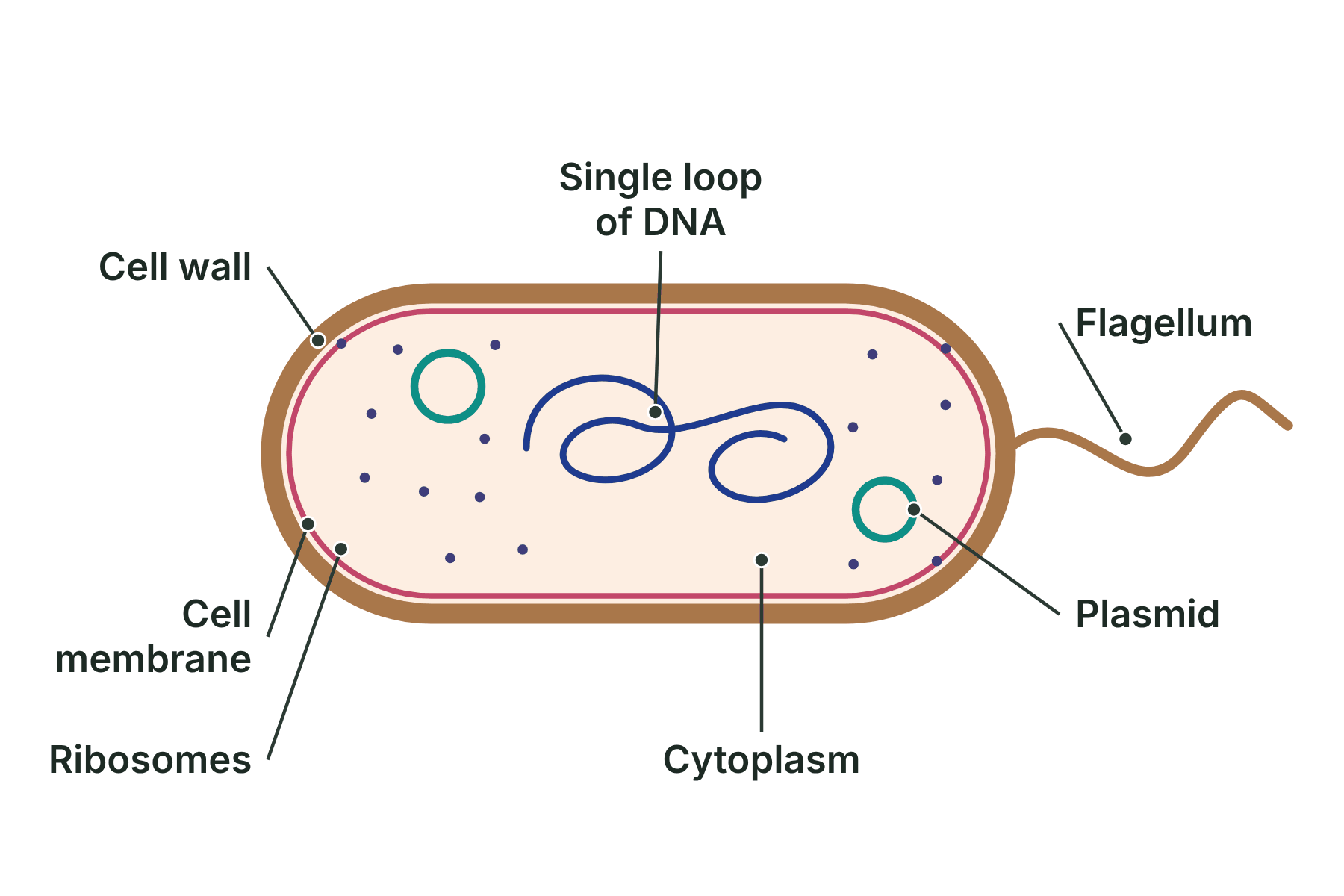
A bacterium is a prokaryotic cell: there is no nucleus.
What is inside
A bacterial cell is much smaller than an animal or plant cell. Everything it needs is packed inside a cell wall and a cell membrane.
-
Cell wall
A tough layer outside the membrane that gives the cell its shape and protects it. It is not made of cellulose.
-
Single loop of DNA
The bacterium's genetic material, lying free in the cytoplasm because there is no nucleus.
-
Plasmids
Small extra rings of DNA that carry spare genes, such as genes for antibiotic resistance.
Eukaryotic and prokaryotic cells compared
Eukaryotic cell (animal or plant)
- Genetic material is enclosed in a nucleus
- Larger, often 10 to 100 µm across
- Has a cell membrane, cytoplasm, mitochondria and ribosomes
- Plant cells also have a cellulose cell wall, chloroplasts and a permanent vacuole
Prokaryotic cell (bacterium)
- No nucleus: a single loop of DNA lies in the cytoplasm
- Much smaller, often 1 to 5 µm long
- Has a cell membrane, cytoplasm and ribosomes, with a cell wall outside
- May have plasmids, and some have a flagellum for swimming
Measuring cells: prefixes
Cells are far too small to measure in metres, so we use prefixes that make the numbers manageable.
-
centi (cm)
One hundredth of a metre: \(1\text{ cm} = 1 \times 10^{-2}\text{ m}\).
-
milli (mm)
One thousandth of a metre: \(1\text{ mm} = 1 \times 10^{-3}\text{ m}\).
-
micro (µm)
One millionth of a metre: \(1\ \mu\text{m} = 1 \times 10^{-6}\text{ m}\). Most cells are measured in micrometres.
-
nano (nm)
One billionth of a metre: \(1\text{ nm} = 1 \times 10^{-9}\text{ m}\). Ribosomes and viruses are measured in nanometres.
How big are cells?
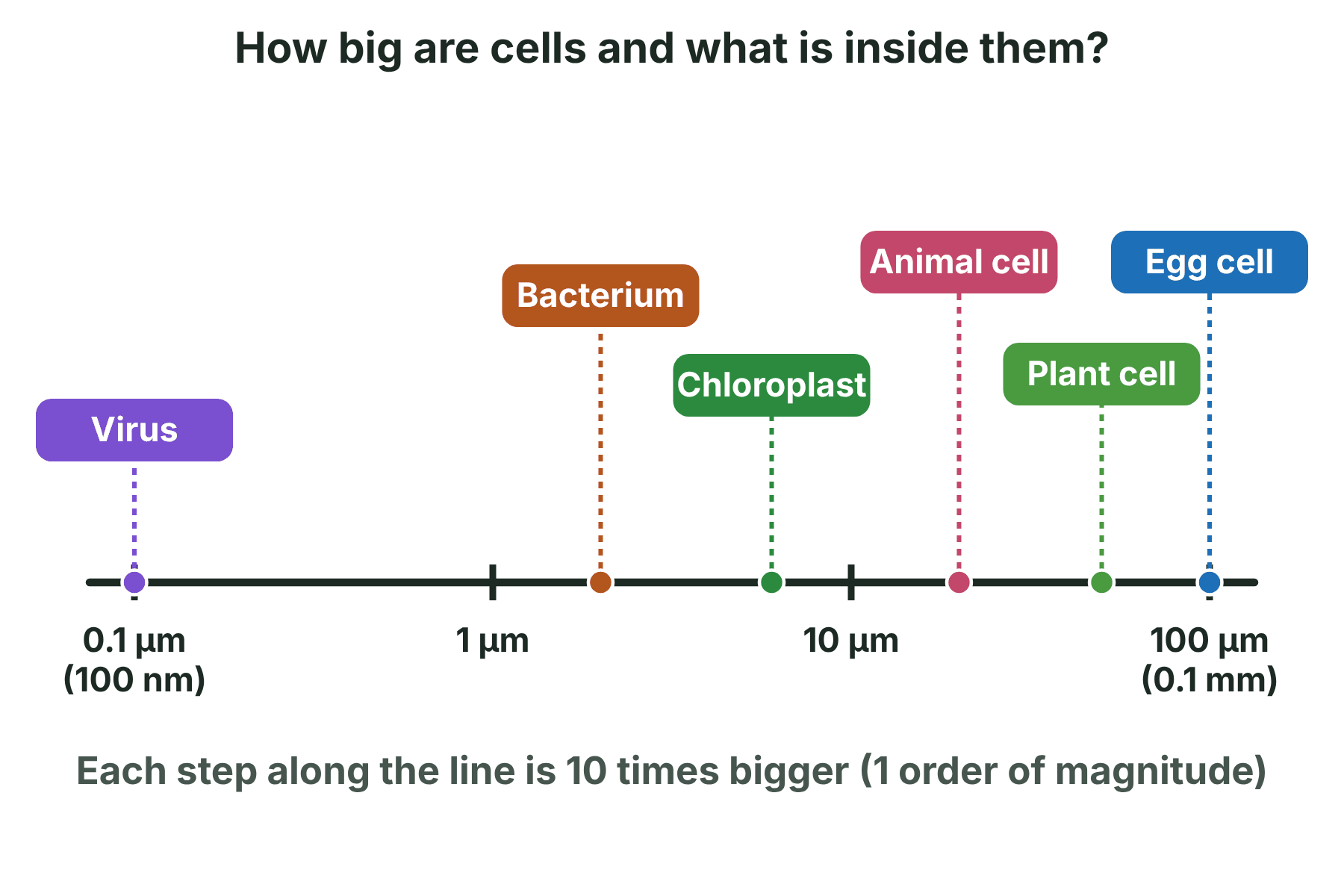
Each marked step on the line is 10 times bigger than the one before.
How many times bigger is one cell than another?
A typical bacterium is \(2\ \mu\text{m}\) long. A typical animal cell is \(2 \times 10^{-5}\text{ m}\) across. How many times wider is the animal cell, and how many orders of magnitude is that?
Show the solutionHide the solution
- 1 Write both sizes in the same unit Bacterium: \(2\ \mu\text{m} = 2 \times 10^{-6}\text{ m}\). Animal cell: \(2 \times 10^{-5}\text{ m}\).
- 2 Divide the larger size by the smaller \(\dfrac{2 \times 10^{-5}}{2 \times 10^{-6}} = 10^{1} = 10\)
- 3 State the order of magnitude A factor of 10 is one order of magnitude. A factor of 100 would be two orders of magnitude.
AnswerThe animal cell is 10 times wider, which is 1 order of magnitude.
Case study
Escherichia coli, a typical bacterium
E. coli is a rod-shaped bacterium that lives in the gut of humans and other animals. Each cell is only about 2 µm long, so around 500 of them laid end to end would stretch just 1 mm. Like every bacterium it has no nucleus: its DNA is one loop in the cytoplasm, and it may carry plasmids as well.
A common mistake
Bacteria do have DNA. It is just not shut inside a nucleus.
A bacterial cell has a single loop of DNA lying free in the cytoplasm, and sometimes plasmids too.
Cell types and sizes
Cell types and sizes
-
Eukaryotic
- nucleus
- animals, plants, fungi
- larger cells
-
Prokaryotic
- no nucleus
- bacteria
- single DNA loop
- plasmids
-
Shared features
- cell membrane
- cytoplasm
- ribosomes
- DNA
-
Prefixes
- centi
- milli
- micro
- nano
-
Scale
- standard form
- orders of magnitude
Summary and exam focus
- Eukaryotic cells have their DNA in a nucleus. Prokaryotic cells do not.
- A bacterial cell has a single loop of DNA and sometimes plasmids.
- Bacterial cells are much smaller than animal and plant cells.
- Micro means one millionth and nano means one billionth.
- Each order of magnitude is a factor of 10.
Exam focus
Describe two differences between a bacterial cell and a human cheek cell. (2 marks) (2 marks)
Make each difference a pair: say what the bacterial cell has and what the human cell has instead. "Bacteria have a cell wall" earns less than "bacteria have a cell wall but human cells do not".
Key terms
The words this lesson expects you to use. Each one is linked from the first place it appears above.
- Eukaryotic cell
- A cell whose genetic material is enclosed in a nucleus, such as an animal or plant cell.
- Prokaryotic cell
- A cell with no nucleus, whose genetic material lies free in the cytoplasm, such as a bacterium.
- Nucleus
- The part of a eukaryotic cell that contains the genetic material and controls the cell's activities.
- Cytoplasm
- The jelly-like substance inside a cell where most chemical reactions happen.
- Cell membrane
- A thin layer around the cell that controls what enters and leaves.
- Cell wall
- A rigid layer outside the cell membrane that supports the cell. In plants it is made of cellulose.
- Plasmid
- A small ring of DNA, separate from the main loop, found in bacteria.
- Standard form
- A way of writing very large or very small numbers as \(A \times 10^{n}\), where A is between 1 and 10.
- Order of magnitude
- A factor of ten. One order of magnitude is 10 times, two is 100 times.
- Micrometre (µm)
- One millionth of a metre, the unit most cells are measured in.
Questions and answers
15 questions set on this lesson, with the mark schemes and model answers open.
Name the type of cell that has no nucleus.
Mark scheme — 1 mark available
- Prokaryotic (cell) — 1 mark
Model answer
A prokaryotic cell, for example a bacterial cell.
Describe two differences between a bacterial cell and an animal cell.
Mark scheme — 2 marks available
- Cell wall present in bacteria but not in animal cells — 1 mark
- DNA is a single loop (no nucleus) in bacteria, but enclosed in a nucleus in animal cells — 1 mark
- Plasmids in bacteria only — 1 mark
- Bacterial cell is smaller — 1 mark
Model answer
Any two from: a bacterial cell has a cell wall but an animal cell does not; the DNA of a bacterial cell is a single loop in the cytoplasm but in an animal cell it is enclosed in a nucleus; a bacterial cell may have plasmids but an animal cell does not; a bacterial cell is much smaller than an animal cell.
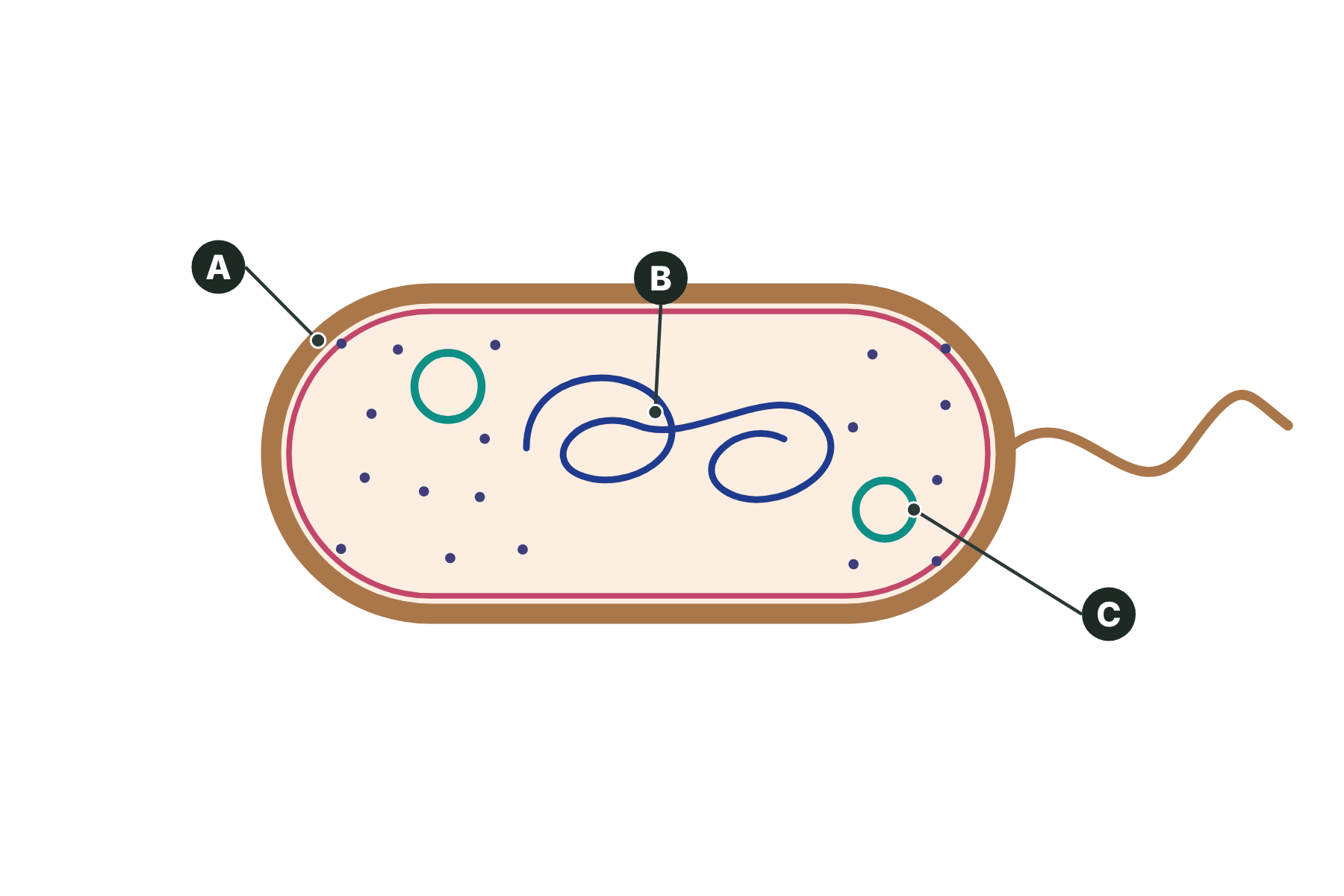
Figure 1 shows a bacterial cell. Name the structures labelled A, B and C.
Mark scheme — 3 marks available
- A: cell wall — 1 mark
- B: DNA / single loop of DNA / genetic material — 1 mark
- C: plasmid — 1 mark
Model answer
A is the cell wall. B is the (single loop of) DNA. C is a plasmid.
A bacterial cell is 2 µm long. Calculate how many of these cells, laid end to end, would stretch 1 mm.
Mark scheme — 2 marks available
- Converts 1 mm to 1000 µm — 1 mark
- 1000 ÷ 2 = 500 — 1 mark
Model answer
1 mm = 1000 µm. 1000 ÷ 2 = 500 cells.
The width of an animal cell is \(2 \times 10^{-5}\text{ m}\). The width of a bacterial cell is \(2 \times 10^{-6}\text{ m}\). Calculate how many times wider the animal cell is, and give the difference as an order of magnitude.
Mark scheme — 2 marks available
- Divides the two widths to give 10 — 1 mark
- One order of magnitude — 1 mark
Model answer
\(\dfrac{2 \times 10^{-5}}{2 \times 10^{-6}} = 10\). The animal cell is 10 times wider, which is one order of magnitude bigger.
Describe the structure of a bacterial cell.
Mark scheme — 4 marks available
- Cytoplasm and cell membrane — 1 mark
- Cell wall (outside the membrane) — 1 mark
- Single loop of DNA, not in a nucleus — 1 mark
- Plasmids — 1 mark
Model answer
A bacterial cell is a prokaryotic cell with no nucleus. Its genetic material is a single loop of DNA lying free in the cytoplasm, and it may also contain small rings of DNA called plasmids. The cytoplasm is surrounded by a cell membrane, and outside the membrane there is a cell wall.
Compare the structure of a bacterial cell with the structure of a plant cell.
What the examiner wants: Aim for similarities and differences, and use the names of the structures. A good answer links each point as "bacterial cells have..., whereas plant cells have...".
Mark scheme — 6 marks available
- Both have a cell membrane, cytoplasm and a cell wall — 1 mark
- Plant cell DNA is in a nucleus; bacterial DNA is a loop in the cytoplasm — 1 mark
- Plant cells have chloroplasts — 1 mark
- Plant cells have a permanent vacuole — 1 mark
- Bacterial cells may have plasmids (and a flagellum) — 1 mark
- Bacterial cell is smaller / plant cell wall is cellulose — 1 mark
Model answer
Both cells have a cell membrane, cytoplasm, ribosomes and a cell wall. In a plant cell the wall is made of cellulose, but a bacterial wall is not. A plant cell has its DNA enclosed in a nucleus, whereas a bacterial cell has no nucleus and its DNA is a single loop in the cytoplasm. A plant cell has chloroplasts and a permanent vacuole, which a bacterial cell does not. A bacterial cell may have plasmids and a flagellum, which a plant cell does not. A bacterial cell is much smaller.
Which type of cell has no nucleus?
Why: A prokaryotic cell, such as a bacterium, has no nucleus. Its DNA lies free in the cytoplasm.
What is a plasmid?
Why: A plasmid is a small extra ring of DNA found in bacteria, separate from the main loop of DNA.
Which structure is found in both bacterial cells and plant cells?
Why: Both have a cell wall, although a plant cell wall is made of cellulose and a bacterial one is not. Neither the nucleus nor chloroplasts nor mitochondria are found in bacteria.
How is the genetic material arranged in a bacterial cell?
Why: Bacteria have a single loop of DNA in the cytoplasm, and sometimes plasmids too.
What is the value of 1 µm in metres?
Why: Micro means one millionth, so 1 µm is one millionth of a metre.
One cell is 1000 times wider than another. How many orders of magnitude bigger is it?
Why: Each order of magnitude is a factor of 10, and \(1000 = 10^{3}\), so the difference is 3 orders of magnitude.
Which of these is the smallest?
Why: A virus is about 100 nm across, much smaller than a bacterium (about 2 µm), an animal cell or a plant cell.
Which organisms are made of prokaryotic cells?
Why: Bacteria are prokaryotes. Fungi, plants and animals are all made of eukaryotic cells.