Biology · Culturing Microorganisms and Developing Medicines
Uses of Monoclonal Antibodies
Because a monoclonal antibody finds one molecule, it can be used like a guided missile or a detector. This lesson is for separate Biology only: Combined Science students do not need it. It explains how monoclonal antibodies are used in pregnancy tests, in diagnosis, and in the treatment of diseases such as cancer.
Learning Objectives
- 1Explain how monoclonal antibodies are used in pregnancy testing.
- 2Explain how monoclonal antibodies are used in diagnosis, including to locate blood clots and cancer cells.
- 3Explain how monoclonal antibodies are used in the treatment of diseases such as cancer.
- 4Explain the advantages of using monoclonal antibodies to target specific cells compared with drug and radiotherapy treatments.
Retrieval practice
-
1
Why is a monoclonal antibody specific?
Show answerHide answer
It has a shape that fits only one antigen.
-
2
What is a hormone?
Show answerHide answer
A chemical messenger, made by a gland and carried in the blood.
-
3
What is cancer?
Show answerHide answer
Uncontrolled cell division, caused by changes in cells.
-
4
What are tumour cells?
Show answerHide answer
Cells that divide in an uncontrolled way, and may form a lump.
Antibodies as detectors and carriers
Monoclonal antibodies can be made to fit any antigen that a scientist chooses. That makes them useful in three ways. They can detect a particular molecule in a sample, as in a pregnancy test. They can carry a label, such as a radioactive atom or a dye, to a particular place in the body, so that a doctor can see where a clot or a tumour is. They can carry a drug straight to the cells that need it, and nowhere else. In each case it is the same property that matters: an antibody binds to its own antigen, and to nothing else.
Pregnancy testing
A pregnancy test detects a hormone that is only present in the urine of a pregnant woman.
-
The hormone
After an embryo implants in the uterus, the placenta makes a hormone called hCG (human chorionic gonadotrophin), which passes into the urine.
-
Mobile antibodies
The end of the test strip has monoclonal antibodies that bind to hCG. They are attached to a coloured bead, and they are free to move when wet.
-
Test line
Further along the strip is a line of different monoclonal antibodies that bind hCG, and are fixed in place. If hCG is in the urine, it carries the coloured antibodies to this line, where it is caught, and the line changes colour.
-
Control line
A second line has antibodies that bind the coloured antibodies, and not hCG. It changes colour whether or not hCG is present, which shows that the test is working.
-
Reading it
Two lines means that the woman is pregnant, one line, the control, means that she is not, and no control line means that the test did not work.
How a pregnancy test works
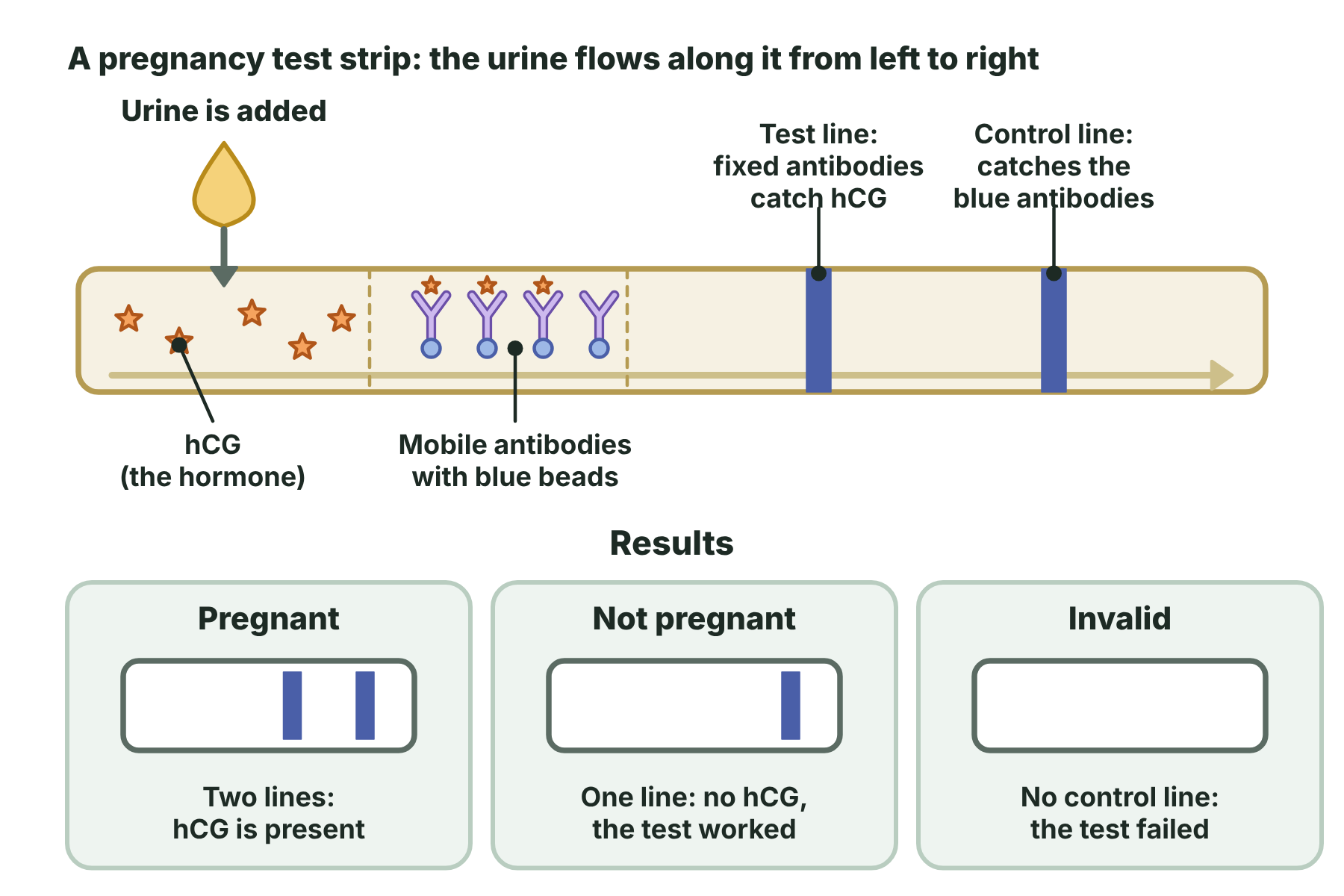
The test line only turns blue if hCG is present, and the control line always shows that the test works.
Diagnosis
Monoclonal antibodies can be used to find disease in the body, and in samples from it.
-
Locating blood clots
Antibodies are made that bind to fibrin, a protein found in clots. A radioactive label is attached, and is injected into the patient. A scanner detects the radioactivity, which shows where the clots are.
-
Locating cancer cells
Many cancer cells have antigens on their surface, called tumour markers, that are not found on healthy cells. Labelled antibodies that bind to the tumour markers show the position of a tumour on a scan, including small ones that have spread.
-
Laboratory tests
Antibodies are used to detect hormones, drugs and the proteins of pathogens in a sample of blood or urine, as in tests for infections.
-
Why it works
The antibody carries the label to one type of cell only, so the scan is clear.
Treating disease
A drug can be attached to a monoclonal antibody, so that it is delivered to the cells that have the antigen.
-
Targeting cancer
An antibody that fits a tumour marker is joined to an anticancer drug, a toxin or a radioactive substance. It travels in the blood, and binds only to the cancer cells, which are killed.
-
Blocking signals
Some antibodies bind to receptors on a cancer cell, which stops the chemical signals that tell the cell to divide.
-
Other diseases
Monoclonal antibodies are also used for some immune diseases, such as rheumatoid arthritis and multiple sclerosis.
-
A real example
Herceptin is an antibody against a protein called HER2, which is found in large amounts on the cells of about 1 in 5 breast cancers.
Targeting cancer cells
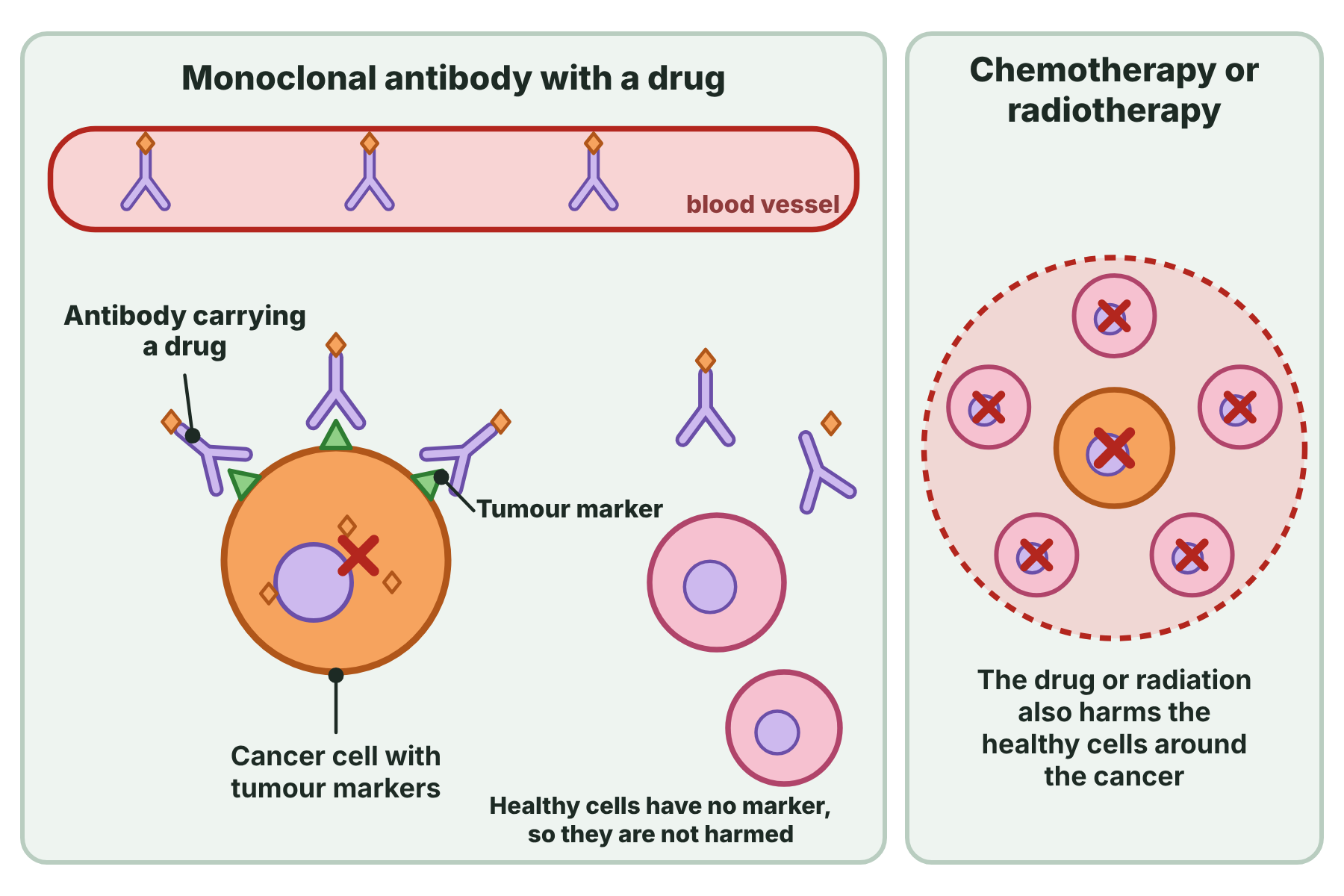
Monoclonal antibodies deliver a treatment only to the cells that have the antigen.
Monoclonal antibodies compared with drugs and radiotherapy
Monoclonal antibodies
- Bind only to cells with the antigen
- Healthy cells are mostly not harmed
- The drug is delivered straight to the cancer
- Fewer and milder side effects
Chemotherapy and radiotherapy
- Drugs travel round the whole body, and radiation hits healthy tissue
- Damage rapidly dividing healthy cells, such as hair and gut
- Cause hair loss, sickness and tiredness
- Higher doses are often needed
Limits of monoclonal antibodies
They are a valuable treatment, but not a perfect one.
-
Cost
They are expensive to make, so treatments cost a lot.
-
Side effects
Some patients have reactions such as fever, rashes and allergic reactions, because the body may treat the antibody as foreign.
-
Not for every cancer
The treatment only works if the cancer cells have an antigen that is not found on healthy cells.
-
Resistance
Some cancer cells change, and stop having the marker, so the treatment stops working.
Reading a pregnancy test
Three tests were done. Test A shows two coloured lines, test B shows one coloured line, at the control position, and test C shows no coloured lines. State what each result shows.
Show the solutionHide the solution
- 1 Test A The test line has formed, so hCG is present, and the control line shows that the test worked.
- 2 Test B The control line has formed but not the test line, so there is no hCG.
- 3 Test C No control line means that the antibodies did not move properly, so the result cannot be trusted.
AnswerTest A shows that the woman is pregnant. Test B shows that she is not pregnant, as the test worked but there was no hCG. Test C is invalid, as there is no control line, so the test did not work and must be repeated.
Summary and exam focus
- A pregnancy test uses two types of monoclonal antibody to detect the hormone hCG in urine.
- Labelled antibodies can locate blood clots and cancer cells on a scan.
- Antibodies carrying a drug are used to treat cancer, and bind only to the cancer cells.
- This is more specific than chemotherapy or radiotherapy, which also damage healthy cells.
- The treatments are expensive, and can cause side effects.
Exam focus
Explain how monoclonal antibodies are used to treat cancer, and why this is better than treating cancer with chemotherapy. (6 marks) (6 marks)
Say that the antibody has a shape that fits an antigen on the cancer cells only, that it is joined to a drug, and that it carries the drug to the tumour. Then compare with chemotherapy, which damages healthy dividing cells all over the body and causes side effects.
Key terms
The words this lesson expects you to use. Each one is linked from the first place it appears above.
- hCG
- A hormone, human chorionic gonadotrophin, made by the placenta, which is found in the urine of a pregnant woman.
- Tumour marker
- An antigen found on cancer cells, but not on healthy cells.
- Diagnosis
- Finding out what disease a patient has.
- Radioactive label
- A radioactive atom attached to a molecule, so that it can be detected on a scan.
- Fibrin
- A protein that forms the mesh of a blood clot.
- Target
- The cell or molecule at which a treatment is aimed.
- Chemotherapy
- The use of drugs that kill cells that divide rapidly, to treat cancer.
- Radiotherapy
- The use of radiation to kill cancer cells.
- Control line
- A line on a test that shows that the test has worked.
You've finished the notes
Check your understanding
Test yourself while it is fresh. Start with the flashcards, then try the exam questions.
Something here looks wrong?
Tell us what and we will go and look. It goes to whoever writes these pages, nobody else, and we do not ask who you are — so there is nothing to sign and nothing comes back to you.