Biology · Culturing Microorganisms and Developing Medicines
Making Monoclonal Antibodies
Antibodies are made by lymphocytes, but a single lymphocyte cannot be grown into a factory. This lesson is for separate Biology only: Combined Science students do not need it. It explains how scientists make large amounts of one type of antibody, called monoclonal antibodies, using hybridoma cells.
Learning Objectives
- 1Explain what is meant by a monoclonal antibody.
- 2Explain why a lymphocyte that makes the desired antibody cannot simply be grown in a laboratory.
- 3Describe the production of monoclonal antibodies, including the use of lymphocytes and the production of hybridoma cells.
- 4Explain that hybridoma cells divide, and produce the antibodies, so that large numbers of identical antibodies can be collected.
Retrieval practice
-
1
What is an antigen?
Show answerHide answer
A molecule on the surface of a pathogen that the immune system recognises as foreign.
-
2
What is an antibody?
Show answerHide answer
A protein made by a lymphocyte that fits one antigen and helps to destroy the pathogen.
-
3
Why does an antibody fit only one antigen?
Show answerHide answer
It has a specific shape, which matches the shape of that antigen.
-
4
What is cancer?
Show answerHide answer
Uncontrolled cell division, caused by changes in cells.
One cell, one antibody
Each lymphocyte makes just one kind of antibody, which fits one particular antigen. If scientists want a large supply of one antibody, for example to find a particular protein or to treat a disease, they need many identical lymphocytes. The problem is that a lymphocyte that has been taken out of the body does not divide, and so dies after a short time. The solution was to join it to another kind of cell that divides all the time. The antibodies that result are called monoclonal antibodies: mono means one, and clonal means that they come from a clone, a group of identical cells that arose from a single cell. They are all identical, and they all fit the same antigen.
The two parent cells
Lymphocyte from a mouse
- Makes the desired antibody, which fits the antigen
- Does not divide outside the body
- Dies after a short time in culture
- Gives the hybridoma its ability to make antibodies
Tumour cell
- Does not make the desired antibody
- Divides rapidly, and does not stop
- Can be grown in culture for a long time
- Gives the hybridoma its ability to divide
Producing monoclonal antibodies
The method has a number of stages, and it begins with an animal that makes the antibodies.
-
1 Inject the antigen
A mouse is injected with the antigen against which the antibody is needed, for example a protein found on cancer cells.
-
2 Collect the lymphocytes
The mouse's immune system makes lymphocytes that produce antibodies against the antigen. These lymphocytes are removed from the mouse, usually from the spleen.
-
3 Fuse with tumour cells
The lymphocytes are mixed with tumour cells, and joined together with a chemical or an electric pulse. Each fused cell is a hybridoma cell.
-
4 Select the right cells
The hybridoma cells are separated into many small groups, and each is tested. Only some make the antibody that is needed, and these are kept.
-
5 Grow and collect
The selected hybridoma cells divide to form a clone, in large fermenters. They make large amounts of the same antibody, which is collected and purified.
Making monoclonal antibodies
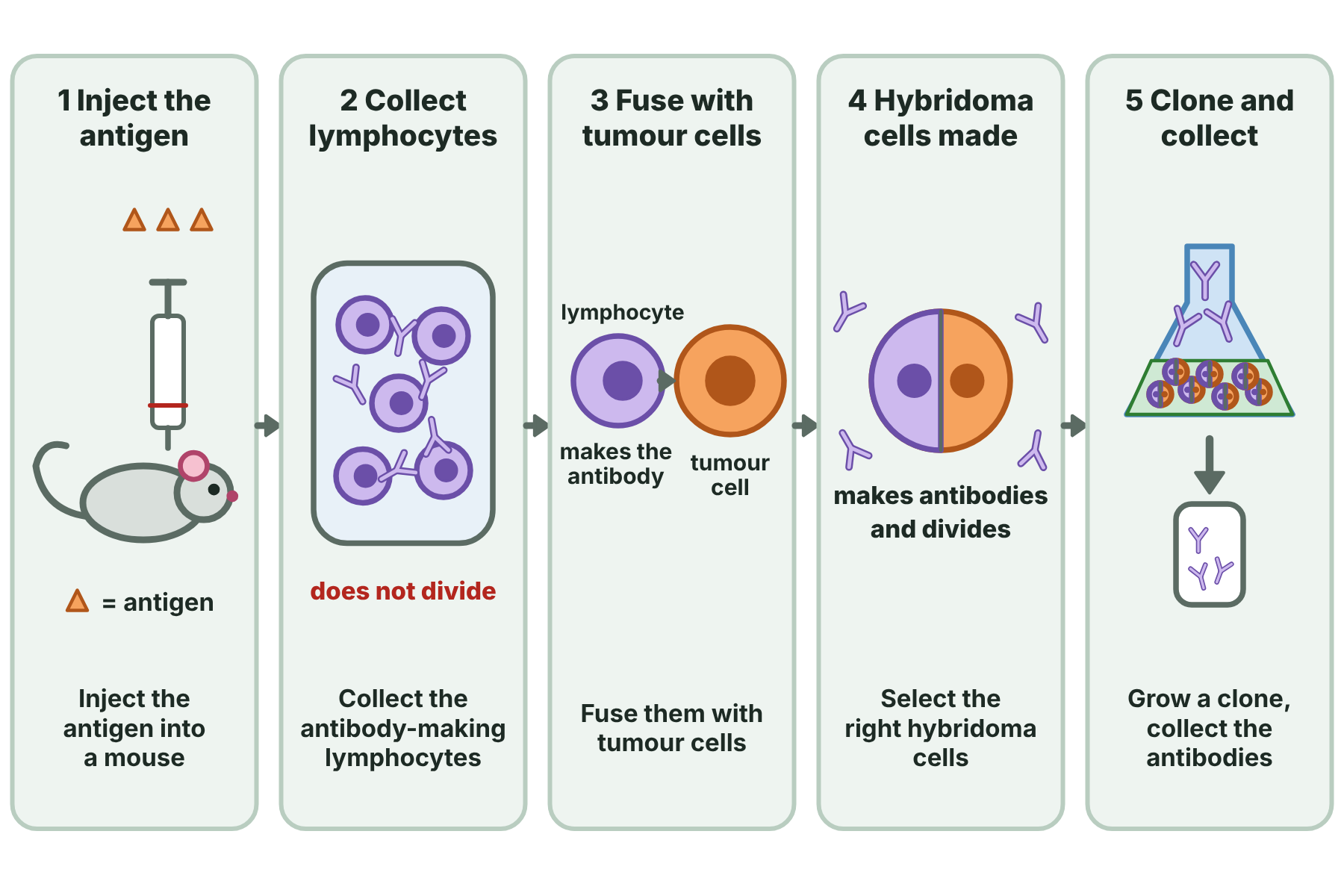
A hybridoma cell can make the desired antibody, and divide, so it can be cloned.
Why hybridoma cells are the answer
A hybridoma cell has the useful features of both of the cells that were joined to make it.
-
From the lymphocyte
It has the genes to make the specific antibody that fits the antigen.
-
From the tumour cell
It divides again and again, and does not die, as the original lymphocyte would.
-
A clone
Every cell that is formed by division is genetically identical, so they all make the same antibody.
-
Large scale
The cells can be grown in huge tanks for as long as is needed, and the antibodies are collected from the liquid.
Properties of monoclonal antibodies
Monoclonal antibodies are used in medicine and in research because of the way they behave.
-
Specific
Each type binds to one antigen only, so it can find one protein among thousands of others.
-
Pure and consistent
All the antibodies are identical, and each batch is the same.
-
Plentiful
Hybridoma cultures give far more antibody than could be taken from an animal.
-
Can be labelled
A dye, radioactive atom or drug can be attached to the antibody, so that it carries the label to where its antigen is.
How a hybridoma population grows
A single hybridoma cell divides once every 24 hours. Calculate the number of cells after 7 days, and explain why a hybridoma cell is used, and not an ordinary lymphocyte.
Show the solutionHide the solution
- 1 Number of doublings 7 days at one division each day gives 7 divisions.
- 2 Calculate \(2^7 = 128\) cells, all identical.
- 3 Explain Only a cell that both divides, and makes the antibody, can give a large supply.
AnswerThere are 128 hybridoma cells after 7 days. A hybridoma cell is used because it keeps on dividing, and makes the specific antibody, but an ordinary lymphocyte does not divide in the laboratory, so only a few would ever be made.
Case study
The invention of monoclonal antibodies
In 1975 two scientists at Cambridge, Georges Köhler and César Milstein, joined mouse lymphocytes to tumour cells for the first time, and made hybridoma cells that could make a single antibody and be grown for ever. They did not patent the method, so that scientists everywhere could use it freely. It led to a huge range of tests and treatments, and in 1984 they shared the Nobel Prize in Physiology or Medicine, together with Niels Jerne. Antibodies from mice can cause an immune reaction in people, so scientists now change them to make them more like human antibodies before they are used as medicines.
Summary and exam focus
- Monoclonal antibodies are identical antibodies, that all fit one antigen, made by one clone of cells.
- Lymphocytes that make the antibody are collected from a mouse that has been injected with the antigen.
- Lymphocytes are fused with tumour cells to make hybridoma cells.
- Hybridoma cells divide, and make the antibody, so they can be grown in large numbers.
- The antibodies are collected and purified.
Exam focus
Describe how monoclonal antibodies are produced, and explain why hybridoma cells are used. (6 marks) (6 marks)
Put the stages in order: inject the antigen into a mouse, collect lymphocytes that make the antibody, fuse them with tumour cells to make hybridoma cells, select the right ones, and clone them. Then explain that the lymphocyte makes the antibody but does not divide, and the tumour cell divides but does not make it, so the hybridoma does both.
Key terms
The words this lesson expects you to use. Each one is linked from the first place it appears above.
- Monoclonal antibody
- An antibody made by a clone of identical cells, all of which fit the same antigen.
- Hybridoma cell
- A cell made by joining an antibody-producing lymphocyte to a tumour cell.
- Clone
- A group of genetically identical cells or organisms, formed from one original cell.
- Tumour cell
- A cell that divides in an uncontrolled way.
- Lymphocyte
- A white blood cell that makes antibodies.
- Antigen
- A molecule that causes the immune system to make antibodies.
- Specific
- Acting on one thing only.
- Fusion
- The joining of two cells to make one.
- Fermenter
- A large tank in which cells are grown in large numbers.
You've finished the notes
Check your understanding
Test yourself while it is fresh. Start with the flashcards, then try the exam questions.
Something here looks wrong?
Tell us what and we will go and look. It goes to whoever writes these pages, nobody else, and we do not ask who you are — so there is nothing to sign and nothing comes back to you.