Biology · DNA and Protein Synthesis
Genetic Variants and Their Effects (Higher tier)
A change in the DNA can change a protein. This lesson is for separate Biology only, and for the Higher tier only: Combined Science and Foundation students do not need it. It explains how variants in the non-coding and coding DNA of a gene can change the phenotype.
Learning Objectives
- 1(Higher tier) Describe how a genetic variant in the non-coding DNA in front of a gene can alter the amount of protein made.
- 2(Higher tier) Describe how a variant in the coding DNA can change the amino acid sequence and the activity of the protein.
- 3(Higher tier) Describe different types of change to the base sequence, such as substitution, insertion and deletion.
- 4(Higher tier) Use examples to link a variant to its effect on the phenotype.
Retrieval practice
-
1
What does RNA polymerase do?
Show answerHide answer
It makes mRNA from the coding DNA of a gene.
-
2
Where does RNA polymerase bind?
Show answerHide answer
To non-coding DNA in front of a gene.
-
3
What is a codon?
Show answerHide answer
Three mRNA bases that code for one amino acid.
-
4
What decides the shape of a protein?
Show answerHide answer
The order of amino acids in the polypeptide.
Same gene, different version
A gene is a section of DNA, but there can be different versions of it. A genetic variant is a difference in the DNA base sequence between individuals. Variants arise by mutation. Most do nothing, but some change how much of a protein a cell makes, or what that protein is like. Because proteins decide the characteristics of an organism, a change to a gene can change the phenotype. Where in the gene the variant occurs makes a great difference.
Changes to the base sequence
There are three basic ways in which the sequence of bases can change.
-
Substitution
One base is swapped for a different one. This may change one amino acid, or it may change nothing at all, because several triplets can code for the same amino acid.
-
Insertion
One or more extra bases are added. The reading of all the following triplets can shift, which usually changes every amino acid after that point.
-
Deletion
One or more bases are lost, which also shifts the reading of triplets that follow, unless exactly three bases are lost.
-
Frameshift
An insertion or deletion that is not a multiple of three changes all of the codons after it, and usually gives a non-working protein.
Variants in the non-coding DNA
The DNA in front of a gene does not code for a protein, but it matters, because it is where RNA polymerase binds.
-
The binding site
RNA polymerase binds to non-coding DNA before the gene. The better it binds, the more often the gene is transcribed.
-
A variant in this region
A variant can make it easier or harder for RNA polymerase to bind. The amino acid sequence of the protein stays the same, since the gene itself has not changed.
-
The effect
The amount of protein made changes. More polymerase binding means more mRNA and more protein, and less binding means less protein.
-
Phenotype
If the quantity of protein matters, the phenotype changes. For example, a variant can switch a gene on in a tissue where it was off.
Variants in the coding DNA
A change inside the gene itself can alter the protein that is made.
-
A different amino acid
A substitution can swap one amino acid for another, so the protein's shape may change, along with its activity.
-
A shortened protein
A change that makes a stop codon too early means the polypeptide is cut short and usually does not work.
-
A frameshift
An insertion or deletion can change all the amino acids that follow, which usually results in a non-functional protein.
-
No effect
Some changes do not alter the amino acid, because the genetic code has several triplets for the same amino acid. The phenotype is then unchanged.
Where a variant is, and what it does
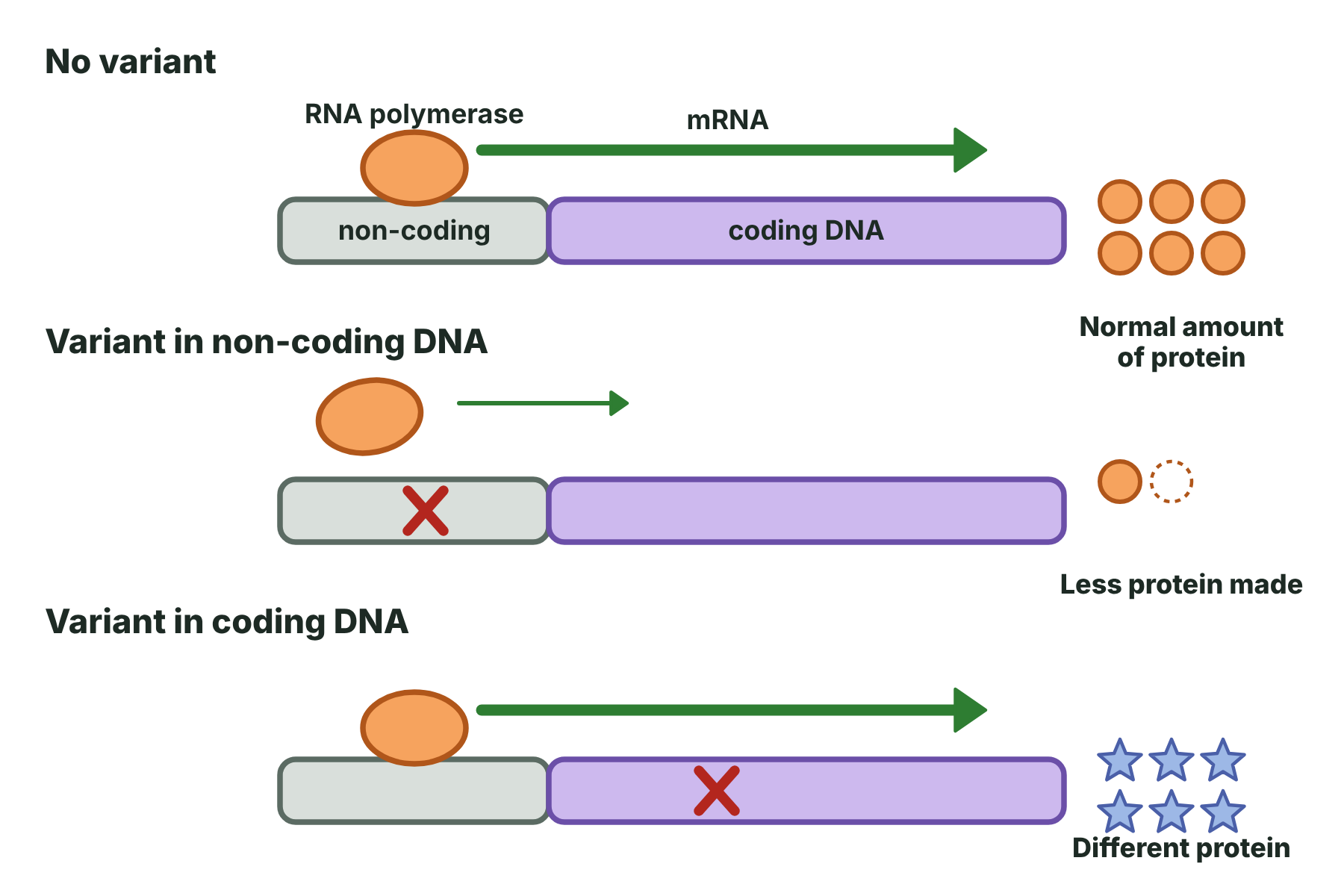
A variant in front of the gene changes how much protein is made. A variant in the gene changes what protein is made.
Non-coding and coding variants
Variant in non-coding DNA
- In the region in front of the gene
- Changes how well RNA polymerase binds
- Changes the quantity of protein produced
- The protein itself is normal
Variant in coding DNA
- Inside the gene itself
- Can change the amino acid sequence
- Can change the shape and activity of the protein
- The quantity of protein may be normal
Case study
Sickle cell disease
The gene for one part of haemoglobin, the protein in red blood cells that carries oxygen, can have a variant in its coding DNA. A single base in the gene is changed, so the triplet that codes for glutamic acid codes for valine instead. This one different amino acid changes the shape of the haemoglobin. When oxygen levels are low the faulty molecules stick together and distort the red blood cell into a sickle shape. These cells block small blood vessels and carry less oxygen, which causes pain and tiredness.
Case study
Digesting milk as an adult
Most mammals stop making the enzyme lactase after they are weaned, but many people can digest milk all their lives. This is because they have a variant in the non-coding DNA near the lactase gene. It does not change the lactase protein at all. Instead, it keeps the gene switched on in adulthood, by affecting the binding of the proteins that turn the gene on, so that more lactase is produced. It is a good example of a non-coding variant that changes the quantity of a protein, and so the phenotype.
Summary and exam focus
- A genetic variant is a difference in the base sequence of DNA.
- A variant in the non-coding DNA can change how well RNA polymerase binds, and so change the quantity of protein made.
- A variant in the coding DNA can change the amino acid sequence, and so the shape and activity of the protein.
- Substitutions, insertions and deletions are three types of change, and insertions or deletions can shift the reading frame.
- Many variants have no effect on the phenotype.
Exam focus
Explain how a genetic variant in the coding DNA of a gene, and a variant in the non-coding DNA in front of the gene, can each affect the phenotype. (6 marks) (6 marks)
Contrast the two. For non-coding DNA, talk about RNA polymerase binding and the quantity of protein. For coding DNA, talk about the sequence of amino acids, the shape of the protein and its activity.
Key terms
The words this lesson expects you to use. Each one is linked from the first place it appears above.
- Genetic variant
- A difference in the base sequence of DNA between individuals.
- Mutation
- A change in the base sequence of DNA.
- Substitution
- A mutation in which one base is replaced by another.
- Insertion
- A mutation in which one or more bases are added.
- Deletion
- A mutation in which one or more bases are removed.
- Frameshift
- An insertion or deletion that changes how all of the following triplets are read.
- Coding DNA
- The part of a gene that codes for the sequence of amino acids in a protein.
- Non-coding DNA
- DNA that does not code for a protein, such as the region in front of a gene where RNA polymerase binds.
- Phenotype
- The observable characteristics of an organism, produced by its genes and the environment.
- Sickle cell disease
- An inherited disease caused by a variant in the haemoglobin gene, which distorts red blood cells.
You've finished the notes
Check your understanding
Test yourself while it is fresh. Start with the flashcards, then try the exam questions.
Something here looks wrong?
Tell us what and we will go and look. It goes to whoever writes these pages, nobody else, and we do not ask who you are — so there is nothing to sign and nothing comes back to you.