Biology · DNA and Protein Synthesis
Protein Synthesis (Higher tier)
A protein is made in two stages: transcription in the nucleus and translation at a ribosome. This lesson is for separate Biology only, and for the Higher tier only: Combined Science and Foundation students do not need it. It explains the role of RNA polymerase, mRNA, codons, tRNA and ribosomes.
Learning Objectives
- 1(Higher tier) Describe transcription, including the role of RNA polymerase and the production of mRNA.
- 2(Higher tier) Describe translation, including the roles of the ribosome, codons and tRNA.
- 3(Higher tier) Use the base pairing rules to work out a messenger RNA sequence and the amino acids it codes for.
- 4(Higher tier) Compare the structures of DNA and RNA.
Retrieval practice
-
1
What is a triplet?
Show answerHide answer
A group of three bases that codes for one amino acid.
-
2
Which base pairs with A in DNA?
Show answerHide answer
T.
-
3
What is a ribosome?
Show answerHide answer
A structure in the cytoplasm where proteins are made.
-
4
Where is DNA found in a eukaryotic cell?
Show answerHide answer
In the nucleus.
Why DNA needs a messenger
The DNA of a cell never leaves the nucleus, but proteins are made on ribosomes in the cytoplasm. A gene cannot go to the ribosome, so a copy of the gene is made instead. This copy is a different molecule called messenger RNA (mRNA). The mRNA carries the code to the ribosome, where the protein is assembled. Making the mRNA copy is called transcription, and using it to build the protein is called translation.
DNA and RNA
DNA
- Two strands in a double helix
- Contains the sugar deoxyribose
- Bases A, T, C and G
- Very long, stays in the nucleus
RNA
- A single strand
- Contains the sugar ribose
- Bases A, U, C and G, with uracil (U) instead of thymine
- Short, and leaves the nucleus
Transcription in the nucleus
Transcription makes an mRNA copy of one gene.
-
1
RNA polymerase binds
The enzyme RNA polymerase attaches to the non-coding DNA that lies in front of the gene.
-
2
The DNA unwinds
The hydrogen bonds between the bases break and the two strands separate in that region.
-
3
mRNA is built
RNA polymerase moves along the coding DNA of the gene and joins RNA nucleotides, which pair with the exposed bases. A pairs with U, T with A, C with G and G with C.
-
4
mRNA leaves
The complementary mRNA strand is released, the DNA closes up, and the mRNA travels out of the nucleus through a pore to the cytoplasm.
Translation at the ribosome
Translation turns the code in the mRNA into a polypeptide.
-
1
mRNA attaches
The mRNA binds to a ribosome in the cytoplasm.
-
2
Codons are read
The ribosome reads the mRNA in groups of three bases called codons, and each codon codes for one amino acid.
-
3
tRNA brings amino acids
Transfer RNA (tRNA) molecules carry specific amino acids to the ribosome. The tRNA has three bases, an anticodon, that pair with the codon.
-
4
Amino acids are joined
The ribosome links the amino acids in the order of the codons, to form a polypeptide.
-
5
The chain is released
At a stop codon the polypeptide is released and folds into a protein.
Transcription and translation
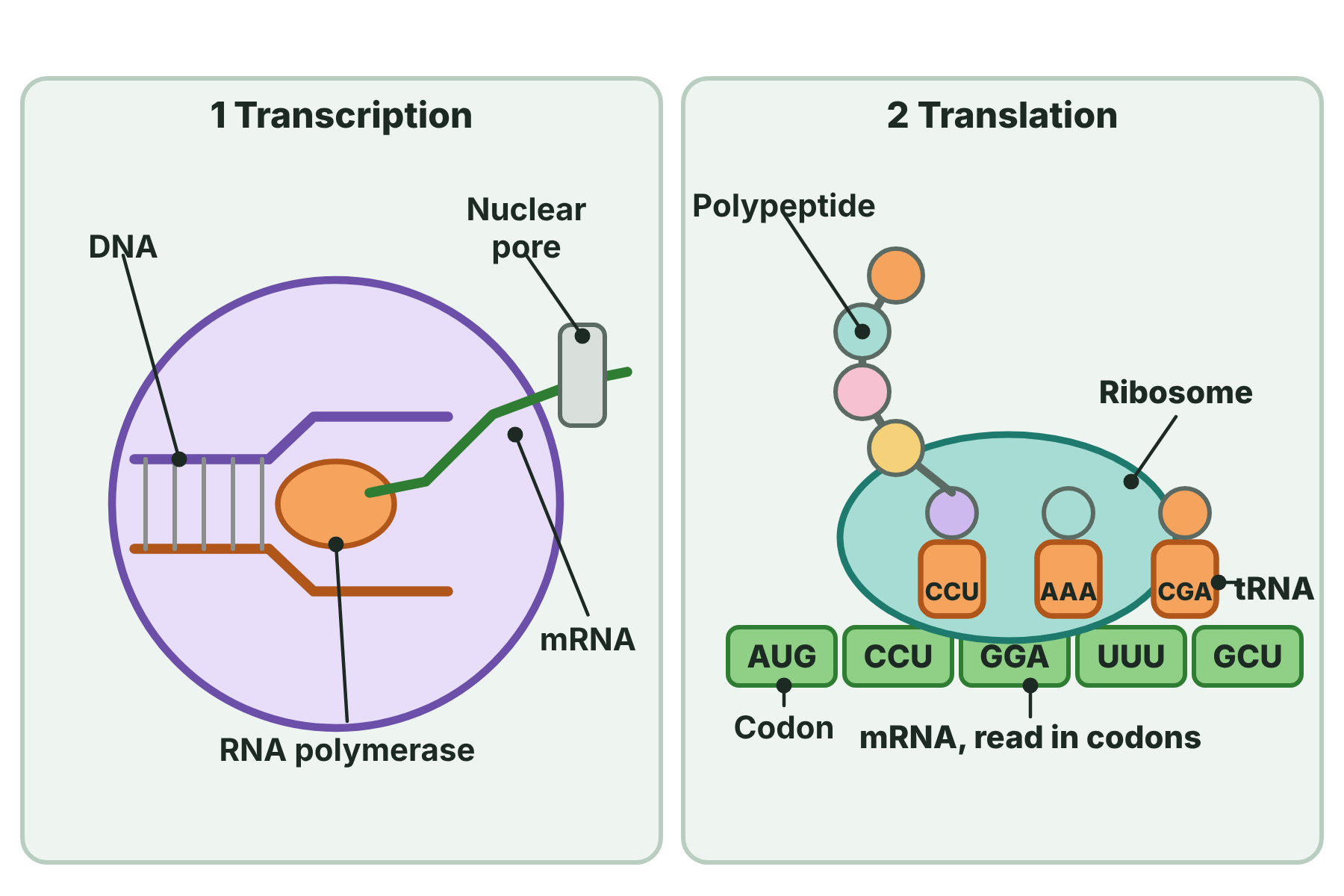
The code is copied into mRNA, then read at the ribosome to build the polypeptide.
The key molecules
Four different molecules do the work, and each has a clear job.
-
RNA polymerase
An enzyme that makes mRNA by joining RNA nucleotides according to the order of bases in the DNA.
-
mRNA
A single-stranded copy of a gene, which carries the code from the nucleus to the ribosome.
-
Ribosome
The structure that reads the mRNA and joins amino acids together to make a polypeptide.
-
tRNA
A molecule that carries one particular amino acid to the ribosome, and has an anticodon that matches a codon.
From DNA to amino acids
The coding strand of part of a gene has the base sequence T A C G G A C C T. Write the mRNA sequence, and use the codon table to give the amino acids. Codon table: AUG = methionine, CCU = proline, GGA = glycine, UUU = phenylalanine.
Show the solutionHide the solution
- 1 Pair each base with its RNA partner T pairs with A, A with U, C with G and G with C. The sequence is T A C, G G A, C C T.
- 2 Write the mRNA T A C becomes A U G, G G A becomes C C U, and C C T becomes G G A, so the mRNA is A U G C C U G G A.
- 3 Split it into codons AUG, CCU, GGA.
- 4 Use the table AUG is methionine, CCU is proline and GGA is glycine.
AnswerThe mRNA is A U G C C U G G A, and the amino acids are methionine, proline and glycine.
Making a protein in a cell
Protein synthesis is happening in all of your cells, all of the time.
-
Fast
Many ribosomes can read one mRNA at the same time, so lots of copies of a protein are made quickly.
-
Controlled
A gene is only transcribed when its protein is needed, so cells make the proteins they need and no others.
-
Energy needed
It takes a lot of energy, supplied by respiration in mitochondria.
-
Different cells, different proteins
All body cells have the same genes, but different genes are transcribed in different cells, which is why a muscle cell differs from a nerve cell.
Case study
Insulin made by bacteria
The human gene for insulin was put into bacteria in the 1970s. The bacteria transcribe the gene into mRNA and translate it at their ribosomes, using the same code as in humans, and so they make human insulin. Before this, insulin had to be extracted from the pancreas of pigs and cattle. The first genetically engineered insulin became available for patients in 1982.
Summary and exam focus
- Transcription: RNA polymerase binds in front of the gene and makes a complementary mRNA strand from the coding DNA.
- The mRNA leaves the nucleus and attaches to a ribosome.
- Translation: the ribosome reads the mRNA in codons, and tRNA brings the matching amino acids.
- Amino acids are linked to form a polypeptide, which folds into a protein.
- RNA has uracil instead of thymine, and is a single strand.
Exam focus
Describe the stages of protein synthesis, including transcription and translation. (6 marks) (6 marks)
Keep transcription and translation separate and use their key words. In transcription, include RNA polymerase, the non-coding DNA before the gene, and complementary mRNA. In translation, include ribosome, codons, tRNA and amino acids being linked.
Key terms
The words this lesson expects you to use. Each one is linked from the first place it appears above.
- Transcription
- Making a complementary mRNA copy of a gene from DNA.
- Translation
- Reading the code in mRNA at a ribosome to build a polypeptide.
- RNA polymerase
- The enzyme that makes mRNA by joining RNA nucleotides complementary to the DNA.
- mRNA
- Messenger RNA: a single-stranded copy of a gene that carries the code to a ribosome.
- tRNA
- Transfer RNA: a molecule that carries a particular amino acid to the ribosome.
- Codon
- A group of three bases in mRNA that codes for one amino acid.
- Anticodon
- The three bases on a tRNA molecule that pair with a codon.
- Ribosome
- The structure in the cytoplasm that reads mRNA and builds the polypeptide.
- Uracil
- The base in RNA that takes the place of thymine, and pairs with adenine.
- Non-coding DNA
- DNA that does not code for a protein, including the region in front of a gene where RNA polymerase binds.
You've finished the notes
Check your understanding
Test yourself while it is fresh. Start with the flashcards, then try the exam questions.
Something here looks wrong?
Tell us what and we will go and look. It goes to whoever writes these pages, nobody else, and we do not ask who you are — so there is nothing to sign and nothing comes back to you.