Biology · DNA and Protein Synthesis
The Structure of DNA
DNA carries the instructions for building every living thing. This lesson looks at its structure: a polymer of nucleotides, with two strands joined by complementary base pairs and coiled into a double helix.
Learning Objectives
- 1Describe DNA as a polymer made of nucleotides, each with a sugar, a phosphate group and a base.
- 2Describe the double helix, and explain how complementary base pairs hold the two strands together.
- 3State the base pairing rules and use them to write the sequence of the complementary strand.
- 4Explain why the hydrogen bonds between bases are weak, and why this is useful.
Retrieval practice
-
1
Where is DNA found in a human cell?
Show answerHide answer
In the nucleus, as chromosomes.
-
2
What is a gene?
Show answerHide answer
A short section of DNA that codes for a particular protein.
-
3
What is a chromosome?
Show answerHide answer
A long, coiled molecule of DNA that carries many genes.
-
4
What shape is a DNA molecule?
Show answerHide answer
A double helix.
The molecule of heredity
DNA stands for deoxyribonucleic acid. It is the genetic material that is passed from parents to their children, and it contains the instructions for making every protein in the body. DNA is a very long molecule, but it is built from a small number of simple building blocks repeated millions of times. Understanding its structure was one of the great discoveries of the twentieth century, because the structure explains how the molecule can store information and how it can be copied.
DNA is a polymer
A polymer is a long molecule made of many small repeating units. In DNA the repeating units are called nucleotides.
-
Nucleotides
Each nucleotide is made of three parts joined together: a sugar, a phosphate group and one base.
-
The sugar and phosphate
They form the backbone of each strand. Sugar and phosphate groups alternate along the length of the strand, joined in a long chain.
-
Four different bases
The base in each nucleotide is one of four: adenine (A), thymine (T), cytosine (C) and guanine (G).
-
A very long chain
A human chromosome contains one DNA molecule with many millions of nucleotides.
A nucleotide
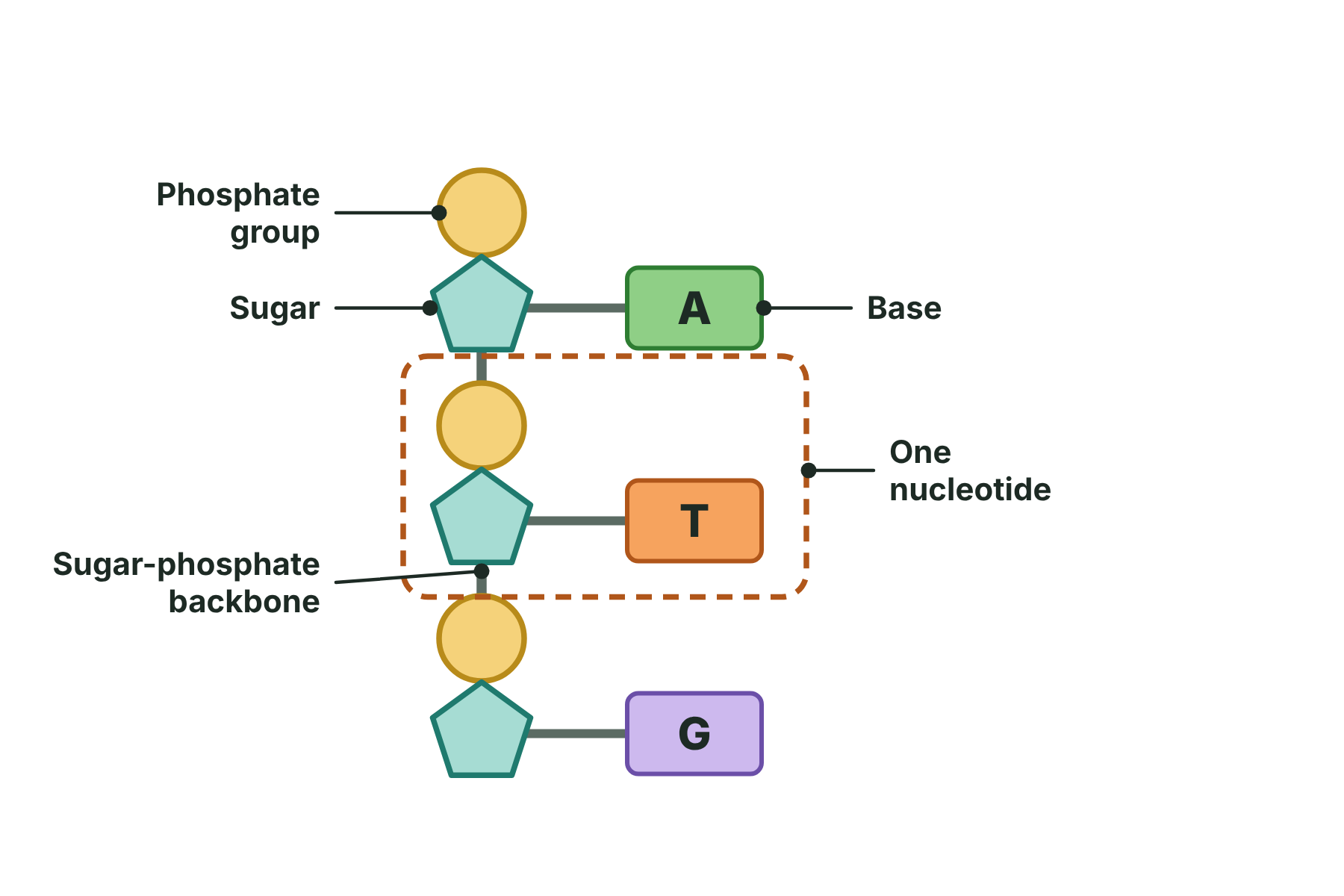
Each nucleotide has a phosphate, a sugar and one of four bases.
The double helix
A DNA molecule is made of two strands, not one.
-
Two strands
The two polymer strands run alongside each other, with the bases pointing inwards, like the two sides of a ladder with rungs.
-
Coiled into a helix
The ladder is twisted around itself into a spiral shape, known as a double helix.
-
Joined by base pairs
The bases of one strand are linked to the bases of the other, forming the rungs of the ladder.
-
Hydrogen bonds
The bases are held together by weak hydrogen bonds. These bonds are weak individually, but there are millions of them, so the whole molecule is very stable.
Complementary base pairing
Each base can only join with one other base. This is the rule that makes DNA copy accurately.
-
A pairs with T
Adenine always pairs with thymine.
-
C pairs with G
Cytosine always pairs with guanine.
-
Complementary strands
Because of the pairing rule, one strand is a mirror image of the other. If you know the order of bases on one strand, you can work out the order on the other.
-
Why it matters
When DNA is copied, each strand is used as a template, and the pairing rule makes sure that the copy is the same as the original.
The DNA double helix
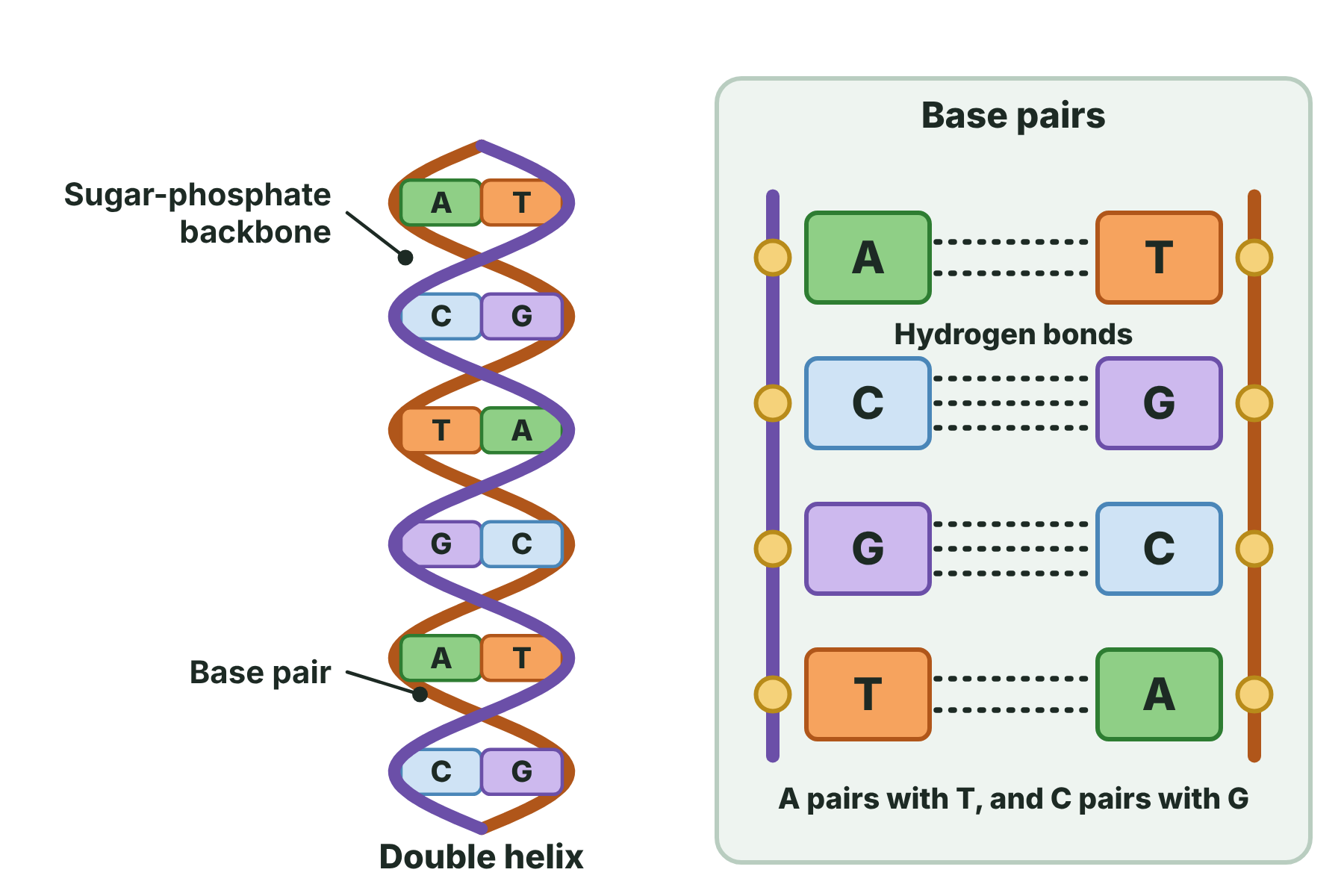
A always pairs with T, and C always pairs with G.
Writing the complementary strand
One strand of a DNA molecule has the base sequence A T G C C A G T. Write the sequence of the strand that pairs with it.
Show the solutionHide the solution
- 1 Apply the rule to each base in turn A pairs with T, T with A, C with G and G with C.
- 2 Pair the first four bases A T G C pairs with T A C G.
- 3 Pair the last four bases C A G T pairs with G T C A.
- 4 Write the full strand T A C G G T C A.
AnswerT A C G G T C A.
Working out the percentage of each base
A sample of DNA has 30% adenine. What percentage of the bases are thymine, cytosine and guanine?
Show the solutionHide the solution
- 1 Find the thymine A pairs with T, so the amount of T equals the amount of A, which is 30%.
- 2 Find what is left \(100 - 30 - 30 = 40\%\) is cytosine plus guanine.
- 3 Share it equally C pairs with G, so they are equal: \(40 \div 2 = 20\%\) each.
AnswerThymine 30%, cytosine 20% and guanine 20%.
Why weak bonds are useful
Hydrogen bonds are weak, and that is an advantage.
-
Strands can separate
The strands can be separated, or unzipped, without breaking the strong bonds in the backbone. This happens when DNA is copied.
-
Access to the code
To make a protein, the two strands separate in front of the gene so that its code can be read.
-
Many together are strong
Millions of hydrogen bonds hold the helix together, so it does not come apart on its own.
Case study
Watson, Crick and Rosalind Franklin
In 1953 James Watson and Francis Crick built a model of DNA that showed its double helix structure. They used an X-ray photograph taken by Rosalind Franklin, which showed that DNA was a helix, and the measurements made by Maurice Wilkins. Watson, Crick and Wilkins received a Nobel Prize in 1962, but Franklin had died in 1958 and could not be given one. The model explained how DNA can be copied and how it stores information.
Summary and exam focus
- DNA is a polymer made of nucleotides.
- Each nucleotide has a sugar, a phosphate group and one of four bases: A, T, C or G.
- Two strands are coiled into a double helix, joined by complementary base pairs.
- A pairs with T, and C pairs with G, held by weak hydrogen bonds.
- The weak bonds let the strands separate when DNA is copied or read.
Exam focus
Describe the structure of a DNA molecule. (4 marks) (4 marks)
Use the words polymer, nucleotide, base, double helix and complementary base pairs. A good answer gives the parts of a nucleotide, says that there are two strands, and names the pairing rule A with T and C with G, with the hydrogen bonds that hold them.
Key terms
The words this lesson expects you to use. Each one is linked from the first place it appears above.
- DNA
- Deoxyribonucleic acid: the molecule that carries the genetic code, made of two strands in a double helix.
- Polymer
- A long molecule made of many small repeating units joined together.
- Nucleotide
- The repeating unit of DNA, made of a sugar, a phosphate group and a base.
- Base
- One of the four chemicals (A, T, C or G) in a nucleotide, whose order forms the genetic code.
- Complementary base pairing
- The rule that A pairs with T and C pairs with G.
- Double helix
- The shape of DNA: two strands twisted around each other.
- Hydrogen bond
- A weak bond that holds the paired bases of the two DNA strands together.
- Sugar-phosphate backbone
- The outer part of each DNA strand, made of alternating sugar and phosphate groups.
- Adenine
- The base A, which pairs with thymine.
- Guanine
- The base G, which pairs with cytosine.
You've finished the notes
Check your understanding
Test yourself while it is fresh. Start with the flashcards, then try the exam questions.
Something here looks wrong?
Tell us what and we will go and look. It goes to whoever writes these pages, nobody else, and we do not ask who you are — so there is nothing to sign and nothing comes back to you.