Biology · DNA and Protein Synthesis
The Genome and the Human Genome Project
A genome is an organism's complete set of DNA. This lesson explains what the human genome contains, how the Human Genome Project mapped it, and how knowing the genome is changing medicine.
Learning Objectives
- 1Describe the genome as the entire DNA of an organism, and a gene as a section of DNA that codes for a specific protein.
- 2Describe the Human Genome Project and state what it found.
- 3Discuss the potential applications of the Human Genome Project in medicine.
- 4Evaluate the benefits and the possible problems of knowing a person's genome.
Retrieval practice
-
1
What is a gene?
Show answerHide answer
A section of a DNA molecule that codes for a protein.
-
2
How many chromosomes are in a human body cell?
Show answerHide answer
46, which is 23 pairs.
-
3
What are the four bases in DNA?
Show answerHide answer
A, T, C and G.
-
4
What do genes code for?
Show answerHide answer
Proteins.
The complete set of instructions
The genome of an organism is all of the DNA that it has. In a human, it is the DNA of all 23 pairs of chromosomes in the nucleus of a cell. Reading the genome is like reading a very long instruction manual. For a long time no one knew the order of all the bases, until a huge international project set out to find it. That project, the Human Genome Project, was one of the most ambitious in the history of science.
What is in the human genome
The numbers are huge, and they put a human in context.
-
About 3 billion base pairs
If the bases of one human genome were printed as letters in a book, it would be thousands of volumes long.
-
About 20 000 genes
Each gene codes for one or more proteins. The genes are spread along the 23 pairs of chromosomes.
-
A small part is genes
Only a small percentage of the DNA is made of genes. The rest is non-coding DNA, which includes the regions that control when genes are switched on.
-
Almost the same in everyone
The DNA of any two people is more than 99% identical. The tiny differences make each person unique.
The human genome in numbers
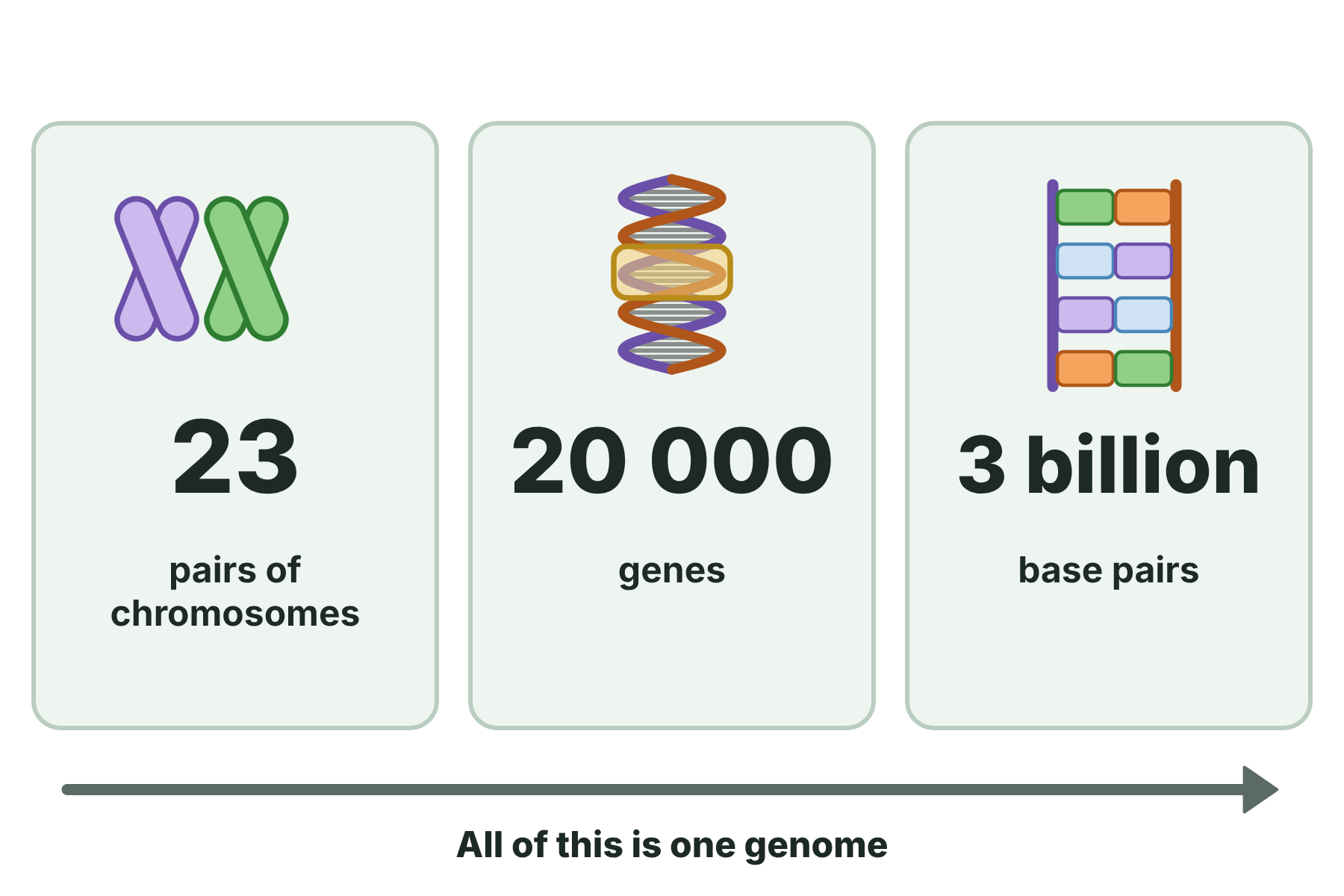
The human genome is stored in 23 pairs of chromosomes in the nucleus of every body cell.
The Human Genome Project
The project turned the genome into a map and a reference text for biologists.
-
1
1990
Scientists from many countries start work, with the aim of finding the order of all of the bases in human DNA.
-
2
Cut up the DNA
Samples of DNA from volunteers are broken into small pieces that can be read by machines.
-
3
Read the pieces
The order of bases in each piece is found by a sequencing machine.
-
4
Put it together
Computers match overlapping pieces and assemble them into the complete sequence.
-
5
2003
The project is finished, 13 years later. It cost a few billion pounds, and all of the data was made freely available.
What the project found
The project gave a lot of results, some of them surprising.
-
The number of genes
Humans have around 20 000 genes, far fewer than expected and not many more than a mouse.
-
The order of every base
The complete sequence of the human genome is now known and published for any scientist to use.
-
Where many genes are
The project mapped the position of many genes, including some that cause inherited disorders.
-
Similarity between people
It showed that all people are genetically very similar, and that human variation is small.
Applications in medicine
Knowing the genome could change the way many diseases are predicted, diagnosed and treated.
-
Finding genes for disorders
Scientists can search for the genes linked to inherited disorders, such as cystic fibrosis, so that carriers can be identified and tested.
-
Predicting the risk
Genetic tests can show if someone has a variant that raises the chance of a disease, such as the BRCA1 gene and breast cancer. They can then be screened early or change their lifestyle.
-
Personalised medicine
The best drug and the right dose can be chosen using a patient's own genes, so treatments work better and cause fewer side effects.
-
New treatments
Knowing which gene is faulty gives researchers a target for gene therapy, or for new drugs.
-
Tracing ancestry and migration
Comparing genomes shows how closely different people and populations are related.
Benefits and concerns about knowing your genome
Benefits
- Early diagnosis, and prevention of some diseases
- Treatment matched to the person
- Faster development of new drugs
- Better understanding of inherited disorders
Concerns
- Privacy: who should have access to the information?
- Insurance and employers could discriminate against people
- Stress for someone told they are likely to develop a disease with no cure
- Cost, and an unequal chance of benefiting
Case study
Testing for the BRCA1 gene
Some people inherit a variant of a gene called BRCA1, which makes breast and ovarian cancers much more likely. A woman with a family history of cancer can be tested for the variant. If she has it, she can be screened more often so that any cancer is found early, or she may choose to have preventive surgery. The test is a direct result of genome research. It also shows the dilemma: should relatives be told, and how will the result affect her insurance?
Summary and exam focus
- The genome is all of the DNA of an organism, and in humans there are about 3 billion base pairs and 20 000 genes.
- The Human Genome Project ran from 1990 to 2003 and found the order of all of the bases.
- The results can be used to find genes that cause disorders, to predict risk and to personalise treatment.
- Concerns include privacy, discrimination by insurers or employers, and the emotional effect of the results.
- People are more than 99% identical in their DNA.
Exam focus
Discuss the possible benefits and risks of using information from the Human Genome Project in medicine. (6 marks) (6 marks)
Write two balanced paragraphs. Give at least two benefits, such as predicting disease risk and personalised medicine, and at least two concerns, such as privacy and discrimination, and then give a conclusion.
Key terms
The words this lesson expects you to use. Each one is linked from the first place it appears above.
- Genome
- The entire DNA of an organism.
- Gene
- A section of a DNA molecule that codes for a specific protein.
- Human Genome Project
- An international project, completed in 2003, that found the order of all of the bases in human DNA.
- Sequencing
- Finding the order of bases in a piece of DNA.
- Non-coding DNA
- DNA that does not code for a protein, but may help to control genes.
- Genetic test
- A test that looks for a particular variant of a gene in a person's DNA.
- Personalised medicine
- Choosing a treatment that suits a person according to their own genes.
- Gene therapy
- Treating a genetic disorder by changing or replacing the faulty gene.
- Inherited disorder
- A condition caused by a faulty gene that is passed from parents to children.
You've finished the notes
Check your understanding
Test yourself while it is fresh. Start with the flashcards, then try the exam questions.
Something here looks wrong?
Tell us what and we will go and look. It goes to whoever writes these pages, nobody else, and we do not ask who you are — so there is nothing to sign and nothing comes back to you.