Biology · Enzymes and Digestion
Viewing as
Teacher view: every answer and mark scheme set out in full.
Investigating the Effect of pH on Amylase
This lesson covers the core practical on how pH affects the enzyme amylase. It explains the method with continuous sampling, the variables, how to turn the results into a rate, how to describe and explain the graph, and how to evaluate the investigation.
Learning Objectives
- 1Describe a method to investigate the effect of pH on the rate of reaction of amylase, using iodine and continuous sampling.
- 2Identify the independent, dependent and control variables in the investigation.
- 3Calculate the rate of reaction from the time taken, using rate = 1000 ÷ time.
- 4Describe and explain the shape of a graph of rate against pH.
- 5Evaluate the method and suggest improvements.
- 6State the safety precautions for the investigation.
Retrieval practice
-
1
What does amylase digest?
Show answerHide answer
Starch, into simple sugars.
-
2
What does iodine solution do in the presence of starch?
Show answerHide answer
It turns from orange-brown to blue-black.
-
3
What does denatured mean?
Show answerHide answer
The enzyme has lost its shape, so the active site no longer fits the substrate.
-
4
What is the optimum pH of amylase?
Show answerHide answer
About pH 7.
Testing what pH does to an enzyme
You already know that every enzyme has an optimum pH. In this practical you find out for yourself. Amylase digests starch, and iodine solution can tell you when the starch has gone, because iodine is blue-black with starch and orange-brown without it. If you time how long the starch takes to disappear, you can work out the rate of the reaction. By doing this at several different pH values, you can see which pH gives the fastest rate. The method uses continuous sampling: you take a small sample of the mixture at regular intervals while the reaction is going on, and test each one.
The investigation
A good investigation starts with a clear question and a clear plan for what you will change and measure.
-
Question
How does pH affect the rate at which amylase digests starch?
-
What you change
The pH. You use buffer solutions at pH 5, 6, 7, 8 and 9.
-
What you measure
The time taken for all of the starch to be digested.
-
How you know
Iodine solution on a spotting tile. It is blue-black while starch is present, and orange-brown when there is none left.
-
Buffer solutions
A buffer keeps the pH of the mixture constant at the value you want, even when the reaction is going on.
The equipment
Each piece of apparatus has a job.
-
Test tubes
One for each pH, to hold the starch, amylase and buffer.
-
Water bath at 35 °C
Keeps the temperature the same in every test. The thermometer checks it.
-
Spotting tile
Holds a drop of iodine solution in each well, ready for the samples.
-
Dropping pipette
Moves a drop of the mixture to the iodine.
-
Stopwatch
Times the whole reaction and tells you when to take each sample.
-
Syringes
Measure the volumes of starch, amylase and buffer.
The apparatus for the amylase and pH investigation
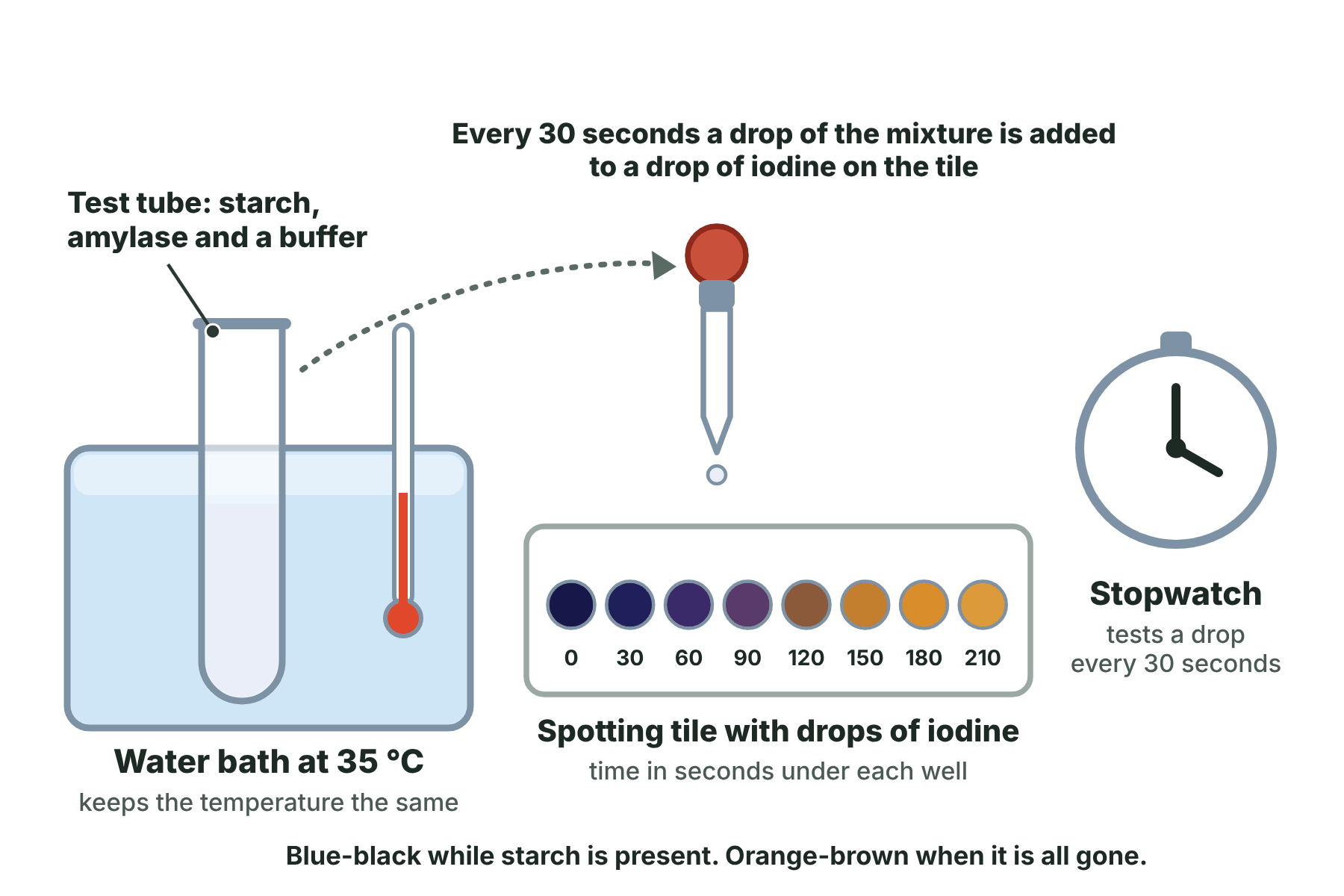
A drop of the mixture is tested every 30 seconds. The time at which the iodine stays orange-brown is the time taken for the starch to be digested.
The method
Do each pH in turn, and keep everything else the same.
-
1
Prepare the tile
Put a drop of iodine solution into each well of a spotting tile.
-
2
Set up the tubes
Put 2 cm³ of amylase solution and 2 cm³ of the pH 5 buffer into a test tube. Put 2 cm³ of starch solution into a second tube. Stand both in the water bath at 35 °C for a few minutes so that they reach the same temperature.
-
3
Start the reaction
Pour the starch into the amylase and buffer, mix, and start the stopwatch at once.
-
4
Sample every 30 seconds
Use a dropping pipette to take a drop of the mixture and add it to a drop of iodine on the tile. Rinse the pipette between samples.
-
5
Stop when it is orange-brown
When the iodine stays orange-brown, all the starch has been digested. Record the time.
-
6
Repeat
Repeat with buffers at pH 6, 7, 8 and 9, using a clean tile each time. Repeat each pH at least three times and calculate a mean.
The variables in this investigation
Independent variable
- What you change
- The pH of the buffer solution
- Five values: pH 5, 6, 7, 8 and 9
Dependent variable
- What you measure
- The time for the starch to be digested
- Used to work out the rate of reaction
Keeping it a fair test
Only the pH should change. Everything else that could affect the rate has to be controlled.
-
Temperature
Use the same water bath at 35 °C for all of the tubes, and check it with a thermometer.
-
Volumes
Use the same volume of amylase, starch and buffer every time.
-
Concentrations
Use the same concentration of amylase and of starch every time.
-
Sampling
Take a sample at the same intervals, and use the same size of iodine drop.
-
Why it matters
If anything else changes, you cannot be sure that the change in rate was caused by the pH.
Turning the times into rates
The time taken tells you how fast the reaction was, but a shorter time means a faster reaction, which can be confusing on a graph. The rate fixes this.
-
The equation
Rate = 1000 ÷ time taken, in seconds. The 1000 just gives easier numbers.
-
Why it works
A shorter time gives a larger rate. A longer time gives a smaller one.
-
Units
The units are arbitrary, because it is only used for comparing the different pH values.
Calculating the rate
At pH 6 the mean time for all of the starch to be digested was 90 seconds. Calculate the rate of reaction. Give your answer to one decimal place.
Show the solutionHide the solution
- 1 Write the equation Rate = 1000 ÷ time.
- 2 Substitute Rate = 1000 ÷ 90.
- 3 Round the answer 1000 ÷ 90 = 11.11, which is 11.1 to one decimal place.
Answer11.1 (arbitrary units)
Results and the graph
The table shows an example set of mean results. They are made-up values, which show the pattern you would expect.
-
pH 5
250 seconds, rate 4.0
-
pH 6
90 seconds, rate 11.1
-
pH 7
60 seconds, rate 16.7
-
pH 8
125 seconds, rate 8.0
-
pH 9
333 seconds, rate 3.0
The effect of pH on the rate of reaction of amylase
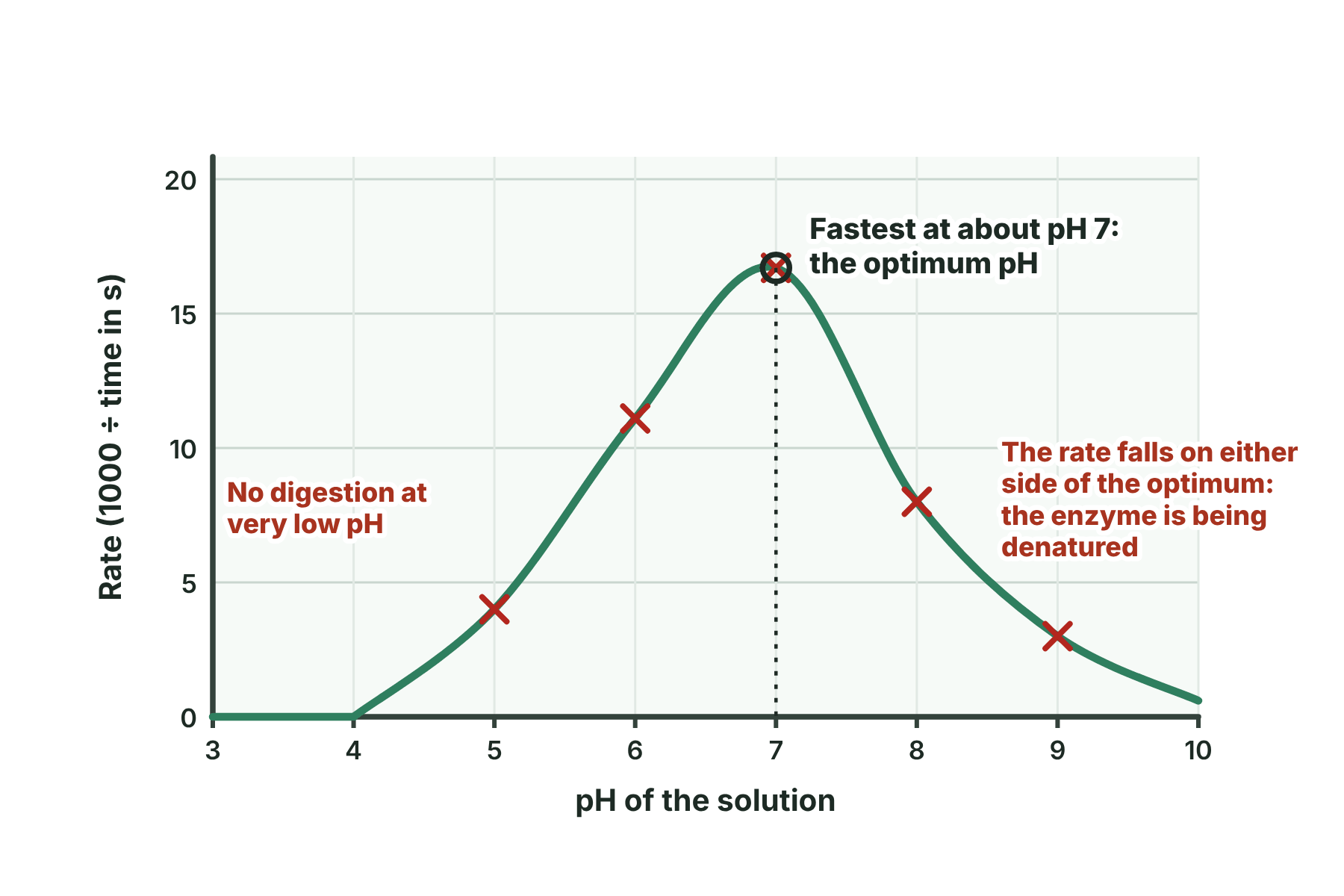
The rate is highest at pH 7 and falls on either side. pH 7 is the optimum.
Describing and explaining the pattern
Examiners often ask you to describe the graph first, and then to explain it. Keep the two apart.
-
Describe
The rate increases as the pH rises from 5 to 7. It is highest at about pH 7. Above pH 7 the rate decreases.
-
Use the data
Quote values from the graph, such as a rate of 16.7 at pH 7 compared with 4.0 at pH 5.
-
Explain the peak
pH 7 is the optimum pH for amylase, so the active site has exactly the right shape for the starch to fit.
-
Explain the fall
At other pH values the bonds that hold the enzyme in shape are affected. The active site changes shape and the enzyme begins to be denatured, so fewer enzyme-substrate complexes form and the rate falls.
-
Conclusion
The optimum pH for amylase is about pH 7.
Using a graph to work out a time
The rate of reaction at pH 8 is 8.0. Use rate = 1000 ÷ time to work out the time taken for all of the starch to be digested.
Show the solutionHide the solution
- 1 Rearrange the equation Rate = 1000 ÷ time, so time = 1000 ÷ rate.
- 2 Substitute Time = 1000 ÷ 8.0.
- 3 Give the answer with its unit 125 seconds.
Answer125 seconds.
Evaluating the method
No method is perfect. Evaluating means saying what limits the results, and how you could improve them.
-
Judging the colour
Deciding when the iodine has stopped being blue-black is done by eye, so it is subjective. A colorimeter, or a set of standard colours to compare with, would be more reliable.
-
Sampling every 30 seconds
You only know the time to the nearest 30 seconds. Sampling every 10 seconds would give more precise times.
-
Large steps in pH
The optimum could lie between two of the pH values. Testing values such as 6.5, 7.0 and 7.5 would show the optimum more precisely.
-
Repeats
Repeating each pH at least three times and calculating a mean makes the results more reliable. An anomalous result can be spotted and left out of the mean.
-
Temperature
The mixture could warm up or cool down. Checking it with the thermometer helps.
-
Mixing
Starting the stopwatch the moment the starch is added, and mixing well, makes the start time clearer.
Safety
Think about what could go wrong before you start.
-
Eye protection
Wear goggles. Enzyme solutions and iodine can irritate the eyes.
-
Skin
Wash off any amylase or iodine solution that gets onto the skin. Iodine also stains clothes.
-
Hot water
Take care with the water bath, and do not stand over it.
-
Spills
Wipe up spills at once, because a wet floor is a slip hazard.
Case study
Why amylase stops working in the stomach
Amylase starts to digest starch in your mouth, where the pH of saliva is close to 7. When the food reaches the stomach, it is mixed with hydrochloric acid, and the pH falls to about 2. This is far from the optimum for amylase, so the active site changes shape, the enzyme is denatured, and it stops working. The starch is digested later, when the pancreas and the small intestine supply more amylase and the food is neutralised by bile.
The conclusion
The rate of an enzyme-controlled reaction is fastest at the optimum pH. For amylase in this investigation the optimum is about pH 7, and the rate falls on either side because the enzyme is denatured.
Rate = 1000 ÷ time. The shorter the time, the higher the rate.
Amylase and pH
Amylase and pH
-
Method
- starch
- amylase and a buffer in a water bath
- a drop tested in iodine every 30 s
-
Variables
- independent: pH
- dependent: time
- control: temperature and volumes
-
Rate
- 1000 ÷ time taken
-
Results
- fastest at about pH 7
- slower on either side
-
Evaluation
- colorimeter
- shorter intervals
- more pH values
- repeats
Summary and exam focus
- Starch and amylase are mixed with a buffer, and a drop of the mixture is tested with iodine every 30 seconds.
- The time at which the iodine stays orange-brown is the time taken to digest the starch.
- Rate = 1000 ÷ time. A shorter time means a faster rate.
- The independent variable is the pH. The dependent variable is the time. The temperature is controlled with a water bath.
- The rate is highest at the optimum pH, about 7 for amylase, and falls on either side because the enzyme is denatured.
Exam focus
Describe how you would investigate the effect of pH on the rate of reaction of amylase. (6 marks) (6 marks)
Say what you change (the pH, using buffers), what you measure (the time for the starch to disappear, using iodine every 30 seconds) and what you keep the same (the temperature, using a water bath, and the volumes and concentrations).
Key terms
The words this lesson expects you to use. Each one is linked from the first place it appears above.
- Continuous sampling
- Taking a small sample at regular intervals during a reaction and testing each one.
- Buffer solution
- A solution that keeps the pH constant at a particular value.
- Spotting tile
- A tile with small wells, used to test many small drops one after the other.
- Independent variable
- The variable that you change in an investigation.
- Dependent variable
- The variable that you measure in an investigation.
- Control variable
- A variable that you keep the same, so that it does not affect the results.
- Water bath
- A container of water at a steady temperature, used to keep the temperature of the tubes constant.
- Optimum pH
- The pH at which an enzyme works fastest.
- Rate of reaction
- A measure of how fast a reaction goes, worked out here as 1000 ÷ time.
- Anomalous result
- A result that does not fit the pattern, and is probably due to an error.
- Reliable
- Giving similar results when the investigation is repeated.
Questions and answers
20 questions set on this lesson, with the mark schemes and model answers open.
Name the solution used to show when all of the starch has been digested.
Mark scheme — 1 mark available
- Iodine (solution) — 1 mark
Model answer
Iodine solution.
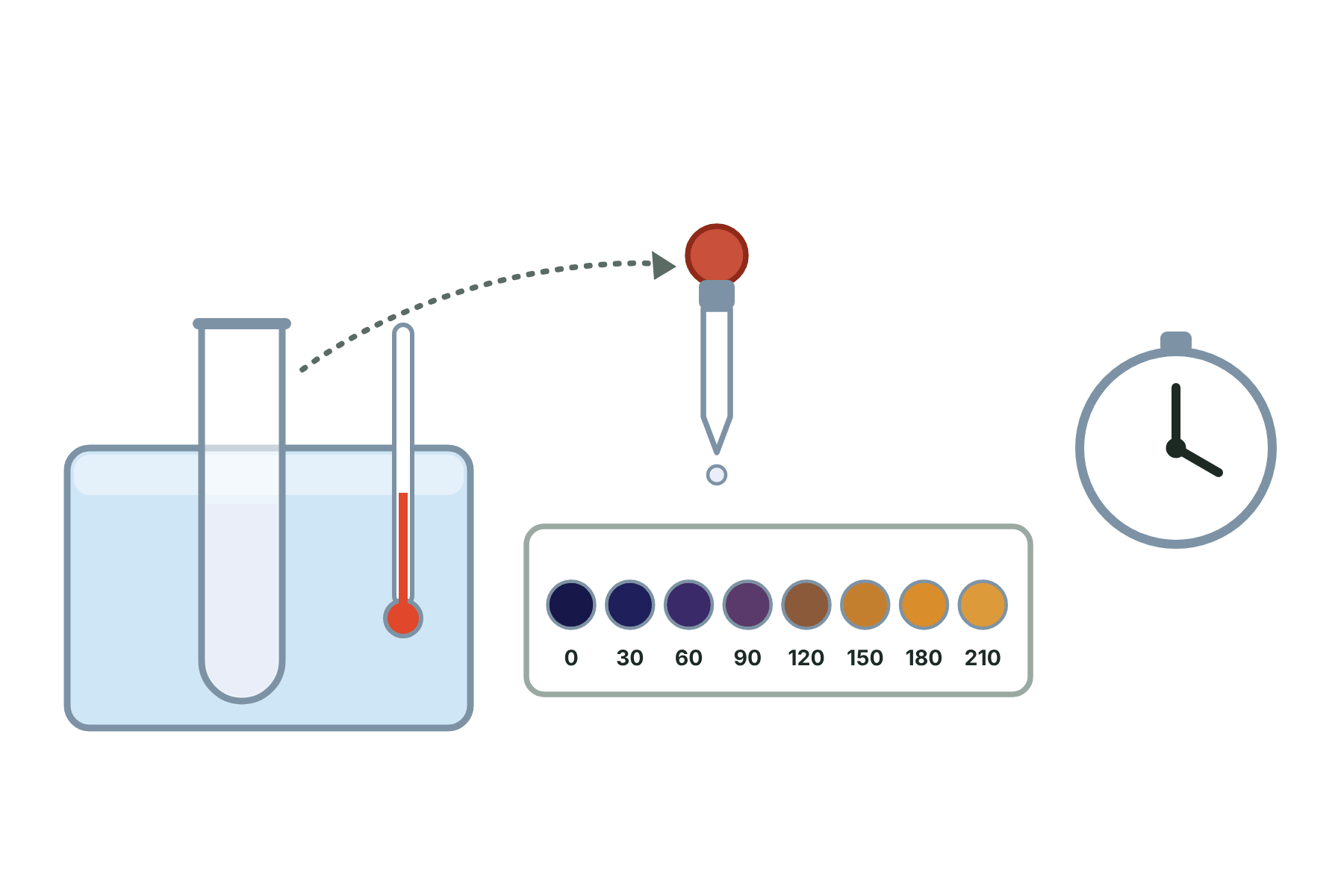
Figure 1 shows the apparatus used to investigate amylase. Explain the purpose of the water bath and of the spotting tile.
Mark scheme — 2 marks available
- Water bath keeps the temperature constant — 1 mark
- Spotting tile holds drops of iodine for testing samples — 1 mark
Model answer
The water bath keeps the temperature constant, so that temperature does not affect the rate. The spotting tile holds drops of iodine, so that samples of the mixture can be tested.
A buffer solution is added to the mixture of starch and amylase. Explain why.
Mark scheme — 2 marks available
- Keeps the pH constant — 1 mark
- At the value being tested / so pH is the only variable — 1 mark
Model answer
The buffer keeps the pH constant. This means that the pH stays at the value being tested, so only the pH changes.
In an investigation into the effect of pH on the rate of reaction of amylase, state the independent variable, the dependent variable and one control variable.
Mark scheme — 3 marks available
- Independent variable: pH — 1 mark
- Dependent variable: time for the starch to be digested / rate — 1 mark
- Control variable: e.g. temperature, volume or concentration — 1 mark
Model answer
The independent variable is the pH. The dependent variable is the time taken for the starch to be digested. A control variable is the temperature (or the volume or concentration of the amylase or starch).
At pH 7 the mean time taken for the starch to be digested was 60 seconds. Use rate = 1000 ÷ time to calculate the rate. Give your answer to one decimal place.
Mark scheme — 2 marks available
- 1000 ÷ 60 — 1 mark
- 16.7 — 1 mark
Model answer
1000 ÷ 60 = 16.7.
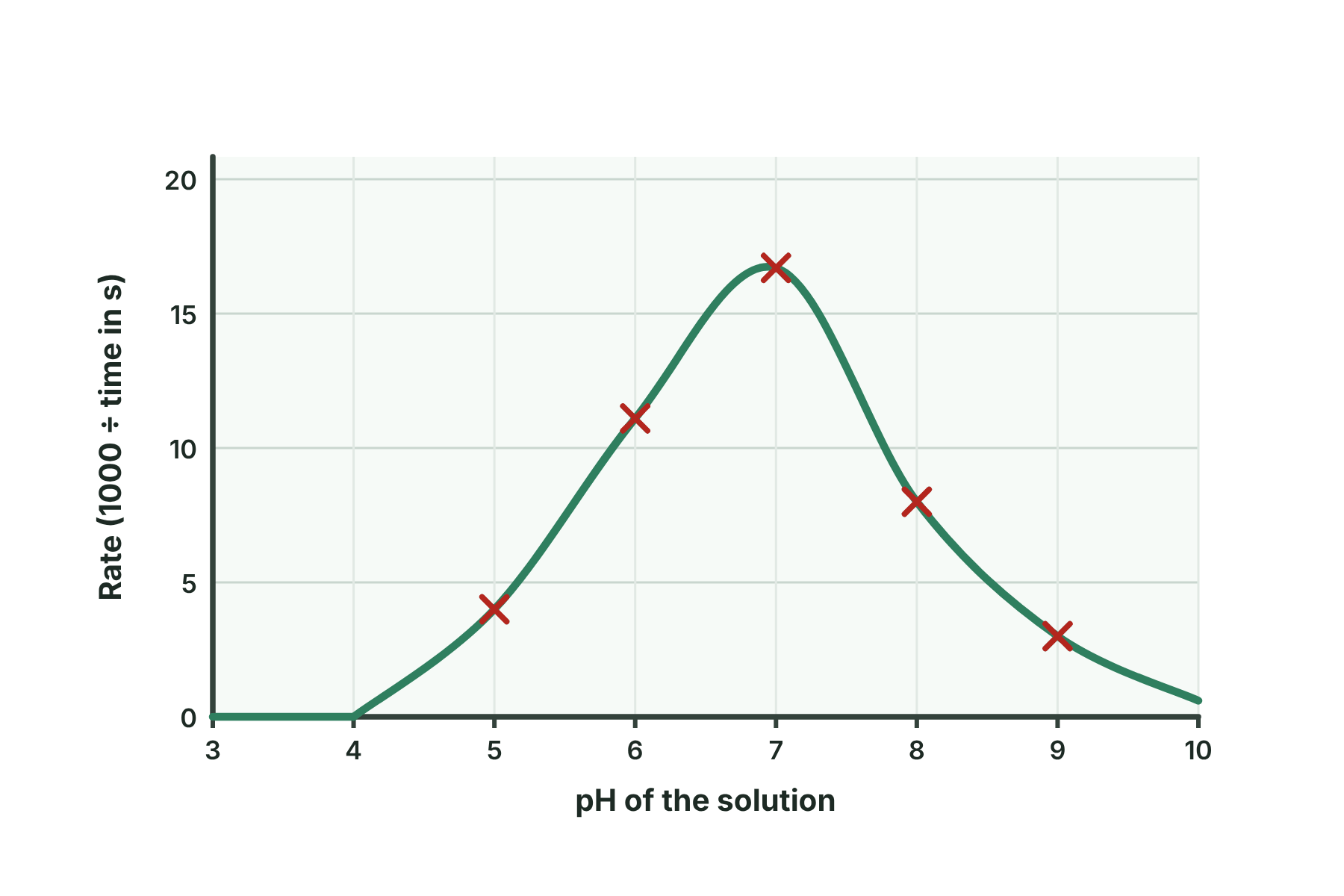
Figure 2 shows the results of the investigation. (a) Use Figure 2 to give the optimum pH. (b) The rate at pH 8 was 8.0. Use rate = 1000 ÷ time to calculate the time taken at pH 8.
Mark scheme — 3 marks available
- (a) pH 7 — 1 mark
- (b) 1000 ÷ 8.0 — 1 mark
- 125 seconds — 1 mark
Model answer
(a) pH 7. (b) Time = 1000 ÷ 8.0 = 125 seconds.
Describe the effect of pH on the rate of reaction shown in Figure 2.
Mark scheme — 3 marks available
- Rate increases from pH 5 to 7 — 1 mark
- Highest at pH 7 (about 16.7) — 1 mark
- Decreases above pH 7 — 1 mark
Model answer
The rate increases as the pH rises from 5 to 7. The rate is highest at pH 7, at about 16.7. Above pH 7 the rate decreases.
Explain why the rate of reaction is lower at pH 9 than at pH 7.
Mark scheme — 3 marks available
- pH 9 is away from the optimum — 1 mark
- The active site changes shape / the enzyme is denatured — 1 mark
- The starch no longer fits / fewer complexes form — 1 mark
Model answer
pH 9 is not the optimum pH for amylase. The shape of the active site changes and the enzyme is denatured. The starch no longer fits the active site, so fewer enzyme-substrate complexes form.
The investigation only used whole pH values from 5 to 9, and judged the colour of the iodine by eye. Suggest two improvements to the method, and explain why each would help.
Mark scheme — 4 marks available
- Test pH values in smaller steps near pH 7 — 1 mark
- To find the optimum more precisely — 1 mark
- Use a colorimeter / colour standards — 1 mark
- So that the end point is not subjective — 1 mark
Model answer
Test more pH values near the optimum, such as 6.5, 7 and 7.5, to find the optimum pH more precisely. Use a colorimeter to measure the colour of the iodine, so that the end point is not decided by eye.
Describe how you would investigate the effect of pH on the rate of reaction of amylase.
What the examiner wants: Say what you change, what you measure and how, and what you keep the same.
Mark scheme — 6 marks available
- Mix starch, amylase and a buffer — 1 mark
- In a water bath at a constant temperature — 1 mark
- Take drops every 30 seconds and add them to iodine — 1 mark
- Time taken for the iodine to stay orange-brown — 1 mark
- Repeat with different pH buffers, keeping other variables the same — 1 mark
- Calculate the rate / repeat to find a mean — 1 mark
Model answer
Put starch, amylase and a buffer of a certain pH into a test tube in a water bath at a set temperature. Start a stopwatch. Every 30 seconds, take a drop of the mixture and add it to a drop of iodine on a spotting tile. When the iodine stays orange-brown, all the starch has been digested, so record the time. Repeat with buffers of different pH, keeping the temperature, volumes and concentrations the same. Calculate the rate as 1000 ÷ time and repeat each pH to find a mean.
What does the colour of iodine solution tell you in this investigation?
Why: Iodine is blue-black when starch is present and orange-brown when the starch has all been digested.
What is the independent variable?
Why: The pH is the variable that you change deliberately.
What is the dependent variable?
Why: The time taken for the starch to be digested is what you measure.
Why is a water bath used in this investigation?
Why: It keeps the temperature the same in every test, so that only the pH changes.
What is the purpose of a buffer?
Why: A buffer keeps the pH constant at the value being tested.
The time taken at one pH is 50 s. What is the rate, using rate = 1000 ÷ time?
Why: 1000 ÷ 50 = 20.
At which pH was amylase fastest in the example investigation?
Why: The rate was highest at pH 7, at about 16.7.
Why does the rate fall at a pH far from the optimum?
Why: The active site changes shape and the enzyme is denatured, so fewer substrate molecules fit.
Which change would make the results more precise?
Why: Sampling every 10 seconds, instead of every 30 seconds, gives a more precise value for the time.
A student says the rate at pH 9 is lower than at pH 7 because the enzyme is used up. What is the best response?
Why: Enzymes are not used up. At pH 9 the enzyme is being denatured, so the active site no longer fits the starch.