Biology · Evolution and Natural Selection
Classification and the Three Domains
How do we sort the millions of species on Earth into groups? This lesson explains the five kingdom system, and how genetic analysis led to the suggestion of three domains.
Learning Objectives
- 1Describe the five kingdoms method of classification, and the features of each kingdom.
- 2Describe how genetic analysis led to the three domains system.
- 3Describe the three domains and the groups in them.
- 4Explain why scientific classification changes as new evidence is discovered.
Retrieval practice
-
1
What is a eukaryotic cell?
Show answerHide answer
A cell with a nucleus and other membrane-bound organelles.
-
2
What is a prokaryotic cell?
Show answerHide answer
A cell with no nucleus, such as a bacterium.
-
3
What is a species?
Show answerHide answer
A group of organisms that can breed to produce fertile offspring.
-
4
What is a common ancestor?
Show answerHide answer
A species from which two or more other species have evolved.
Sorting living things into groups
There are millions of different species, so scientists need a way to sort them into groups. Classification places organisms in groups according to their features, and ideally it also shows how closely they are related. Carl Linnaeus, in the eighteenth century, grouped organisms into a hierarchy, and gave each species a two-part Latin name, such as Homo sapiens, with the genus first and the species second. For a long time, the largest groups were kingdoms, based on the structure of the cells and the way an organism feeds.
The five kingdoms
The five kingdom system was the standard method for much of the twentieth century.
-
Animals
Multicellular, with no cell walls, no chloroplasts, and they feed on other organisms. Examples are insects, fish and mammals.
-
Plants
Multicellular, with cell walls of cellulose, and chloroplasts for photosynthesis. Examples are mosses, ferns and flowering plants.
-
Fungi
Mostly multicellular with cell walls of chitin, and no chloroplasts. They feed by absorbing nutrients from dead or living organisms. Examples are mushrooms and yeast.
-
Protists
Mostly single-celled eukaryotes, with a wide range of features. Examples are amoeba and Plasmodium, the cause of malaria.
-
Prokaryotes
Single-celled organisms with no nucleus, such as bacteria.
The three domain system
In 1977 an American scientist, Carl Woese, suggested a new system, based on genetic evidence.
-
Comparing genes
Woese compared the sequences of bases in the genes for ribosomal RNA in many organisms. Ribosomes are found in all living things, so the gene can be compared across all of them.
-
A surprise
The prokaryotes were not one group. Some of them, now called archaea, were as different from bacteria as they were from the eukaryotes.
-
Three domains
Living things are placed in three large groups called domains, which are above the level of kingdoms.
-
New evidence
Later studies of other genes and of the structure and chemistry of cells supported the three domains.
The three domains
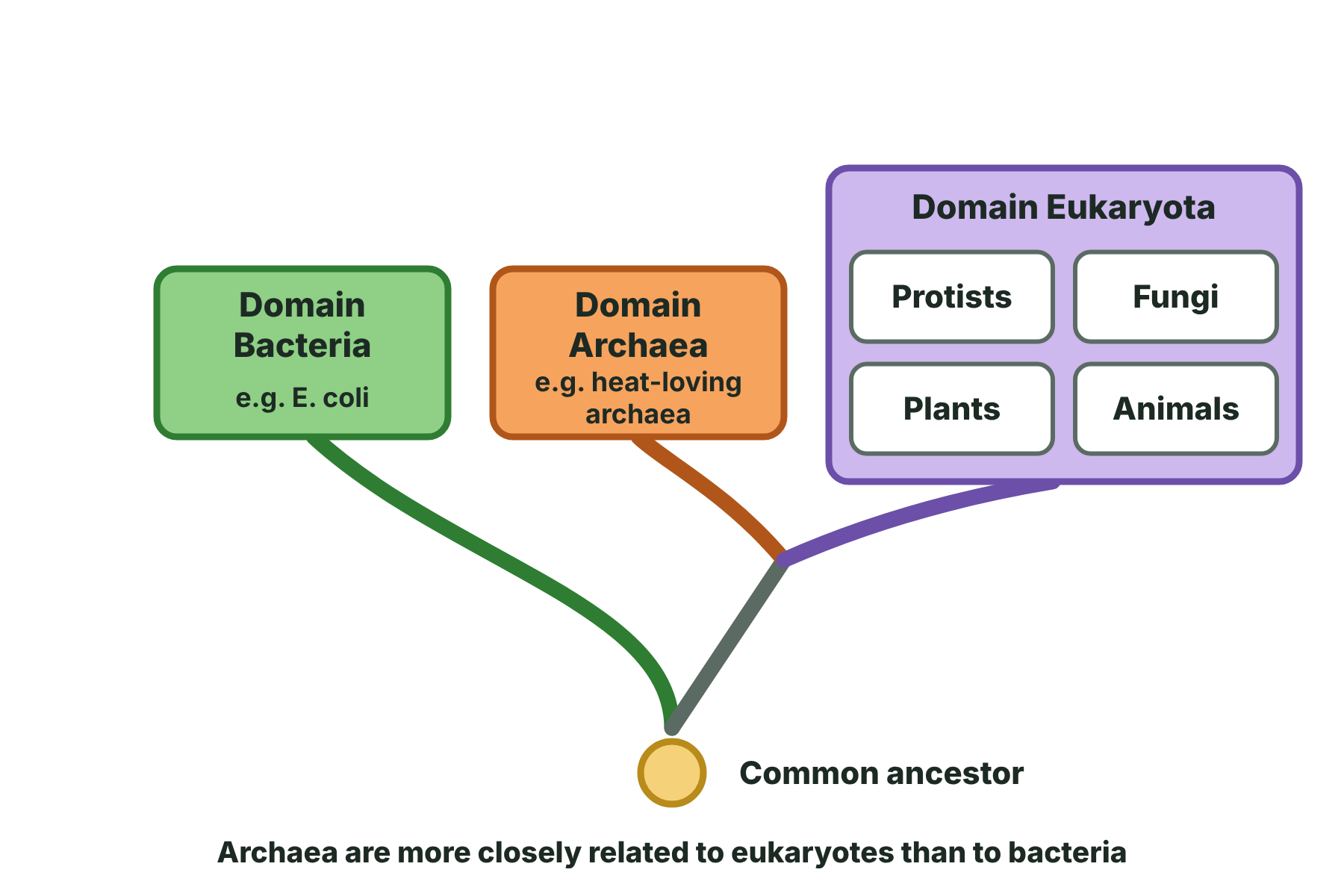
Genetic evidence puts living things into three domains, with the four kingdoms of eukaryotes in one of them.
Five kingdoms and three domains
The five kingdoms system
- Based mainly on structure and the way of feeding
- Places all prokaryotes in one kingdom
- Has five groups at the top level
- Developed before DNA sequencing was possible
The three domains system
- Based on genetic analysis, especially of ribosomal RNA
- Splits the prokaryotes into Bacteria and Archaea
- Has three groups at the top level
- Shows the evolutionary relationships more accurately
The three domains
Each domain has its own features.
-
Bacteria
Single-celled prokaryotes found everywhere, such as in soil, water and the human gut. Their cell walls are made of a substance called peptidoglycan.
-
Archaea
Single-celled prokaryotes without a nucleus, often found in extreme habitats such as hot springs, salt lakes and deep-sea vents. They have different genes, cell membranes and ribosomes from bacteria.
-
Eukaryota
All organisms whose cells have a nucleus, including protists, fungi, plants and animals.
Why classification changes
Classification is a model that scientists change when there is better evidence.
-
New technology
DNA sequencing made it possible to compare the genes of species, which was not possible when the kingdoms were drawn up.
-
Appearances can mislead
Organisms that look alike can be unrelated, as with analogous structures, and some that look different are closely related, so genes are a better guide to ancestry.
-
Evidence is peer reviewed
New ideas are tested by other scientists before they are accepted, so Woese's proposal took several years to gain support.
-
Still changing
Scientists continue to revise the tree of life as more genomes are sequenced.
Case study
Life in boiling water
When Carl Woese looked at the genes of microbes from hot springs, he found that many of them were not bacteria at all. Some archaea live in water at over 100 degrees Celsius at the bottom of the ocean, or in very salty lakes that would kill most other living things, and others make methane in the guts of cows. One of them gave scientists an enzyme that is now used in the PCR method to copy DNA. The discovery of archaea shows how looking at genes can show up groups that were not seen before.
Summary and exam focus
- The five kingdoms are animals, plants, fungi, protists and prokaryotes.
- Carl Woese used genetic analysis to propose three domains in 1977.
- The three domains are Bacteria, Archaea and Eukaryota.
- Eukaryota includes the kingdoms of protists, fungi, plants and animals.
- Classification changes as new evidence, such as DNA sequences, is discovered.
Exam focus
Describe how the three domains system of classification differs from the five kingdoms system, and explain why the system was changed. (4 marks) (4 marks)
State what each system is based on, and the main difference: the prokaryotes are split into two domains, Bacteria and Archaea. For the explanation, say that genetic analysis, such as comparing ribosomal RNA genes, gave new evidence about relationships.
Key terms
The words this lesson expects you to use. Each one is linked from the first place it appears above.
- Classification
- Sorting living things into groups according to their features and relationships.
- Kingdom
- One of the large groups into which living things were sorted, such as animals or plants.
- Domain
- One of the three largest groups of living things: Bacteria, Archaea and Eukaryota.
- Archaea
- A domain of single-celled prokaryotes, often found in extreme environments.
- Bacteria
- A domain of single-celled prokaryotes, with cell walls containing peptidoglycan.
- Eukaryota
- The domain of organisms whose cells have a nucleus.
- Binomial name
- The two-part Latin name of a species, such as Homo sapiens.
- Genetic analysis
- Comparing the base sequences of DNA or RNA of different species.
- Prokaryote
- An organism with cells that have no nucleus.
You've finished the notes
Check your understanding
Test yourself while it is fresh. Start with the flashcards, then try the exam questions.
Something here looks wrong?
Tell us what and we will go and look. It goes to whoever writes these pages, nobody else, and we do not ask who you are — so there is nothing to sign and nothing comes back to you.