Biology · Evolution and Natural Selection
The Pentadactyl Limb
A human arm, a bat's wing and a whale's flipper do very different jobs, but their bones are laid out in the same way. This lesson is for separate Biology only: Combined Science students do not need it. It explains how the pentadactyl limb gives evidence for evolution from a common ancestor.
Learning Objectives
- 1Describe the pentadactyl limb and the bones that it is made of.
- 2Explain how the anatomy of the pentadactyl limb provides evidence for evolution from a common ancestor.
- 3Explain how natural selection has adapted the limb for different functions.
- 4Distinguish between homologous and analogous structures.
Retrieval practice
-
1
What is a common ancestor?
Show answerHide answer
A species from which two or more other species have evolved.
-
2
What is natural selection?
Show answerHide answer
The process by which better adapted individuals survive and reproduce, passing on their alleles.
-
3
What is an adaptation?
Show answerHide answer
A feature that helps an organism to survive in its environment.
-
4
What other evidence is there for evolution, apart from fossils?
Show answerHide answer
DNA comparisons, and stone tools for humans.
The same bones, different jobs
Many land vertebrates, and some that live in water, have front limbs with a common pattern of bones. This limb has five digits, and it is called the pentadactyl limb, from the Greek for five fingers. If different species had been designed separately for different jobs, we would not expect them to share the same arrangement. The sensible explanation is that they inherited it from a common ancestor, and that natural selection has changed it in each species to suit its way of life.
The pattern of bones
All pentadactyl limbs have the same sets of bones, in the same order.
-
Humerus
A single large bone in the upper limb, between the shoulder and the elbow.
-
Radius and ulna
Two bones in the lower part of the limb, between the elbow and the wrist.
-
Carpals
A group of small bones that form the wrist.
-
Metacarpals and phalanges
The long bones of the hand, and the bones of the fingers, which are called digits.
The same bones in four different limbs
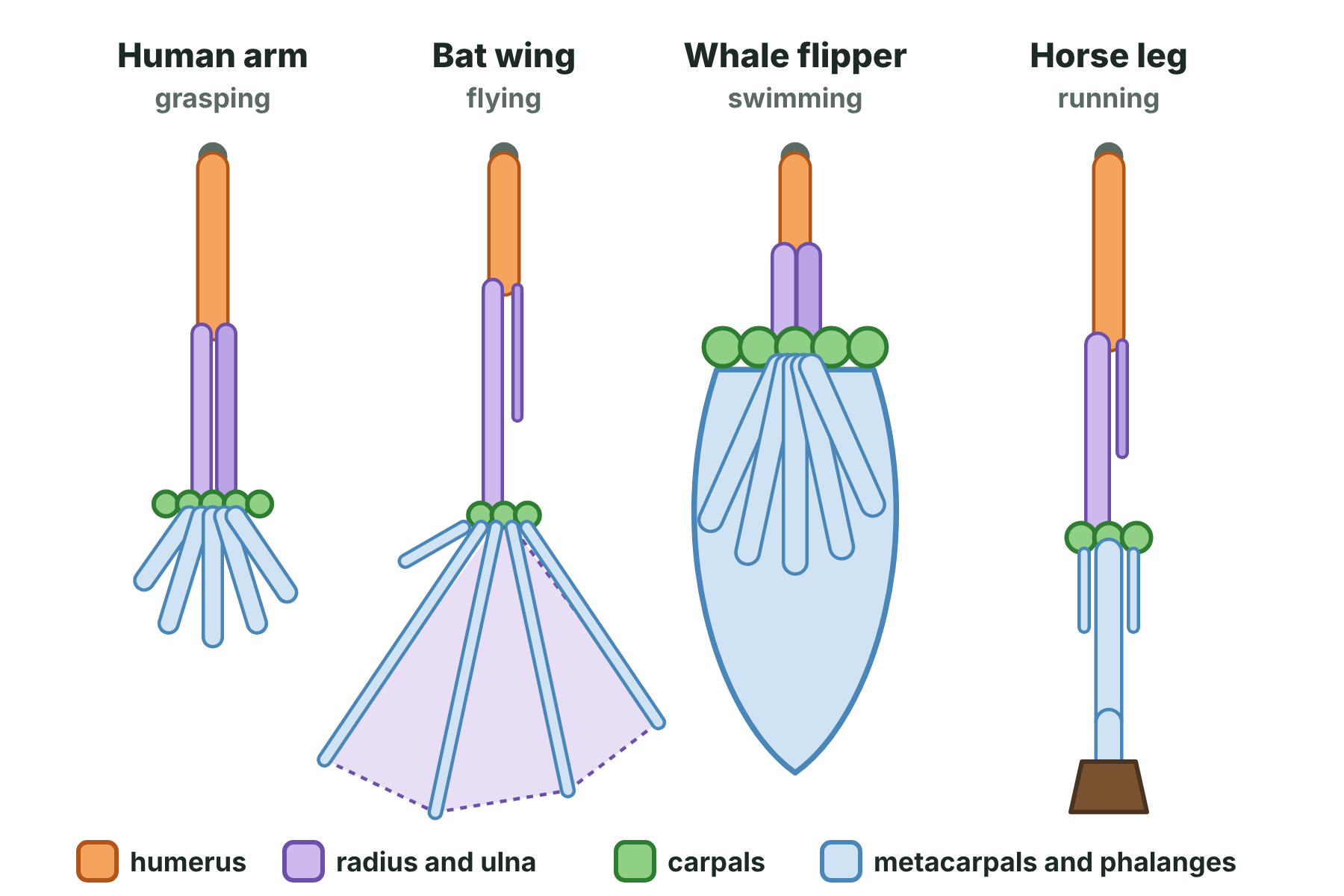
The same set of bones is used in each limb, but their size and shape are adapted for different functions.
Homologous and analogous structures
Homologous structures
- Have the same basic structure, such as the pentadactyl limb
- May have different functions, such as grasping or flying
- Are inherited from a common ancestor
- Provide evidence of a shared evolutionary history
Analogous structures
- Have different underlying structures
- Have the same function, such as the wings of a bird and an insect
- Evolved separately, with no shared ancestor
- Show how similar problems can lead to similar solutions
Adapted for different functions
The bones have changed in size and shape, as natural selection has favoured different features in each species.
-
Human arm
The bones are of moderate length, with a thumb that can touch the other fingers, so that the hand can grasp and hold tools.
-
Bat wing
The finger bones are very long and thin, and support a membrane of skin, so that the wing is light and can flap.
-
Whale flipper
The bones are short and flattened, and enclosed in a paddle, which makes a stable steering surface for swimming.
-
Horse leg
The bones are long and few digits remain, with only one that has a hoof, so that the leg can move forwards and back quickly for running.
Why this is evidence for evolution
The limb supports the theory in three ways.
-
The pattern
Species with very different habits share one unusual pattern of bones. Common ancestry is the simplest explanation.
-
The changes are useful
Each limb is modified in a way that fits its function, which is what natural selection predicts.
-
Agreement with other evidence
The relationships suggested by the limb match those found from fossils and from DNA comparisons.
-
Divergent evolution
Over a long time, an ancestral limb has evolved in different directions in different environments.
Case study
Whales and their land ancestors
Whales live entirely in the sea, but they breathe air, and they have a pentadactyl limb inside the flipper, which is evidence that they evolved from land mammals. Fossils found in Pakistan and Egypt show a series of animals with shorter and shorter legs and a body more suited to swimming. Modern whales even have small, useless bones in their bodies where a pelvis and hind legs once were. The anatomy and the fossils tell the same story.
Summary and exam focus
- The pentadactyl limb has a humerus, a radius and ulna, carpals, and five digits.
- It is found in many different animals, which use their limbs for different jobs.
- The common pattern shows that these animals have a common ancestor.
- Natural selection has changed the size and shape of the bones to suit each function.
- Homologous structures have the same structure and a common ancestor, and analogous ones have the same function only.
Exam focus
The wing of a bat, the flipper of a whale and the arm of a human all have the same basic pattern of bones. Explain how this provides evidence for evolution. (4 marks) (4 marks)
State the similarity (the same bones), then explain that it suggests a common ancestor, and finish by saying that natural selection has adapted the bones for different functions. Link each point to the evidence.
Key terms
The words this lesson expects you to use. Each one is linked from the first place it appears above.
- Pentadactyl limb
- A limb with five digits, found in many vertebrates, with the same basic arrangement of bones.
- Humerus
- The bone of the upper limb.
- Radius
- One of the two bones in the lower limb.
- Ulna
- The other bone in the lower limb.
- Carpals
- The small bones of the wrist.
- Digits
- The fingers or toes.
- Homologous structure
- A structure with the same underlying arrangement in different species, inherited from a common ancestor.
- Analogous structure
- A structure with the same function in different species, but a different origin.
- Divergent evolution
- The evolution of different features in related species, so that they become less alike.
You've finished the notes
Check your understanding
Test yourself while it is fresh. Start with the flashcards, then try the exam questions.
Something here looks wrong?
Tell us what and we will go and look. It goes to whoever writes these pages, nobody else, and we do not ask who you are — so there is nothing to sign and nothing comes back to you.