Biology · Evolution and Natural Selection
Darwin and Wallace
Two naturalists reached the same idea almost at the same time. This lesson is for separate Biology only: Combined Science students do not need it. It covers the work of Charles Darwin and Alfred Russel Wallace, and the impact of their ideas on modern biology.
Learning Objectives
- 1Describe the work of Darwin and Wallace in developing the theory of evolution by natural selection.
- 2Explain why Darwin delayed publishing, and why his ideas were controversial.
- 3Explain the impact of the theory on modern biology.
- 4Explain why the theory became more widely accepted over time.
Retrieval practice
-
1
What is variation?
Show answerHide answer
The differences between individuals of the same species.
-
2
What is a mutation?
Show answerHide answer
A random change in the base sequence of DNA.
-
3
What does a species mean?
Show answerHide answer
A group of organisms that can breed together to produce fertile offspring.
-
4
What is a gene?
Show answerHide answer
A section of DNA that codes for a protein.
Where do species come from?
In the early nineteenth century most people in Britain believed that every species had been created separately, and had not changed since. A few thinkers suggested that species might change over time, but nobody had a convincing explanation of how. The theory that Darwin and Wallace put forward, evolution by natural selection, was the first to be supported by a large amount of evidence. It has since become the central idea of biology.
Setting the scene
Darwin and Wallace both spent years collecting living and fossil specimens in distant places, and both were struck by the huge variety of life and by how well each species fitted where it lived. Wallace had no connection with Darwin's ideas, but arrived independently at the same explanation.
- 1809 Charles Darwin is born in Shrewsbury.
- 1831 Darwin sets out on HMS Beagle, a voyage of five years round the world.
- 1835 Darwin visits the Galápagos Islands and studies the animals there.
- 1858 Wallace sends Darwin a paper with the same idea, and both are presented to the Linnean Society.
- 1859 Darwin publishes On the Origin of Species.
Charles Darwin
Darwin built up evidence over more than twenty years before he published.
-
The Beagle voyage
He collected plants, animals and fossils in South America and the Pacific, and noticed that related species differ from place to place.
-
The Galápagos
He saw that the finches, tortoises and mockingbirds on each island were slightly different, although they looked related to species on the mainland.
-
Selective breeding
He studied how pigeon breeders produced new varieties by choosing parents, and realised nature could do the same.
-
Delay
He spent about twenty years collecting evidence and checking his ideas before publishing, partly because he knew it would upset many people.
Alfred Russel Wallace
Wallace worked on his own, but came to the same conclusion.
-
Collector
He spent years collecting specimens in the Amazon and in South-East Asia, selling them to pay for his travels.
-
The idea
In 1858, while ill with a fever on an island in Indonesia, he realised that competition for resources would let the best-suited individuals survive.
-
The letter
He sent his ideas to Darwin, who was shocked at how closely they matched his own unpublished work.
-
Joint presentation
Their two papers were read together to the Linnean Society in July 1858, and Darwin's book followed in 1859.
-
Biogeography
Wallace also worked on how animals are distributed around the world, and drew a line between the Asian and Australian animals of Indonesia.
Darwin's description
How Darwin named his explanation.
This preservation of favourable variations and the rejection of injurious variations, I call Natural Selection.
A timeline of the theory of evolution
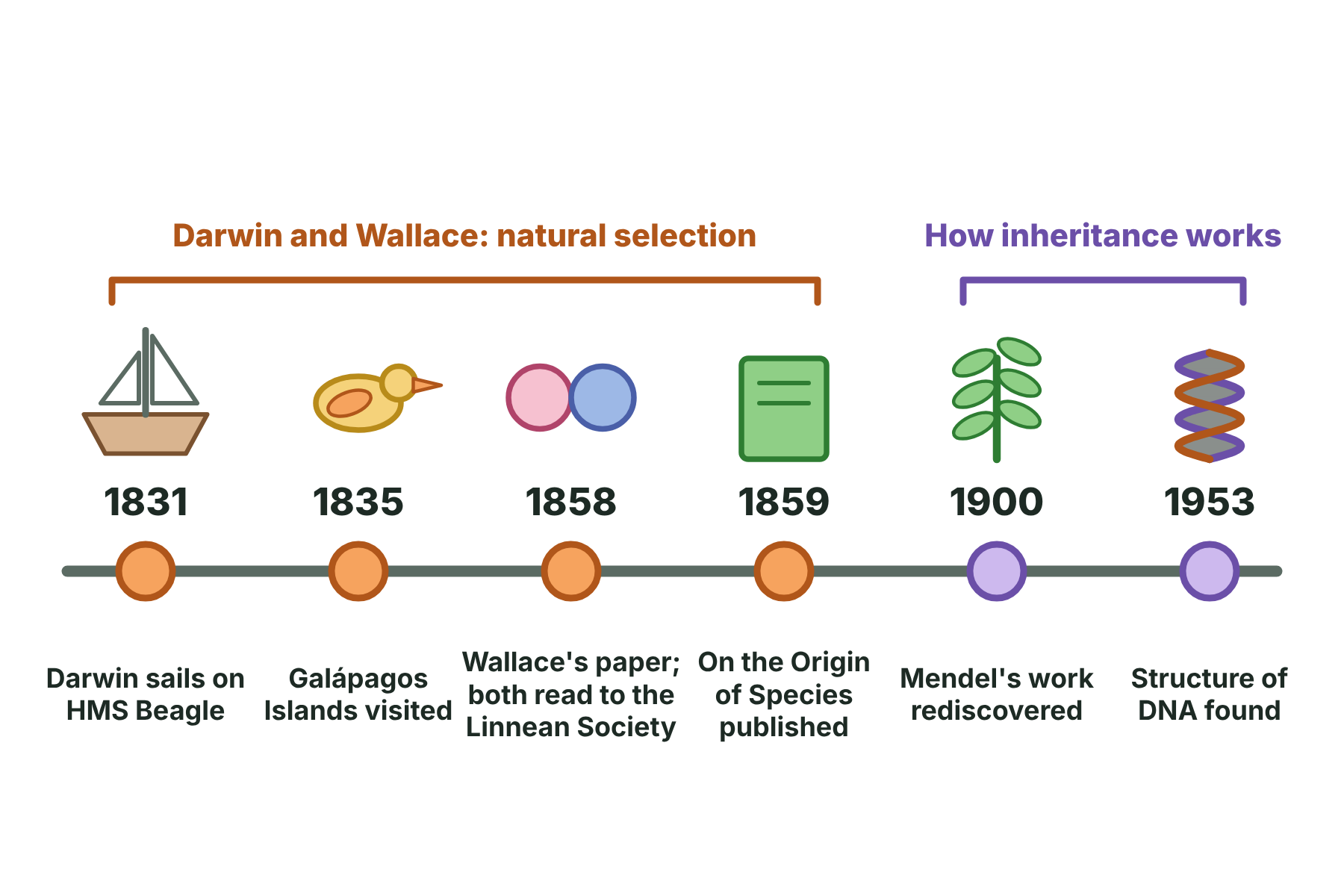
The theory of natural selection came first, and the explanation of how inheritance works came later.
Why the theory was controversial
The ideas of Darwin and Wallace raised strong objections.
-
Religious beliefs
Many people believed that God had created each species separately, and the Church opposed the idea that species change.
-
Humans and apes
The suggestion that people shared an ancestor with apes was offensive to many. The 1860 Oxford debate between Bishop Wilberforce and T. H. Huxley became famous.
-
Too slow to see
Evolution takes thousands or millions of years, so no one could watch it happen.
-
No mechanism
Neither Darwin nor Wallace could explain how features are inherited, and there was no evidence about genes until Mendel's work was recognised.
The impact on modern biology
Evolution by natural selection is now the unifying idea of the whole subject.
-
Explains the diversity of life
All living things share common ancestors, which is why they share features such as DNA and the genetic code.
-
Genetics
Mendel's work and the discovery of genes and DNA provided the mechanism of inheritance that Darwin lacked, and strongly supported the theory.
-
Medicine
The theory explains the evolution of antibiotic-resistant bacteria and how pathogens change.
-
Conservation and agriculture
It helps to explain how species adapt, how they respond to changes in their environment and how selective breeding works.
Darwin and Wallace
Darwin
- Collected evidence over many years on the Beagle voyage and at home
- Studied selective breeding as a model
- Had a draft of the theory for about twenty years
- Published the full theory with a great deal of evidence
Wallace
- Collected specimens in the Amazon and South-East Asia
- Studied the distribution of animals
- Wrote down the idea in a few days in 1858
- Sent a short paper that pushed Darwin to publish
Case study
The Galápagos finches
Darwin collected finches from several of the Galápagos Islands, and later found that they were different species with different shaped beaks. Some had thick, strong beaks for cracking seeds, some had thin beaks for catching insects and one used a spine to get grubs out of wood. They all looked related to a single mainland species. Later research suggested that the finches had descended from a common ancestor that arrived on the islands, and that natural selection had shaped the beaks to suit the food on each island.
Summary and exam focus
- Darwin collected evidence on the Beagle voyage and published On the Origin of Species in 1859.
- Wallace came up with the same idea independently, and their papers were presented together in 1858.
- The theory explains how species change over time by natural selection.
- It was controversial because of religious beliefs, the link to apes and the lack of a mechanism for inheritance.
- It became more accepted when genetics and DNA provided the mechanism.
Exam focus
Describe the contributions of Darwin and Wallace to the theory of evolution by natural selection, and explain why the theory was not accepted by everyone at first. (6 marks) (6 marks)
Name what each scientist did (the Beagle voyage and the Galápagos for Darwin, collecting and the 1858 letter for Wallace). For the second part, give at least two reasons, such as religious objections and the lack of a mechanism for inheritance.
Key terms
The words this lesson expects you to use. Each one is linked from the first place it appears above.
- Evolution
- The gradual change in the inherited characteristics of a species over many generations.
- Natural selection
- The process by which individuals with features that suit their environment survive and reproduce more than others.
- Theory
- An explanation, supported by evidence, that has been tested many times.
- Species
- A group of organisms that can breed together to produce fertile offspring.
- Charles Darwin
- The English naturalist who developed the theory of evolution by natural selection.
- Alfred Russel Wallace
- The naturalist who independently developed the idea of natural selection.
- On the Origin of Species
- The book that Darwin published in 1859, setting out the theory of evolution.
- Common ancestor
- A species from which two or more different species have evolved.
- Creationism
- The belief that each species was created separately and has not changed.
You've finished the notes
Check your understanding
Test yourself while it is fresh. Start with the flashcards, then try the exam questions.
Something here looks wrong?
Tell us what and we will go and look. It goes to whoever writes these pages, nobody else, and we do not ask who you are — so there is nothing to sign and nothing comes back to you.