Biology · Evolution and Natural Selection
Natural Selection
Why are there so many different species, each suited to where it lives? This lesson explains Darwin's theory of evolution by natural selection step by step, and shows how it works with the example of the peppered moth.
Learning Objectives
- 1Explain Darwin's theory of evolution by natural selection, using the key stages.
- 2Explain how adaptations help organisms to survive and reproduce.
- 3Use the peppered moth as an example of natural selection in action.
- 4Distinguish natural selection from the idea that acquired characteristics are inherited.
Retrieval practice
-
1
What is variation?
Show answerHide answer
The differences between individuals of the same species.
-
2
Where do new alleles come from?
Show answerHide answer
Mutations.
-
3
What is an allele?
Show answerHide answer
A different version of the same gene.
-
4
What is the difference between genetic and environmental variation?
Show answerHide answer
Genetic variation comes from genes, environmental variation from the surroundings.
Survival of the fittest
In every habitat, more organisms are born than can possibly survive. They compete for food, water, light, space and mates, and they have to avoid predators and disease. Because of variation, some individuals are better suited to the conditions than others. Those that are better adapted are more likely to survive and breed, and they pass on their alleles. Over many generations the species gradually changes. This is evolution by natural selection.
The steps of natural selection
Learn the stages in order, and use all of the key words in an exam answer.
-
1
Variation
Individuals in a population differ from each other, because of differences in their genes caused by mutation and sexual reproduction.
-
2
Competition
More offspring are born than the environment can support, so individuals compete for limited resources and are affected by predators and disease.
-
3
Survival of the best adapted
Individuals with characteristics that give an advantage are more likely to survive. This is sometimes called survival of the fittest.
-
4
Reproduction
The survivors breed and pass on the alleles for the useful characteristics to their offspring.
-
5
Change over generations
The proportion of the population with the useful alleles increases, and so the population gradually changes.
Natural selection in a population of beetles
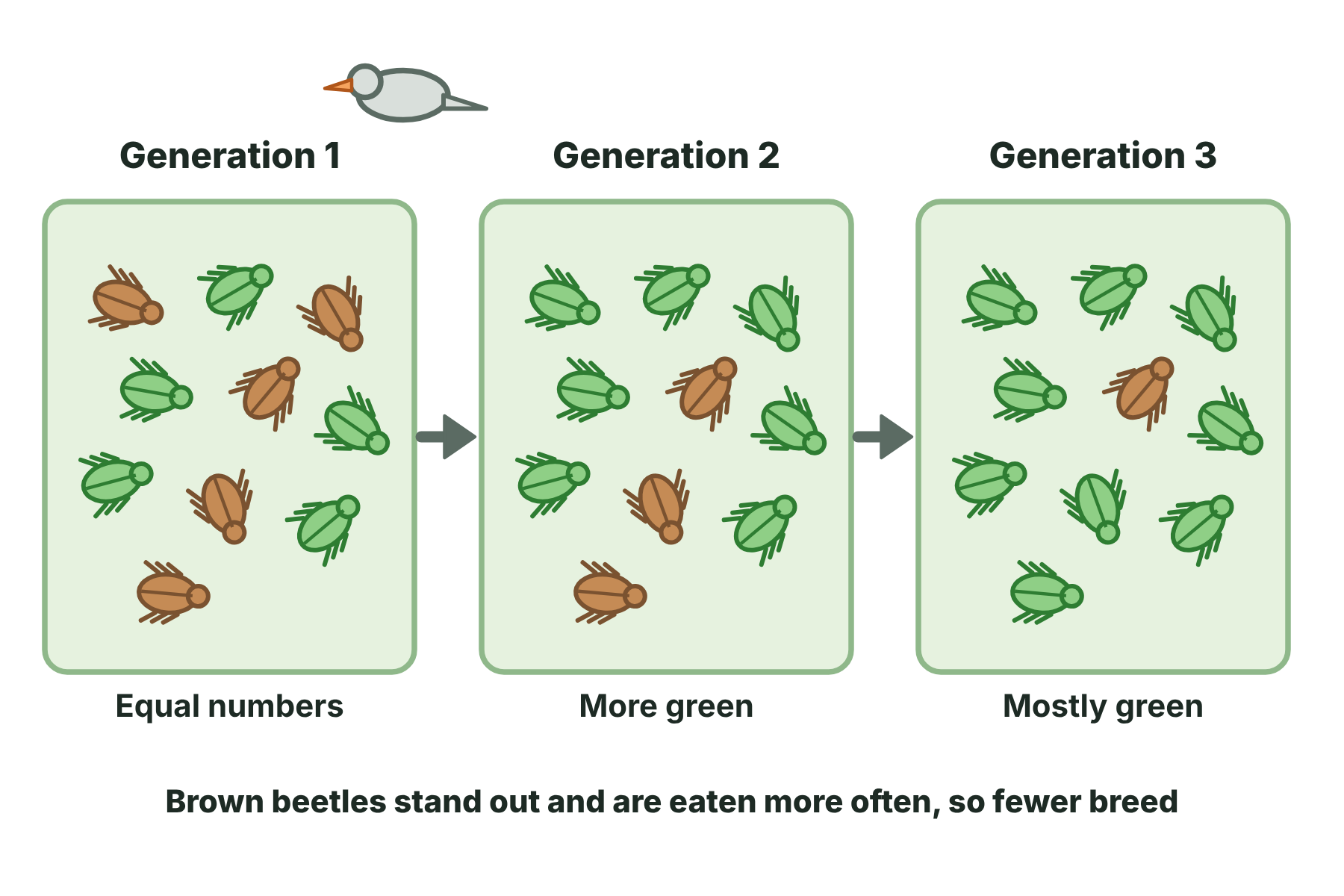
The better camouflaged beetles survive and breed, so their alleles become more common.
Adaptations
A feature that helps an organism to survive in its environment is called an adaptation.
-
Structural
A physical feature, such as the thick fur and white colour of a polar bear, which keep it warm and camouflaged.
-
Behavioural
The way an organism acts, such as the migration of birds or the hibernation of hedgehogs.
-
Functional
A feature of its body processes, such as the production of venom in a snake.
-
Inherited
Adaptations are controlled by alleles, so they can be passed on to offspring. This is why natural selection can change a species.
Reading data on the peppered moth
In Manchester in 1848, 2% of peppered moths were dark. By 1895 the figure was 98%. Calculate the change in the percentage of dark moths and the percentage of pale moths in 1895.
Show the solutionHide the solution
- 1 Find the change in dark moths \(98 - 2 = 96\) percentage points.
- 2 Pale moths in 1848 \(100 - 2 = 98\%\) were pale.
- 3 Pale moths in 1895 \(100 - 98 = 2\%\) were pale, so the proportions of dark and pale moths almost swapped.
AnswerThe percentage of dark moths rose by 96 percentage points, and 2% were pale in 1895.
Case study
The peppered moth
Peppered moths rest on tree trunks, and before the Industrial Revolution most were pale, which matched the lichen-covered bark. Soot from factories killed the lichens and blackened the trees, so pale moths were easy for birds to see and dark moths were hidden. The dark form went from about 2% of the moths in Manchester in 1848 to about 98% in 1895. After the Clean Air Act of 1956 the air improved, the trees became paler again and the pale form increased again.
Darwin and Lamarck
Natural selection (Darwin)
- Individuals vary because of their genes
- Better adapted individuals survive and breed
- The alleles that give an advantage become more common
- It happens over many generations
Inheritance of acquired characteristics (Lamarck)
- Organisms change during their lifetime by using or not using parts
- The changes are passed to offspring
- For example, a giraffe stretching its neck gives long-necked offspring
- It is not supported by evidence, since acquired characteristics do not change genes
Evidence and speciation
Natural selection can explain how new species form as well as how populations change.
-
Isolation
If a population is split up, for example by a mountain range or by islands, the two groups are no longer able to interbreed.
-
Different conditions
The environment of each group may be different, so natural selection favours different characteristics in each.
-
New species
Over many generations the groups can become so different that they can no longer breed with one another. They are now separate species.
-
Evidence
Fossils, DNA comparisons and observations such as the peppered moth all support the theory.
Summary and exam focus
- Individuals in a population show variation caused by mutation and sexual reproduction.
- There is competition for limited resources, and individuals that are better adapted survive and reproduce.
- They pass on their alleles, so over generations the proportion of useful alleles increases.
- Adaptations can be structural, behavioural or functional.
- Acquired characteristics are not inherited, so Lamarck's idea does not explain evolution.
Exam focus
Explain how natural selection could have led to a population of rabbits becoming mostly white after the climate became colder and snowy. (6 marks) (6 marks)
Write the steps in order using the key words: variation, competition, survival of the best adapted, reproduction and passing on alleles, then change over generations. Link each to the white fur and the snowy habitat so that it is an explanation and not a general description.
Key terms
The words this lesson expects you to use. Each one is linked from the first place it appears above.
- Natural selection
- The process in which better adapted individuals survive and reproduce, passing on their alleles.
- Adaptation
- A feature that helps an organism to survive and reproduce in its environment.
- Competition
- The struggle between organisms for the same limited resources.
- Survival of the fittest
- The idea that the individuals best suited to their environment are the ones that survive and breed.
- Evolution
- The gradual change in the inherited characteristics of a population over many generations.
- Speciation
- The formation of a new species from an existing one.
- Isolation
- The separation of populations so that they cannot interbreed.
- Camouflage
- Coloration that helps an organism to blend in with its surroundings.
- Predation
- When one animal hunts and eats another.
- Selection pressure
- A factor in the environment that affects which individuals survive.
You've finished the notes
Check your understanding
Test yourself while it is fresh. Start with the flashcards, then try the exam questions.
Something here looks wrong?
Tell us what and we will go and look. It goes to whoever writes these pages, nobody else, and we do not ask who you are — so there is nothing to sign and nothing comes back to you.