Biology · Evolution and Natural Selection
Fossil Evidence for Human Evolution
Fossils show how our ancestors looked and moved. This lesson covers three key fossil finds, Ardi, Lucy and the fossils found by the Leakey family, and what they tell us about the evolution of humans.
Learning Objectives
- 1Describe the evidence for human evolution from fossils, including Ardi, Lucy and the fossils found by Leakey.
- 2Compare the features of these fossils, including brain size and the way they moved.
- 3Explain how the fossils show a gradual change over millions of years.
- 4Evaluate the strengths and the limitations of fossil evidence.
Retrieval practice
-
1
What is a fossil?
Show answerHide answer
The remains of an organism that lived long ago, preserved in rock.
-
2
What is evolution?
Show answerHide answer
The gradual change in the inherited characteristics of a species over many generations.
-
3
What is a common ancestor?
Show answerHide answer
A species from which two or more other species have evolved.
-
4
What is natural selection?
Show answerHide answer
The process by which better adapted individuals survive and reproduce.
Our family tree
Humans are part of a group of animals called the hominids, which includes the great apes. Studies of DNA show that our closest living relatives are chimpanzees, and that we share a common ancestor with them from about six to seven million years ago. The evidence for what happened since then comes from fossils. Most of the important finds have been made in East Africa, which suggests that this is where our species first appeared.
Ardi: 4.4 million years ago
Ardipithecus ramidus, nicknamed Ardi, is one of the oldest hominid skeletons ever found.
-
The find
The first fossils were discovered in 1994 at Aramis in Ethiopia, and a partial skeleton of a female was described in 2009.
-
A mixture of features
Ardi had a grasping big toe, so she could climb trees, but her pelvis and feet show she could walk upright on two legs.
-
A small brain
Her brain was only about 300 to 350 cm³, about the same as a chimpanzee's.
-
What it shows
Walking upright began early, before the brain became much bigger, in a woodland habitat and not open grassland.
Lucy: 3.2 million years ago
Lucy, a member of Australopithecus afarensis, is one of the most famous fossils in the world.
-
The find
She was found in 1974 at Hadar in Ethiopia by Donald Johanson and his team, and about 40% of her skeleton was recovered.
-
Walking upright
The shape of her pelvis, her knee joints and her leg bones show that she walked on two legs.
-
Still a climber
Her long arms and curved fingers suggest that she still climbed trees.
-
A small brain
Her brain was about 400 cm³ in volume, still small compared with a human.
The Leakey fossils: 1.6 million years ago
The Leakey family found many fossils in East Africa, which showed a big change in how our ancestors looked.
-
The finds
Louis and Mary Leakey found Homo habilis in Olduvai Gorge in Tanzania, and in 1984 Richard Leakey's team found the skeleton of a young Homo erectus boy at Lake Turkana in Kenya, about 1.6 million years old.
-
Body shape
He was tall, with long legs and a body similar to a modern human, and he walked upright efficiently.
-
A bigger brain
His brain was about 880 cm³, more than twice the size of Lucy's.
-
Tool use
Homo erectus made stone tools and probably used fire.
Brain volume in hominid fossils
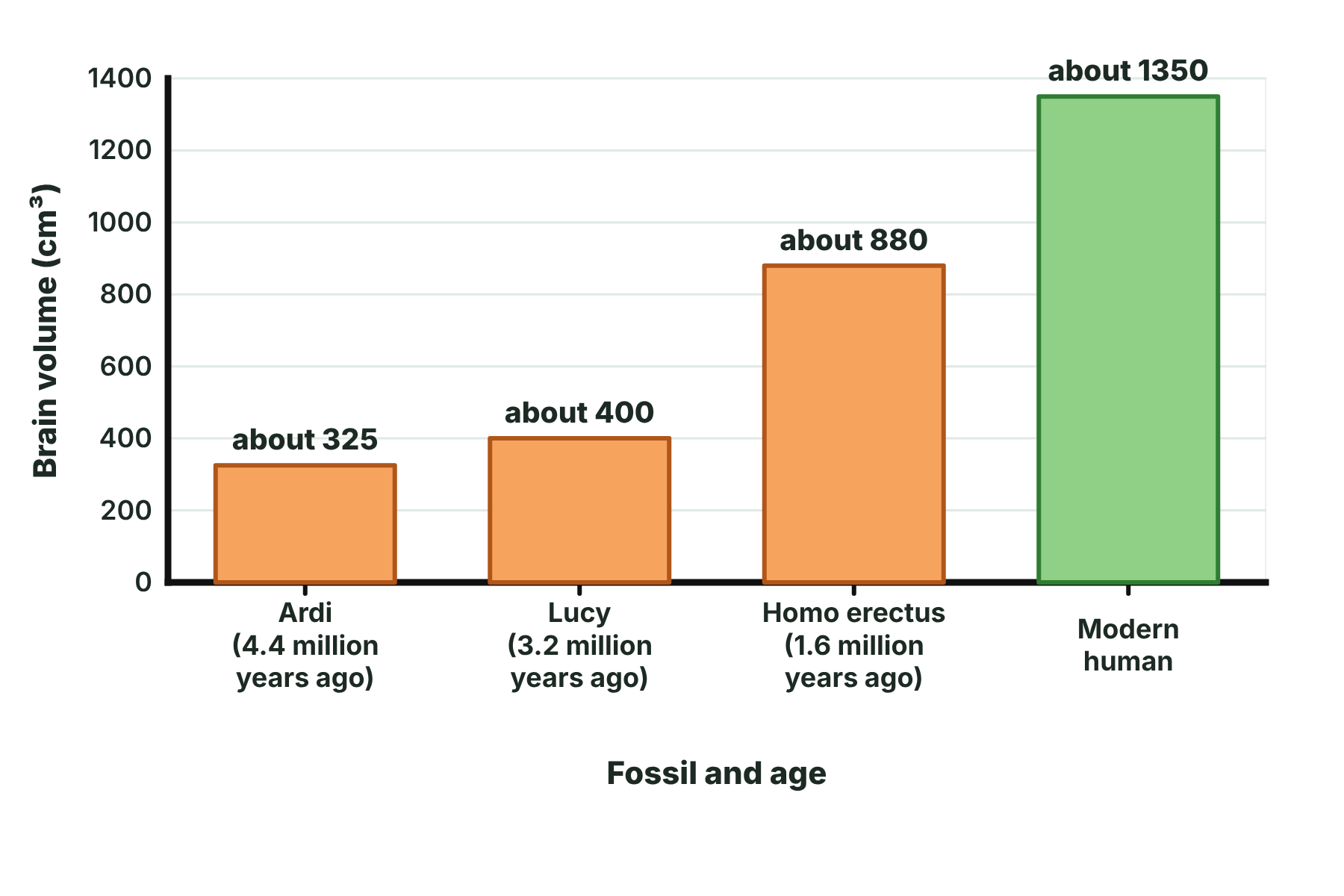
Brain size increased gradually, but walking upright came first.
Comparing the fossils
Ardi and Lucy
- Small brain, about 325 to 400 cm³
- Walked upright, but could also climb trees
- Smaller bodies, about 1.1 to 1.2 m tall
- Found in Ethiopia, 4.4 and 3.2 million years ago
Homo erectus (Leakey fossils)
- Larger brain, about 880 cm³
- Walked upright efficiently, with body proportions like ours
- Taller, about 1.6 m
- Found in Kenya, 1.6 million years ago, with stone tools
Percentage change in brain size
Lucy's brain was about 400 cm³ and the Homo erectus boy's was about 880 cm³. Calculate the percentage increase in brain volume.
Show the solutionHide the solution
- 1 Find the increase \(880 - 400 = 480\) cm³.
- 2 Divide by the original \(480 \div 400 = 1.2\).
- 3 Convert to a percentage \(1.2 \times 100 = 120\%\).
AnswerA 120% increase.
What the fossils show, and what they do not
Fossil evidence is powerful, but it has limits.
-
Gradual change
The fossils show a series of changes in the order of walking upright, then bigger brains, over millions of years.
-
Common ancestor
They support the idea that humans evolved from earlier apes, and are related to other species.
-
The record is incomplete
Fossilisation is rare, and many early hominids were not preserved, so there are gaps.
-
Interpretation
Often only a few bones are found, so scientists may disagree about which species a fossil belongs to, and how the species are related.
-
Dating
Fossils have to be dated, and the methods have errors in them, especially for very old finds.
Case study
Lucy
Lucy was found on 24 November 1974 by Donald Johanson, and was named after the Beatles song Lucy in the Sky with Diamonds that was playing in the camp. About 40% of her skeleton was found, which is very unusual for a fossil that old. Her pelvis and knee showed that she walked on two legs, over three million years ago, which was a major surprise because it showed that upright walking came before big brains. She was about 1.1 m tall.
Summary and exam focus
- Ardi lived 4.4 million years ago, could walk upright and climb, and had a small brain.
- Lucy lived 3.2 million years ago, walked upright, and had a small brain of about 400 cm³.
- The Leakey Homo erectus fossils are 1.6 million years old, with a larger brain and a body like ours.
- The fossils show that upright walking evolved first and large brains later.
- Fossil evidence is incomplete, and fossils are difficult to interpret and date.
Exam focus
Describe how the fossils of Ardi, Lucy and the Leakey Homo erectus boy provide evidence for human evolution. (6 marks) (6 marks)
Give the age of each fossil with at least one fact, such as the brain volume or walking upright, and then say what they show together. Use words such as gradually, over millions of years and evidence that humans evolved from apes.
Key terms
The words this lesson expects you to use. Each one is linked from the first place it appears above.
- Fossil
- The preserved remains or traces of an organism that lived long ago.
- Hominid
- A member of the group that includes humans and their ancestors, and the great apes.
- Ardi
- Ardipithecus ramidus, a hominid that lived about 4.4 million years ago.
- Lucy
- A fossil of Australopithecus afarensis from about 3.2 million years ago.
- Homo erectus
- An early human species that lived about 1.9 million years ago, with a large brain and a body like ours.
- Bipedal
- Walking upright on two legs.
- Brain volume
- The size of the brain, measured in cubic centimetres.
- Common ancestor
- A species from which two or more other species have evolved.
- Dating
- Working out how old a fossil or rock is.
You've finished the notes
Check your understanding
Test yourself while it is fresh. Start with the flashcards, then try the exam questions.
Something here looks wrong?
Tell us what and we will go and look. It goes to whoever writes these pages, nobody else, and we do not ask who you are — so there is nothing to sign and nothing comes back to you.