Biology · Evolution and Natural Selection
Stone Tools and Human Evolution
Stone is one of the few materials that survives for millions of years. This lesson explains how the development of stone tools over time shows the evolution of our ancestors, and how scientists work out how old the tools are.
Learning Objectives
- 1Describe the development of stone tools over time, and what it tells us about human evolution.
- 2Explain how stone tools can be dated from the environment in which they are found.
- 3Compare stone tools with fossils as evidence for human evolution.
- 4Evaluate the strengths and the limitations of stone tools as evidence.
Retrieval practice
-
1
What was the brain volume of Lucy?
Show answerHide answer
About 400 cm³.
-
2
Which fossil is 1.6 million years old?
Show answerHide answer
The Leakey Homo erectus fossils.
-
3
What is a fossil?
Show answerHide answer
The preserved remains of an organism that lived long ago.
-
4
What evolved first, walking upright or a large brain?
Show answerHide answer
Walking upright.
Evidence from what our ancestors made
Bones and teeth are rare, because they only fossilise in special conditions, but stone tools last for millions of years. When an early hominid chipped a stone to make a sharp edge, it left evidence of what it could do and how it thought. A simple tool shows that the maker could use a hand and eye together. A carefully shaped tool shows a plan, and the ability to learn and pass on skills. For this reason, stone tools are a second main source of evidence for human evolution, beside fossils.
The development of stone tools
Tools became more complex as the brains of our ancestors grew bigger, and the ages are approximate.
- 3.3 million years ago The oldest known tools yet found, at Lomekwi in Kenya, made before the first Homo fossils.
- 2.6 million years ago Oldowan tools, simple choppers and flakes, made by early Homo such as Homo habilis.
- 1.7 million years ago Acheulean hand axes, made by Homo erectus, shaped on both sides.
- 300 000 years ago Finely made flake tools and spear points, used by Neanderthals and early Homo sapiens.
- 40 000 years ago Thin blades, and tools of bone and antler, including needles, used by modern humans.
Oldowan tools
These are the oldest well-known tools, named after Olduvai Gorge in Tanzania.
-
How they were made
A round stone was struck with another to knock off sharp flakes, which left a rough chopper.
-
What they were used for
Cutting meat from carcasses, scraping hides and breaking bones to get at the marrow.
-
What they show
The makers could coordinate hand and eye, and could choose a suitable stone and strike it at the right angle, but there was no standard shape.
Hand axes
Acheulean hand axes are a big step forward in design.
-
How they were made
Flakes were struck from both sides of a stone, to give a symmetrical, teardrop shape with a sharp edge all round.
-
Planning
The maker had to picture the finished shape in advance, and carry out many steps in the right order, which needs a larger brain and skill.
-
Spread
They were made for over a million years, and found across Africa, Europe and Asia, so the skill was passed on.
-
Uses
Cutting, digging and butchering animals, and perhaps woodworking.
Later tools
The tools of later humans were more varied and more specialised.
-
Prepared cores
Neanderthals shaped a core so that a flake of a chosen size could be struck off in a single blow, which needed a great deal of planning.
-
Blades and points
Modern humans made long, thin blades and fitted stone points to spears.
-
New materials
They also used bone, antler and ivory, for needles, harpoons and ornaments, and clothes could be sewn.
-
Art and culture
Tools appear alongside cave paintings and jewellery, showing symbolic thought.
Dating a tool from the rock layers
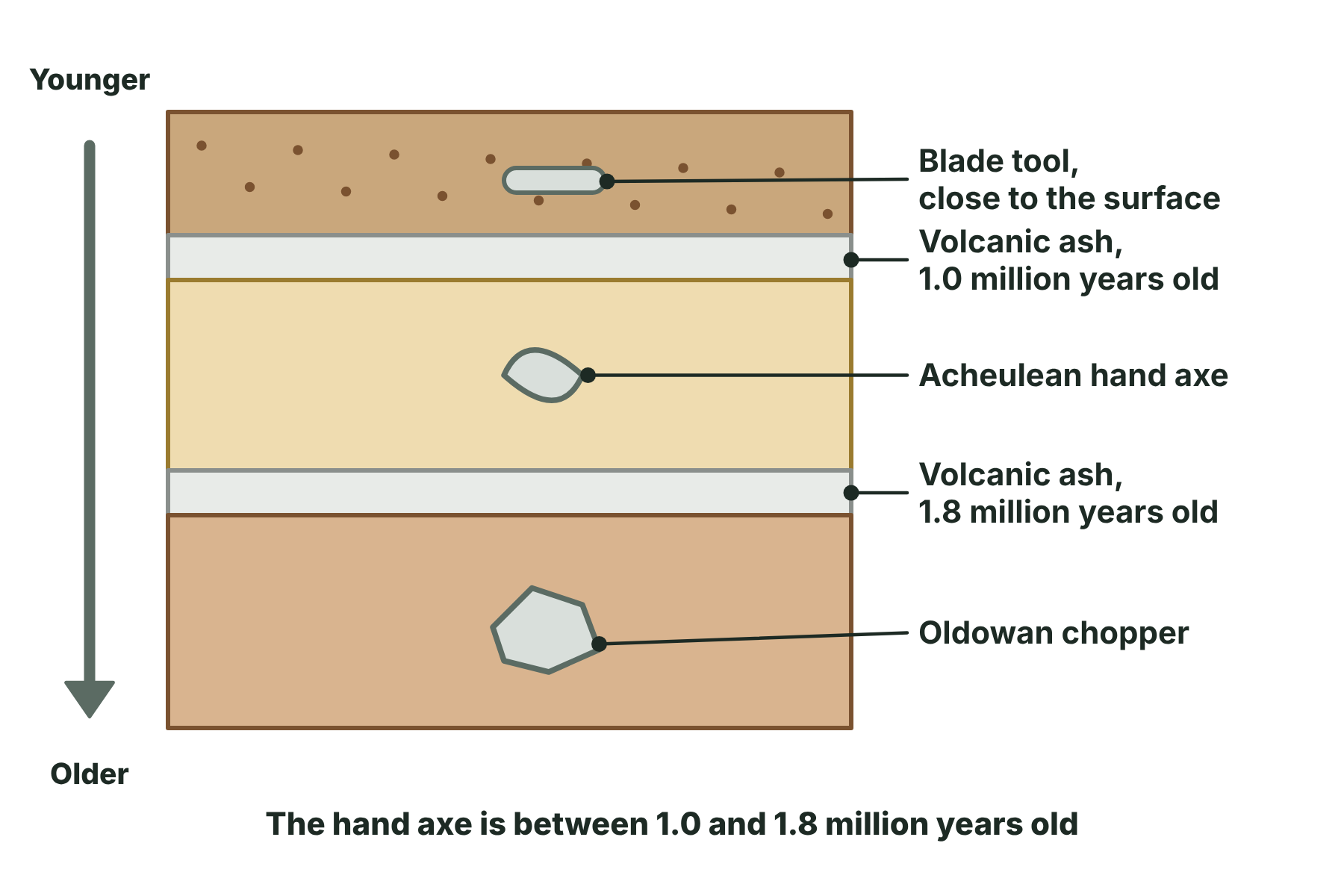
A tool is older than the layers above it and younger than the layers below it.
Dating tools from their environment
Tools themselves cannot be dated directly, so scientists date the rocks and other material around them.
-
Layers of rock
Sediments build up in layers, so deeper layers are older. A tool is usually about the same age as the layer it was buried in.
-
Dating volcanic ash
Layers of ash from volcanic eruptions can be dated by measuring radioactive decay in the minerals, such as potassium decaying to argon. A tool between two layers is younger than the lower one and older than the upper one.
-
Other finds in the layer
Fossils of animals whose age is known, or charcoal from fires, can help to date the layer. Charcoal and bone younger than about 50 000 years can be dated by carbon-14.
-
Cross-checking
Using more than one method, and testing several samples, makes the result more reliable.
Working out the age of a tool
A layer of volcanic ash is dated at 1.8 million years old. A stone tool is found 30 cm below this layer. Sediment builds up at about 1 cm every 1000 years. Calculate the approximate age of the tool.
Show the solutionHide the solution
- 1 Find the extra time The tool is 30 cm deeper, so \(30 \times 1000 = 30\,000\) years older than the ash.
- 2 Add this to the age of the ash \(1\,800\,000 + 30\,000 = 1\,830\,000\) years.
- 3 Check The tool is older than the layer above it, so the answer should be larger than 1.8 million years.
AnswerAbout 1 830 000 years old.
Fossils and stone tools as evidence
Fossils
- Show what our ancestors looked like
- Show brain size and body shape
- Rare, and often incomplete
- Can be hard to classify
Stone tools
- Show what our ancestors could do and how they behaved
- Show skills, planning and culture
- Last for a long time, and are more common
- Do not show what the maker looked like
Strengths and limitations
Stone tools give extra evidence, but they have limits too.
-
Strength: durable
Stone survives well, so there are many tools from a long period, giving a continuous record.
-
Strength: link to brain size
The more complex tools appear when brain size increases, supporting the theory of gradual change.
-
Limitation: perishable tools
Tools made of wood, bone or plant fibre rot away, so the record is biased towards stone.
-
Limitation: who made it?
A tool is often found without the fossil of its maker, so scientists cannot be certain which species made it.
-
Limitation: movement
Layers can be disturbed by erosion and animals, and so tools may be in the wrong layer.
Case study
Tools older than the genus Homo
In 2015 scientists working at Lomekwi in Kenya announced that they had found stone tools that were 3.3 million years old. That is 700 000 years older than any Oldowan tools, and before the first fossils of the genus Homo. It suggests that tool making began earlier than people thought, and may have been done by an earlier hominid, such as Australopithecus. The find shows how new evidence can change ideas, and why scientists must keep looking.
Summary and exam focus
- Stone tools developed over time, from simple Oldowan choppers to hand axes and later finely made blades.
- More complex tools show greater skill, planning and larger brains.
- Tools are dated from their environment: the layer of rock, volcanic ash, or other material found with them.
- Deeper layers are older, and ash layers above and below give a range of ages.
- Tools are durable, but may be missing, wrongly placed, or without the fossil of the maker.
Exam focus
Describe how stone tools provide evidence for human evolution, and explain how the age of a stone tool can be worked out. (6 marks) (6 marks)
Describe the change in tools over time (simple choppers, then symmetrical hand axes, then blades) and link it to increasing skill and brain size. For dating, say that tools are dated by the layer of rock they are found in and by dating the rock or ash above and below.
Key terms
The words this lesson expects you to use. Each one is linked from the first place it appears above.
- Stone tool
- A tool made by shaping stone, to give a sharp edge.
- Oldowan
- The oldest well-known stone tool culture, made up of simple choppers and flakes.
- Hand axe
- A symmetrical stone tool shaped on both sides, made by Homo erectus.
- Layer of rock
- A band of sediment that built up over time, so lower layers are older.
- Volcanic ash
- Material thrown out by a volcano, which forms layers that can be dated.
- Radiocarbon dating
- A method of dating organic remains, up to about 50 000 years old, by measuring carbon-14.
- Dating
- Working out how old something is.
- Culture
- The skills, ideas and behaviours that are passed on within a group.
- Hominid
- A member of the group that includes humans and their ancestors, and the great apes.
You've finished the notes
Check your understanding
Test yourself while it is fresh. Start with the flashcards, then try the exam questions.
Something here looks wrong?
Tell us what and we will go and look. It goes to whoever writes these pages, nobody else, and we do not ask who you are — so there is nothing to sign and nothing comes back to you.