Biology · Health and Infectious Disease
Health and Types of Disease
Health is more than not being ill. This lesson looks at the World Health Organization's definition, at communicable and non-communicable diseases, and at why one disease can make a person more likely to catch another.
Learning Objectives
- 1Describe health as defined by the World Health Organization (WHO).
- 2Describe the difference between communicable and non-communicable diseases.
- 3Explain why the presence of one disease can lead to a higher susceptibility to other diseases.
- 4Interpret data on diseases, including identifying correlation.
Retrieval practice
-
1
What is a microorganism?
Show answerHide answer
A living thing that is too small to see without a microscope.
-
2
What is an enzyme?
Show answerHide answer
A biological catalyst, made of protein.
-
3
What is a mutation?
Show answerHide answer
A random change in the DNA of an organism.
-
4
What do white blood cells do?
Show answerHide answer
They help to defend the body against disease.
What is health?
If someone asked you whether you were healthy, you might say yes if you have no illness. But the World Health Organization, the WHO, defines health in a wider way. It says that health is a state of complete physical, mental and social well-being, and not merely the absence of disease or infirmity. So a person who has no disease but is lonely, anxious or has nowhere to live is not fully healthy. Physical, mental and social well-being all affect each other.
The three parts of health
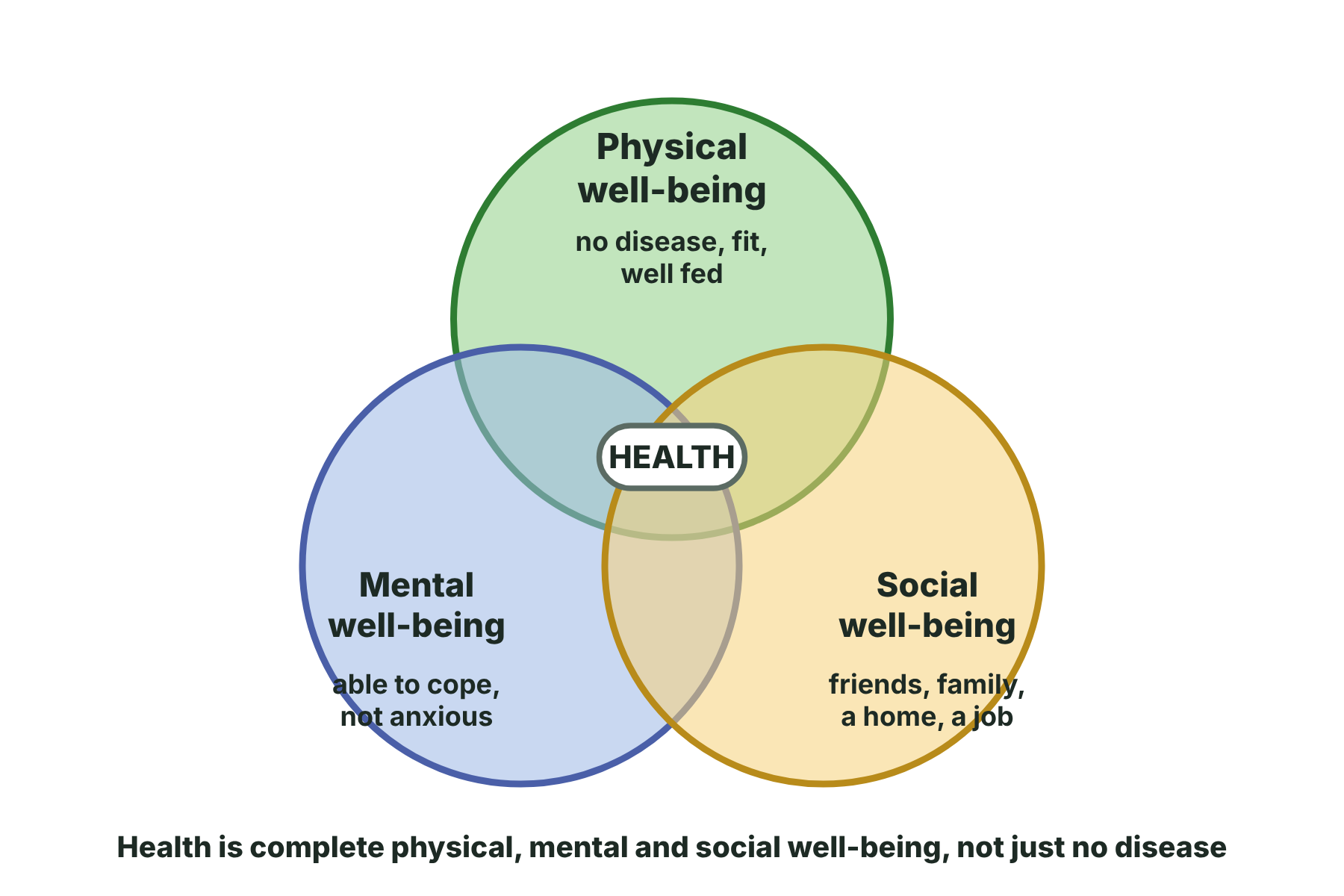
Health needs all three types of well-being, not just freedom from disease.
Communicable and non-communicable diseases
Diseases can be divided into two groups, depending on whether they can be passed between people.
-
Communicable disease
A disease that can spread from one person to another, or from animals to people. It is caused by a pathogen, and is also called an infectious disease. Examples are cholera, tuberculosis and malaria.
-
Non-communicable disease
A disease that cannot be passed from person to person. It is not caused by a pathogen. Examples are cancer, coronary heart disease, type 2 diabetes and inherited disorders such as cystic fibrosis.
-
Pathogens
A pathogen is a microorganism that causes disease, and includes viruses, bacteria, fungi and protists.
-
Causes of non-communicable disease
They may be caused by genes, lifestyle, the environment or a combination of factors.
Communicable and non-communicable disease
Communicable disease
- Caused by a pathogen
- Can spread between people, or from animals to people
- Examples: cholera, tuberculosis, malaria, HIV
- Can often be prevented by hygiene, vaccination or controlling vectors
Non-communicable disease
- Not caused by a pathogen
- Cannot be passed from one person to another
- Examples: cancer, heart disease, diabetes, cystic fibrosis
- Often caused by lifestyle, genes or the environment
How one disease can lead to another
Diseases do not always happen alone. Having one disease can make a person more susceptible to others.
-
A weakened immune system
HIV destroys white blood cells, so the body cannot fight other infections. People with HIV are far more likely to catch tuberculosis.
-
Damaged tissue
Damage to the skin or lining of the lungs, from eczema or asthma for example, makes it easier for pathogens to get into the body.
-
Poor nutrition
Malnutrition weakens the immune system, so children who are underweight get more infections, and infections cause diarrhoea and make malnutrition worse.
-
A virus that can cause cancer
Human papillomavirus (HPV) can lead to cervical cancer, so a communicable disease can cause a non-communicable one.
-
Mental health
Physical illnesses such as a long-term disease can lead to anxiety and depression, and stress can weaken the immune system.
Interpreting a link between two diseases
A scatter graph of data from several countries shows that the percentage of the population with HIV is higher in countries with a higher rate of tuberculosis (TB). State the type of correlation, and explain why the data alone does not prove that one disease causes the other.
Show the solutionHide the solution
- 1 Describe the pattern As the rate of HIV rises, the rate of TB also rises, so there is a positive correlation.
- 2 State the limits A correlation is not proof of cause and effect.
- 3 Suggest another factor Poverty or poor healthcare could increase both, which are called confounding factors.
- 4 Use the science We know that HIV weakens the immune system, which is a mechanism that explains the link.
AnswerThere is a positive correlation. A correlation shows a link, but does not prove cause, since other factors such as poverty, poor healthcare or overcrowding may affect both.
Factors that affect health
Whether people stay healthy depends on many things.
-
Diet and exercise
Poor diet can cause deficiency diseases and obesity, and exercise helps to keep the heart and muscles healthy.
-
Stress and mental health
Long-term stress can lead to illness, and mental health problems can affect eating, sleep and relationships.
-
Life situations
Poverty, poor housing, unemployment and lack of healthcare make it more likely that a person will become ill.
-
Genes
Some people inherit a risk of a disease such as cystic fibrosis or some cancers.
-
Pathogens
Contact with pathogens can lead to infections, especially if a person is already unwell.
Case study
HIV and tuberculosis
Tuberculosis (TB) is caused by a bacterium that many people have in their bodies without symptoms, because the immune system keeps it in check. In someone with HIV, the numbers of white blood cells fall, so the TB bacteria can multiply and cause active disease. TB is the leading cause of death for people living with HIV. In parts of southern Africa a large proportion of people with TB also have HIV. This is a clear example of one disease increasing susceptibility to another.
Summary and exam focus
- The WHO defines health as complete physical, mental and social well-being, and not just the absence of disease.
- Communicable diseases are caused by pathogens and can spread, and non-communicable diseases cannot.
- One disease can raise the risk of another, for example HIV weakens the immune system, so TB is more likely.
- A correlation shows a link between two variables, but does not prove cause.
- Health is affected by diet, stress, life situation, genes and pathogens.
Exam focus
Explain why a person with HIV is more likely to develop tuberculosis than a healthy person, and describe the difference between a communicable and a non-communicable disease. (6 marks) (6 marks)
For the first part, give the mechanism: HIV destroys white blood cells, so the immune system is weak and cannot fight the TB bacteria. For the second, state that a communicable disease is caused by a pathogen and can be passed on, and give an example of each type.
Key terms
The words this lesson expects you to use. Each one is linked from the first place it appears above.
- Health
- A state of complete physical, mental and social well-being, and not merely the absence of disease or infirmity.
- Communicable disease
- A disease that can be passed from one person to another, caused by a pathogen.
- Non-communicable disease
- A disease that cannot be passed from one person to another, and is not caused by a pathogen.
- Pathogen
- A microorganism that causes disease.
- Susceptibility
- How likely a person is to get a disease.
- Immune system
- The body's defence against pathogens.
- Malnutrition
- A condition caused by a diet that does not provide the right nutrients in the right amounts.
- Correlation
- A relationship between two variables, where a change in one is linked to a change in the other.
- WHO
- The World Health Organization, the United Nations agency that works on global health.
You've finished the notes
Check your understanding
Test yourself while it is fresh. Start with the flashcards, then try the exam questions.
Something here looks wrong?
Tell us what and we will go and look. It goes to whoever writes these pages, nobody else, and we do not ask who you are — so there is nothing to sign and nothing comes back to you.