Biology · Health and Infectious Disease
Pathogens and Common Infections
Four kinds of organism cause infectious disease. This lesson describes viruses, bacteria, fungi and protists, and five common infections: cholera, tuberculosis, Chalara ash dieback, malaria and HIV.
Learning Objectives
- 1Describe a pathogen as a disease-causing organism, including viruses, bacteria, fungi and protists.
- 2Describe the structure and size of each type of pathogen.
- 3Describe cholera, tuberculosis, Chalara ash dieback, malaria and HIV, including their symptoms.
- 4Explain how pathogens cause harm to a host.
Retrieval practice
-
1
What is a pathogen?
Show answerHide answer
A microorganism that causes disease.
-
2
What is a communicable disease?
Show answerHide answer
A disease caused by a pathogen that can be spread from one organism to another.
-
3
What does a prokaryotic cell not have?
Show answerHide answer
A nucleus.
-
4
What is a eukaryote?
Show answerHide answer
An organism whose cells have a nucleus.
Small but dangerous
Pathogens are tiny, but they are the cause of some of the world's most serious diseases. They get into the body of a host, which is the organism they infect, and reproduce there. They harm the host in two main ways. Some damage the cells that they live in, or use up their resources. Others, especially bacteria, make toxins, which are poisons that damage the tissues and cause the symptoms of the disease. Because they can reproduce very quickly, the numbers of pathogens can grow fast.
The four types of pathogen
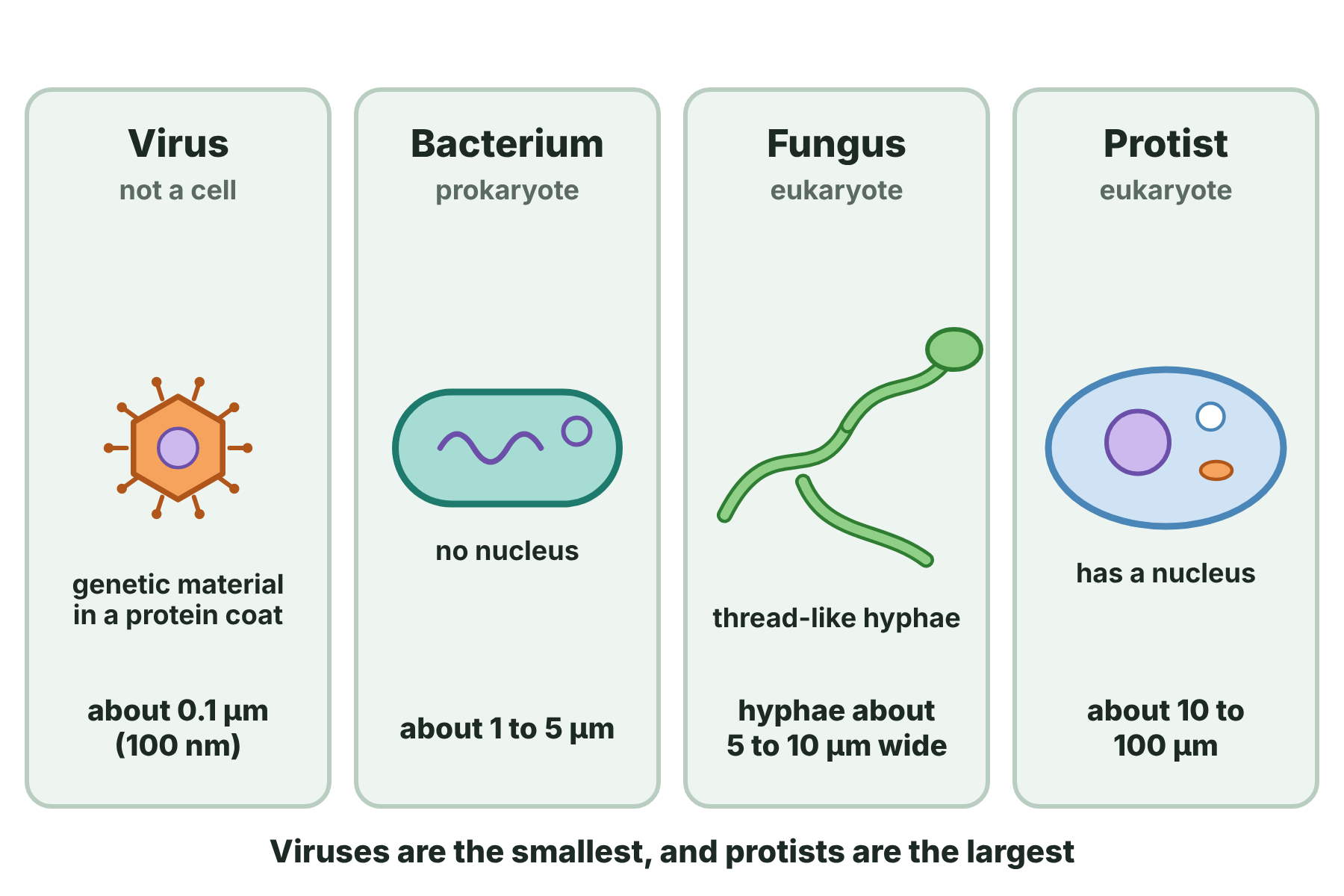
Viruses are far smaller than bacteria, and protists are much larger.
The four types of pathogen
Each type has its own structure and way of causing disease.
-
Viruses
Tiny particles, about 100 nanometres across, made of genetic material inside a protein coat. They are not cells. They can only reproduce inside the cells of a host, which they damage or destroy.
-
Bacteria
Single-celled prokaryotes, about 1 to 5 micrometres long, with no nucleus. They reproduce by dividing, as often as every 20 minutes, and many make toxins.
-
Fungi
Some are single-celled, such as yeast, and some are made of thread-like hyphae that grow into their host and digest it. They spread by spores.
-
Protists
Eukaryotic organisms, mostly single-celled, with a nucleus. Some are parasites that live in the cells or blood of their host.
Comparing sizes
A virus is 100 nm across, and a bacterium is 2 \(\mu\)m long. How many times larger is the bacterium than the virus? (1 \(\mu\)m = 1000 nm)
Show the solutionHide the solution
- 1 Convert to the same units 2 \(\mu\)m = \(2 \times 1000 = 2000\) nm.
- 2 Divide the larger by the smaller \(2000 \div 100 = 20\).
- 3 State the answer The bacterium is 20 times longer.
AnswerThe bacterium is 20 times longer than the virus.
Cholera (bacterium)
Cholera is caused by the bacterium Vibrio cholerae.
-
Symptoms
Severe watery diarrhoea and vomiting. The toxin makes the cells of the gut lining release water, and so the person loses a great deal of fluid.
-
Danger
The loss of water and salts leads to dehydration, and without treatment a person can die within hours or days.
-
Treatment
Rehydration by drinking a solution of salts and sugar, or by a drip, and antibiotics in serious cases.
-
Where
It is common where there is no safe drinking water or sewage treatment, and affects millions of people a year.
Tuberculosis (bacterium)
Tuberculosis (TB) is caused by Mycobacterium tuberculosis.
-
Lung damage
The bacteria infect the lungs, where the immune system walls them off in small lumps. The tissue is damaged, so it becomes difficult to breathe.
-
Symptoms
A long-lasting cough, sometimes with blood, weight loss, fever and night sweats.
-
Treatment
A course of several antibiotics for at least six months. Some strains are resistant to the drugs.
-
Scale
About 10 million people become ill with TB each year, making it one of the biggest killers among infectious diseases.
Chalara ash dieback (fungus)
Chalara ash dieback is a disease of ash trees, caused by a fungus.
-
The pathogen
The fungus Hymenoscyphus fraxineus infects the leaves, where it grows and blocks the movement of water in the tree.
-
Symptoms
Leaf loss, dark patches on the leaves, and lesions (dead patches) on the bark, followed by the death of the tree.
-
Arrival in Britain
It was first found in a nursery in 2012, and has spread widely, with millions of ash trees likely to die.
-
Effects
The loss of ash trees changes woodland, and harms the many species that depend on them.
Malaria (protist)
Malaria is caused by protists of the genus Plasmodium, which are carried by mosquitoes.
-
The cycle
The protists enter a person in the bite of an infected mosquito, go to the liver, and then infect red blood cells, where they multiply and burst out.
-
Symptoms
Repeated bouts of fever, chills and sweating, headache and tiredness, as the red blood cells burst, and the blood and liver are damaged.
-
Danger
Severe malaria can lead to anaemia, damage to organs and death, especially in children.
-
Where
It is found in tropical regions, in particular sub-Saharan Africa, with about 250 million cases a year.
HIV (virus)
HIV is the human immunodeficiency virus.
-
How it works
HIV infects and destroys white blood cells called lymphocytes, which are part of the immune system.
-
Symptoms
At first there may be a flu-like illness, and then few symptoms for years, while the number of white blood cells falls.
-
AIDS
When there are too few white blood cells, the immune system fails and the person gets serious infections and cancers. This stage is called AIDS.
-
Treatment
There is no cure, but antiretroviral drugs can control the virus so that a person can live a long, healthy life.
Bacterial and viral pathogens
Bacteria
- Living cells, about 1 to 5 \(\mu\)m
- Reproduce on their own, by dividing
- Often make toxins
- Treated with antibiotics
Viruses
- Not cells, about 0.1 \(\mu\)m
- Can only reproduce inside host cells
- Damage or destroy the cells they infect
- Antibiotics do not work
Summary and exam focus
- The four types of pathogen are viruses, bacteria, fungi and protists.
- Cholera is caused by a bacterium and causes severe diarrhoea, which leads to dehydration.
- Tuberculosis is caused by a bacterium and damages the lungs.
- Chalara ash dieback is caused by a fungus and causes leaf loss and bark lesions.
- Malaria is caused by a protist and damages the blood and liver, and HIV is caused by a virus and destroys white blood cells, leading to AIDS.
Exam focus
Describe the symptoms of malaria and of tuberculosis, and state the type of pathogen that causes each of them. (4 marks) (4 marks)
Name the pathogen type and the organism: malaria is caused by a protist, Plasmodium, and TB by a bacterium, Mycobacterium tuberculosis. Then give two symptoms or effects of each, for example fever and damage to the blood and liver for malaria, and a cough and lung damage for TB.
Key terms
The words this lesson expects you to use. Each one is linked from the first place it appears above.
- Pathogen
- A microorganism that causes disease.
- Virus
- A tiny particle made of genetic material in a protein coat, that can only reproduce inside host cells.
- Bacterium
- A single-celled prokaryote with no nucleus.
- Fungus
- An organism, such as a mushroom or yeast, that digests its food outside its body and absorbs it.
- Protist
- A mostly single-celled eukaryote.
- Toxin
- A poison made by a pathogen, which damages the host's tissues.
- Host
- The organism that a pathogen lives in or on.
- Dehydration
- A harmful loss of water from the body.
- AIDS
- The stage of HIV infection when the immune system has failed and serious infections develop.
- Lesion
- An area of damaged or diseased tissue.
You've finished the notes
Check your understanding
Test yourself while it is fresh. Start with the flashcards, then try the exam questions.
Something here looks wrong?
Tell us what and we will go and look. It goes to whoever writes these pages, nobody else, and we do not ask who you are — so there is nothing to sign and nothing comes back to you.