Biology · Health and Infectious Disease
The Life Cycle of a Virus
Viruses are not cells, and cannot reproduce on their own. This lesson is for separate Biology only: Combined Science students do not need it. It explains how viruses reproduce inside host cells, by the lytic pathway and the lysogenic pathway.
Learning Objectives
- 1Describe the structure of a virus.
- 2Describe the lytic pathway of a virus life cycle.
- 3Describe the lysogenic pathway of a virus life cycle.
- 4Explain why viruses can remain hidden in the body for a long time, and why they are hard to treat.
Retrieval practice
-
1
Are viruses cells?
Show answerHide answer
No.
-
2
How big is a typical virus?
Show answerHide answer
About 100 nanometres across.
-
3
What does HIV attack?
Show answerHide answer
White blood cells.
-
4
What is a host cell?
Show answerHide answer
A cell that a virus infects and uses to make more viruses.
Hijacking a cell
A virus is not alive on its own. It has no cytoplasm, no ribosomes and no way of making energy, so it cannot grow or reproduce by itself. Instead it takes over the machinery of a living host cell and uses it to make more viruses. This can happen in two ways. In the lytic pathway the virus quickly makes copies and destroys the cell, but in the lysogenic pathway the virus stays hidden in the host's DNA, for a long time.
The structure of a virus
A virus is very simple.
-
Genetic material
A virus contains DNA or RNA, which carries the instructions for making new viruses.
-
A protein coat
The genetic material is surrounded by a coat of protein, called a capsid, which protects it.
-
Attachment proteins
Proteins on the surface fit into receptor molecules on the surface of a host cell. This is why a virus can only infect certain types of cell.
-
No cell parts
There is no nucleus, cytoplasm or cell membrane, so a virus is not a cell, and it does not respire or grow.
The lytic pathway
In this pathway new viruses are made quickly, and the host cell is destroyed.
-
1
Attachment
The virus attaches to a host cell, by attachment proteins that fit receptors on the cell surface.
-
2
Entry
The virus injects, or the cell takes in, the virus's genetic material.
-
3
Replication
The host cell makes copies of the viral genetic material, and the viral proteins, using its own enzymes and ribosomes.
-
4
Assembly
The new genetic material and coats are put together to form new virus particles.
-
5
Lysis
The host cell bursts open, which is called lysis, and releases the new viruses, which go on to infect other cells.
The lysogenic pathway
In this pathway the virus stays hidden for a time, without destroying the cell.
-
1
Attachment and entry
As in the lytic pathway, the virus attaches and its genetic material enters the host cell.
-
2
Integration
The viral DNA is joined into the host cell's own chromosome. It is then called a provirus, or a prophage in bacteria.
-
3
Copied with the host
Each time the host cell divides, the viral DNA is copied along with the host's DNA, and passed to the daughter cells. No new viruses are made, and the cell seems healthy.
-
4
A trigger
Stress, damage or a change in conditions can cause the viral DNA to come out of the chromosome. It then starts the lytic pathway, and new viruses are made.
Lytic and lysogenic pathways
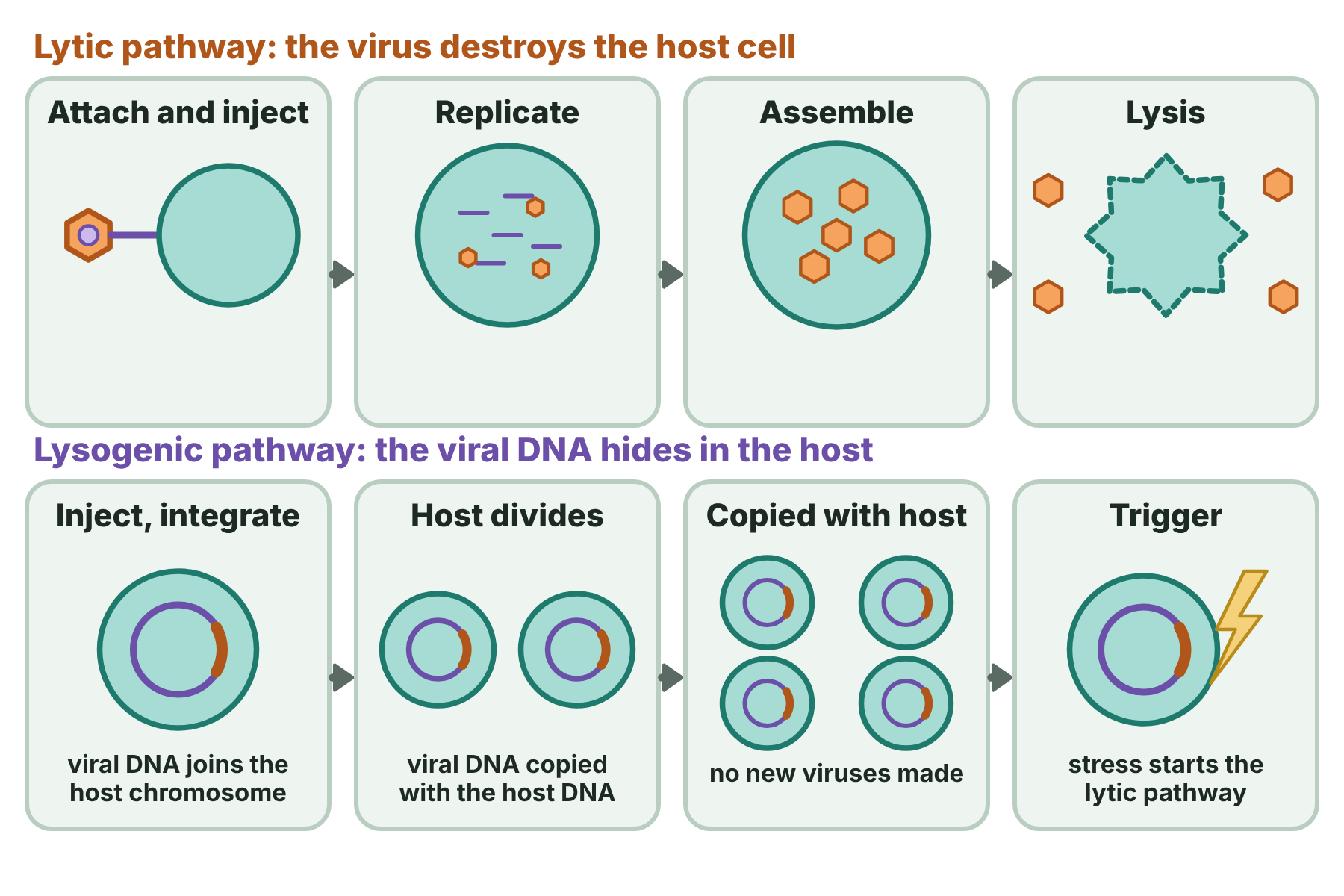
The lytic pathway makes new viruses at once. The lysogenic pathway hides the viral DNA until a trigger starts the lytic pathway.
Lytic and lysogenic pathways
Lytic pathway
- New viruses are made straight away
- The viral genetic material is not joined to the host's
- The host cell bursts and is destroyed
- Symptoms appear quickly
Lysogenic pathway
- No new viruses are made at first
- The viral DNA is joined to the host's chromosome
- The host cell survives and divides
- The infection can be hidden for years, until a trigger
How fast do viruses multiply?
One virus infects a cell by the lytic pathway. The cell releases 100 new viruses, and each of them infects a new cell and does the same. How many viruses are released after three rounds of infection?
Show the solutionHide the solution
- 1 First round One virus gives 100 viruses.
- 2 Second round Each of the 100 gives 100, so \(100 \times 100 = 10\,000\) viruses.
- 3 Third round \(10\,000 \times 100 = 1\,000\,000\) viruses.
- 4 Express as a power \(100^3 = 10^6\).
AnswerOne million viruses.
Why viruses are hard to treat
The way that viruses reproduce has important effects.
-
Antibiotics do not work
Antibiotics attack processes in bacteria, such as building a cell wall, and a virus has none of them.
-
Inside host cells
Drugs that attack the virus must not harm the host cell, which is difficult.
-
Hidden infections
In the lysogenic pathway the virus is not making any proteins, so the immune system cannot find it. HIV does this, and it is why it cannot be cured.
-
Vaccines
They are the best way of preventing viral disease, as they prepare the immune system before infection.
Case study
Cold sores and the lysogenic pathway
Herpes simplex virus causes cold sores on the lips. After the first infection, the virus is not removed. It hides in nerve cells, in a dormant state similar to the lysogenic pathway, and makes no new viruses, so the person has no symptoms. A trigger such as stress, illness, strong sunlight or a cold can wake the virus up, and it enters the active pathway, producing virus particles and a new cold sore. This explains why many people get cold sores again and again.
Summary and exam focus
- A virus is a piece of genetic material in a protein coat, and can only reproduce inside a host cell.
- In the lytic pathway, the virus makes copies, and the cell bursts, which releases new viruses.
- In the lysogenic pathway, the viral DNA joins the host's chromosome and is copied when the cell divides.
- A trigger can start the lytic pathway.
- A hidden virus is hard to find or treat, so some, such as HIV, cannot be cured.
Exam focus
Describe the lytic and lysogenic pathways of a virus, and explain why a virus that uses the lysogenic pathway is difficult to treat. (6 marks) (6 marks)
Describe the lytic pathway in order (attach, enter, replicate, assemble, lysis), and the lysogenic pathway as integration into the host chromosome, copying with the host, and a trigger. For treatment, say that in the hidden stage no viral proteins are made, so the immune system and drugs cannot find it.
Key terms
The words this lesson expects you to use. Each one is linked from the first place it appears above.
- Capsid
- The protein coat that surrounds the genetic material of a virus.
- Lytic pathway
- A virus life cycle in which new viruses are made at once and the host cell bursts.
- Lysogenic pathway
- A virus life cycle in which the viral DNA joins the host's chromosome and is copied with it.
- Lysis
- The bursting open of a cell, releasing its contents.
- Provirus
- Viral DNA that has been joined into the chromosome of a host cell.
- Host cell
- A cell that a virus infects and uses to reproduce.
- Replication
- Making copies, such as of genetic material.
- Receptor
- A molecule on the surface of a cell that a virus or other chemical can bind to.
- Dormant
- Inactive, but able to become active again.
You've finished the notes
Check your understanding
Test yourself while it is fresh. Start with the flashcards, then try the exam questions.
Something here looks wrong?
Tell us what and we will go and look. It goes to whoever writes these pages, nobody else, and we do not ask who you are — so there is nothing to sign and nothing comes back to you.