Biology · Health and Infectious Disease
Stomach Ulcers and Ebola
One of these diseases was found to be caused by a bacterium only in the 1980s, and the other can kill about half of the people it infects. This lesson is for separate Biology only: Combined Science students do not need it. It covers stomach ulcers caused by Helicobacter, and Ebola.
Learning Objectives
- 1Describe how Helicobacter pylori causes stomach ulcers, and how the infection spreads and is treated.
- 2Describe Ebola as a viral disease that causes haemorrhagic fever.
- 3Explain how Ebola is spread by body fluids, and how its spread can be prevented.
- 4Describe how scientific ideas about stomach ulcers changed.
Retrieval practice
-
1
What type of pathogen causes tuberculosis?
Show answerHide answer
A bacterium.
-
2
What is a vector?
Show answerHide answer
An organism that carries a pathogen from one host to another.
-
3
How are viruses different from bacteria?
Show answerHide answer
Viruses are not cells, and they can only reproduce inside host cells.
-
4
What do antibiotics treat?
Show answerHide answer
Bacterial infections.
Two very different diseases
These two diseases are different in almost every way, but both show how knowing the cause and the route of infection leads to prevention. One is a common bacterial infection of the stomach, which many people carry without knowing it. The other is a rare but very dangerous viral disease, which has caused several large outbreaks in Africa. In both cases, the way they are spread decides how they can be stopped.
Stomach ulcers and Helicobacter pylori
A stomach ulcer is an open sore in the lining of the stomach. Most are caused by the bacterium Helicobacter pylori.
-
A bacterium in the stomach
H. pylori is a spiral-shaped bacterium that lives in the mucus that covers the stomach wall. Around half of the world's population is infected.
-
How it survives acid
It makes an enzyme that produces ammonia, which neutralises the acid around it, and its spiral shape helps it to burrow into the mucus.
-
How it causes ulcers
It damages the cells that make mucus, and the lining becomes inflamed. The stomach acid and enzymes then attack the exposed lining, and form an ulcer.
-
Symptoms
Burning pain in the stomach, nausea and, if an ulcer bleeds, vomiting blood or black stools. A long-term infection also increases the risk of stomach cancer.
Helicobacter and a stomach ulcer
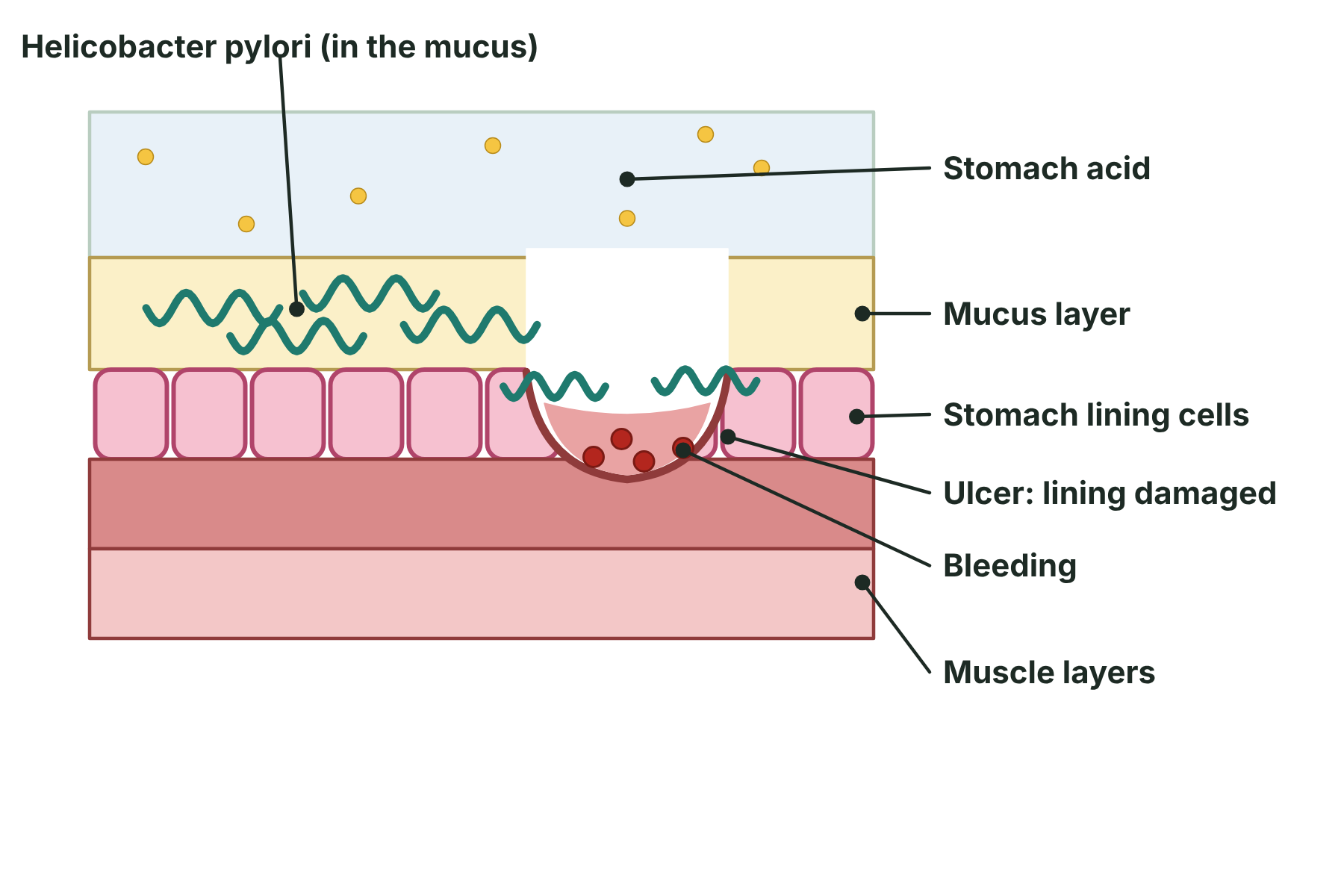
The bacteria damage the protective mucus, so acid can reach and wear away the lining.
Spread, treatment and discovery
The way that the cause of ulcers was found is a good story of science.
-
Spread
By oral transmission: swallowing the bacteria in food or water that is contaminated, or from saliva by sharing cutlery or kissing. It is more common where hygiene is poor.
-
Prevention
Washing hands, safe water and well-prepared food. Treating infected people stops them from passing on the bacteria.
-
Treatment
A combination of antibiotics to kill the bacteria, plus a drug that reduces stomach acid, which allows the ulcer to heal.
-
An old idea
Before the 1980s doctors thought that ulcers were caused by stress, spicy food and too much acid, and treated them with antacids.
-
A new idea
In 1982 Robin Warren and Barry Marshall found the bacteria in ulcers. To prove it, Marshall drank a culture of H. pylori and developed stomach inflammation. They won a Nobel Prize in 2005.
Ebola
Ebola virus disease is a rare but severe disease caused by a virus. It causes a haemorrhagic fever, which means a fever together with bleeding.
-
The pathogen
The Ebola virus is a thread-like virus found in animals, probably fruit bats, and it can pass to people.
-
Symptoms
After 2 to 21 days, a high fever, headache, muscle pain, vomiting and diarrhoea. In severe cases the virus damages blood vessels and the liver, which leads to internal and external bleeding.
-
Danger
Around half of the people who are infected die, with rates varying from about 25% to 90% between outbreaks, depending on care.
-
Outbreaks
The largest outbreak, in West Africa in 2014 to 2016, caused over 28 000 cases and more than 11 000 deaths.
How Ebola spreads, and how to stop it
Ebola is spread by direct contact with body fluids, and not through the air like flu.
-
Transmission
Through blood, vomit, faeces, sweat or other body fluids of an infected person, or from the bodies of people who have died, and by contact with infected animals.
-
Close care
Family members and healthcare workers who care for the sick are most at risk, as are people at funerals where the body is touched.
-
Isolation
Infected people are isolated in treatment units, and the people they met are traced and watched for 21 days.
-
Protection
Health workers wear full protective suits, gloves, masks and goggles, and wash with disinfectant.
-
Safe burials
Bodies are handled by trained teams, using protective equipment.
-
Vaccine and treatment
A vaccine has been used to protect health workers and contacts, and medicines such as monoclonal antibodies improve the chance of survival.
Helicobacter pylori and Ebola virus
Stomach ulcers (Helicobacter pylori)
- Caused by a bacterium
- Spread by oral transmission, in food and water
- Damages the lining of the stomach
- Treated with antibiotics and acid-reducing drugs
Ebola
- Caused by a virus
- Spread by contact with body fluids
- Causes fever and bleeding
- Controlled by isolation, protective equipment and vaccination
Case study
The doctor who drank the bacteria
In 1984 Barry Marshall wanted to show that H. pylori caused stomach disease, but his idea was not believed by many doctors. He had no way of testing it on animals, so he decided to try it on himself. He swallowed a culture of the bacteria, and after a few days he developed stomach pain, nausea and inflammation of the stomach lining, which was seen with an endoscope. He was then cured with antibiotics. The experiment, and the research with Warren, led to a Nobel Prize in 2005 and to ulcers being cured with antibiotics.
Summary and exam focus
- Most stomach ulcers are caused by the bacterium Helicobacter pylori, which damages the stomach lining.
- It spreads by oral transmission, and is treated with antibiotics and acid-reducing drugs.
- Ebola is a virus that causes haemorrhagic fever, with a high death rate.
- It is spread through body fluids, and prevented by isolation, protective equipment and vaccination.
- Marshall and Warren's work changed the understanding of ulcers.
Exam focus
Describe how stomach ulcers are caused, spread and treated, and explain how the spread of Ebola can be reduced. (6 marks) (6 marks)
Name the pathogen and the route for each: Helicobacter pylori is a bacterium spread orally, and Ebola is a virus spread by body fluids. Then give specific control measures that match the route, such as hygiene and antibiotics for ulcers, and isolation and protective clothing for Ebola.
Key terms
The words this lesson expects you to use. Each one is linked from the first place it appears above.
- Helicobacter pylori
- A spiral-shaped bacterium that lives in the stomach and causes ulcers.
- Stomach ulcer
- An open sore in the lining of the stomach.
- Oral transmission
- Spread by swallowing a pathogen, for example in food, water or saliva.
- Ebola
- A viral disease that causes haemorrhagic fever.
- Haemorrhagic fever
- A fever with bleeding, caused by damage to blood vessels.
- Body fluids
- Liquids from the body, such as blood, vomit, faeces and sweat.
- Contact tracing
- Finding and watching the people who have been in contact with an infected person.
- Protective equipment
- Clothing and masks that protect health workers from infection.
- Inflammation
- Redness, swelling and pain caused by the body's response to damage or infection.
You've finished the notes
Check your understanding
Test yourself while it is fresh. Start with the flashcards, then try the exam questions.
Something here looks wrong?
Tell us what and we will go and look. It goes to whoever writes these pages, nobody else, and we do not ask who you are — so there is nothing to sign and nothing comes back to you.