Biology · Human Defences and Immunity
Antibiotics
Antibiotics changed medicine, but they only work on bacteria. This lesson explains how antibiotics kill bacteria without harming human cells, why they do not work on viruses, and how to use them properly.
Learning Objectives
- 1Explain that antibiotics can only be used to treat bacterial infections.
- 2Explain why antibiotics inhibit cell processes in the bacterium but not in the host.
- 3Describe the discovery of penicillin.
- 4Describe the importance of using antibiotics correctly.
Retrieval practice
-
1
What is a bacterium?
Show answerHide answer
A single-celled prokaryote with no nucleus.
-
2
What is a virus?
Show answerHide answer
A particle of genetic material in a protein coat, which can only reproduce inside host cells.
-
3
What is antibiotic resistance?
Show answerHide answer
The ability of bacteria to survive an antibiotic.
-
4
What does the cell wall do in a bacterium?
Show answerHide answer
It gives the cell strength and shape.
Drugs that kill bacteria
Before antibiotics, a small cut or a sore throat could kill. Infections such as pneumonia, tuberculosis and blood poisoning were often fatal, and surgery was very dangerous because of infection. Antibiotics are medicines that kill bacteria, or stop them from growing. They are a great achievement, because they treat the infection after it has started, and not only prevent it. But they only work on bacteria, and it is important to understand why.
How antibiotics work
Antibiotics attack processes or structures that are found in bacteria, but not in human cells.
-
Cell wall
Bacteria have a cell wall made of a substance that human cells do not have. Penicillin stops bacteria from building this wall. As they grow and take in water, the weak cell bursts.
-
Protein synthesis
Bacterial ribosomes are different from those in human cells. Some antibiotics, such as tetracycline, block these ribosomes, so the bacteria cannot make proteins.
-
Selective
Because human cells do not have the cell wall, and have different ribosomes, antibiotics kill the bacteria but do not harm the host.
-
Inhibit and kill
Some antibiotics kill the bacteria, and others stop them from reproducing, so that the immune system can destroy them.
How an antibiotic kills bacteria but not host cells
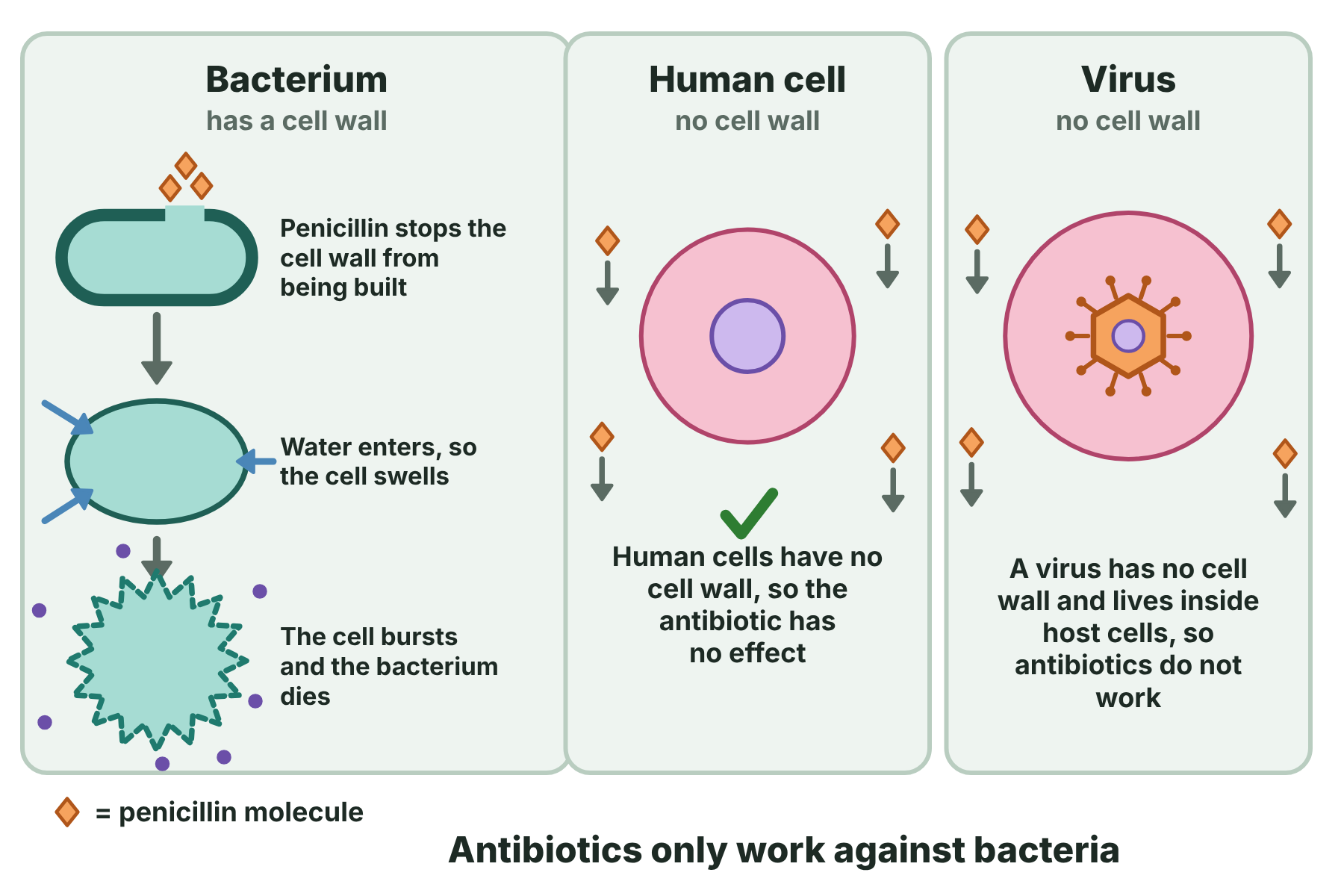
Antibiotics target features that bacteria have and human cells and viruses do not.
Why antibiotics do not work on viruses
This is one of the most important ideas about antibiotics.
-
No cell wall
A virus has no cell wall to attack, and no ribosomes of its own.
-
Inside host cells
Viruses live and reproduce inside the cells of the host, and any chemical that would damage the virus is likely to harm the host cell too.
-
Using host machinery
They use the host cell's own processes, so there is nothing separate for the drug to target.
-
What works instead
Viral diseases can be prevented with vaccines, and some can be treated with antiviral drugs, which are designed for a particular virus.
Bacterial and viral infections
Bacterial infection
- Caused by bacteria, which are living cells
- Bacteria have cell walls and their own ribosomes
- Treated with antibiotics
- Examples: tuberculosis, cholera, chlamydia
Viral infection
- Caused by viruses, which are not cells
- Viruses reproduce inside host cells
- Antibiotics do not work, so vaccines or antiviral drugs are used
- Examples: flu, HIV, measles, colds
The discovery of penicillin
Penicillin was the first antibiotic to be widely used.
-
1928
Alexander Fleming, a Scottish scientist, noticed that a mould called Penicillium had grown on a dish of Staphylococcus bacteria, and the bacteria near the mould had been killed.
-
Isolation
In the late 1930s, Howard Florey and Ernst Chain, with a team at Oxford, found how to purify penicillin and showed that it cured infected mice.
-
Mass production
During the Second World War it was made in large amounts, and saved the lives of many wounded soldiers.
-
Recognition
Fleming, Florey and Chain shared the Nobel Prize in 1945.
Using antibiotics correctly
Antibiotic resistance makes it important to use them with care.
-
Only for bacterial infections
They should not be used for colds, flu or most sore throats, which are caused by viruses.
-
Choosing the right one
Different antibiotics work on different bacteria, so a doctor may do a test to find the right one. Broad-spectrum antibiotics work on many types, and narrow-spectrum ones work on a few.
-
Complete the course
The whole course should be taken, even when the person feels better, so that all of the bacteria are killed.
-
Not for animals unnecessarily
Using them routinely on farm animals helps to select for resistant bacteria.
Choosing an antibiotic
A bacterial culture was tested with three antibiotics. The clear zones were A, 18 mm; B, 6 mm; and C, 0 mm. State which antibiotic is the most effective, and which one the bacteria are resistant to.
Show the solutionHide the solution
- 1 Compare the zones 18 mm is larger than 6 mm, and 0 mm.
- 2 Choose the most effective A, because it inhibited bacteria over the biggest area.
- 3 Resistance C had no effect, so the bacteria are resistant to it.
AnswerAntibiotic A is the most effective, with the largest clear zone. The bacteria are resistant to antibiotic C, as there is no zone.
Case study
Fleming and the mould
In September 1928, Alexander Fleming returned from a holiday to his laboratory at St Mary's Hospital, London, and found that a dish of Staphylococcus bacteria had been contaminated with a mould. Around the mould there was a clear area where the bacteria had not grown. Fleming realised that the mould was making a substance that killed bacteria. He called it penicillin, but he found it hard to purify, and it was Florey and Chain who turned it into a medicine more than ten years later.
Summary and exam focus
- Antibiotics kill bacteria or stop their growth.
- They target features such as the cell wall and ribosomes, which are not in human cells.
- They do not harm the host, and they do not work on viruses.
- Penicillin was discovered by Fleming in 1928, and developed by Florey and Chain.
- Antibiotics should be used only when needed, and the course finished.
Exam focus
Explain why antibiotics can be used to treat a bacterial infection but not a viral infection. (4 marks) (4 marks)
Say that antibiotics inhibit processes in bacteria, such as building the cell wall, which human cells and viruses do not have. Then say that viruses live inside host cells and have no separate structures for the antibiotic to target, so they are not harmed.
Key terms
The words this lesson expects you to use. Each one is linked from the first place it appears above.
- Antibiotic
- A drug that kills bacteria or stops them growing.
- Penicillin
- The first widely used antibiotic, made from the mould Penicillium.
- Cell wall
- A rigid layer outside the cell membrane of a bacterium, which human cells do not have.
- Ribosome
- A structure where proteins are made. Bacterial ribosomes differ from human ones.
- Broad-spectrum antibiotic
- An antibiotic that works against many types of bacteria.
- Antiviral drug
- A drug that is designed to stop a particular virus from reproducing.
- Selective
- Affecting some things but not others.
- Zone of inhibition
- A clear area on an agar plate where bacteria cannot grow.
- Mould
- A type of fungus that grows as a furry mass.
You've finished the notes
Check your understanding
Test yourself while it is fresh. Start with the flashcards, then try the exam questions.
Something here looks wrong?
Tell us what and we will go and look. It goes to whoever writes these pages, nobody else, and we do not ask who you are — so there is nothing to sign and nothing comes back to you.