Biology · Human Defences and Immunity
Herd Immunity and Evaluating Vaccination
When enough people are vaccinated, even those who are not protected are safer. This lesson is for separate Biology only: Combined Science students do not need it. It explains herd immunity, and weighs up the advantages and the disadvantages of vaccination.
Learning Objectives
- 1Explain what is meant by herd immunity.
- 2Explain why some people depend on herd immunity for protection.
- 3Describe the advantages and the disadvantages of immunisation.
- 4Evaluate vaccination programmes using data.
Retrieval practice
-
1
What does a vaccine contain?
Show answerHide answer
An inactive or weakened pathogen, or its antigens.
-
2
What are memory lymphocytes?
Show answerHide answer
Lymphocytes that stay in the body and respond quickly to a pathogen they have met before.
-
3
What disease was eradicated in 1980?
Show answerHide answer
Smallpox.
-
4
What is a booster dose?
Show answerHide answer
An extra dose to keep immunity high.
Protecting the whole community
A vaccine protects the person who is given it. But when a large proportion of a population is vaccinated, there are also fewer people who can pass the disease on, so it is much more difficult for it to spread. This protects people who have not been vaccinated, as well as the people who have. This indirect protection is called herd immunity, and it is one of the most important reasons for having vaccination programmes.
Herd immunity in a population
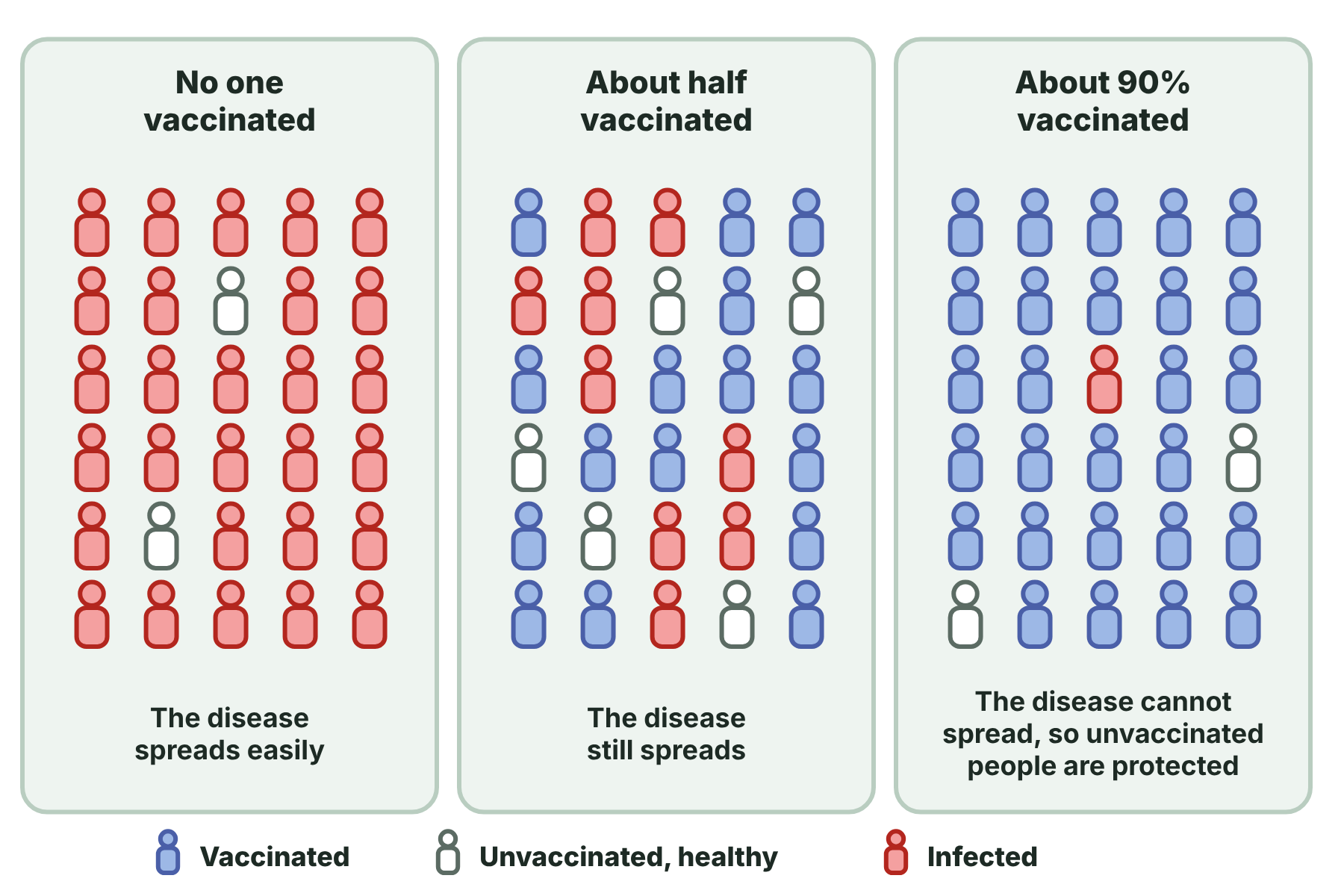
When most people are vaccinated, the disease cannot spread, and the few who are not vaccinated are protected.
How herd immunity works
The idea is simple, but the numbers matter.
-
Breaking the chain
An infected person can only pass the pathogen to people who are not immune. If most people around them are immune, it rarely reaches a new host, and the outbreak dies out.
-
The threshold
The proportion that must be vaccinated depends on how easily the disease spreads. For measles, which is very infectious, it is about 95%, and for others it is lower.
-
Who is protected
Babies who are too young to be vaccinated, people with weak immune systems, and those for whom the vaccine does not work all depend on the immunity of others.
-
If uptake falls
If the number vaccinated drops below the threshold, outbreaks can happen again.
Advantages of vaccination
The benefits are large, both for individuals and for society.
-
Prevents disease
Vaccines prevent illnesses that cause serious harm, such as polio, measles and diphtheria.
-
Saves lives
Millions of deaths are prevented every year. Smallpox was wiped out, and polio is nearly eradicated.
-
Herd immunity
It protects those who cannot be vaccinated.
-
Cost-effective
The cost of a vaccination programme is far less than the cost of treating the disease and its long-term effects.
Disadvantages and concerns
No medical treatment is perfect, and vaccines have limits.
-
Side effects
Common ones are mild, such as soreness, redness or a slight fever. Very rarely, a person may have a severe allergic reaction.
-
Not always effective
Some people do not make enough antibodies, so they are not protected. No vaccine works for everyone.
-
Pathogens change
Some, such as flu, mutate, and the vaccine must be updated, or may not match.
-
Cost and organisation
Making and delivering vaccines to everyone is expensive, and needs a cold chain, health workers and storage.
-
Public concerns
Fears about safety can lead people to refuse vaccines, and reduce the number vaccinated.
Benefits and concerns of vaccination
Advantages
- Prevents serious disease and saves lives
- Herd immunity protects the vulnerable
- Can eradicate diseases
- Cheaper than treating the disease
Disadvantages
- Mild side effects are common, and rarely severe ones
- Not 100% effective for every person
- Some pathogens change, so new vaccines are needed
- Fear about safety can reduce uptake
Interpreting vaccination data
In a town, 92% of children had the measles vaccine in 2010, and there were 2 cases. By 2016 the number vaccinated had fallen to 80%, and there were 150 cases. Describe the pattern, and explain the likely cause.
Show the solutionHide the solution
- 1 Describe the data Vaccination fell by 12 percentage points, and cases rose 75-fold (\(150 \div 2 = 75\)).
- 2 Link them A negative correlation: lower vaccination, more cases.
- 3 Explain Below about 95%, herd immunity is lost, so the pathogen can spread to the unvaccinated.
AnswerAs vaccination fell from 92% to 80%, the number of cases rose from 2 to 150. This is likely to be because the level of vaccination fell below the herd immunity threshold of about 95%, so measles could spread.
Case study
The MMR vaccine scare
In 1998 a doctor, Andrew Wakefield, published a paper suggesting a link between the MMR vaccine (measles, mumps and rubella) and autism. The claim was widely reported, and the number of children given the vaccine in the UK fell from over 90% to around 80%. Many large studies found no link, and the paper was retracted by the journal in 2010, as the research was found to be flawed and unethical. Because vaccination levels had fallen, there were outbreaks of measles, and the rates took many years to recover. It shows how important good evidence and honest reporting are.
Summary and exam focus
- Herd immunity happens when so many people are immune that the disease cannot spread.
- It protects babies, and people who cannot be vaccinated.
- Advantages include preventing disease and death, and eradicating diseases.
- Disadvantages include mild side effects, rare serious reactions, cost, and fears about safety.
- If vaccination rates fall below the threshold, disease outbreaks return.
Exam focus
Explain what is meant by herd immunity, and evaluate the advantages and disadvantages of a national vaccination programme. (6 marks) (6 marks)
Define herd immunity as the protection of unvaccinated people when most of the population is immune. Then give two advantages and two disadvantages with reasons, and end with a judgement that weighs the benefits against the risks, using data if you can.
Key terms
The words this lesson expects you to use. Each one is linked from the first place it appears above.
- Herd immunity
- The protection of unvaccinated people from a disease, because so many others are immune that the disease cannot spread.
- Vaccination programme
- A plan to vaccinate a whole population against a disease.
- Uptake
- The proportion of people who accept a vaccine.
- Threshold
- The level that must be reached before an effect happens, such as the proportion that must be immune.
- Side effect
- An unwanted effect of a treatment.
- Eradication
- The complete removal of a disease.
- Outbreak
- A sudden rise in the number of cases of a disease.
- Vulnerable
- Likely to be harmed, such as people with weak immune systems.
- Retracted
- Withdrawn by a journal because the research was found to be unreliable.
You've finished the notes
Check your understanding
Test yourself while it is fresh. Start with the flashcards, then try the exam questions.
Something here looks wrong?
Tell us what and we will go and look. It goes to whoever writes these pages, nobody else, and we do not ask who you are — so there is nothing to sign and nothing comes back to you.