Biology · Human Defences and Immunity
Physical and Chemical Barriers
Most of the time, pathogens never get inside you. This lesson looks at the body's first line of defence: physical barriers such as the skin, mucus and cilia, and chemical defences such as lysozyme and hydrochloric acid.
Learning Objectives
- 1Describe how the skin, mucus and cilia act as physical barriers to pathogens.
- 2Describe how lysozyme and hydrochloric acid act as chemical defences.
- 3Explain how these defences stop pathogens entering the body.
- 4Explain how damaging these defences, for example by smoking, makes infection more likely.
Retrieval practice
-
1
What is a pathogen?
Show answerHide answer
A microorganism that causes disease.
-
2
What is a cilium?
Show answerHide answer
A tiny hair-like structure on the surface of a cell that can move.
-
3
What is an enzyme?
Show answerHide answer
A biological catalyst, made of protein.
-
4
What does pH measure?
Show answerHide answer
How acidic or alkaline a solution is.
The first line of defence
Every day you breathe in thousands of microorganisms, eat food that has bacteria on it, and touch things that are covered in them. You are rarely ill, because the body has defences that stop most of them from getting in, and kill those that do. These are non-specific defences, because they work against all types of pathogen in the same way. They include physical barriers, which block the pathogens, and chemical defences, which destroy them.
The skin
The skin is the largest barrier, and covers the whole outside of the body.
-
A tough layer
The outer layer of the skin is made of dead cells filled with keratin, which is tough and waterproof, so pathogens cannot easily get through.
-
A chemical layer
The skin makes an oily substance called sebum that kills some bacteria, and sweat contains substances that stop microorganisms growing.
-
Friendly bacteria
Harmless microorganisms live on the skin, and use up the space and food, so that harmful ones cannot settle.
-
Cuts
If the skin is cut, platelets in the blood make a clot, which dries to form a scab. This seals the wound, so that pathogens cannot get in.
Mucus and cilia in the airways
Air carries many microorganisms, so the breathing system has its own defences.
-
Mucus
Goblet cells in the lining of the nose, trachea and bronchi make sticky mucus, which traps dust and pathogens that are breathed in.
-
Cilia
Ciliated cells in the lining have tiny hairs called cilia. They beat in a wave, moving the mucus and the trapped pathogens up towards the throat.
-
Swallowing
The mucus is swallowed or coughed out. In the stomach, acid kills any pathogens that it contains.
-
Nose hairs
Hairs in the nose also trap larger particles.
The lining of the airway
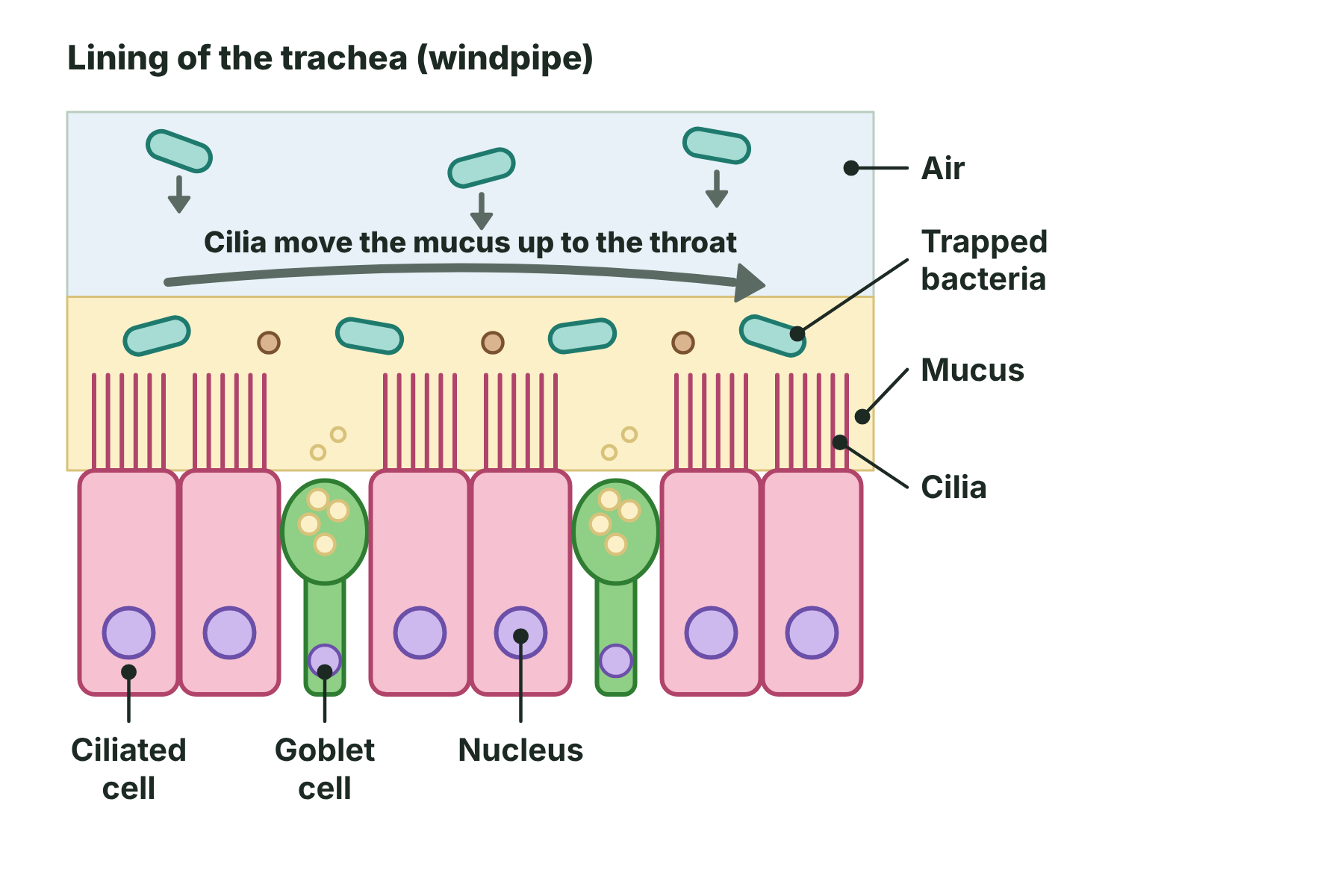
Goblet cells make mucus to trap pathogens, and cilia sweep it away.
Chemical defences
Some defences are chemicals that kill pathogens.
-
Lysozyme
An enzyme found in tears, saliva, nasal mucus and sweat. It breaks down the cell walls of bacteria, and so kills them.
-
Hydrochloric acid
The stomach makes hydrochloric acid, so that the contents are at about pH 2. This kills most of the pathogens that are swallowed with food, drink or mucus.
-
Digestive enzymes
The enzymes in the gut, such as protease, can also break down pathogens.
-
Tears
Tears wash the eye, and contain lysozyme, so that bacteria cannot grow on the surface.
Physical and chemical defences
Physical barriers
- Skin, with keratin
- Mucus, which traps pathogens
- Cilia, which move mucus out of the airways
- Scabs, which seal wounds
Chemical defences
- Lysozyme, which breaks down bacterial cell walls
- Hydrochloric acid in the stomach
- Sebum on the skin
- Enzymes in the gut
Interpreting data on smoking and infection
In a study, 12% of non-smokers and 30% of smokers had a lung infection in one year. Calculate how many times more likely a smoker was to have a lung infection, and suggest an explanation.
Show the solutionHide the solution
- 1 Divide the percentages \(30 \div 12 = 2.5\).
- 2 State the result A smoker is 2.5 times more likely to have an infection.
- 3 Explain it Chemicals in cigarette smoke paralyse and destroy the cilia, so the mucus and trapped pathogens stay in the lungs.
AnswerSmokers were 2.5 times more likely. Smoking damages the cilia, so mucus and pathogens are not moved out of the airways.
Case study
Why smokers cough
A smoker's airways are damaged by the chemicals in tobacco smoke. The cilia are paralysed, and then destroyed over time, and the goblet cells make extra mucus. Since the cilia can no longer sweep the mucus up, it builds up in the lungs, and the only way to remove it is by coughing. The trapped bacteria can then multiply, which leads to infections such as bronchitis. When people stop smoking, the cilia can grow back and start working again.
Summary and exam focus
- The skin is a physical barrier, and scabs seal cuts.
- Mucus traps pathogens, and cilia move the mucus out of the airways.
- Lysozyme, in tears and saliva, breaks down bacterial cell walls.
- Hydrochloric acid in the stomach kills pathogens that are swallowed.
- Smoking damages the cilia, so infections are more likely.
Exam focus
Describe how the skin, mucus and cilia, and the stomach acid, protect the body from pathogens. (6 marks) (6 marks)
Name each defence and say whether it is physical or chemical, then explain how it works using the key words: barrier, trap, kill. For example, mucus traps pathogens and cilia move it away, and stomach acid kills pathogens because of its low pH.
Key terms
The words this lesson expects you to use. Each one is linked from the first place it appears above.
- Non-specific defence
- A defence that works against all pathogens in the same way.
- Barrier
- A structure that stops pathogens from entering the body.
- Mucus
- A sticky liquid made by goblet cells, which traps pathogens and dust.
- Cilia
- Tiny hair-like structures on cells that move in waves, to move mucus.
- Goblet cell
- A cell in the airway lining that makes mucus.
- Lysozyme
- An enzyme in tears and saliva that breaks down the cell walls of bacteria.
- Hydrochloric acid
- The acid made in the stomach, which kills most pathogens.
- Sebum
- An oily substance made by the skin, which can kill some bacteria.
- Platelet
- A cell fragment in the blood that helps it to clot.
You've finished the notes
Check your understanding
Test yourself while it is fresh. Start with the flashcards, then try the exam questions.
Something here looks wrong?
Tell us what and we will go and look. It goes to whoever writes these pages, nobody else, and we do not ask who you are — so there is nothing to sign and nothing comes back to you.