Biology · Human Defences and Immunity
The Immune System
When a pathogen gets past the barriers, the immune system takes over. This lesson explains how white blood cells recognise antigens, make antibodies and memory cells, and how the second infection by the same pathogen is dealt with much faster than the first.
Learning Objectives
- 1Explain the role of the specific immune system in defence against disease.
- 2Describe how antigens trigger an immune response that produces antibodies.
- 3Explain the role of memory lymphocytes in the secondary response.
- 4Interpret a graph of the primary and secondary immune responses.
Retrieval practice
-
1
What cells in the blood fight pathogens?
Show answerHide answer
White blood cells.
-
2
What is a pathogen?
Show answerHide answer
A microorganism that causes disease.
-
3
What is a protein made of?
Show answerHide answer
Amino acids.
-
4
Why do enzymes have a specific shape?
Show answerHide answer
So that only one substrate fits into the active site.
Recognising the enemy
If a pathogen gets past the skin and other barriers, it meets the immune system, which is a network of white blood cells. Some white blood cells attack any pathogen they find. But the immune system can also recognise particular pathogens, and respond to each of them in a targeted way. This is the specific immune response. It works because every pathogen has chemicals on its surface that are different from those on the body's own cells. These chemicals are called antigens.
The two types of white blood cell
Two main groups of white blood cells do the work.
-
Phagocytes
These cells engulf pathogens and digest them. This is called phagocytosis, and it is a non-specific response, since a phagocyte attacks any pathogen.
-
Lymphocytes
These cells recognise the antigens of a particular pathogen and take part in the specific response. Some lymphocytes make antibodies.
-
Antigens
Proteins or other molecules on the surface of a pathogen, which the immune system recognises as foreign.
-
Antibodies
Proteins made by lymphocytes, with a shape that fits one particular antigen.
The immune response
The first time a pathogen enters the body, the response takes several days.
-
1
Exposure
A pathogen enters the body, and phagocytes may engulf some of it.
-
2
Antigen recognised
A lymphocyte with a receptor that fits the pathogen's antigen is activated.
-
3
Lymphocytes multiply
The activated lymphocyte divides many times, to form a large number of identical cells.
-
4
Antibodies made
Many of these cells make antibodies that fit the antigen, and release them into the blood.
-
5
Pathogen destroyed
The antibodies bind to the pathogens and make them clump together, so that phagocytes can engulf them, and some antibodies neutralise toxins.
-
6
Memory cells made
Some of the lymphocytes stay in the body as memory lymphocytes, ready for a future infection.
An antibody fits one antigen
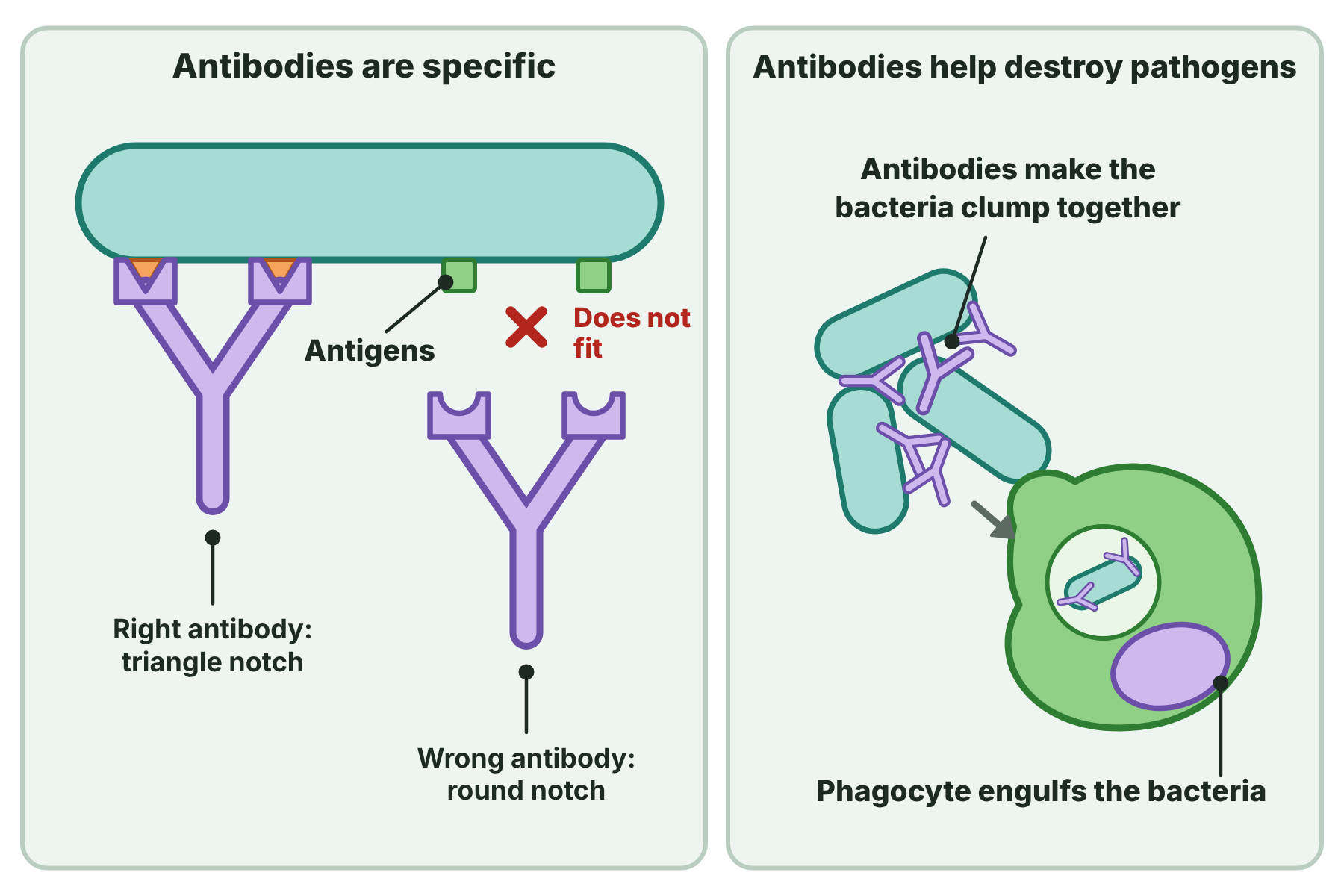
Antibodies are specific: each one fits only one antigen.
Primary and secondary immune responses
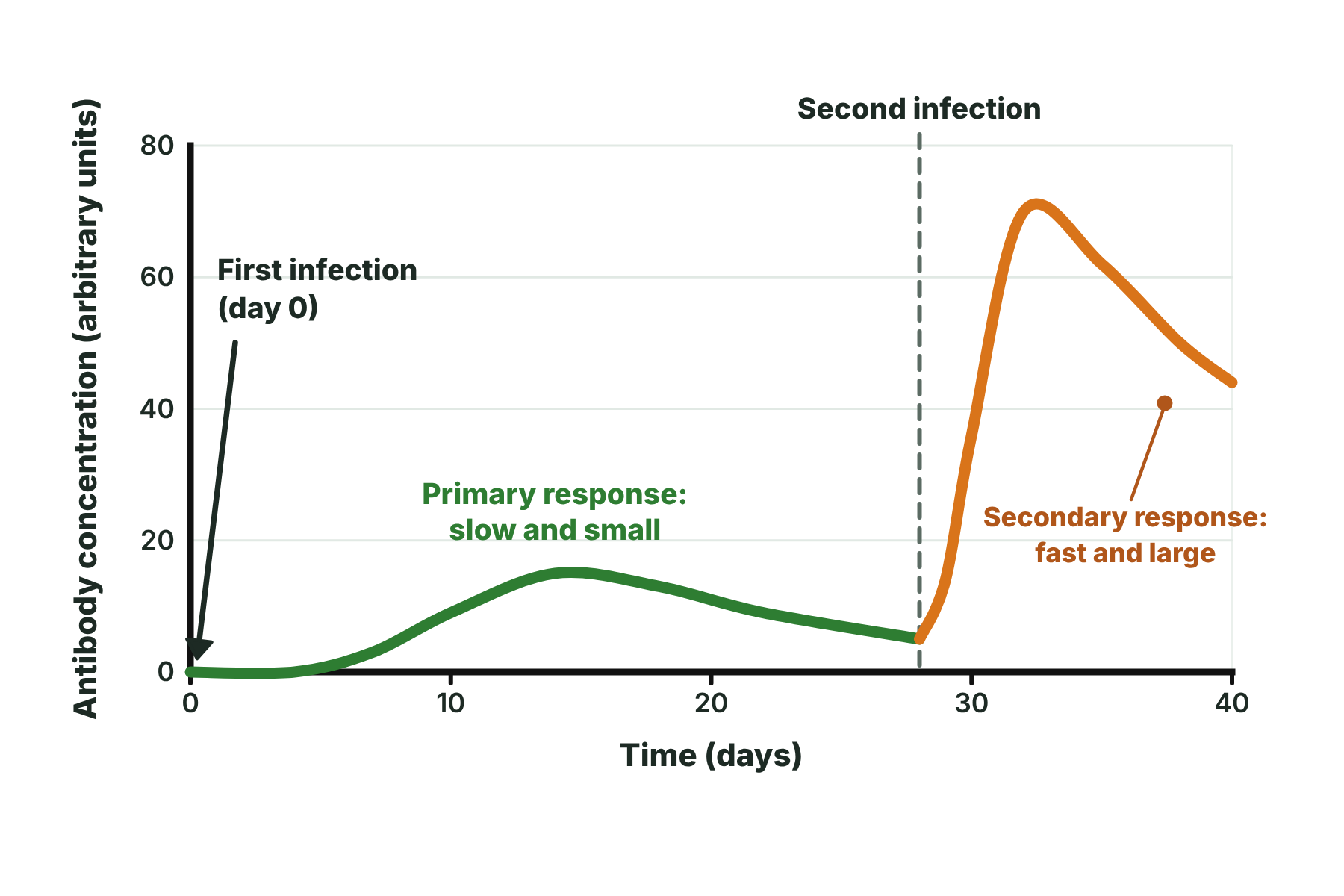
Memory lymphocytes make the secondary response faster and larger than the primary response.
Memory lymphocytes and the secondary response
The second time that the same pathogen enters the body, the body deals with it much more quickly.
-
Memory lymphocytes
They stay in the body for years, and are already specific to the pathogen's antigen.
-
A fast response
When the same pathogen returns, the memory lymphocytes divide at once and make antibodies within hours or a few days.
-
A bigger response
Many more antibodies are made, and the antibody level reaches a higher peak, so the pathogen is killed before it can make the person ill.
-
Immunity
The person is now immune to that pathogen, and has no symptoms when they meet it again.
Primary and secondary responses
Primary response
- First time the body meets the pathogen
- Slow, taking about a week or two
- A small amount of antibody is made
- Person usually becomes ill
Secondary response
- The same pathogen meets the body again
- Fast, taking a few days
- A larger amount of antibody is made
- Person usually has no symptoms
Reading the graph
Using the graph, the peak antibody concentration after the first infection is 15 units, and after the second is 70 units. The first peak is at day 14, and the second peak is at day 32, which is 4 days after the second infection (at day 28). Compare the two responses.
Show the solutionHide the solution
- 1 Compare the times First infection: 14 days to peak. Second infection: 4 days to peak. The difference is \(14 - 4 = 10\) days.
- 2 Compare the heights \(70 \div 15 = 4.7\) times higher.
- 3 Explain Memory lymphocytes from the first infection respond fast, and make more antibodies.
AnswerThe secondary response peaks 10 days sooner (4 days against 14 days), and the peak is about 4.7 times higher.
Case study
Chickenpox
Most people who catch chickenpox as children never have it again. The first infection with the virus causes spots and a fever for a week or so, because the primary response takes time. During that time the body makes memory lymphocytes against the virus. If the virus enters again, the secondary response destroys it so quickly that there are no symptoms. The memory cells can last for life, which is why the immunity is long lasting.
Summary and exam focus
- Pathogens have antigens, which the immune system recognises as foreign.
- Lymphocytes make antibodies with a shape that fits one antigen.
- Antibodies help to destroy the pathogen, and memory lymphocytes are made.
- The secondary response is faster and larger, because of the memory lymphocytes.
- This is why a person is usually immune after a first infection.
Exam focus
Explain how the immune system responds to a pathogen the first time and the second time that it enters the body. (6 marks) (6 marks)
Use the words antigen, lymphocyte, antibody and memory lymphocyte. For the first response, describe the slow production of antibodies, and for the second, say that memory lymphocytes make it faster and larger. Use data from a graph if one is given.
Key terms
The words this lesson expects you to use. Each one is linked from the first place it appears above.
- Antigen
- A molecule on the surface of a cell or pathogen that the immune system recognises.
- Antibody
- A protein made by lymphocytes that binds to a specific antigen.
- Lymphocyte
- A type of white blood cell that makes antibodies.
- Phagocyte
- A white blood cell that engulfs and digests pathogens.
- Phagocytosis
- The engulfing and digesting of pathogens by a phagocyte.
- Memory lymphocyte
- A lymphocyte that stays in the body after an infection, ready to respond quickly to the same antigen again.
- Primary response
- The slow, small immune response the first time a pathogen is met.
- Secondary response
- The fast, large immune response the second time a pathogen is met.
- Immune
- Protected from a particular disease, because of memory lymphocytes.
You've finished the notes
Check your understanding
Test yourself while it is fresh. Start with the flashcards, then try the exam questions.
Something here looks wrong?
Tell us what and we will go and look. It goes to whoever writes these pages, nobody else, and we do not ask who you are — so there is nothing to sign and nothing comes back to you.