Biology · Inheritance
Family Pedigrees
A family tree can show how a characteristic or disorder is passed down. This lesson shows how to read a pedigree chart, how to work out whether an allele is dominant or recessive, and how to calculate the chance that a child is affected.
Learning Objectives
- 1Describe the symbols used in a family pedigree.
- 2Use a pedigree to work out whether a characteristic is caused by a dominant or a recessive allele.
- 3Work out the genotypes of individuals in a pedigree.
- 4Calculate the probability that a child will inherit a disorder.
Retrieval practice
-
1
What is a carrier?
Show answerHide answer
A person with one recessive allele who does not show the disorder.
-
2
What is the chance of a child with ff from Ff x Ff?
Show answerHide answer
1 in 4 (25%).
-
3
What does homozygous mean?
Show answerHide answer
Having two identical alleles.
-
4
What does a dominant allele do?
Show answerHide answer
Shows its effect even when only one copy is present.
Following a characteristic through a family
Geneticists cannot do controlled crosses on people, so they study families instead. A family pedigree is a diagram like a family tree that shows who in a family has a characteristic or a disorder. By looking at which people are affected and how they are related, it is often possible to work out if the allele is dominant or recessive, and the genotype of many family members. This is the basis for genetic counselling.
Reading a pedigree chart
Pedigree charts use a standard set of symbols.
-
Squares and circles
A square is a male and a circle is a female.
-
Shading
A filled shape is a person who has the characteristic or disorder. An unfilled one does not.
-
Lines
A horizontal line joins two partners, and a vertical line leads from them to their children.
-
Generations
The rows are generations, usually numbered with Roman numerals I, II and III. The oldest are at the top.
A pedigree for cystic fibrosis
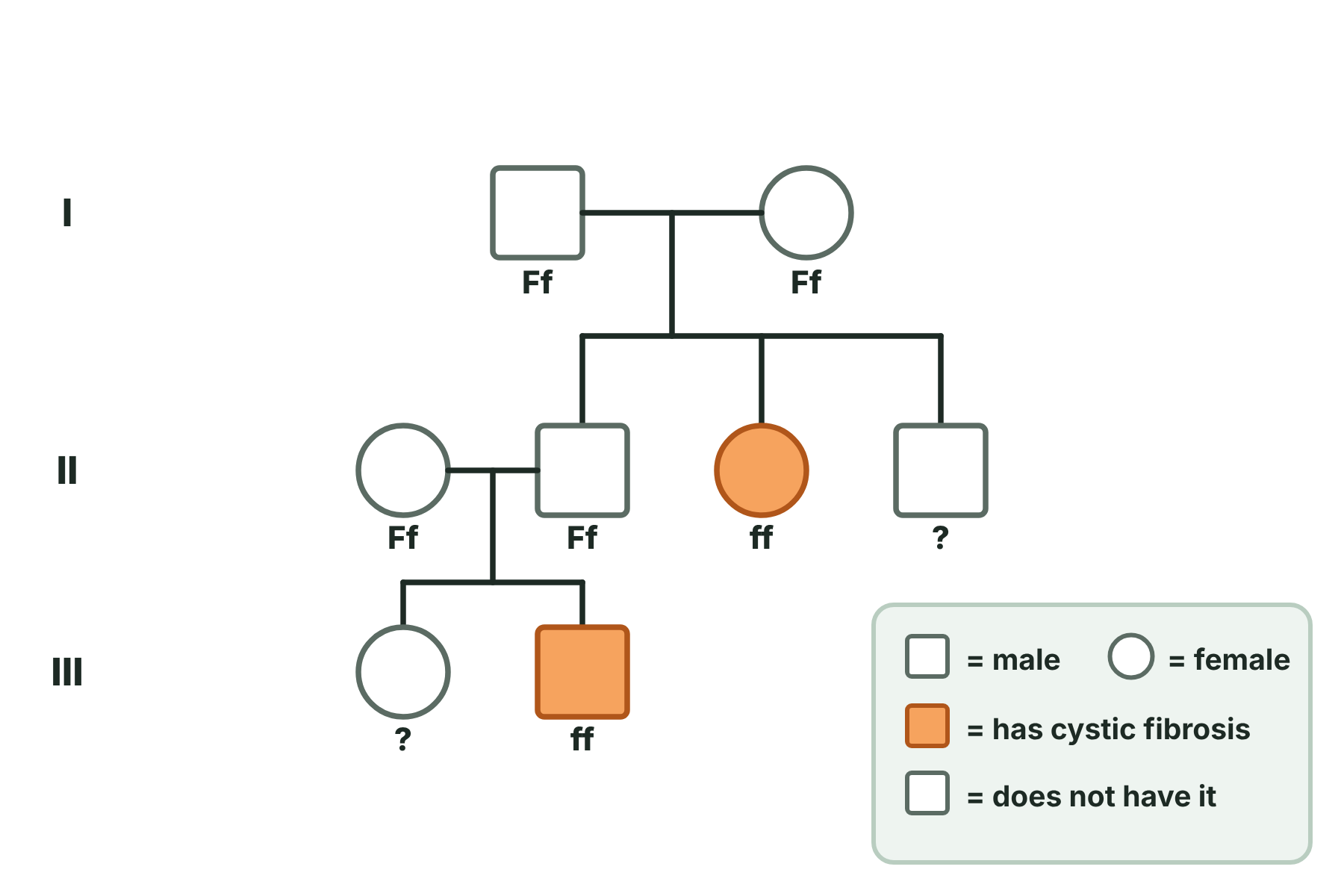
Two unaffected parents with an affected child show that the condition is recessive.
Recessive or dominant?
A pedigree can show which type of allele is involved.
-
Recessive clue
If two unaffected parents have an affected child, the allele must be recessive. Both parents must be carriers, Ff.
-
Dominant clue
If an affected child has at least one affected parent, and the condition appears in every generation, the allele is likely to be dominant.
-
Affected means a pair of alleles
An individual with a recessive disorder has two recessive alleles, ff, so every parent must have passed on at least one f.
-
Unaffected with a dominant allele
In a dominant condition, an unaffected person has two recessive alleles, hh, and cannot pass the disorder on.
Working out genotypes from the pedigree
In the cystic fibrosis pedigree, the parents in generation I are both unaffected and have a daughter with cystic fibrosis. State the genotypes of the parents, and the daughter, and explain how you know.
Show the solutionHide the solution
- 1 Look at the daughter She has cystic fibrosis, which is recessive, so she must be ff.
- 2 She got one f from each parent One recessive allele came from her mother and one from her father.
- 3 Look at the parents They do not have the disorder, so each must have a dominant allele, F.
- 4 State the parents' genotypes They must both be Ff, so both are carriers.
AnswerThe parents are both Ff, and the daughter is ff.
The probability for the next child
One of the unaffected sons in generation II has a wife who is also a carrier of the allele. State the probability that their child is affected.
Show the solutionHide the solution
- 1 Genotypes Both are Ff.
- 2 Cross Ff x Ff gives FF, Ff, Ff and ff.
- 3 Probability One of the four outcomes is ff, so the chance is \(\frac{1}{4}\), or 25%.
Answer1 in 4, or 25%.
Recessive and dominant disorders
Cystic fibrosis (recessive)
- Caused by a recessive allele
- Affected people have two copies, ff
- Unaffected parents can have an affected child
- Carriers are common and have no symptoms
Huntington's disease (dominant)
- Caused by a dominant allele
- Affected people have at least one copy, Hh
- Every affected person has an affected parent
- Symptoms start in adulthood, often after having children
Other inherited conditions
A pedigree can be used for many conditions.
-
Cystic fibrosis
A recessive disorder of the mucus-producing cells, causing breathing and digestive problems.
-
Huntington's disease
A dominant disorder in which nerve cells in the brain gradually die, usually from middle age.
-
Polydactyly
A dominant condition in which a person has extra fingers or toes, which is not harmful.
-
Genetic counselling
Parents can be advised about the chance of having an affected child, and about tests such as screening embryos or a fetus.
Case study
Huntington's disease and difficult choices
Huntington's disease is caused by a dominant allele, so a child of an affected parent has a 50% chance of inheriting it. The symptoms usually start between 30 and 50, when people may already have had children. A genetic test can tell a young person whether they have the allele, but there is no cure. Some people choose to be tested, but many do not want to know. It is an example of the ethical issues that genetic testing raises.
Summary and exam focus
- A pedigree shows how a characteristic is inherited in a family, using squares, circles and shading.
- If two unaffected parents have an affected child, the allele is recessive and both parents are carriers.
- A dominant condition appears in every generation, and an affected child has an affected parent.
- Genotypes in a pedigree can be worked out using the symbols and the genetic diagram.
- Probabilities for the next child can be found with a Punnett square.
Exam focus
A pedigree shows that two unaffected parents have a child with a genetic disorder. Explain whether the allele that causes the disorder is dominant or recessive, and give the genotypes of the parents. (4 marks) (4 marks)
Use the pedigree as evidence. Say that the parents do not have the disorder but their child does, so the allele must be recessive and hidden in the parents. Define your letters, for example F and f, and state that both parents are Ff.
Key terms
The words this lesson expects you to use. Each one is linked from the first place it appears above.
- Pedigree
- A family tree that shows how a characteristic is inherited through the generations.
- Carrier
- A person with one copy of a recessive allele who does not have the disorder.
- Affected
- Showing the characteristic or the disorder.
- Generation
- A set of individuals at the same stage in a family, such as the parents or the children.
- Inherited disorder
- A condition caused by faulty alleles passed from parents to children.
- Cystic fibrosis
- A recessive disorder that causes thick, sticky mucus in the lungs and gut.
- Huntington's disease
- A dominant disorder that causes the gradual death of brain cells.
- Polydactyly
- A dominant condition in which a person has extra fingers or toes.
- Genetic counselling
- Advice to people about the risk of passing on an inherited disorder.
You've finished the notes
Check your understanding
Test yourself while it is fresh. Start with the flashcards, then try the exam questions.
Something here looks wrong?
Tell us what and we will go and look. It goes to whoever writes these pages, nobody else, and we do not ask who you are — so there is nothing to sign and nothing comes back to you.