Biology · Inheritance
Inheriting Sex
Is a baby going to be a boy or a girl? This lesson explains how sex is determined at fertilisation by the sex chromosomes, and why the chance of each is the same.
Learning Objectives
- 1Describe the sex chromosomes in human females and males.
- 2Use a genetic diagram to show how the sex of an offspring is determined at fertilisation.
- 3State the probability of having a boy or a girl, as a ratio, a fraction and a percentage.
- 4Explain why the father's gamete decides the sex of a baby.
Retrieval practice
-
1
How many pairs of chromosomes are in a human body cell?
Show answerHide answer
23.
-
2
How many chromosomes are in a human gamete?
Show answerHide answer
23.
-
3
What happens in meiosis?
Show answerHide answer
One cell makes four genetically different haploid gametes.
-
4
What is a Punnett square?
Show answerHide answer
A grid that shows all of the possible combinations of gametes.
The 23rd pair
Of the 23 pairs of chromosomes in a human body cell, 22 pairs are the same in males and females. The 23rd pair is different, and these are the sex chromosomes, which decide whether a person is male or female. There are two types, a larger X chromosome and a much smaller Y chromosome. The Y chromosome carries a gene that makes an embryo develop testes, and so develop as a male.
The sex chromosomes
The combination of sex chromosomes a person has decides their sex.
-
Females
Females have two X chromosomes, XX. This is a matching pair.
-
Males
Males have one X and one Y chromosome, XY. The Y is much smaller than the X.
-
Gametes from a woman
Every egg contains one X chromosome, since the mother can only pass on an X.
-
Gametes from a man
Half of the sperm contain an X chromosome and half contain a Y chromosome.
How sex is inherited
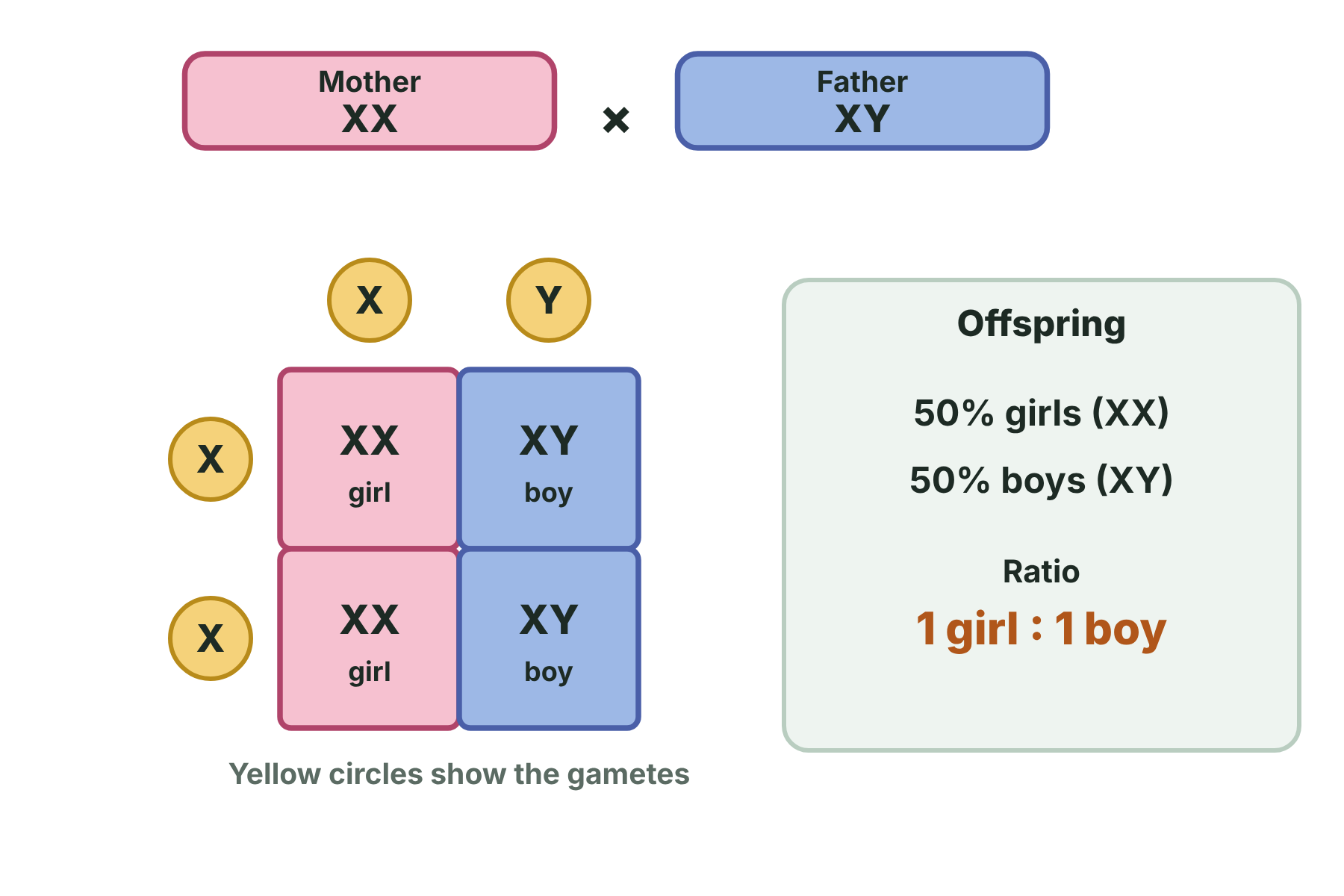
The sex of a child depends on whether the sperm that fertilises the egg carries an X or a Y.
Working out the sex of a baby
The genetic diagram for sex is the same as any other cross.
-
1
Parents' genotypes
The mother is XX and the father is XY.
-
2
Gametes
Each egg carries X. A sperm carries either X or Y, with equal chance.
-
3
Fertilisation
An egg is fertilised by one sperm, at random.
-
4
If the sperm carries X
The zygote is XX, and the baby is a girl.
-
5
If the sperm carries Y
The zygote is XY, and the baby is a boy.
Reading the result
Like any genetic cross, the result is a ratio and a probability.
-
Ratio
1 girl : 1 boy, because two of the four boxes are XX and two are XY.
-
Probability
The chance of a girl is 1 in 2, or 50%, and the chance of a boy is 1 in 2, or 50%.
-
Each baby is independent
Even if a couple already have three girls, the chance of the fourth being a girl is still 50%.
-
The father decides
Because every egg carries an X, it is the sperm that carries the X or the Y that decides.
The chance of three boys in a row
A couple already have two sons. State the probability that their next child is a boy, and the probability that all three children are boys.
Show the solutionHide the solution
- 1 Independent events Each baby has a probability of \(\frac{1}{2}\) of being a boy, regardless of earlier children.
- 2 For the third child The probability is \(\frac{1}{2}\).
- 3 All three Multiply the probabilities for the three babies: \(\frac{1}{2} \times \frac{1}{2} \times \frac{1}{2} = \frac{1}{8}\), which is 12.5%.
AnswerThe next child has a 1 in 2 chance of being a boy. The chance of three boys in a row is 1 in 8, or 12.5%.
Female and male sex chromosomes
Female (XX)
- Two X chromosomes
- All eggs carry one X
- Develop ovaries
- Passes on an X to every child
Male (XY)
- One X and one Y chromosome
- Half of the sperm carry X and half carry Y
- Develop testes, due to a gene on the Y chromosome
- Passes on an X to daughters and a Y to sons
Case study
The Y chromosome and the SRY gene
In the early 1990s scientists found a gene on the Y chromosome that acts as the master switch for becoming male. It is called SRY. In an embryo that has the SRY gene, the cells in the gonads develop into testes, which make testosterone and so male features. Without the gene, the gonads develop as ovaries. Rarely, a person with XY chromosomes lacks a working SRY gene and develops as a female, which shows how important this one gene is.
Summary and exam focus
- Females have two X chromosomes (XX) and males have an X and a Y (XY).
- Every egg has an X, and a sperm has an X or a Y.
- If a sperm with an X fertilises the egg, the baby is a girl, and if it has a Y, the baby is a boy.
- The chance of each sex is 50%, a ratio of 1 : 1.
- Each pregnancy is independent of the earlier ones.
Exam focus
Use a genetic diagram to show how sex is inherited in humans, and state the probability that a baby is a girl. (4 marks) (4 marks)
Show the parents' genotypes, XX and XY, then the gametes in circles, and then a fully completed Punnett square. State the result as a ratio or fraction, such as 1 in 2, and label which boxes are girls and which are boys.
Key terms
The words this lesson expects you to use. Each one is linked from the first place it appears above.
- Sex chromosomes
- The pair of chromosomes that decides the sex of a person: XX in females and XY in males.
- X chromosome
- The larger sex chromosome, found in both males and females.
- Y chromosome
- The smaller sex chromosome, found only in males, which carries a gene for male development.
- Sex determination
- The way in which the sex of an offspring is decided.
- SRY gene
- The gene on the Y chromosome that makes an embryo develop as a male.
- Independent event
- An event whose outcome is not affected by the earlier ones.
- Testes
- The male reproductive organs that make sperm.
- Ovaries
- The female reproductive organs that make eggs.
- Ratio
- A comparison of two amounts, such as 1 : 1.
You've finished the notes
Check your understanding
Test yourself while it is fresh. Start with the flashcards, then try the exam questions.
Something here looks wrong?
Tell us what and we will go and look. It goes to whoever writes these pages, nobody else, and we do not ask who you are — so there is nothing to sign and nothing comes back to you.